

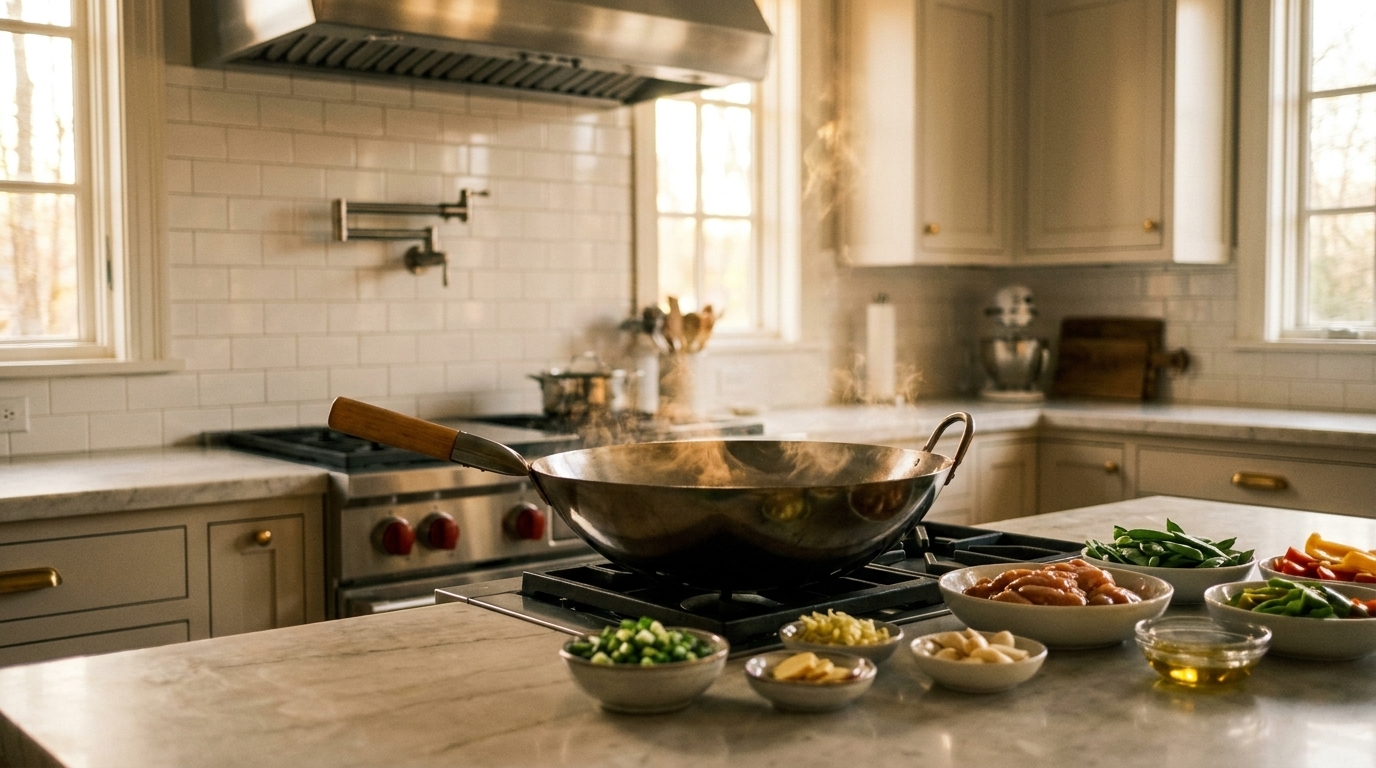
Choosing the right wok size depends on how many people you cook for and what dishes you make most often. A 12-inch carbon steel wok works best for most home cooks, offering the balance between capacity and maneuverability for everyday cooking.
The Direct Answer: Matching Wok Size to Your Cooking Reality
A 12-inch carbon steel wok balances cooking capacity with practicality, giving you room to sear without demanding extra storage or two-handed tossing.
14-inch woks for serious home cooks and small families (2-4 people)
A 14-inch wok gives home cooks who regularly feed 2-4 people more room to work without crowding ingredients -- relevant because a packed wok steams food instead of searing it.
Lodge places the 14-inch size in the range for 4-6 servings, meaning it handles larger meals while remaining practical for smaller households that batch-cook. [1] The wider flat bottom -- some 14-inch models measure up to 7.7 inches across the base -- gives proteins and vegetables more direct contact with the heat source, producing better browning. [2] The tradeoff is weight and maneuverability: at this size, most carbon steel woks require two hands to toss food effectively. [2]
12-inch woks for versatile everyday cooking and apartment kitchens
A 12-inch wok hits the practical middle ground for solo cooks and apartment kitchens -- it handles stir-fries and fried rice for one or two people without the weight or storage demands of a 14-inch pan. [2] Restaurantware describes this size as the versatile middle-ground for average cooking needs, and testing confirms it: a 12.6-inch carbon steel wok produces well-browned fried rice and beef strips without overcrowding the surface. [2][3] The tradeoff is deep-frying capacity -- a narrower base means less room for oil and ingredients before food starts to steam rather than fry. [2] For cooks who primarily make quick, high-heat meals for one to two people, a 12-inch carbon steel wok covers most of that without asking for extra cabinet space.

Wok Size by Household: A Reality Check for Family Cooking
A 12-inch wok handles two-person meals efficiently, while 14-inch models work best for families of four to six without crowding the cooking surface.
Cooking for 2: Why 10-12 inches is your sweet spot
For two people cooking most nights, a 10-12 inch wok handles high-heat meals without the storage demands of a larger pan.
Lodge places their 9-inch wok in the 1-2 person range and their 12.5-inch model in the 2-4 person range -- putting a 10-12 inch wok right at the crossover, wide enough for two full portions without crowding the surface. [4] A 12-inch wok is sized for individual and small-portion cooking, with enough cooking area for stir-fries and sautés without excess pan weight. [5] Carbon steel at this size stays manageable one-handed, which is useful when tossing food quickly over high heat. [6]
Family of 4-6: The case for 12-14 inches and batch cooking
For families of four to six people, the 12-14 inch range covers most cooking scenarios -- including the batch cooking that's standard when feeding more than three people on weeknights.
A 14-inch carbon steel wok handles four to six servings without crowding the surface and fits standard home burners without the heat distribution issues that affect larger woks. [7] Two timed batches in a 14-inch carbon steel wok outperform a single overcrowded batch -- packed surfaces trap steam instead of generating the sear that builds flavor. [7] A 12-inch wok still covers smaller four-person meals when you split ingredients into two quick rounds, keeping each batch light enough to hold temperature throughout the cook. [8]
Beyond Size: The Factors That Actually Determine Your Wok Fit (Comparison Table)
Carbon steel outperforms stainless steel across wok sizes because it heats faster, stays responsive, and builds a natural nonstick patina.
Stovetop type, handle design, and heat distribution: How they override size preferences
Material matters: Carbon steel vs. stainless steel at different sizes (sizing table)
| Size | Carbon steel | Stainless steel |
|---|---|---|
| 10-12" | Light; heats in under 60 sec; one-handed tossing; best for 1-2 people | Heavy; slow to heat; sticks on proteins; not recommended |
| 12-14" | Heat-responsive; handles 2-4 people; two-handed at 14" | Clad construction distributes heat evenly -- works against wok's heat gradient |
| 14"+ | Batch-cook capacity; requires two hands; stays heat-responsive | Impractical weight; resists fast heat changes; no patina development |
Material choice affects performance differently at each size -- carbon steel's advantage grows as woks get larger. [10] Stainless steel is heavy and slow to respond to heat changes; clad stainless construction spreads heat evenly across the surface, which works against the gradient a wok needs to sear food properly. [10][11] Carbon steel at 14 to 16 gauge (about 1.5 to 2mm thick) stays light enough to maneuver at 14 inches, heats quickly, cools fast between batches, and builds a naturally slick surface that stainless can't replicate. [10][3] For more detail on how these materials behave across cooking tasks, our carbon nonstick vs. carbon steel comparison covers the practical differences.


Making Your Final Decision: Size, Material, and Long-Term Cooking Goals
A 12-inch wok handles everyday cooking for most households, while a second larger wok becomes useful when batch-cooking for groups or deep-frying.
The 12-inch compromise: Why most home cooks choose this size and never look back
When most home cooks ask what size wok pan they need for everyday cooking, they end up at 12 inches -- not by default, but because it genuinely fits how most households cook on most nights.
Testing by Wirecutter confirms a 12-inch wok works for solo and two-person cooking and stays manageable one-handed, which matters more than raw capacity when you're actively tossing food over high heat. [12] For cooks who want a single wok that performs across stir-fries, fried eggs, and noodle dishes without demanding technique adjustments, this size hits the right balance.
Our 12-inch carbon steel wok builds a nearly nonstick surface from early use and comes with a stainless steel handle that's oven-safe to 550 degreesF and stays cool during stovetop cooking. [11]
Building your wok collection: When to go bigger, when to stay smaller
A second wok earns its place when your 12-inch consistently runs out of surface area -- most often when batch-cooking for more than four people or deep-frying proteins that need more clearance between pieces to crisp properly. [13] A 14- to 16-inch carbon steel wok handles those larger jobs without sacrificing heat responsiveness, and doubles as a steaming vessel for whole fish or large batches of dumplings that need more vertical clearance than stir-frying allows. [14] For solo cooks, the case for going smaller -- a 10-inch wok -- is mainly about portability and faster heat-up time for single-portion dishes rather than expanding overall capacity. [13] Most home cooks who cook regularly enough to build a collection end up with two: one in the 12-inch range for weeknights and one larger for the jobs that demand more room. [14]
- A 12-inch carbon steel wok handles solo and two-person cooking while staying manageable one-handed during high-heat tossing.
- 14-inch woks suit families of 4-6 people and batch cooking, with a wider flat base that improves browning but requires two hands.
- Carbon steel outperforms stainless steel at all wok sizes--it heats faster, cools quickly between batches, and builds natural patina.
- Crowded woks steam food instead of searing it; two quick batches in a 14-inch wok beat one overcrowded batch.
- Most home cooks who cook regularly end up with two woks: a 12-inch for weeknights and a 14-16 inch for larger jobs.
- Wok size should match your household size and cooking frequency, not just raw capacity or storage space.
- https://www.lodgecastiron.com/blogs/story/what-size-wok-do-i-need?srsltid=AfmBOorj1JJuwHsXMKzwFKGph0mwDzMmIkThNaxSpPbRydRLv5o_sKkV
- https://www.foodandwine.com/best-woks-7973555
- https://www.epicurious.com/expert-advice/the-best-wok-for-stir-frying-at-home-article
- https://www.lodgecastiron.com/blogs/story/what-size-wok-do-i-need?srsltid=AfmBOooWKrkpkWm5ZqJl_xBBGLfE9TI-tCx2Fm2fkEphkd5eYV9ypSpC
- https://mammafong.com/blogs/mammas-cooking-diary/finding-the-perfect-fit-how-to-choose-the-right-size-carbon-steel-wok?srsltid=AfmBOopQkm-e6p6JQu89_9Bk8dJZGQEAHjRaY5OYr2malYRraIxpDE7A
- https://therationalkitchen.com/best-wok/
- https://www.umamicart.com/blog/2026/03/22/best-wok/?srsltid=AfmBOopfmzw3OuMJSoJRGdk0SCIupKPtUNc93xdTFJDeuaSxVIgG9LUH
- https://world.taobao.com/lang/en-us/shopping-guide/1921419099750006784.htm
- https://www.solamexhome.com/flat-bottom-wok-vs-round-wok-which-shape-should-you-buy.html
- https://frienji.kenjilopezalt.com/posts/kenjis-updated-146878779
- https://www.seriouseats.com/best-woks-5218113
- https://www.nytimes.com/wirecutter/reviews/best-woks/
- https://www.seriouseats.com/equipment-how-to-buy-a-wok-which-wok-is-the-best
- https://thewoksoflife.com/best-wok-to-buy/