

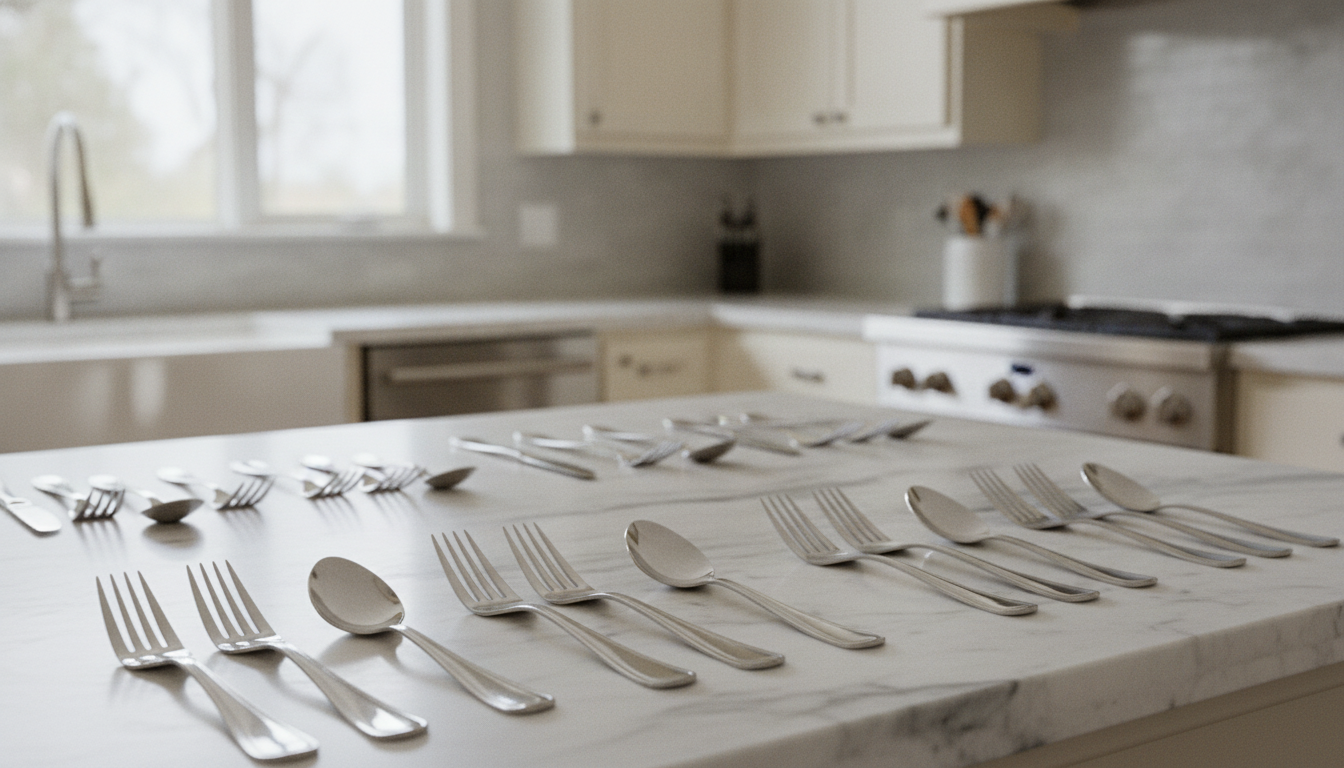
Buying flatware as a matched set costs significantly less per piece than purchasing open stock replacements over time, especially once pieces go missing or need repair. Stainless steel grade matters more than purchase format--check the stamp before buying to ensure your flatware stays bright and rust-free for years.
Why Flatware Purchase Strategy Matters More Than You Think
Buying flatware as a complete set costs roughly 30% less than purchasing pieces individually, and ensures you can always find exact replacements.
The hidden costs of replacing individual pieces over time
Buying flatware piece by piece almost always costs more than buying a complete set upfront. Retailers that sell by the place setting or set typically price around 30% lower than the same utensils purchased individually or one place setting at a time [2]. That discount gap compounds every time a fork goes missing or a knife gets bent, because you're paying retail per-piece prices instead of the bulk rate baked into a full set.
Open stock availability isn't guaranteed either. Classic, long-running patterns from established brands usually offer replacement pieces, but newer or direct-to-consumer lines often don't stock individual forks, spoons, or knives at all [1]. Even popular budget patterns aren't immune: one major brand's open stock replacement packs for forks and teaspoons were listed as available but actually out of stock during recent research, which means "open stock" on paper doesn't always translate to pieces you can actually buy when you need them [3].
If a pattern gets discontinued before you've replaced what you lost, you're left hunting for a close match rather than an exact one, which is why choosing a simple, timeless design matters if you plan to rely on open stock long-term [2]. Blade shape adds another wrinkle: mixing a French-style knife into a set built around place-style blades leaves a place setting that never quite matches, no matter how close the steel grade is [2]. These gaps tend to surface years after purchase, right when a matching replacement matters most.
Matched Flatware Sets: Upfront Investment, Long-Term Certainty
Buying a larger flatware set spreads packaging and retail costs across more pieces, lowering your per-piece price on daily-use forks, knives, and spoons.
What you're actually buying with a complete set (and why consistency matters)
Cost-per-piece breakdown: 20-piece vs. 45-piece sets for 4, 8, and 12-person households Set sizing tracks place settings, not household headcount alone, and that relationship drives the per-piece math. A 20-piece set breaks down into four full place settings, five pieces each: dinner fork, salad fork, knife, spoon, and teaspoon, making it the standard baseline for a 4-person household. A 45-piece set typically covers eight place settings (40 pieces) plus five serving pieces, matching an 8-person household without leaving serving tools as an afterthought. Twelve-person households usually need either a 65-piece set or two 45-piece sets combined, which introduces overlap in serving pieces you may not need twice.
Household size and set size:
- 4 people: 20-piece set, four complete place settings
- 8 people: 45-piece set, eight settings plus serving pieces
- 12 people: 65-piece set, or two combined 45-piece sets
Larger sets generally lower the cost per individual piece, since manufacturers spread packaging, shipping, and retail markup across more units. That gap tends to be smaller for serving pieces, which cost roughly the same to produce regardless of set size, so buying a bigger set mainly pays off on the forks, knives, and spoons you use daily rather than the pieces that sit in a drawer most of the year. For a 12-person household, running the math on two combined 45-piece sets versus one purpose-built larger set is worth doing before you buy, since duplicate serving pieces can erase some of the bulk savings you'd otherwise expect.
Open Stock Flatware: Flexibility and Replacement Economics
When open stock makes financial sense: replacing lost or damaged pieces
Open stock earns its keep in one narrow but common scenario: replacing a single fork, spoon, or knife after loss or damage rather than rebuilding an entire collection. Buying one replacement piece costs far less than purchasing a new multi-piece set, and it keeps your existing collection intact without introducing a mismatched pattern [6]. The math flips once a pattern goes out of production, though.
One longtime owner of a discontinued pattern reported single replacement forks running $50 to $80 apiece, some more worn than her 25-year-old originals, while a full new set in a pattern she liked would have run over $1,500 for the quantities she wanted [7]. That same buyer noted that for anyone less attached to a specific discontinued design, buying a whole new set outright would have been cheaper than hunting individual pieces on eBay or Etsy one at a time [7]. Open stock replacement makes financial sense only while a pattern stays in active production and per-piece pricing stays close to what you originally paid.
Before relying on it long-term, confirm with the retailer whether pieces are actually stocked, not just listed, since availability gaps can turn a quick fix into a drawn-out search for an exact match [6].
The true cost of buying à la carte: 18/10 stainless steel pricing comparison across 5-year ownership
Cost projection: matched set vs. open stock replacement scenarios Running the numbers over five and ten years shows how upfront set purchases and piecemeal open stock purchases diverge, even when the per-piece math looks close at checkout. An 18/10 set that stays in service a decade or more avoids nearly all replacement spending, since the higher nickel content resists the corrosion and pitting that force early replacements [10]. One ownership model comparing a $600 premium set lasting 15 years against a $250 mid-range set lasting 10 years found the mid-range option can end up cheaper in raw dollars once total cost is divided by years owned, even though the pricier set lasts longer [11]. Open stock replacement moves in the opposite direction: every lost or bent piece gets repurchased at full retail markup instead of the bulk rate baked into an original set, so that markup repeats with each replacement rather than being paid once [10].
Scenario snapshot:
- 5-year, matched set: little added cost beyond the original purchase
- 5-year, open stock: cost scales directly with pieces lost, each at full markup
- 10-year, matched set: alloy durability, not purchase format, decides total spend [11]
- 10-year, open stock: repeated markups widen the gap versus a matched set [10]
What to avoid when choosing between matched and open stock (material grade, durability, and resale value)
Three mistakes account for most flatware regret years later. The first is buying on pattern alone without checking the grade stamped on the back: 18/0 stainless lacks the nickel that fights corrosion, so a set that looks identical to 18/10 in the store can develop tea-staining, pitting, and water-spotting within a few years of regular dishwasher use [10]. The second is mixing grades across a set to save money, pairing cheaper serving pieces with a higher-grade place setting, which creates uneven wear that shows up as some pieces staying bright while others dull and spot. The third is buying for a trendy finish or a name without weighing warranty support or long-term maintenance, a mistake that surfaces across both budget and premium categories [12]. Resale value adds a fourth consideration worth flagging before purchase: heavily customized or trend-driven patterns tend to hold less resale and collector interest than simple, classic designs, since buyers gravitate toward patterns with a longer track record [12]. None of these mistakes are visible at checkout. They surface later, when a place setting starts looking mismatched or upkeep gets skipped and shortens the life of an otherwise durable grade. Checking how stainless steel resists rust over time before buying either format helps confirm the grade actually matches what a retailer claims.
So which route actually saves money? Match the purchase to how you eat. A complete set locks in consistency and a lower per-piece cost, while open stock earns its place for quick one-off replacements, as long as the pattern stays in production. Either way, the stainless grade you start with drives what you'll spend over the next five or ten years, so check that stamp before you commit. For more care & maintenance tips on keeping stainless steel bright and rust-free, contact us anytime.
Frequently Asked Questions
-
How many flatware pieces do I actually need for my household size?
The article ties set size to place settings rather than just headcount: a 20-piece set gives four 5-piece place settings for a 4-person household, a 45-piece set covers eight place settings plus five serving pieces for an 8-person household, and a 12-person household typically needs a 65-piece set or two combined 45-piece sets. Note that combining two 45-piece sets duplicates serving pieces, so it's worth comparing that total against a single 65-piece set before buying.
-
Is it cheaper to replace missing flatware piece-by-piece (open stock) or buy a new set?
Open stock is cheaper for one-off replacements while a pattern is still in production, since you avoid buying a full set for a single lost fork. But the article cites a real case where a discontinued pattern's replacement forks ran $50 to $80 each, while a full new set in a liked pattern would have cost over $1,500 for the needed quantity - so once a pattern is discontinued or hard to find, a new set can end up cheaper than hunting individual pieces on eBay or Etsy.
-
Does buying a bigger flatware set (like 45 pieces) really save money per piece compared to a 20-piece set?
Generally yes for the pieces you use daily - forks, knives, and spoons - because manufacturers spread packaging and markup across more units in larger sets. That savings is smaller for serving pieces, which cost about the same to produce regardless of set size, so the bulk discount mainly benefits everyday utensils rather than the pieces that sit in a drawer most of the year.
-
How do I know if a flatware set will resist rust or staining over time?
Check the grade stamped on the back: 18/10 stainless has higher nickel content and resists corrosion, pitting, and water-spotting far better than 18/0, which can develop those issues within a few years of regular dishwasher use even if it looks identical in the store. The article recommends verifying this stamp against what the retailer claims before buying either a matched set or open stock replacements.
-
Will a more expensive flatware set always save money in the long run?
Not necessarily - the article describes one ownership comparison where a $600 premium set lasting 15 years cost more per year owned than a $250 mid-range set lasting 10 years, once total cost was divided by years of use. Alloy durability (the 18/10 vs 18/0 grade), not just price or purchase format, is what the article says ultimately decides long-term spend.
- Matched sets cost roughly 30% less per piece than buying flatware individually over time.
- Open stock availability isn't guaranteed, especially for newer patterns or discontinued designs.
- Stainless steel grade (18/10 vs 18/0) matters more than purchase format for long-term durability and total cost.
- Replacement pieces from discontinued patterns can cost $50-$80 each, making a new set cheaper than hunting matches.
- Mixing different grades or blade styles across a set causes uneven wear and visible mismatches within years.
- A matched set requires little added spending over 5-10 years, while open stock costs compound with each replacement at full markup.
- https://www.bonappetit.com/story/best-silverware-sets
- https://www.etiquettescholar.com/dining_etiquette/table_setting/place_setting/flatware/buy_flatware.html
- https://gemixx.com/feeds/blog/best-rated-silverware-sets
- https://www.google.com/goto?url=CAESowEB6zswFTnhqMQvhKgF344tfVP0hRT3uNM1b2QEec2XBu0bYF5Y42JZe8ILJdc0XYIF2vjUUULQn3OdxB0XhRDyGqQzSq-pu-d0KfnjoUosud6IaNP3FZ1h7ELzx0V3lc3POhyBkqHbMtWApoxieAjcDwXaMZPbjUAU4kU-WmP8Zzb9aDZx7gWgSdMLE7uf_KRY8I-5SKYfXLaJm7UnFCLBmZUB
- https://www.google.com/goto?url=CAESsQEB6zswFXWbujPKgzmY3tkOluIt9RSWeFlifIcloRoqfxrS_gEhSQpdGQhRpVVnjYv19HvV0pTUry-2U4CRelb8FrdyoBGpJl2Nnb_DEXCdWRZ6Zhgam5ZFNHg99_52wICOSxIFaVKnuDt0OP16XLWHeyX66lxjl4kNR-CiyYLuWxhkh7giQePC1XYwrOun9iEm2UXmEpH8Plr6PTywYEkAPnXAYPJU2EqaBjHvlGV1DiA
- https://inoxflatware.com/blogs/handcrafted-tales/open-stock-vs-full-place-settings-which-should-you-buy
- https://www.houzz.com/discussions/6236695/buying-replacement-flatware-is-there-a-trick
- https://www.henckels.com/us/product/cottage-45-pc-18%2F10-stainless-steel-flatware-set-22570-345/22570-345-0.html
- https://www.webstaurantstore.com/guide/585/different-types-of-flatware.html
- https://www.cutlerycraze.com/flatware-material-comparison-stainless-titanium-ceramic-bamboo
- https://flatwarefinesse.com/true-cost-of-premium-flatware/
- https://comparison.alibaba.com/bugatti-flatware.html