

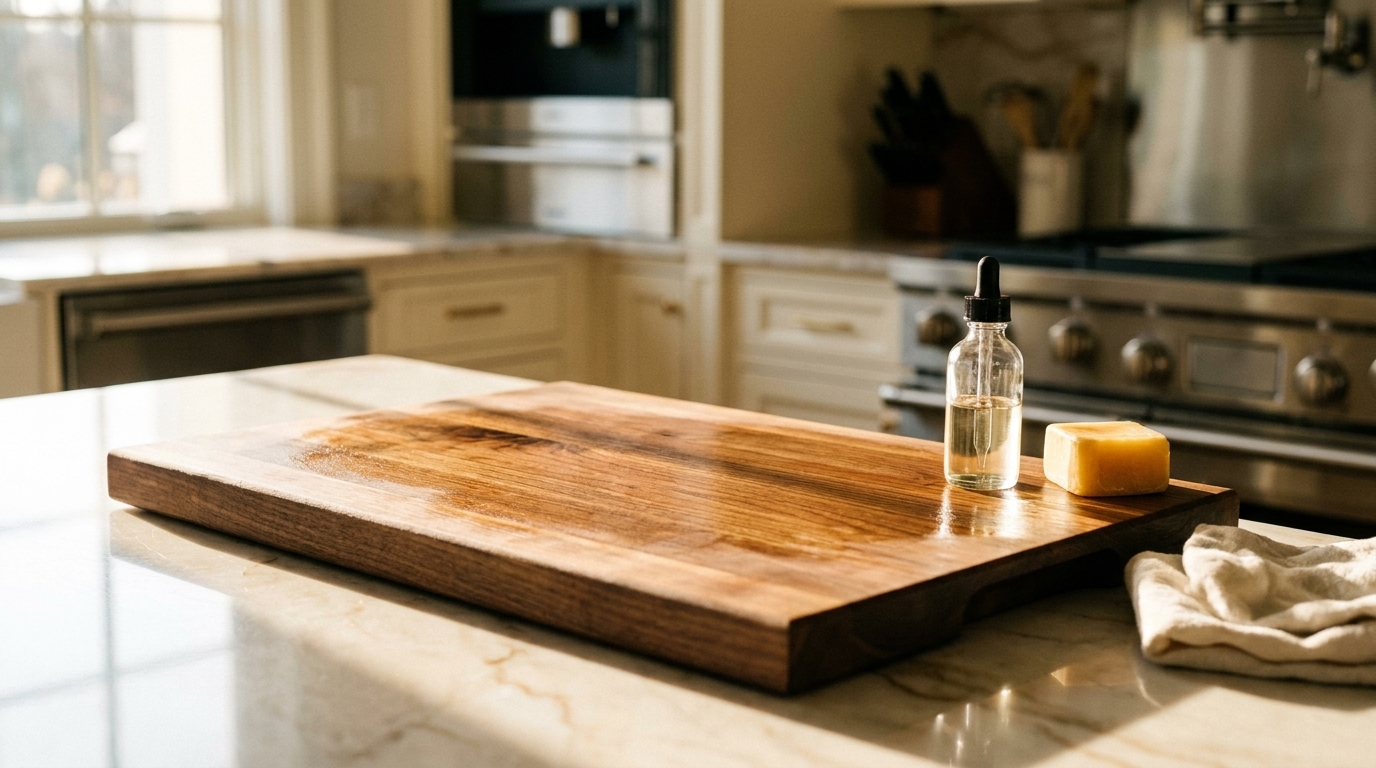
Mineral oil penetrates deep into wood to block moisture and bacteria, while beeswax seals the surface to resist water damage--and professionals use both together for maximum protection. Monthly conditioning keeps most boards healthy, but boards showing deep cracks or warping have passed the point of no return and need replacement.
Why Wood Cutting Board Maintenance Matters: The Direct Answer to Board Longevity
Mineral oil penetrates wood fibers to block moisture and bacteria, while beeswax seals the surface--each protects your board differently depending on wood type.
How mineral oil, beeswax, and coconut oil protect wood grain differently
Each of these three treatments works at a different layer of the wood -- a distinction that matters more on end-grain boards than edge-grain ones, since end-grain absorbs oil faster due to its exposed fiber structure.
Mineral oil penetrates deep into wood fibers, filling pores to block moisture, food particles, and bacteria from reaching the board's interior. [1] Beeswax works at the surface -- it fills knife cuts and micro-gaps with a water-resistant barrier that holds up better than liquid oil alone, and unlike oil, it doesn't get displaced when wet food sits on the board. [2] Regular coconut oil contains long-chain fatty acids that oxidize and go rancid over time, leaving odors or sticky residue in the grain; fractionated coconut oil (MCT oil) is more stable but still less proven than mineral oil for long-term wood protection. [3]
What happens to untreated wood cutting boards after 6 months of use
Without regular oiling, wood fibers dry out and contract unevenly, opening surface cracks and warped edges within months of daily use.
Once a board absorbs more than 12% moisture by weight -- easily triggered when wet food sits on an unprotected surface -- internal swelling stresses glue lines and grain boundaries, forming microchannels where bacteria embed and evade normal cleaning. [6] Brine, blood, and standing liquids accelerate that softening and weaken the structural integrity of glued joints. [4] A board showing deep cracks, warping, or dark stains that won't scrub out has passed the point where oiling helps -- those are replacement indicators, not maintenance problems. [5] Mineral Oil vs. Beeswax vs. Coconut Oil: Performance Comparison Table with Real-World Data
Head-to-head breakdown: absorption rate, water resistance, food safety, and cost per application
Which oil professionals actually choose and why kitchen experts recommend mineral oil for hardwoods like maple and walnut Professionals consistently land on mineral oil as their go-to for hardwoods like maple and walnut because it's flavorless, odorless, and won't go rancid the way vegetable or olive oils do. [11] It penetrates deep into tight-grained hardwoods at a lower cost per application than any alternative, which matters in high-use kitchen environments where boards need conditioning monthly or more. [10] Most pros don't stop at oil alone -- they follow with a beeswax layer to seal the oil in and build water resistance that oil can't maintain on its own. [9] That combination -- mineral oil for deep conditioning, beeswax for surface protection -- is the standard approach across professional kitchens and woodworking experts alike. [11]
The Best Wood for Cutting Boards and How to Care for It Properly
Different woods need different oiling schedules--maple every few days, acacia monthly, and bamboo every 2-3 months--to stay food-safe and prevent damage.
Hard maple, walnut, and cherry: why these woods need specific oil treatments to stay food-safe
Hard maple, walnut, and cherry have different grain densities that directly affect how oil treatments penetrate and how food-safe the board stays with regular use.
Maple's tight, closed grain (Janka 1450) slows oil absorption, so multiple thin applications over consecutive days penetrate more effectively than one heavy coat. [12] Walnut's natural compounds have shown a 99.7% E. coli reduction within three hours of exposure, but these properties require consistent mineral oil conditioning to remain active -- skipping maintenance erodes that natural antibacterial advantage. [12] Cherry, at Janka 950, shows knife marks more readily than maple or walnut, which means oiling intervals matter most here -- exposed grain from even minor cuts gives bacteria more surface area to reach. [12]
What woods to avoid for cutting boards and why acacia and bamboo require different maintenance approaches
Softwoods like pine and open-grain hardwoods like oak aren't suitable for cutting boards -- pine dents and scores too easily, while oak's open grain creates grooves deep enough to trap food particles and moisture that standard cleaning won't reach. [13] Acacia and bamboo both perform well, but their maintenance needs differ in meaningful ways: acacia requires monthly mineral oil conditioning to prevent its dense grain from drying out and to keep its natural tannins and polyphenols active, while bamboo needs oiling only every 2-3 months. [14] The sharper difference is moisture tolerance -- bamboo's laminated construction means water infiltrating glue lines causes layers to separate, so it needs to be washed quickly, towel-dried immediately, and stored upright after every use. [14] Neither board is dishwasher safe, and skipping the upright drying step on bamboo in particular accelerates the delamination that shortens its lifespan. [15]
Step-by-Step Wood Cutting Board Care Guide: Which Oil to Use When
Apply mineral oil first, then seal with beeswax to create a water-resistant barrier that keeps your board protected through regular use and seasonal changes.
When to use mineral oil for deep conditioning versus beeswax for surface sealing
Mineral oil goes on first -- apply it generously with a paper towel across all surfaces and sides, then stand the board upright and let it absorb overnight. [11] Once fully absorbed, wipe off any excess and follow immediately with beeswax to lock the oil in and build the water-resistant surface barrier that oil alone won't maintain. [11] Gently warming the beeswax beforehand makes it easier to distribute and allows it to penetrate slightly deeper into the grain. [11] A reliable way to know if your board needs either treatment: sprinkle a few drops of water on the surface -- if they soak in rather than bead up, start with the mineral oil. [11]
Monthly maintenance routine and seasonal deep-care schedule to prevent cracking and warping
Monthly maintenance and seasonal deep care follow different triggers.
A new board needs oil every two to three days for the first week, then weekly for the first month -- after that, monthly conditioning holds most boards in good shape. [11] For a seasonal deep refresh, particularly before dry winter months, sand lightly with 220-grit paper to clear accumulated knife marks, then apply two to three coats of mineral oil over consecutive days before finishing with a beeswax layer. [16] Boards in daily use benefit from this deeper treatment twice a year; boards used less frequently can go once a year before visible dryness develops. [11]
- Mineral oil penetrates deep into wood fibers to block moisture and bacteria; beeswax seals the surface with water resistance that oil alone cannot maintain.
- Professional kitchens use mineral oil followed by beeswax as the standard approach for hardwoods like maple and walnut.
- Boards absorbing more than 12% moisture by weight develop internal swelling that stresses glue lines and creates microchannels where bacteria embed.
- Maple requires multiple thin oil applications over consecutive days; walnut needs consistent conditioning to maintain its natural 99.7% E. coli reduction.
- New boards need oiling every two to three days for the first week, then weekly for one month, then monthly for maintenance.
- Bamboo's laminated construction requires immediate towel drying and upright storage after every use to prevent delamination.
- Boards showing deep cracks, warping, or dark stains that won't scrub out have passed the maintenance point and need replacement.
- https://beaverwoodcare.com/blogs/news/ultimate-guide-to-cutting-board-oil-and-wax-the-best-food-safe-kitchen-products-for-2025
- https://sloewood.com/what-is-the-best-oil-treatment-for-cutting-boards/
- https://www.woodstuffhq.com/beeswax-vs-mineral-oil/
- https://www.johnboos.com/care-and-maintenance/blocks?srsltid=AfmBOoq15n2AXef-5YYkOCRBDAozzrSvw4-gVSzziPtTIOxHzX8yugDO
- https://www.deerandoak.co.uk/blogs/news/do-wood-cutting-boards-harbor-bacteria?srsltid=AfmBOornGveHSCxNYnmTvpiprkEcwV6-pKlZQHT4XuwMOA7RBNUqyzo0
- https://lifetips.alibaba.com/kitchen-hacks/clean-wooden-cutting-board
- https://www.teakculture.com/blogs/the-teakster/10-best-oils-for-wood-cutting-boards-and-butcher-blocks?srsltid=AfmBOoptlOy6K-lUDDUcDUbg37OSdySqTFQZyQ-fol5uS3l0RBAwqE24
- https://www.bumblechutes.com/post/the-best-cutting-board-oil-options-why-fractionated-coconut-oil-reigns-supreme
- https://thewoodwhisperer.com/articles/cutting-board-finish/?srsltid=AfmBOoq5CJreSrvtDsLv9XhNKIppt0fg6jKfoIP1Ad-iiDU8L-CaM9o3
- https://www.thekitchn.com/how-to-oil-and-maintain-a-wooden-cutting-board-lessons-from-the-kitchn-195642
- https://www.nytimes.com/wirecutter/guides/how-to-clean-wood-cutting-boards/
- https://woodworkerexpress.com/blog/2025/06/best-wood-for-cutting-board/?srsltid=AfmBOorhC5d6Dt5F34x3zJQZnJ6D4UGlF16x8Zcv6eJWAXJLUj2aj2xc
- https://letsgogreen.com/blog/best-cutting-board-material/
- https://koppenhouse.com/blog/acacia-vs-bamboo-cutting-boards/
- https://www.healthierhomes.com/post/what-is-the-healthiest-cutting-board-to-use?srsltid=AfmBOors0WcSzgoPIPFEhwmsLUcUMm90MFuvI6BR4KHLVML0sUTnKV3M
- https://www.coolerkitchen.com/blogs/news/finishing-a-cutting-board?srsltid=AfmBOopfBKVUMFeJ1hoi6x2T8ZltkWkmCmpHY0FFiOb5PoXTzWZIGorZ