

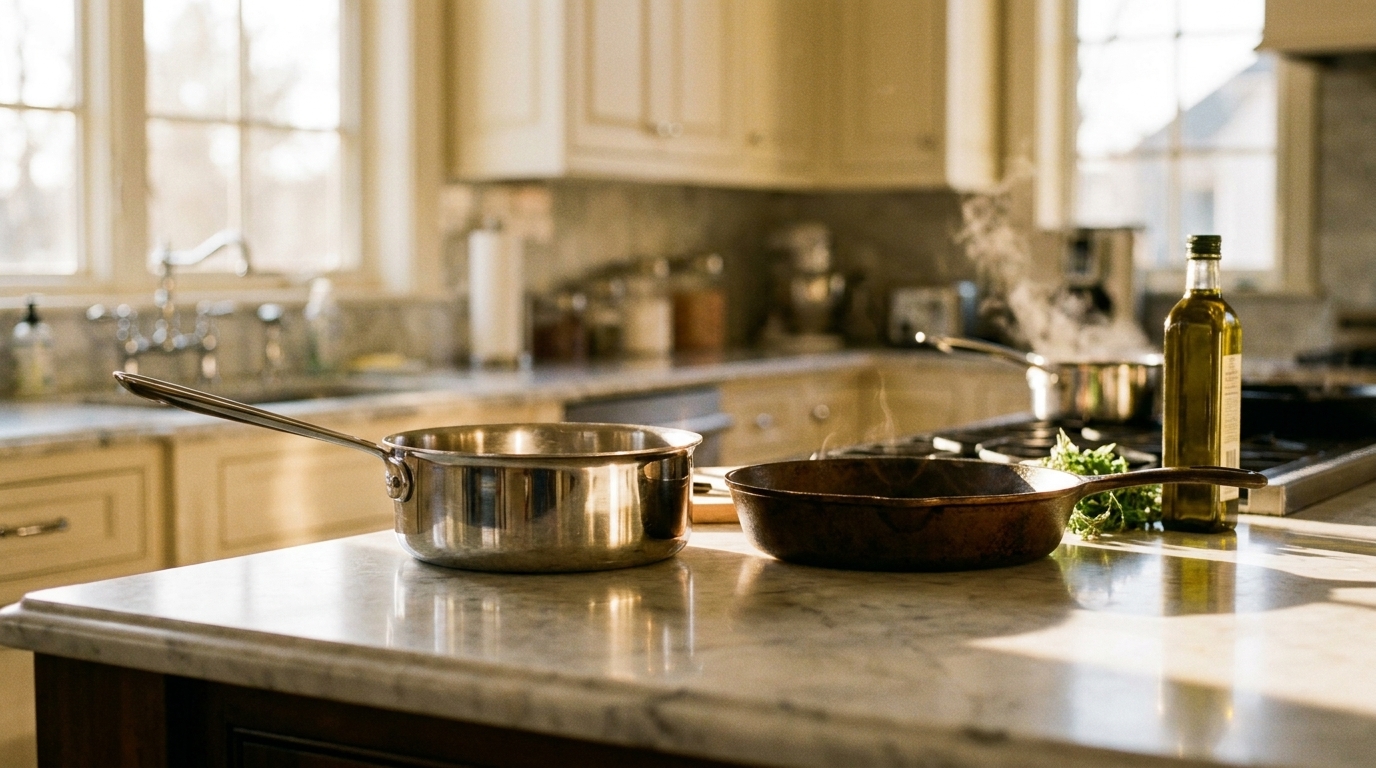
Stainless steel sauciers offer quick heat response and low maintenance, while cast iron delivers superior heat retention but demands regular seasoning and careful handling of acidic ingredients. Your choice depends on whether you prioritize convenience and precise temperature control or are willing to commit to the maintenance ritual for decades of reliable performance.
Why Durability Matters: Understanding Saucier Performance Over Time
Stainless steel sauciers maintain precise temperature control and responsiveness over years of daily use, while cast iron excels at sustained heat but limits mid-cook adjustments.
How daily cooking demands test stainless steel versus cast iron construction
Daily cooking puts both materials through repeated thermal cycles -- heating, cooling, and scrubbing clean before the next meal.
A stainless steel saucier resists corrosion and staining because its chromium content forms a stable, self-healing oxide layer on the surface, requiring no special treatment between uses. [1] Cast iron builds durability differently: its strength develops through seasoning layers that improve with regular cooking, but those layers break down under prolonged moisture exposure, acidic ingredients, or abrasive scrubbing. [2] Understanding these structural differences is the starting point for any honest cast iron vs stainless steel comparison -- especially when the pan taking on daily reductions, sauces, and high-heat searing is a saucier.
Long-term heat response: Which material maintains cooking precision after 5+ years of use
After years of use, heat response is where these materials split most clearly.
Cast iron's high carbon content creates a thermal mass that acts like a heat battery -- once hot it stays hot, but it reacts slowly when you adjust the burner, which limits precision on delicate reductions. [4] A fully-clad stainless steel saucier heats quickly and responds almost immediately to burner changes, and its chromium passive layer prevents surface degradation that would otherwise introduce hot spots over years of use. [4] For sauce work that demands real temperature control, stainless steel maintains its responsiveness consistently over time -- cast iron's advantage stays in sustained high heat, not in precise mid-cook adjustments. [4]

Stainless Steel Saucier Durability: Heat Conductivity, Warping, and Longevity
Fully-clad aluminum cores distribute heat evenly across your saucier's base and walls, preventing warping and keeping temperature consistent during high-heat reductions.
Aluminum core advantages: Why stainless steel sauciers resist warping under high heat
Warping happens when heat distributes unevenly across a pan's base, creating thermal stress points that permanently distort the metal -- and once a pan warps, that damage can't be undone. [6] In a fully-clad stainless steel saucier, a thick-gauge aluminum core runs continuously from the base up through the walls to the rim, sandwiched between two layers of durable stainless steel. [5] This construction equalizes temperature across the entire cooking surface quickly, because aluminum conducts heat far better than steel alone -- spreading it evenly all the way to the rim. [7] For a saucier handling high-heat reductions, that consistent base contact is what keeps your temperature accurate throughout the cook -- if you're learning to cook with stainless steel, understanding how the core construction works is a solid starting point.
Surface durability and resistance to scratching, staining, and discoloration over time
Surface scratches on a stainless steel saucier are cosmetic in early stages, but deep pitting eventually exposes the core layers beneath the surface finish -- and once that happens, the pan is harder to clean and more prone to staining. [8] High-grade stainless steel, such as 18/10, resists rust and discoloration better than lower grades because its higher chromium and nickel content keeps the passive surface layer intact under repeated thermal and mechanical stress. [9] Discoloration from high heat -- those blue or golden rainbow tints -- doesn't signal structural damage, but rust-colored staining does, which is why knowing how to clean stainless steel pans correctly matters for long-term surface integrity. [8] Avoiding abrasive cleaners and metal utensils preserves that surface finish and keeps deep scratching to a minimum over years of daily use. [9]
Cast Iron Saucier Durability: Seasoning, Rust Prevention, and Multi-Generational Use
Proper drying and oiling after each wash prevents rust from forming in cast iron's porous surface, ensuring your pan lasts for generations.
Building and maintaining seasoning layers for lasting nonstick performance
Cast iron's nonstick performance comes from polymerization -- fat heated against metal and oxygen forms a solid, plastic-like coating that fills the surface's microscopic pores and prevents proteins from bonding to bare iron. [10] Multiple thin oil layers build better durability than one thick coat; baking the pan upside down at 450 degreesF with a high smoke-point oil like grapeseed or avocado, repeated two or three times, creates a more resilient base -- understanding which oils work for seasoning helps avoid common setup mistakes. [11] Pre-seasoned pans provide only a foundation coat; real cooking performance develops after months of use and consistent light oiling after each session. [12] Avoid acidic ingredients like tomatoes or wine until that foundation is established -- they degrade early seasoning layers faster than mechanical wear. [10]
Rust and corrosion management: What happens when cast iron sauciers are exposed to moisture
Cast iron rusts when bare iron, oxygen, and moisture interact -- a process that can begin within hours of air exposure once the seasoning layer is compromised. [14] Because the metal is porous, leaving it wet, submerging it in a dishwasher, or skipping the drying step all accelerate oxidation. [13] Rust left untreated continues eating into the metal and can transfer a metallic off-flavor into food. [13] Drying the pan over medium-high heat for one to three minutes after each wash drives moisture out of those pores, and a thin coat of oil applied before storage reestablishes the barrier that keeps corrosion from taking hold. [15]


Stainless Steel vs Cast Iron: Side-by-Side Durability Comparison Chart and Selection Guide
Cast iron outlasts stainless steel by decades, but stainless steel demands far less maintenance and works better with acidic cooking.
Interactive durability comparison table: weight, heat retention, maintenance frequency, and lifespan expectations
| Feature | Stainless Steel Saucier | Cast Iron Saucier |
|---|---|---|
| Weight | Light to moderate | Heavy |
| Heat retention | Moderate; fast temperature response | High; slow to adjust |
| Maintenance frequency | Low; dishwasher-safe, no seasoning needed | High; season monthly, oil after each use |
| Lifespan expectation | Decades with normal use | Lifetime or longer with proper care |
The four variables that matter most for long-term saucier ownership are weight, heat retention, maintenance frequency, and lifespan. Cast iron's density gives it superior heat retention, but that same mass makes it the heavier option -- a real tradeoff for sauce work that involves frequent pan lifting and tilting over long cooking sessions. [16] A stainless steel saucier demands no seasoning and tolerates dishwasher cleaning, while cast iron needs re-seasoning roughly once a month and a light oil coat after every wash to prevent rust from taking hold. [16] Both materials can serve a kitchen for decades, but cast iron's lifespan extends further when maintained correctly -- even heavily rusted pans can be fully restored to working condition. [17]
Choosing your saucier based on cooking style, kitchen environment, and maintenance commitment
Your cooking habits should drive this decision.
Cooks who regularly prepare acidic dishes -- tomato-based sauces, wine reductions, citrus braises -- should lean toward a stainless steel saucier, since bare cast iron reacts with acidic ingredients and damages its seasoning layer. [18] If your kitchen runs humid or you only reach for the saucier a few times a week, cast iron's rust exposure risk compounds -- stainless steel is non-reactive and requires no special atmospheric conditions to stay protected. [19] Cooks who genuinely enjoy the maintenance ritual -- seasoning, oiling, hand-washing after every session -- will find cast iron rewards that commitment with decades of use; those who want to wash and move on are better matched with stainless steel. [18]
- Stainless steel sauciers respond immediately to burner adjustments, while cast iron's thermal mass creates slow temperature shifts.
- Fully-clad stainless steel with aluminum cores distributes heat evenly and prevents warping that permanently damages pans.
- Cast iron requires monthly seasoning and oil after every wash to prevent rust; stainless steel tolerates dishwashers and needs no maintenance.
- High-grade 18/10 stainless steel resists rust and discoloration better than lower grades under repeated thermal and mechanical stress.
- Cast iron reacts with acidic ingredients like tomatoes and wine, degrading seasoning layers; stainless steel stays non-reactive.
- Both materials last decades, but cast iron extends further with proper care--even heavily rusted pans can be fully restored.
- https://langhe-industry.com/cast-iron-vs-stainless-steel/
- https://cookfixes.com/cast-iron-vs-stainless-steel/
- https://leeknives.com/carbon-steel-vs-stainless-steel-vs-cast-iron/
- https://chopchopusa.com/blogs/news/cast-iron-vs-stainless-steel
- https://cutleryandmore.com/products/all-clad-d3-stainless-saucier-21258?srsltid=AfmBOoqhG24ZFxiDZjZHC7LnfcjYg66pNXE5G480CZjg2LgtgIHDYQTl
- https://www.nytimes.com/wirecutter/reviews/the-best-skillet/
- https://www.eater.com/24427087/made-in-vs-all-clad-stainless-steel-cookware
- https://xtrema.com/blogs/blog/signs-it-is-time-to-replace-your-stainless-steel-pans?srsltid=AfmBOopdoqB5AIfTS2eQ3ncsVQXnW_0-H9ikAP-x0lYXeuuHedZD21--
- https://www.zhenneng.com/blog/how-long-do-stainless-steel-pots-and-pans-last
- https://www.seriouseats.com/how-to-buy-season-clean-maintain-cast-iron-pans
- https://chopchopusa.com/blogs/news/how-often-should-you-season-cast-iron
- https://www.marthastewart.com/8324383/how-to-make-cast-iron-skillet-last-forever
- https://www.marthastewart.com/how-to-clean-rusty-cast-iron-skillet-8408007
- https://www.seriouseats.com/how-to-restore-vintage-cast-iron-cookware
- https://minimalistbaker.com/guide-to-cast-iron-cookware-care-cooking-tips-best-brands-dos-and-donts/
- https://www.360cookware.com/blogs/360-cookware-blog/stainless-steel-vs-cast-iron-cookware?srsltid=AfmBOooVnSYFgex-uhrrkaw9mBhGNWl-tN03O5JxW7lJ8jc6ezm9vMA5
- https://razab.com/blogs/kitchen-tips/cast-iron-vs-stainless-steel?srsltid=AfmBOooZnBDNErkIqXS44oq-Ark1sTqZg0N7_5tS5_eUXO_OdaSe6HQt
- https://www.debuyer-usa.com/blogs/guides/choosing-your-champion-cast-iron-vs-stainless-steel?srsltid=AfmBOoqCRYtXq78uG9Q22jLBekVgoG1MvoqLypCTvrb6HuxrvjjZdPJL
- https://www.everythingkitchens.com/blog/guide-to-cookware-material-best-pots-pans-material-for-the-kitchen.html?srsltid=AfmBOooYQGUvxKQGz3GSSxDXMqnxeyc1eZGPAanjbQJMNECjA_gxB84V