

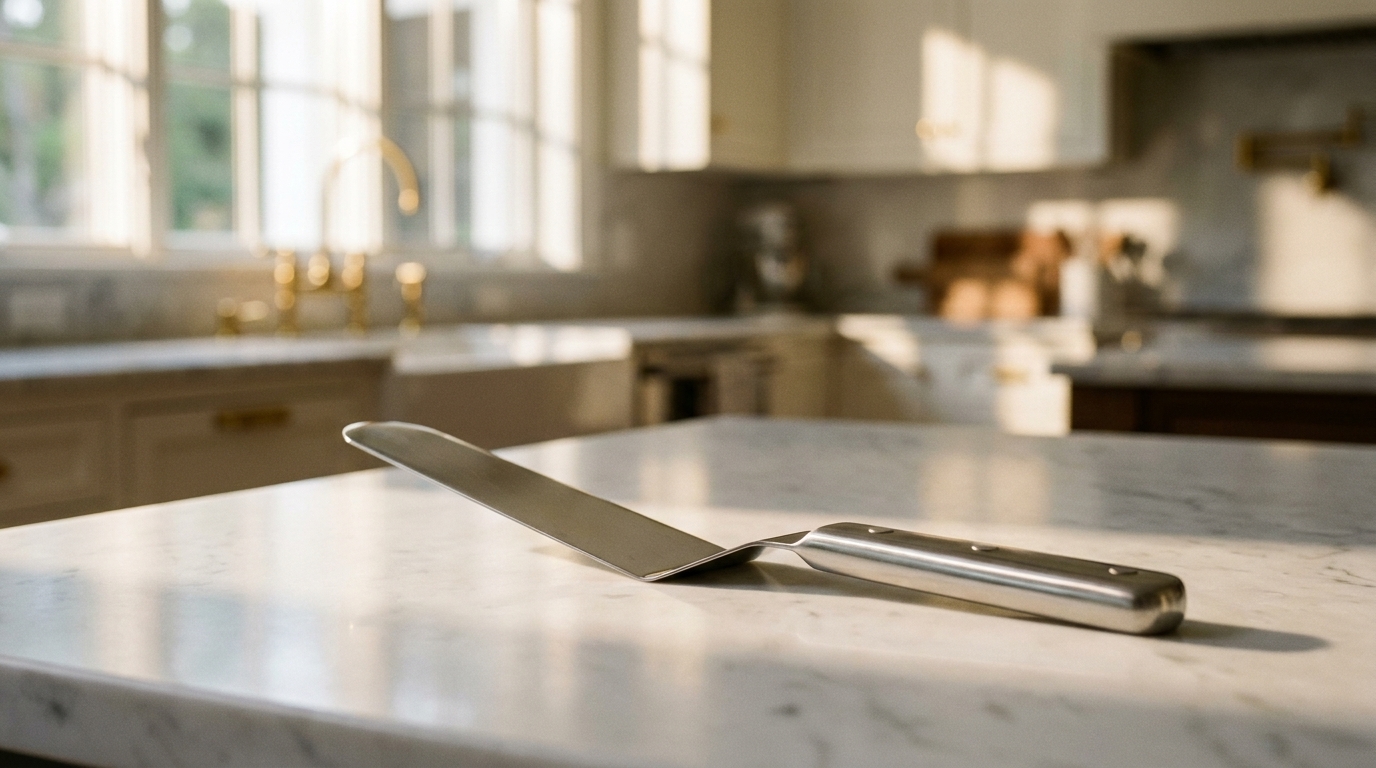
Learn how an offset spatula extends far beyond frosting, handling delicate fish fillets, plated proteins, glazing vegetables, and spreading sauces with precision. Its thin, angled blade gives you controlled contact with food that wooden spoons and tongs simply can't match.
What Is an Offset Spatula and Why Every Kitchen Needs One
An offset spatula's angled blade and thin construction let you spread, lift, and scoop with precision while keeping your knuckles safe from heat and edges.
The anatomy of an offset spatula: blade angle, handle design, and material differences
The offset spatula's defining feature is its angled blade -- bent away from the handle at roughly 28 to 36 degrees, which keeps your knuckles clear of whatever you're spreading while still letting the blade reach flat into pans. [1] Blade thickness matters more than most people expect: blades under 1mm thin slide cleanly under cake layers and along pan edges, while thicker blades struggle to get underneath food without causing damage. [1] Most offset spatulas pair a stainless steel blade with a plastic or wood handle, and stainless steel handles tough jobs well while wood stays comfortable to grip without transferring heat -- nylon blades, by contrast, are too flexible to lift or scoop with any real control. [2] A handle around 5 inches long with a rounded, textured grip gives you the leverage needed for extended work without hand fatigue. [1]
How offset spatulas differ from straight spatulas and when each one matters
A straight spatula -- also called an icing spatula -- has no bends in the blade, making it useful for smoothing the sides of a cake or creating decorative striations in buttercream. [3] The offset drops the blade down at an angle and then levels it out again, which keeps your knuckles clear and lets the blade reach flat into pan corners -- something a straight blade can't do without forcing an awkward wrist position. [3] A straight spatula can't do anything an offset can't, but an offset handles tasks a straight blade can't reach, like sliding under a chilled cake layer or spreading batter evenly all the way to pan edges. [3] For most kitchens, one offset covers both roles.

12 Kitchen Tasks Where an Offset Spatula Outperforms Other Tools
An offset spatula's angled blade slides under delicate proteins and spreads sauces across surfaces in one smooth pass, handling tasks that other tools approach less cleanly.
Savory cooking applications: flipping delicate fish, transferring eggs, and plating proteins without damage
The offset spatula's angled blade extends its usefulness well beyond baking -- its thin, flexible edge slides cleanly under delicate fish fillets, fried eggs, and plated proteins without applying pressure that breaks them apart. [4] A blade angle in the low 70-degree range cups the fillet gently as it slides underneath, whereas straighter blades require more force and risk cracking the protein. [5] That same blade geometry works just as well for transferring fried eggs -- the thin edge gets under the whites cleanly before the yolk has a chance to break. [4] For plating, the angled reach positions proteins precisely without tongs, which can pierce or compress the surface. [6]
Prep work and finishing: spreading sauces, scraping bowls clean, and applying glazes to roasted vegetables
Beyond plating proteins, the offset spatula handles prep and finishing tasks that other tools approach less cleanly.
Its angled blade spreads sauces across sheet pans or serving platters in one smooth pass, covering more surface area per stroke than a spoon requires multiple passes to reach. [7] That same blade profile works for scraping bowls nearly clean along curved walls in one continuous arc -- if you're comparing scrapers across tasks, our bench scraper guide covers where each tool wins. [8] For finishing roasted vegetables, a thin blade distributes glazes like honey or miso evenly across cut surfaces before the pan returns under the broiler, without pushing ingredients aside. [7]
Choosing the Right Offset Spatula: Size, Material, and Handle Comfort
Pick the right size and handle material to match your kitchen tasks, from frosting cakes to decorating cupcakes.
Small vs. large offset spatulas: which size handles which kitchen taskSize determines where the offset spatula performs best.
Large blades -- typically 8 to 9 inches -- cover more ground per stroke, making them practical for spreading batter evenly across full sheet pans, smoothing frosted cake layers, and moving assembled, chilled cakes between stands. [3] Mini blades around 4.5 inches give you tighter control for cupcake decorating, navigating a crowded cookie sheet, and spreading condiments on sandwiches without dragging toppings. [9] If you can only keep one size, the mini handles the widest range of everyday tasks and takes up about as much drawer space as a spoon. [3]
Stainless steel, silicone, and wood handles: durability, heat resistance, and maintenance
Handle material determines how your offset spatula holds up and what care it needs.
Stainless steel handles are dishwasher-safe and built for daily use, though they conduct heat more readily than wood or silicone. [10] Silicone handles resist temperatures up to 600 degreesF, are dishwasher-safe, and the only real downside is that lower-quality silicone can retain cooking odors even after washing. [11] Wood handles stay comfortable in the hand and won't melt near a flame, but they warp in the dishwasher -- handwash and air dry to keep them functional for the long haul. [9]


Building Your Kitchen Tool Collection: Pairing Offset Spatulas with Essential Cookware
Proper care and storage--hand-washing, drying promptly, and laying the spatula flat--keeps the blade's offset angle and flexibility intact for years of precise cooking.
Why offset spatulas are the missing link between your cookware and your technique
Most kitchen tool gaps aren't about missing cookware -- they're about missing the tool that lets you use cookware precisely.
An offset spatula fills that role by giving you direct, controlled contact with pan surfaces, baked goods, and proteins in ways that wooden spoons, tongs, or standard spatulas can't replicate. [12] Bakers use it to reach pan corners without compromising non-stick coatings; home cooks use it to transfer proteins from pan to plate without tearing; prep cooks use it to spread glazes flush against sheet pan edges. [3] Pairing it with a well-chosen cookware set closes the gap between what a recipe asks for and what your hands can actually deliver. [12]
Maintenance and care: keeping your offset spatula performing at its best
Proper care keeps the blade's offset angle and flexibility intact -- both of which directly affect performance.
Stainless steel blades are dishwasher-safe, but repeated cycles can stress the handle joint and dull the finish; hand-washing and drying promptly extends the blade's functional life. [3] Storing the spatula flat, rather than upright in a packed utensil holder, protects the thin blade from being bent out of alignment by neighboring tools over time. [13] A blade that no longer lies flat under light pressure or flexes inconsistently has lost its precision -- at that point, replacing it costs less time than working around a compromised tool. [3]
- Offset spatula's 28-36 degree angled blade keeps knuckles clear while reaching flat into pan corners and edges.
- Thin blades under 1mm slide cleanly under delicate proteins like fish fillets and fried eggs without tearing.
- Mini 4.5-inch blades offer tighter control for cupcakes and crowded sheets; large 8-9-inch blades cover more surface per stroke.
- Stainless steel blades handle daily use and are dishwasher-safe; wood handles stay comfortable but require hand-washing.
- Offset spatulas spread sauces, glazes, and batters evenly across sheet pans in single passes where spoons require multiple strokes.
- Storing the spatula flat protects the thin blade from bending out of alignment; hand-washing extends functional life.
- https://www.americastestkitchen.com/equipment_reviews/1630-offset-spatulas
- https://chefequipment.com/blogs/resources/types-of-spatulas-and-their-uses?srsltid=AfmBOoqxUX2vILzuSHbgbEYsMVJoY9WF3NiFdIgXE11Gq66P1momV98t
- https://www.seriouseats.com/what-is-an-offset-spatula-7099792
- https://www.seriouseats.com/best-fish-spatula-slotted-offset-spatula
- https://www.foodandwine.com/best-fish-spatulas-11732845
- https://japanesetaste.com/blogs/japanese-taste-blog/10-types-of-spatulas-and-their-practical-uses
- https://scarlatifamilykitchen.com/glossary-of-cooking-terms/
- https://reluctantgourmet.com/cooking-utensils/
- https://www.nytimes.com/wirecutter/reviews/best-spatula/
- https://www.webstaurantstore.com/guide/1062/types-of-spatulas.html?srsltid=AfmBOoriDU1UHiK_l4tO2BTESqUKLnI7f4bsGFhuNl0r2Ls4-4al4Qg6
- https://www.seriouseats.com/best-nonstick-silicone-spatulas-turners-flippers
- https://www.kingarthurbaking.com/blog/2022/12/09/baking-with-offset-spatula
- https://www.savoringthegood.com/spatula-types/