

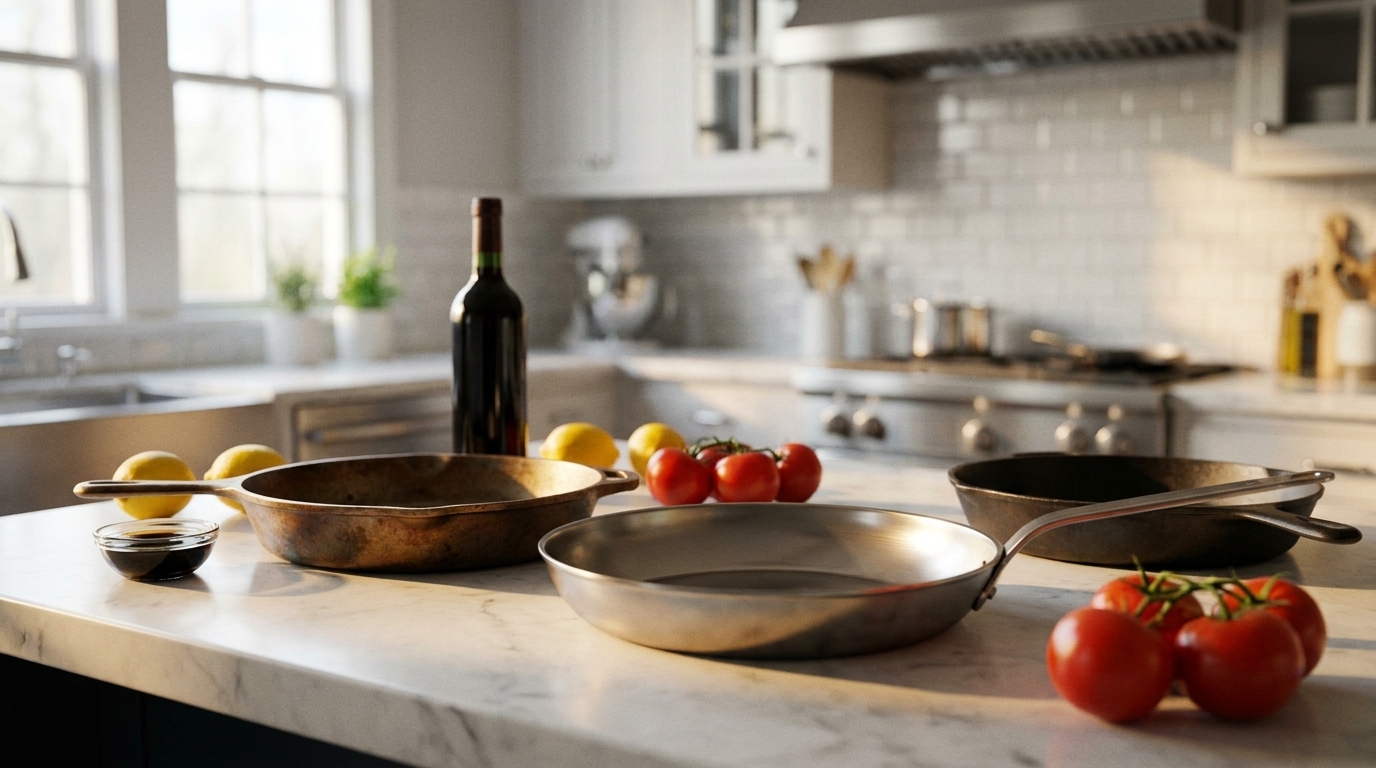
Carbon steel handles acidic foods better than cast iron because its thinner construction allows faster seasoning recovery, while cast iron's heat retention keeps acidic ingredients in reactive contact with the metal longer. For dishes simmering under 15 minutes, either pan works well; for longer cooking, enameled cast iron or stainless steel prevents metal leaching entirely.
The Direct Answer: Which Pan Handles Acidic Foods Better?
Carbon steel recovers its seasoning faster than cast iron after acid contact, making it the better choice for cooks who regularly prepare tomato sauces and citrus-based dishes.
Why carbon steel outperforms cast iron for acidic cooking
Carbon steel contains less than 2% carbon compared to cast iron's 2-3.5%, which directly affects how each pan responds to acidic ingredients like tomatoes, citrus, and wine-based sauces.[1] When acid contacts a seasoned surface, it strips the polymerized oil layer that acts as a barrier between metal and food -- but carbon steel's thinner, lighter construction lets you rebuild that seasoning more quickly than cast iron's denser structure allows.[1] Cast iron's strong heat retention also works against it here: acidic food stays in reactive contact with any exposed metal longer while the pan holds temperature.[2] For cooks who regularly prepare acidic dishes, carbon steel's faster seasoning recovery gives it a clear practical advantage over uncoated cast iron.[1]
What happens when acidic foods meet seasoned cast iron
When acid contacts cast iron, the seasoning degrades and iron molecules migrate into the food.
America's Test Kitchen tested this by simmering tomato sauce in seasoned and unseasoned cast iron, with stainless steel as a control -- tasters detected no metallic flavor at 15 minutes but noted it at the 30-minute mark in both cast iron pans.[4] Lab analysis confirmed the unseasoned skillet transferred more iron than the seasoned one, while stainless steel leached virtually none.[4] Brief acid contact -- a quick deglaze or a squeeze of lemon at the finish -- won't damage a well-seasoned pan, but simmering past 15 minutes risks off-flavors and seasoning loss.[5] For long-cooked acidic dishes, enameled cast iron removes the problem entirely since the enamel doesn't react with acid.[5]

What Pan Material Is Best for Acidic Food: The Chemistry Behind It
Carbon steel recovers from acid damage faster than cast iron because it reaches seasoning temperature quickly, letting you cook tomato and wine sauces without long recovery waits.
How iron reacts with acids and why seasoning breaks down
Iron reacts with acidic ingredients -- tomatoes, citrus, wine -- through a displacement reaction: hydrogen ions pull iron molecules off the pan surface and release them as ferrous ions into the food.[7] The seasoning layer, a polymerized oil film bonded to the metal through heat, blocks this reaction when intact -- but acid acts as a solvent that degrades the polymer chain over time.[6][8] Once breached, bare metal is exposed, leaching accelerates, and food develops a metallic taste alongside visible grey patches where seasoning has worn away.[7] Harder polymers formed from drying oils with high polyunsaturated fat content resist acid longer, which is why oil choice affects both nonstick performance and acid resilience.[8]
Carbon steel's natural advantage: lower iron reactivity and faster seasoning recovery
Carbon steel reaches and exits cooking temperatures faster than cast iron, and that responsiveness is what makes seasoning recovery practical on the stovetop.[10] Seasoning forms when oil polymerizes at 450-500 degreesF, and because carbon steel hits that threshold quickly, a thin coat of drying oil applied after acid exposure bonds into a fresh protective layer within one high-heat stovetop session.[9][11] Cast iron's thermal mass requires longer to reach and hold polymerization temperature, making stovetop recovery less reliable and often requiring multiple oven treatments instead.[10] In practice, after an acidic dish strips some surface protection, carbon steel can return to cooking-ready condition the same day -- a meaningful difference if you cook tomato-based or wine-reduced sauces regularly.[9]
Is Carbon Steel Safe for Acidic Food: A Complete Safety Assessment
Iron leaching from carbon steel during acidic cooking is real but manageable--enameled cast iron or ceramic eliminates the concern entirely for long-simmered dishes.
Iron leaching concerns debunked: what the science actually shows
The concern about iron leaching from carbon steel is real but heavily context-dependent -- acidity level and contact time drive it more than pan material alone.
Research confirms that metal transfer from cookware increases with both acidity and cooking duration, but stays low under typical home cooking conditions.[13] The 2024 Matfer case in France, where certain carbon steel pans exceeded European safety limits, involved boiling an acidic solution for two hours -- not a realistic proxy for how most home cooks actually use their pans.[13] Iron is also an essential nutrient, so trace amounts transferred during normal cooking carry little health risk for most people; the leaching concern is substantially more significant with aluminum cookware, which releases far more metal than steel under acidic conditions.[12][14]
Comparing carbon steel, cast iron, and stainless steel for tomato-based dishes
For tomato-based dishes, where pH falls between 4.0 and 4.6 and cook times frequently exceed 20 minutes, all three bare metals carry different tradeoffs. [16] Carbon steel is more reactive to acidic foods than cast iron, though both transfer iron under sustained acid exposure -- the difference is seasoning recovery speed, not acid immunity. [15] Stainless steel avoids iron transfer but isn't neutral: simmering tomato sauce past 20 minutes increases chromium leaching by 3.7x and nickel by 5.2x, and lab testing found 0.31 ppm nickel migration at 95 degreesC -- above FDA's 0.2 ppm daily intake limit for sensitive individuals. [16] A short tomato pan sauce is manageable in any well-seasoned reactive pan, but for longer-simmered dishes, a non-toxic braiser in enameled cast iron or ceramic sidesteps all three limitations at once. [15]


Pan Selection Decision Framework: Choose Your Best Tool for Acidic Cooking
Carbon steel handles short acidic dishes better than cast iron, while enameled cast iron or stainless steel work best for long-simmering recipes.
Comparison table: cast iron vs. carbon steel for 8 common acidic recipesThe table below compares both materials across eight common acidic recipes, using cook time and acid concentration as the primary decision factors. Carbon steel's faster seasoning recovery makes it more forgiving for shorter acid-contact dishes, while cast iron's thermal mass becomes a liability in long-simmering applications -- it holds heat longer, keeping acidic food in sustained reactive contact with the metal surface. [18][19] For recipes with high acid concentration and cook times beyond 20-30 minutes, neither bare metal is the ideal choice; enameled cast iron or ceramic sidesteps the reactive-surface problem entirely without requiring seasoning maintenance. [17]
| Recipe | Acid source | Cook time | Carbon steel | Cast iron | Recommended pan |
|---|---|---|---|---|---|
| Quick tomato pan sauce | Tomatoes (pH 4.0-4.6) | < 15 min | ✓ OK | ✓ OK | Either; re-season after |
| Long-simmered marinara | Tomatoes | 45-60 min | ✗ Avoid | ✗ Avoid | Enameled cast iron |
| Lemon butter pan sauce | Citrus juice | 3-5 min | ✓ OK | ✓ OK | Either |
| Shakshuka | Tomatoes | 20-30 min | ✓ Borderline | ✗ Avoid | Carbon steel |
| Wine pan reduction | Wine | 5-8 min | ✓ OK | ✓ OK | Either |
| Coq au vin | Wine + tomato | 60-90 min | ✗ Avoid | ✗ Avoid | Enameled cast iron |
| Citrus-glazed seafood | Citrus juice | 6-8 min | ✓ OK | ✓ Borderline | Carbon steel |
| Balsamic glaze | Vinegar (pH 2.5-3.0) | 8-12 min | ✓ Borderline | ✗ Avoid | Carbon steel |
When to reach for stainless steel, nonstick, or enameled cast iron instead
Stainless steel handles acidic dishes for 15-20 minutes without seasoning maintenance and goes straight in the dishwasher -- a practical default for quick tomato pan sauces or citrus-deglazed proteins where you want flavor-neutral results without any reactive-surface concerns. [20] PFAS-free nonstick and ceramic-coated options cut acid reactivity to zero for short preparations, though ceramic coatings typically degrade within one to three years and PTFE coatings shouldn't exceed 400 degreesF. [21] For extended braises and long-simmered acidic sauces, enameled cast iron is the only option that pairs cast iron's heat retention with a fully non-reactive surface -- the fused enamel layer blocks all metal-food contact regardless of cook time or acid level. [20]
- Carbon steel recovers from acid damage faster than cast iron due to quicker heat response and easier seasoning restoration.
- Acidic dishes under 15 minutes are safe in seasoned carbon steel or cast iron; beyond 30 minutes, both bare metals risk metallic flavor and seasoning loss.
- Stainless steel avoids iron transfer but leaches chromium and nickel when simmering tomato sauce past 20 minutes, exceeding safe daily intake limits for sensitive individuals.
- Enameled cast iron is the only bare-metal option that handles long-simmered acidic dishes without seasoning degradation or metal leaching.
- Iron leaching from carbon steel under normal cooking conditions is minimal and safe; the 2024 European safety concern involved unrealistic two-hour boiling tests.
- Acid acts as a solvent that degrades the polymerized oil seasoning layer, exposing bare metal and accelerating leaching--harder polymers from drying oils resist acid longer.
- https://www.webstaurantstore.com/blog/5090/carbon-steel-vs-cast-iron.html?srsltid=AfmBOooxzx6FRXGZiwxA84LR_lgCgbyVsJLuV1YniH9OHbQt6hXxKM4M
- https://www.zendaguide.com/post/cookware-leaching-food-chemistry
- https://www.epicurious.com/expert-advice/what-not-to-cook-in-a-cast-iron-skillet-article
- https://www.americastestkitchen.com/articles/7499-can-you-cook-acidic-ingredients-in-cast-iron
- https://www.seriouseats.com/the-truth-about-cast-iron
- https://news.vt.edu/articles/2024/08/cast-iron-myths.html
- https://www.titaudoumiu.com/industry-news/acidic-foods-in-cast-iron/
- https://sherylcanter.com/wordpress/2010/01/a-science-based-technique-for-seasoning-cast-iron/
- https://www.kitchenmarks.com/cookware-types-explained/
- https://sherylcanter.com/wordpress/2010/01/a-science-based-technique-for-seasoning-cast-iron/comment-page-4/
- https://pmc.ncbi.nlm.nih.gov/articles/PMC10386729/
- https://ireadlabelsforyou.com/is-carbon-steel-non-toxic/
- https://www.canada.ca/en/health-canada/services/household-products/safe-use-cookware.html
- https://3littleplums.com/blog/carbon-steel-vs-cast-iron
- https://lifetips.alibaba.com/kitchen-hacks/foods-you-shouldnt-cook-in-stainless-steel-skillets
- https://vmtcnc.com/carbon-steel-vs-cast-iron/
- https://leeknives.com/carbon-steel-vs-stainless-steel-vs-cast-iron/
- https://www.kulina.ie/guide-pans/cast-iron-steel-stainless-pans-comparison/?srsltid=AfmBOooOFPvxjg8q3UkBK3pEnUYl0DsY-ntLduVYjzZHSDn_XYNj_D2j
- https://www.cupindy.com/blogs/info/best-cooking-pan-guide?srsltid=AfmBOopAULI-i1WQqSKyhyqU2JYFgofyeR9JVpf65YTXNqGAQuYhzbYK
- https://plasticdetox.org/articles/cast-iron-vs-stainless-steel-vs-ceramic-cookware.html