

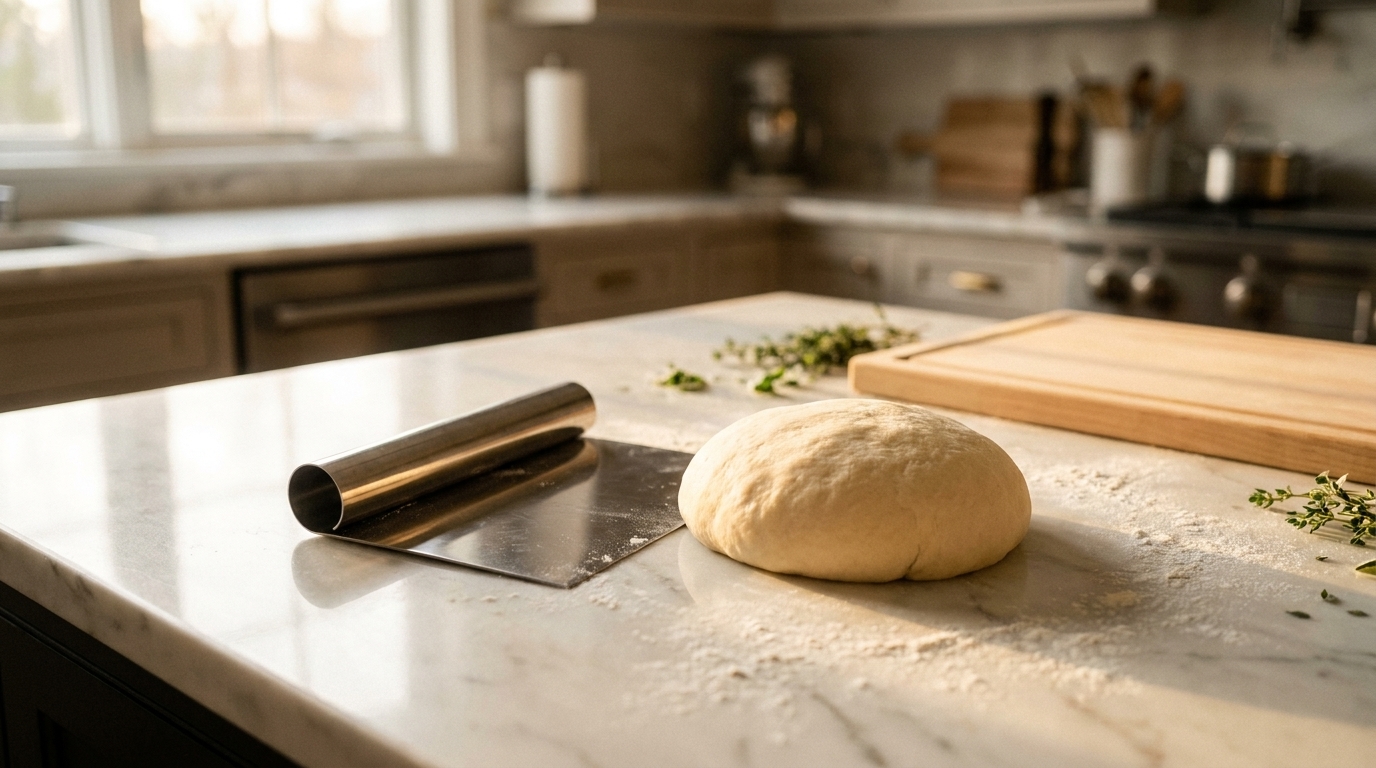
A bench scraper outperforms a spatula for eight essential kitchen tasks, from portioning dough and scraping surfaces to lifting delicate items and making precision cuts. Its rigid, flat blade applies even pressure across full-width cuts, making it indispensable for bakers and prep-heavy cooks.
Cutting and Portioning Dough Without Tearing or Stretching
A bench scraper's straight blade cuts dough cleanly in one downward stroke, preserving gluten structure and preventing the weak spots that come from dragging or hand-tearing.
How a bench scraper's sharp edge cuts dough cleanly versus a spatula's rounded edge
A bench scraper's straight, rigid blade applies even pressure across the full cut line in a single downward motion, dividing dough without pulling the gluten network sideways -- the core advantage over a spatula's rounded, flexible tip that forces a rocking or dragging stroke through resistant dough. [5] That dragging motion stretches gluten strands unevenly, leaving cut edges weakened and more prone to tearing during shaping. [5] Gluten strands tear when stretched under too much lateral force, so for high-hydration doughs like sourdough or pizza, any unnecessary stress introduced during portioning shows up later as a weak spot in the crust or crumb structure. [5]
Best practices for dividing bread dough, pizza dough, and pastry sheets
For bread dough, hold the bench scraper at a shallow angle to the work surface and use as few downward cuts as possible -- each extra cut interrupts the gluten network you developed during mixing and folding.[7] For pizza dough, a bench scraper divides a sticky batch into even portions in one clean stroke; at higher hydrations, that vertical pressure prevents the tearing that comes from pulling dough apart with your hands.[8] The same logic applies to pastry sheets: straight downward pressure from a full-width blade cuts through without dragging, which protects delicate structure in ways a spatula or dull tool can't.[6] Flour the blade lightly between cuts whenever dough begins sticking to the metal.

Scraping Work Surfaces and Cleaning Up Dried Batter or Sticky Residue
A bench scraper's rigid blade clears dried batter and sticky residue in one forward pass, keeping your workspace ready for the next task without spreading debris.
Why bench scrapers remove stuck-on ingredients better than spatulas
When batter dries or dough sticks to a counter, a bench scraper's rigid, straight blade applies consistent pressure across the full width of the residue in a single forward pass -- something a spatula's flexible head can't replicate because it deflects away from the surface under resistance. [10] That deflection is the practical problem: instead of lifting stuck material, a spatula tends to spread it sideways. [10] A bench scraper's wide, flat contact also picks up debris that sponges and towels leave behind, making it the faster option for clearing flour, dried batter, and caramel spills before they bond more firmly to the surface. [9]
Using a bench scraper to prep your workspace for the next task
Prepping your workspace for the next task is where the bench scraper earns its place in daily cooking routines.
In professional kitchens, cutting boards aren't washed between every ingredient -- a bench scraper clears vegetable scraps, flour, and dough bits in seconds, letting you move directly to the next task without breaking rhythm. [12] A quick forward pass every few minutes prevents debris buildup, reduces cross-contamination risk, and keeps your surface ready for different ingredients. [11] This approach is a core part of mise en place discipline -- sweeping scraps into a trash bowl before switching tasks takes seconds with a bench scraper and significantly longer with a sponge that spreads residue instead of lifting it. [11]
Transferring Chopped Ingredients and Moving Prepped Items Efficiently
A bench scraper's flat, straight-edged blade transfers chopped ingredients in fewer passes than a spatula, keeping everything corralled and your countertop clean.
The bench scraper's flat blade as a mise en place workhorse
The bench scraper's wide, flat blade covers the full width of a cutting board in a single scoop, moving diced onions, minced garlic, or chopped herbs into a bowl without scattering any to the countertop. [13] The blade's surface area is larger than a knife's, so you move more in fewer passes -- a real advantage when you're working through several ingredients at once. [14] Using a knife for this transfer instead -- dragging the sharp edge sideways across the board -- misaligns the blade and dulls it faster than regular cutting does, making the bench scraper the right tool for this task on two counts. [15] Keeping a bench scraper beside your cutting board during mise en place means cleaner transfers and sharper knives with no extra effort. [14]
Comparing bench scraper efficiency to spatula for ingredient transport
When moving larger quantities of chopped ingredients, the rectangular blade of a bench scraper covers more surface area than a spatula's rounded head, letting you clear a full section of the cutting board in a single scoop rather than multiple passes. [16] A spatula's flexible, rounded profile causes ingredients to roll off the sides during transfer -- a consistent problem when moving diced vegetables, minced shallots, or coarsely chopped herbs. [17] The bench scraper's straight edges act as a natural barrier that keeps ingredients corralled on the blade from board to bowl, reducing scatter and cleanup at both ends of the transfer. [16]
Lifting and Flipping Delicate Items Like Cookies, Pancakes, and Thin Fish
A rigid bench scraper spreads weight evenly across its full width, letting you slide delicate cookies, pancakes, and fish fillets onto the pan without cracking or breaking them.
Why a bench scraper's thin, rigid blade prevents breakage compared to flexible spatulas
A flexible spatula bends under the weight of a delicate item as you lift, creating a curved support surface that concentrates stress at the food's center rather than distributing it evenly -- that uneven load is what cracks thin cookies or breaks a fish fillet mid-transfer. [18] A bench scraper's rigid blade stays flat throughout the entire lift, spreading weight evenly across its full width so thin pancakes, cookies, and fish fillets reach the pan intact. [18] The thin front edge slides cleanly under delicate foods in a single forward motion, giving you the same mechanical advantage as a thin-edged fish spatula -- but with a wider, fully rigid surface that doesn't flex as you lift. [19]
Technique for using a bench scraper under delicate foods without damage
To slide a bench scraper under a delicate food cleanly, hold the blade at a shallow angle to the surface -- roughly 15 to 20 degrees -- and lead with the thin front edge using one steady forward push rather than a rocking or wedging motion. [20] A low approach angle lets the blade travel beneath the food rather than press against it, which is the same mechanical principle that makes acutely angled spatula blades easier to maneuver under thin fish fillets. [20] Once the blade is fully under the item, keep it parallel to the surface as you lift -- any tilt shifts the load toward one edge and cracks thin cookies or breaks apart a fragile fillet mid-transfer. [21] If the food resists, a brief chill in the refrigerator firms up delicate cookies or bars enough that the blade releases cleanly without tearing the base.
Portioning Soft Foods and Creating Clean Lines in Brownies, Fudge, and Baked Goods
A bench scraper's rigid, full-width blade cuts brownies and fudge cleanly in one downward stroke, preventing the smearing and crumbling that narrower knives leave behind.
Achieving precision cuts in brownies, sheet cakes, and fudge with a bench scraper
A bench scraper's straight blade spans the full width of a brownie or sheet cake in a single downward stroke, eliminating the lateral drag that smears dense chocolate bars or fudge across the cut line [23]. Lightly oil the blade before each cut -- this prevents sticking, particularly with caramel-dense or fudge-based bars that grip metal under pressure [23].
For the cleanest result, score your cut lines into the surface while the bake is still slightly warm, then chill the pan before completing full cuts; the firmed structure releases from the blade cleanly rather than compressing and crumbling under it [23]. A bench scraper's rigid, full-width edge also keeps each cut perfectly vertical, where a narrower or flexible blade can angle slightly and leave uneven sides [22].
Bench scraper versus knife: when each tool is the right choice
A bench scraper handles bars more effectively than a knife when cutting directly on a cutting board -- its straight edge spans the full cut line in one downward stroke without the lateral drag that pulls crumbs from bar edges [24].
A chef's knife (straight-edge, not serrated) earns its place when bars are sticky or slightly warm: running the blade under hot water and wiping it between each cut prevents chocolate or caramel from gripping the metal and tearing the top surface [22].
For completely cooled, firm bars, blade width becomes the deciding factor -- a bench scraper's wider edge covers more of the cut line in a single pass than most chef's knives, making cleaner work of larger pans in fewer strokes [24].


Scraping Bowls and Mixing Vessels to Maximize Ingredient Use
A bench scraper's wide, flat blade clears bowl walls in one or two passes, ensuring every measured ingredient--including expensive additions--makes it into your batter rather than drying on the sides.
How a bench scraper removes more batter and dough from bowl sides than a spatula
A bench scraper's wider blade covers more of a bowl's interior per pass than a standard spatula's narrower head, pulling thin brownie batter, thick cookie dough, and sticky bread dough from bowl sides in fewer strokes. [25] Unlike a spatula with a handle, the bench scraper is held directly along its top edge -- this handleless grip lets you reach into the bowl and apply leverage at a lower angle, improving blade-to-wall contact through the full sweep. [25] A spatula's handle forces your hand above the rim and reduces that contact angle, which is why batter accumulates along lower walls even after several passes. [26] The result: a bench scraper typically clears a mixing bowl in one or two strokes where a spatula requires three or four. [25]
Reducing waste and improving consistency by fully incorporating mixed ingredients
Leaving batter or dough on bowl walls between folds means unmixed flour, fat, or leavening agents get distributed unevenly through the final bake -- a direct source of inconsistent texture across a batch. [27] A bench scraper's rigid edge clears these wall deposits and pulls them back into the mix with firm, flat contact, ensuring expensive additions like vanilla bean paste or high-quality chocolate end up in the batter rather than dried on the bowl. [28] Complete bowl incorporation also matters for accuracy: when a recipe's ratios depend on every measured ingredient making it into the mix, residue left on bowl walls is effectively wasted, altering the balance that controls texture, rise, and flavor. [27]
Decorating and Plating with Precision: Creating Patterns and Lines
A bench scraper's rigid blade maintains full-width contact across a plate, creating clean sauce swipes, chocolate work, and precise garnish placement that repeat consistently.
Using a bench scraper to create professional plating effects and decorative lines
A bench scraper's straight, rigid edge makes it a natural plating tool for sauce swipes, chocolate work, and decorative lines -- all tasks that depend on consistent flat contact across a surface [29]. To execute a clean sauce stroke, place a dollop of thick sauce near the plate's edge, press the blade lightly against the surface, and pull in one steady motion; this creates the kind of defined, tapered landing zone that anchors a protein or vegetable without smearing [31].
For chocolate, the same rigid geometry lets you drag across a chilled, tempered surface at a shallow angle to pull uniform shards or spread ganache into an even, ridge-free layer [30]. A spoon curves and lifts mid-stroke -- the bench scraper maintains full-width contact throughout, which is what makes results repeatable plate after plate [29].
Chef techniques for sauce swipes, chocolate shards, and garnish placement
For garnish placement, the bench scraper works as a positioning tool as well as a transport surface -- sliding it under a cluster of microgreens, herb sprigs, or edible flowers lets you set them down precisely in one motion rather than nudging them by hand. Chocolate shards form when tempered chocolate or caramel is spread thin across a flat surface with the blade, chilled until firm, then lifted from beneath at a low angle; this controlled pressure snaps the set material into defined pieces rather than crumbling it [32].
Adjusting blade pressure during the initial spread controls final shard thickness -- a thinner pass produces fine fragments for topping tarts, while a thicker layer yields larger pieces for plated desserts [32]. Unique Comparison Tool: Bench Scraper vs. Spatula Task Matrix
Interactive comparison table: 8 kitchen tasks ranked by tool effectiveness
The table below compares each of the 8 tasks by how well each tool performs, using the core properties that drive the differences covered throughout -- blade rigidity, edge geometry, and surface width [34]. A bench scraper wins tasks that demand firm, flat contact: portioning dough, scraping surfaces, transferring ingredients, and making precision cuts in bars [34]. A spatula stays competitive where flex is the point -- folding batter into curved bowls and spreading frosting on rounded surfaces -- but the gap widens on every task requiring straight-edge control [33]. Ratings below reflect practical performance across real kitchen conditions, not feature comparisons in isolation [35].
| Kitchen Task | Bench Scraper | Spatula | Deciding Factor |
|---|---|---|---|
| Cutting and portioning dough | ★★★★★ | ★★☆☆☆ | Rigid edge cuts without tearing gluten network |
| Scraping work surfaces | ★★★★★ | ★★☆☆☆ | Flat blade lifts stuck residue in one forward pass |
| Transferring chopped ingredients | ★★★★★ | ★★★☆☆ | Wide rectangular blade corrals ingredients from board to bowl |
| Lifting delicate items | ★★★★☆ | ★★★☆☆ | Rigid surface distributes weight evenly mid-lift |
| Precision cuts in brownies and fudge | ★★★★★ | ★★☆☆☆ | Full-width straight edge eliminates lateral drag |
| Scraping mixing bowls | ★★★★☆ | ★★★★☆ | Both effective; bench scraper wins on wider, shallow bowls |
| Frosting and decorating | ★★★★☆ | ★★★★☆ | Bench scraper for straight edges; spatula for curved surfaces |
| Roughly chopping vegetables | ★★★★☆ | ★★☆☆☆ | Blade width and rigidity support controlled chopping strokes |
How to choose between a bench scraper and spatula for your cooking style
Your cooking style determines which tool earns a permanent spot on your prep surface.
If you bake regularly -- bread, pizza, pastry, or bar cookies -- a bench scraper handles the core tasks that define those workflows: portioning dough, scraping surfaces, and making clean cuts without lateral drag. [36] Cooks who rarely bake but rely on curved pans and mixing bowls will reach for a flexible spatula more often, since its curved, pliable profile suits stirring and folding in ways a rigid blade can't match. [37] Owning both is the most practical setup -- a bench scraper for flat-surface prep work, a spatula for everything that involves curved edges and heat. [38] Is a Bench Scraper Worth It?
Investment, Durability, and Long-Term Value
Why a quality bench scraper is an essential kitchen investment, not a luxury
Most bench scrapers cost between $8 and $27, with an average of $14 across tested models -- a price that's easy to justify given how many tasks one tool covers. [39] A single bench scraper handles slicing, rough chopping, scraping, leveling, lifting, and transferring ingredients -- tasks that would otherwise require multiple tools or improvised workarounds. [17] Its flat profile stores in a single drawer slot without displacing other equipment, and a stainless steel blade holds up to daily use far longer than plastic alternatives. [34] For cooks who bake or prep large quantities regularly, there's little else in the kitchen that covers this much ground for this little cost. [17]
Material durability and maintenance: getting years of performance from one tool
Stainless steel bench scrapers resist rust, staining, and blade deformation even under daily restaurant-volume use -- one tested model logged six years of professional prep work and 20 years of total use without measurable degradation [12]. Most stainless models are dishwasher-safe, though hand washing and immediate drying -- the same approach used to clean stainless steel pans -- extends blade life further, particularly after contact with acidic ingredients [40].
The beveled edge stays functional longest when used at a shallow angle against smooth boards and steel surfaces; dragging it steeply against abrasive or grit-coated surfaces accelerates edge wear [12]. Wooden-handled models require hand washing only and regular conditioning to prevent the handle from drying and cracking over time -- more upkeep than plastic or rubber handles, but manageable with consistent care [40].
Choosing the Right Bench Scraper: Material, Size, and Handle Design
Stainless steel scrapers excel at cutting and precision work, while plastic handles better with curved bowls and delicate surfaces.
Stainless steel vs. plastic bench scrapers: pros, cons, and best use casesStainless steel and plastic are the two main bench scraper materials, and the right choice depends on the tasks you prioritize. Stainless steel is more rigid -- better for cutting dough, scraping dried residue off flat surfaces, and making precision cuts through dense bars -- and holds its shape under daily heavy use [42].
Plastic scrapers have a rounded, flexible edge that conforms to bowl curves, making them more effective at scraping curved mixing vessels than a rigid metal blade can manage [42]. If your work surfaces scratch easily, plastic is the safer option for counter work; wooden handles on metal scrapers trap debris and crack over time, while plastic handles can be fully soaked for easier cleanup [41].
Blade width, thickness, and handle ergonomics that match your cooking style
Blade width around 6 inches is the practical sweet spot -- scrapers under 5 inches struggle to cut through full dough portions and can't hold enough chopped ingredients during transfers, while longer models offer no meaningful advantage for most home kitchen tasks [39]. Blade thickness matters more than edge sharpness: thinner, slightly flexible stainless steel sits flush with the work surface and slides under small food items that thicker blades push instead of collect [17].
For handles, rounded silicone or rubber grips outperform wood and hard plastic in daily use -- they hold up with wet or oily hands and skip the hand-wash-only upkeep that wooden handles require [17]. If you have smaller hands, avoid handles with a pronounced center hump, which can reduce grip control despite being marketed as ergonomic [39].


Maintenance and Care: Keeping Your Bench Scraper Sharp and Functional
Wipe your blade between tasks and avoid abrasive scrubbers to keep stainless steel from corroding and maintain clean cuts through dough.
How to clean, store, and maintain a bench scraper for years of reliable use
Stainless steel bench scrapers store flat in a single drawer slot without needing a dedicated block or guard -- but avoid stacking heavy items on top, which can bow a thinner blade over time. [40] During baking sessions, wiping the blade with a damp towel between tasks removes flour, fat, and dough residue before it dries and bonds to the metal, cutting down the effort required at full cleanup. [43] Avoid steel wool or abrasive scouring pads on stainless blades: the chromium oxide layer that protects stainless steel from rust takes up to 24 hours to repair after surface damage, and aggressive scrubbing can accelerate corrosion along those scratches. [44] For plastic or silicone scrapers, full submersion is fine, but check that the handle connection stays tight over time -- water intrusion at the seam is the most common failure point for multi-piece designs. [40]
When to sharpen or replace your bench scraper and how to spot wear
Bench scrapers don't sharpen the way knives do, but they show wear in ways worth tracking. Plastic scrapers round at the edges with regular use, reducing their ability to cut dough cleanly or maintain flush contact with a flat surface [34].
On metal models, a handle that wiggles against the blade is the primary warning sign -- that movement indicates a failing attachment and creates gaps where debris collects [34]. When a scraper drags through dough rather than cutting cleanly, or leaves jagged edges on bars instead of straight cuts, the blade geometry has shifted enough to compromise results [45].
Replace a plastic scraper when the edge no longer holds a straight profile; replace a metal one when handle flex or visible blade deformation affects how it performs under pressure [39].
- Bench scrapers cut dough cleanly without tearing the gluten network, unlike spatulas that drag and stretch.
- A rigid blade lifts stuck residue in one forward pass, clearing work surfaces faster than flexible tools.
- Wide rectangular blade transfers chopped ingredients without scattering, protecting knife edges from dulling.
- Rigid surface distributes weight evenly when lifting delicate items like cookies and fish fillets intact.
- Straight edge eliminates lateral drag when portioning brownies and fudge, creating clean cuts without smearing.
- Stainless steel models cost $8-$27 and handle slicing, scraping, leveling, and transferring--replacing multiple tools.
- Metal bench scrapers last 20+ years with proper care; plastic edges round with use and need replacement sooner.
- https://www.dioro.com/blogs/news/bench-scraper?srsltid=AfmBOooIwM6ieQCZOi3jb8ro7GmE5tBF75CqJ_EnHLaL46Kkdttjqag_
- https://www.chowhound.com/1848315/professional-bakeware-items/
- https://www.dioro.com/blogs/news/bench-scraper?srsltid=AfmBOoogR3Rt5sOoa7A4FVsIEqHAIXF3hCEohJwQS2SJvm7XQCKnYyYe
- https://www.thespruceeats.com/definition-bench-scraper-908878
- https://www.tastingtable.com/1549405/how-to-throw-pizza-dough-without-tearing/
- https://www.theperfectloaf.com/guides/how-to-preshape-bread-dough/
- https://foodal.com/knowledge/baking/shaping-bread/
- https://www.acouplecooks.com/pizza-dough-recipe/
- https://www.dioro.com/blogs/news/bench-scraper?srsltid=AfmBOooLHRk4CzQ4D5xYZuB9yO4crYj9yBF5_lx-LUBePjlSrj0nAOXL
- https://thecontentauthority.com/blog/scraper-vs-spatula
- https://www.dioro.com/blogs/news/bench-scraper?srsltid=AfmBOopeEQEPc9nVDNFQpd0MDhhO0DLmJi0YExtJ_0jKXlxMdORngKoD
- https://www.chefapprovedtools.com/reviews/oxo-good-grips-bench-scraper
- https://www.nytimes.com/wirecutter/reviews/roundup-staff-favorite-kitchen-tools/
- https://www.allrecipes.com/what-is-a-bench-scraper-7643609
- https://www.thedailymeal.com/1254591/knife-scraping-cutting-board/
- https://www.dioro.com/blogs/news/bench-scraper?srsltid=AfmBOoq6xm6yzhuP67zYI5II37g-teho2U0a0jBPuQuPoD6RMYVH5Tkz
- https://www.seriouseats.com/best-bench-scrapers-6341995
- https://lifetips.alibaba.com/kitchen-hacks/the-three-spatulas-every-kitchen-needs
- https://mastermindquotes.com/are-you-a-kitchen-pro-name-these-15-rare-cooking-tools/
- https://www.seriouseats.com/best-fish-spatula-slotted-offset-spatula
- https://www.dioro.com/blogs/news/baking-essentials-for-baking-spatulas-and-tools?srsltid=AfmBOorabn9YO1Bm9VEFWlT6mbQS-GxY_gK4ioQb7habjDI0ikQD4X_v
- https://handletheheat.com/how-to-cut-brownies/
- https://www.tastingtable.com/1550169/cut-dessert-bars-even/
- https://www.tasteofhome.com/article/how-to-cut-dessert-bars/
- https://www.seriouseats.com/best-bowl-scrapers-6746839
- https://gir.co/blogs/products/rubber-scraper-vs-spatula?srsltid=AfmBOoqQq1fYGjO77rV5SmZlGcZiwBM7IuraGU0rQcmW10b1xu7dnXvL
- https://www.dioro.com/blogs/news/baking-equipment?srsltid=AfmBOoq7ZvclDVHy4HqaSmrXt17vIEkUae17GwzAqayWadTGfRmh9gy3
- https://www.dioro.com/blogs/news/rubber-scraper?srsltid=AfmBOorAmmZLz50u1fdS33svjjT7z5Ju7J0B0ZdPXNQf_mfcWQ80H4gJ
- https://www.menutiger.com/blog/food-plating-techniques
- https://www.restaurantindia.in/article/fine-dining-plating-12-essentials-that-elevate-every-dish.12978
- https://www.lemon8-app.com/@mitcx_kitcxen/7459485760786465326?region=us
- https://cooktildelicious.com/author/ruth/page/2/
- https://gir.co/blogs/products/rubber-scraper-vs-spatula?srsltid=AfmBOoqWQtPy6YtKnvWSlQMWqZi4riQWgAL1Ts4FB5B4U_LIbBptC9SR
- https://www.allrecipes.com/best-bench-scrapers-8584399
- https://www.dioro.com/blogs/news/bench-scraper?srsltid=AfmBOorGGkvySDQt6SgLW4CU-ZeOUJZDqXCH_ttSkWK810w9QLjISp-_
- https://thegourmandiseschool.com/top-10-baking-tools/?srsltid=AfmBOorxQcH9FhpVWChA847EAe9j-stBVIJvEfipFRhYdpodDctshbvP
- https://www.dioro.com/blogs/news/bench-scraper?srsltid=AfmBOopsae3drIF4cFHasNm3Oj9mMI37WdjOEcX1fMAPRhyGmF59Clgc
- https://www.seriouseats.com/kitchen-gear-you-should-have-two-of-11696695
- https://www.foodandwine.com/best-bench-scrapers-7498492
- https://www.cuisineathome.com/review/best-bench-scraper/
- https://www.saveur.com/shop/best-cake-decorating-tools/
- https://loafybread.com/what-equipment-do-you-need-to-make-bread/
- https://www.dioro.com/blogs/news/bench-scraper?srsltid=AfmBOooVbh0tCCi_pQwwDZ3Ba2qAvzHhpxV_DS5_7VGowTSuwUt29fM1
- https://elementknife.com/blogs/pro-tips-knife-care/a-comprehensive-guide-to-knife-care-maintenance?srsltid=AfmBOoq1dfIjsOKpM-fhuxDDPl8YZ7Qv1xmxRWKM_7LFPmsTOKk8miC5
- https://www.nellacut.com/how-to-recover-performance-from-chipped-or-worn-kitchen-chef-knives/
- Summary
- Cutting and Portioning Dough Without Tearing or Stretching
- Scraping Work Surfaces and Cleaning Up Dried Batter or Sticky Residue
- Transferring Chopped Ingredients and Moving Prepped Items Efficiently
- Lifting and Flipping Delicate Items Like Cookies, Pancakes, and Thin Fish
- Portioning Soft Foods and Creating Clean Lines in Brownies, Fudge, and Baked Goods
- Scraping Bowls and Mixing Vessels to Maximize Ingredient Use
- Decorating and Plating with Precision: Creating Patterns and Lines
- Choosing the Right Bench Scraper: Material, Size, and Handle Design
- Maintenance and Care: Keeping Your Bench Scraper Sharp and Functional
- Key Takeaways
- References