

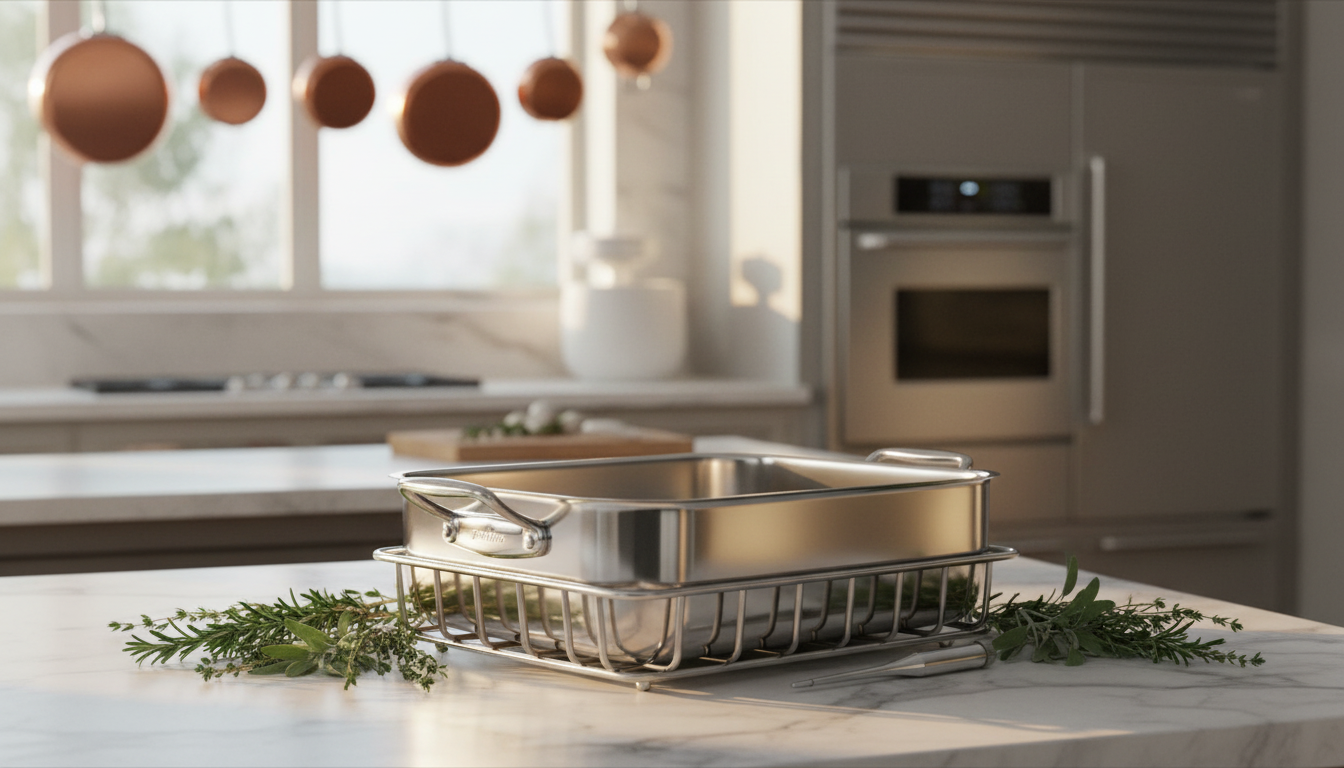
Match your turkey's weight to the right roasting pan size and depth to prevent steaming or scorching, ensuring even browning and crisp skin. A sturdy stainless pan with a rack, proper clearance, and dimensions scaled to your bird delivers the foundation for perfectly roasted poultry.
Match Your Turkey Weight to the Right Roasting Pan Size
A rack that elevates your turkey off the pan floor prevents steaming and ensures crisp, evenly browned skin instead of pale, rubbery results.
Turkey weight chart: 12-16 lbs, 16-20 lbs, 20-24 lbs, and 24+ lbs with recommended pan dimensions
Matching pan dimensions to turkey weight prevents two common problems: a bird that crowds the pan walls and steams instead of browning, or a pan so oversized that drippings scorch before you can make gravy [1]. The ranges below reflect dimensions pulled from roasting pans built specifically for holiday birds, so use them as a starting point and double-check clearance inside your own oven.
- 12-16 lbs: a 16-inch oval or rectangular pan with 3 to 3.5 inches of depth fits comfortably, roughly 16 inches long by 12 inches wide [2].
- 16-20 lbs: look for pans in the 16.8 to 17-inch range, such as a 16.8" x 12.8" x 3.4" or 17" x 12.5" pan built with this weight class in mind [1][2].
- 20-24 lbs: a 17" x 14" pan with a sturdy rack gives a bigger bird room for air circulation without crowding the sides [2].
- 24+ lbs: step up to a 19-inch covered oval roaster for the extra headroom, though models in this size are typically rated to hold up to 20 lbs of poultry, so confirm the specific pan's weight rating before buying if your bird runs heavier [1].
Whichever range applies, a rack that elevates the turkey off the pan floor matters as much as the footprint itself, since it keeps the skin from steaming in its own drippings [2].
Why pan capacity matters more than oven space: airflow, browning, and heat distribution
Oven interior dimensions set the outer limit on pan size, but capacity inside the pan is what actually determines how your turkey cooks. A pan that's too snug traps steam around the bird's sides, so the skin stays pale and rubbery instead of crisping, since hot air can't move freely around the meat [3]. Too much empty pan lets drippings spread thin and scorch before the bird finishes roasting, leaving you with burnt fond instead of gravy base [3].
Elevating the turkey on a rack addresses the airflow problem directly: it lifts the bird off the pan floor so heat can circulate underneath as well as around the sides, which is what drives even browning and a crisp exterior [2]. A tri-ply or multi-layer metal base also helps distribution by spreading heat evenly across the pan surface, reducing the hot spots that cause uneven cooking or localized burning near the pan walls [2]. In practice, this means two turkeys of the same weight can cook unevenly in different pans if one allows proper air movement around the bird and the other doesn't, regardless of whether both technically fit inside your oven.
Oven clearance matters for the pan to go in and out safely, but capacity and rack elevation are what decide whether the turkey browns evenly or steams in its own juices.

Understanding Roasting Pan Depth and How It Affects Your Turkey
A 2-inch deep pan works best for standard turkeys, while larger birds benefit from 2.5 to 3 inches of depth to hold gravy without steaming the meat.
Shallow vs. deep pans: 2-inch depth for even cooking versus 2.5-3-inch for larger birds and gravyA heavy 2-inch deep pan is a depth commonly recommended for a classic Thanksgiving bird, since that clearance lets hot air reach the sides and crisp the skin without trapping steam against the meat [4]. One well-tested method built around this depth uses an 18-by-20-inch stainless or aluminum pan exactly 2 inches deep, warning that anything deeper causes the turkey to steam rather than roast [4].
The same logic drives the standard holiday guidance to pick a shallow pan at least 2 inches longer and wider than the bird on every side, so oven air can flow completely around it [5]. That width matters as much as depth: a shallow pan with generous clearance still lets heat move freely, while a narrow pan with extra depth can trap the bird's sides in rising steam [4][5].
Once a turkey grows past the mid-size range, a slightly deeper wall, typically 2.5 to 3 inches, gives enough volume to hold stock, drippings, and aromatics for gravy without them sloshing over the sides during basting or when you lift a heavy roaster from the oven. The tradeoff is real, though: push depth higher than a small bird needs and you're back to the same steaming problem the 2-inch guidance was designed to avoid, so matching depth to actual bird size and gravy needs, rather than maximizing capacity, is what delivers crisp skin and enough drippings for the gravy pot.
The depth-to-turkey-weight ratio: why a pan that's too shallow creates dry breast meat
Breast meat is the leanest part of the bird, with less fat to buffer against moisture loss, so it dries out fastest when a pan can't hold steam against the skin. A shallow pan exposes more of that surface area to dry oven air, and the ratio works against you as the bird gets heavier: a 12-pound turkey has less mass to protect than a 20-pound one, but both lose moisture at a similar rate if the pan depth doesn't scale with the weight.
Pan depth functions as a mini-environment that traps steam and bastes the meat from the inside, and cooks who've measured this directly note that sides rising close to three inches keep wine, stock, and herbs circulating under the meat instead of evaporating off a flat surface [6]. The same principle explains why recipes built around larger birds call for more liquid in the pan bottom, since a wider or heavier turkey spreads drippings thinner and they can scorch, drying out the surrounding breast meat, before the roast finishes [7].
Undersizing depth for a big bird isn't just a crowding problem, it's a moisture problem: the breast sits closest to the dry heat with the least insulation, so it pays the price first whenever pan depth and turkey weight fall out of proportion with each other.
Roasting Pan Material and Design Features That Deliver Better Results
Stainless steel roasting pans resist warping at high heat and brown turkey skin evenly, while a proper rack underneath lets hot air circulate for crispier results.
Stainless steel construction for superior heat retention and browning compared to nonstick alternatives
Stainless steel earns its reputation in turkey roasting pans because it resists warping at high oven temperatures and holds heat evenly across the surface, which matters when a 15 to 20 pound bird spends hours in the oven [2]. Tri-ply and multi-layer stainless construction spreads heat across the full pan surface, reducing hot spots that cause scorched patches near the walls while the rest of the skin stays pale [2]. Nonstick surfaces trade some of that high-heat tolerance for easier food release, and hybrid designs that pair raised stainless ridges with recessed nonstick valleys try to split the difference, offering browning in one zone and easy cleanup in another [2]. Stainless also handles stovetop deglazing right after roasting, so gravy comes together in the same pan without transferring drippings elsewhere, a step most nonstick coatings aren't built to handle at searing temperatures [2]. Most stainless roasting pans clean up with a hand wash or a dishwasher cycle, though checking the manufacturer's care instructions helps the finish and rivets hold up over years of holiday use. The tradeoff breaks down by priority:
- Stainless steel: strong browning, stovetop-safe, withstands repeated high heat [2]
- Nonstick/hybrid: easier release and cleanup, less reliable searing [2]
- Enamel carbon steel: good heat retention, but skips stovetop deglazing [2]
If stainless steel's durability and heat performance matter for whatever pan size you've settled on, the case for stainless steel cookware holds up for both everyday cooking and holiday roasting.
Rack inclusion, handle design, and side channels: which features matter most for turkey roasting
A rack is the single feature that most affects how turkey skin crisps, since lifting the bird off the pan floor lets hot air move underneath instead of pooling juices against the skin [9]. V-shaped racks cradle the breast upright for even browning, while U-shaped racks sit lower and support heavier birds, including 20 to 24 pound turkeys, without tipping [8]. Nonstick-coated racks release skin cleanly and wipe down faster, though bare stainless wire tolerates metal utensils and high heat without flaking [8][9].
Handles matter just as much once the pan is loaded: stainless handles that are riveted rather than welded hold up better under weight, and handles positioned to stay cool cut down on bulky oven mitts [8][10]. Triple-riveted loop handles on both ends give a more secure grip for lifting a full pan from the oven, a detail reviewers single out on higher-capacity models [8]. Side channels or tapered, drip-free rims reduce spillage when carrying a pan of hot drippings to the stovetop or carving station, which matters more as bird size and liquid volume increase [8].
If you're narrowing down a model with these features in mind, a roasting pan with a rack is worth comparing against rackless designs before committing to one for turkey day.
Roasting Pan Selection Essentials: Find Your Perfect Fit Before Turkey Day
Measure your turkey's weight and oven width before buying--the smaller number determines the right pan size to fit safely.
Sizing chart: input your turkey weight and oven dimensions to get an exact pan recommendation
Before buying a pan, grab a tape measure and check two numbers: your turkey's weight and the interior width of your oven rack. A simple formula ties them together, aim for roughly one inch of pan length per pound of turkey, then add two inches of clearance on each side so hot air can circulate past the pan walls [11]. That clearance number is what decides whether a pan that fits your bird on paper will actually slide in and out of your oven without scraping the door seal or heating elements [2]. Cross-reference the result against the chart below to land on a pan size instead of guessing.
- 12-16 lb bird: 16-17" pan, needs about 20-21" of oven width [11][2].
- 16-20 lb bird: 17" pan, needs about 21" of oven width [2].
- 20-24 lb bird: 17-19" pan, needs about 21-23" of oven width [1].
- 24+ lb bird: 19" covered roaster, needs about 23" of oven width, and this size is rated to hold up to 20 lbs of poultry before you need to size up further [1].
If your oven runs narrow, a rectangular pan usually clears door hinges more easily than an oval one of the same length, since the corners don't add extra width the way a rounded oval does [2]. Measure twice: once for the turkey, once for the oven, and let the smaller number set the ceiling on pan size.
Common roasting pan mistakes and how to avoid them: oversizing, undersizing, and depth errors explained
Most sizing mistakes start at the tape measure, not the turkey. Shoppers check the oven's interior width but skip the handles, which can add two to three inches on each side, so a pan that looks like a fit on paper ends up wedged against the oven walls once it's loaded and ready to slide in [12]. Manufacturer dimensions add another layer of error: oven ridges that hold up shelves narrow the usable space, and a pan's advertised interior measurements don't always match its real footprint once you account for wall thickness and shape [12]. Undersizing often comes from buying thin, disposable pans to save money, which can warp under a turkey's weight and risk buckling when you lift them, so sliding one onto a sturdy baking sheet first makes handling safer [12]. Handle choice compounds depth and size errors too, since vertical handles save space but become nearly impossible to grip with oven mitts in a tight oven, while a pan with no handles at all turns lifting a 20-pound bird and its drippings into a real burn risk [12].
- Measure oven width with ridges and shelf supports included, not just the opening [12]
- Add handle width, often 2-3 inches per side, to your pan measurement [12]
- Skip disposable thin pans unless set on a baking sheet for support [12]
- Choose horizontal handles over vertical ones if oven clearance is tight [12]
Getting the size right comes down to two measurements and a little planning: match pan length to your bird, leave clearance on every side for airflow, and pick a depth that balances crisp skin with enough room for gravy. A sturdy, well-built pan with a rack handles all of that and lasts through years of holiday dinners. If you want a starting point, our roasting pan pairs a stainless build with a rack designed to suit birds from about 12 pounds up to larger holiday-sized roasts. Have a question about sizing or care & maintenance? Contact us, and we'll help you get it right before turkey day.
Frequently Asked Questions
-
What size roasting pan should I buy based on my turkey's weight?
The article gives a weight-to-pan chart: 12-16 lbs calls for a roughly 16" x 12" pan 3-3.5" deep; 16-20 lbs fits a 16.8-17" pan; 20-24 lbs needs a 17" x 14" pan with a sturdy rack; and 24+ lbs calls for a 19" covered oval roaster, though those are typically rated only up to 20 lbs, so confirm the specific pan's weight rating before buying a heavier bird.
-
How much oven clearance do I need for each pan size?
The article's formula is about one inch of pan length per pound of turkey plus two inches of clearance on each side. By its chart, a 12-16 lb bird needs about 20-21" of oven width, 16-20 lbs needs about 21", 20-24 lbs needs about 21-23", and 24+ lbs needs about 23".
-
Is it safe to use a thin, disposable roasting pan for a big turkey?
The article warns that thin, disposable pans can warp under a turkey's weight and risk buckling when lifted, so if you use one, slide it onto a sturdy baking sheet first for support. It also flags that a pan with poor or no handles turns lifting a 20-pound bird and its drippings into a real burn risk, so handle design matters for safety as well as pan thickness.
-
Should I pick a deep pan or a shallow one for the best turkey?
For a classic-size bird, the article points to a 2-inch-deep pan (like the 18"x20" example cited) so hot air reaches the sides and crisps the skin without trapping steam. Once a turkey grows past mid-size, it recommends stepping up to 2.5-3 inches of depth to hold drippings for gravy, but going deeper than a smaller bird needs reintroduces the same steaming problem the shallower guidance was meant to avoid.
-
Is stainless steel worth it over nonstick for a holiday roasting pan?
The article says stainless steel resists warping at high heat, browns evenly, and is the only option of the three discussed that handles stovetop deglazing for gravy in the same pan. Nonstick and hybrid designs trade some of that heat tolerance for easier release and cleanup, and the article notes stainless pans typically need only a hand wash or dishwasher cycle, with care instructions helping the finish and rivets hold up over years of holiday use.
- Match pan size to turkey weight: 12-16 lbs needs 16-inch pan, 16-20 lbs needs 17-inch, 20-24 lbs needs 17-19 inch, 24+ lbs needs 19-inch covered roaster.
- A rack elevating the turkey off the pan floor is as critical as pan dimensions, allowing hot air to circulate underneath and crisp the skin instead of steaming it.
- Pan depth of 2 to 3 inches balances crisp skin with enough liquid volume for gravy, matching depth to bird size prevents both steaming and scorched drippings.
- Stainless steel with tri-ply construction resists warping, distributes heat evenly, and handles stovetop deglazing for gravy, outperforming nonstick for browning.
- Measure your oven's interior width including ridges and shelf supports, then add 2-3 inches per handle to your pan measurement to ensure it actually fits.
- Undersized thin disposable pans warp under a turkey's weight and risk buckling when lifting, so place them on a sturdy baking sheet for support.
- Horizontal handles grip better than vertical ones in tight ovens, and riveted handles hold up better than welded ones under a loaded pan's weight.
- https://food4kitchen.com/turkey-roasting-pan/
- https://cookwarewire.com/bakeware/best-roasting-pans-for-turkey/
- https://picksworthbuying.com/best-turkey-roasting-pans/
- https://eggheadforum.com/discussion/1145400/continued-discussion-of-turkey-cooking-temps
- https://30seconds.com/food/tip/10991/Turkey-Cooking-Tips-5-Steps-to-Help-You-Roast-the-Perfect-Thanksgiving-Turkey
- https://world.taobao.com/lang/en-us/shopping-guide/2041586194394906624.htm
- https://www.cookingforengineers.com/recipe/74/Classic-Roast-Turkey/11
- https://theeverydaykitchen.com/best-roaster-pan-for-turkey/
- https://thekitchenprofessor.com/blog/best-roasting-rack-turkey/
- https://www.aol.com/shopping/kitchen/article/roasting-rack-thanksgiving-turkey-193750252.html
- https://cookwarecanvaas.com/best-pans-for-baking-turkey/
- https://bakingbites.com/2008/11/how-to-choose-a-roasting-pan/