

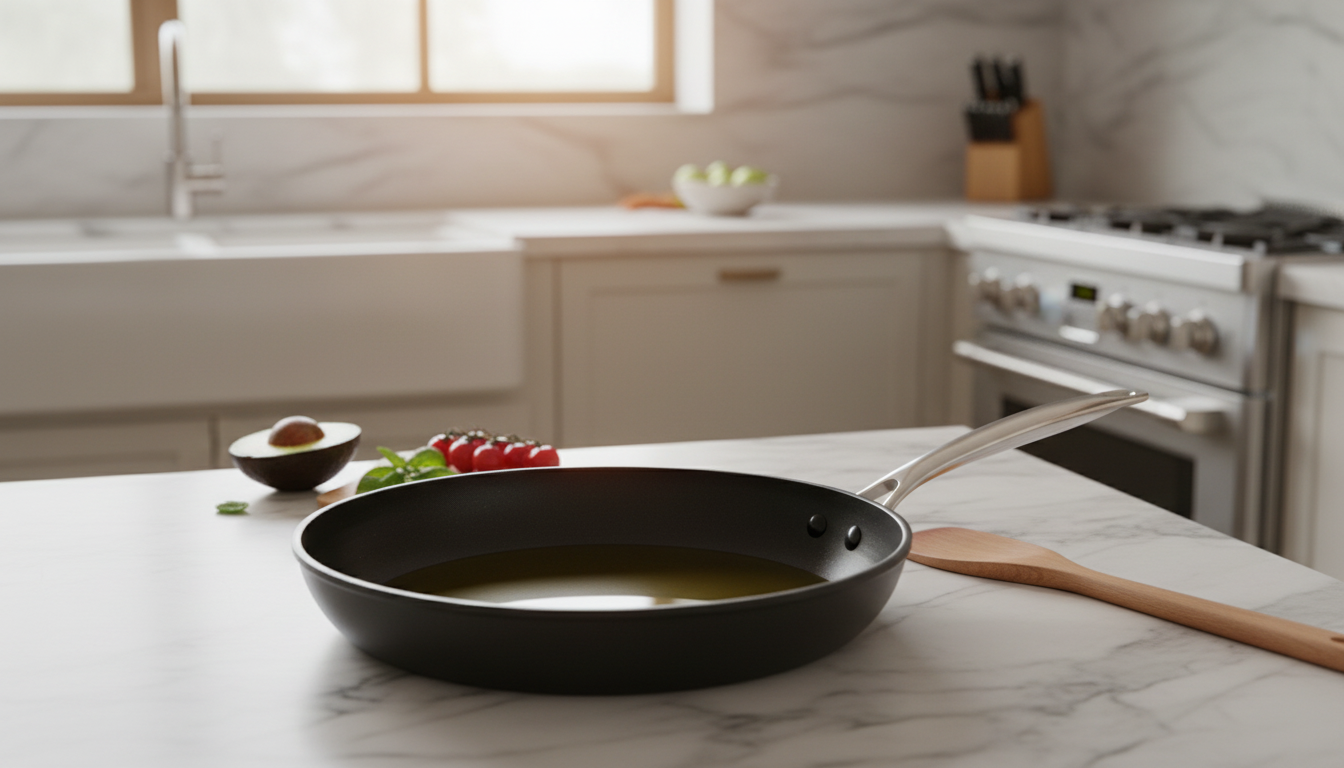
Master the heat-oil-wash routine that keeps nonstick coatings performing meal after meal instead of failing within months. Consistency across every cooking session--medium heat, thin oil layers, and gentle hand washing--is what actually extends your pan's working life.
The Heat, Oil, Wash Cycle: The Complete Maintenance System That Extends Pan Life
Repeating heat, oil, and wash every cooking session protects your nonstick coating and keeps your pan performing for years, not months.
The "repeat" in this cycle isn't an afterthought, it's the mechanism that makes the other two steps matter.
Heating on medium and oiling correctly during a single cook won't protect a coating that gets blasted with high heat or scrubbed with abrasive pads the next ten times it's used; the payoff only shows up when the same routine runs every single session, meal after meal, for the life of the pan.
Treat heat, oil, and wash as a loop that restarts with every cooking session, not a best practice you dip into occasionally, and the cumulative effect is what actually separates a nonstick pan that holds up for years from one that fails within months.
Optimal heat settings for nonstick pans: why medium heat prevents coating degradation
Medium heat matters because PTFE based nonstick coatings are a polymer layer, and polymers respond to heat by softening, off gassing, or wearing thin, not by getting tougher. The nonstick slickness that lets eggs slide and crepes flip without resistance comes from that same polymer layer sitting on the pan's surface, so keeping the burner at medium protects the coating that creates the effect in the first place [6].
Cranking the heat higher doesn't cook food faster in any meaningful way on a nonstick surface, since these pans aren't built for searing or high heat browning, and pushing past their comfort zone just shortens how long the coating keeps working. A simple habit that helps: preheat on medium for a minute or two before adding oil or food, rather than starting on high and adjusting down.
Watching for early warning signs, like faint smoke, a shifting color on the coating, or food starting to stick where it didn't before, gives a clear signal to lower the burner before any damage sets in. Over time, sticking to medium heat as the default setting, even for tasks that feel like they'd benefit from more, keeps the nonstick layer intact and preserves the exact quality that made the pan worth buying.
Oil selection and application: which fats preserve nonstick surfaces longest
High smoke point oils, like avocado oil at roughly 500 to 520 degreesF and grapeseed oil, hold up best on nonstick surfaces because they resist breaking down before the coating reaches its own temperature limit [7][8]. Applying oil in a thin, even layer rather than pooling it prevents residue from baking onto the surface, which dulls slickness and makes cleanup harder over time [7]. Lower smoke point options, including coconut oil around 350 degreesF, still work for medium heat tasks like sautéing eggs or vegetables, but pushing them toward higher temperatures speeds up coating wear [7].
Two choices are worth avoiding outright: aerosol cooking sprays, since their propellants and additives can leave a sticky film that reduces nonstick performance, and excessive oil, which pools and burns unevenly instead of coating the pan [7]. Rotating between a couple of neutral, high smoke point oils, rather than reaching for the same bottle every time, also helps prevent that residue from building up across repeated cooking sessions [7]. Washing closes out the cycle: let the pan cool first, then hand wash with warm water, a soft sponge, and mild dish soap rather than running it through the dishwasher, since harsh detergents and prolonged heat can dull the coating faster than gentle hand washing.
This heat-oil-wash sequence isn't a one-time fix, it's a loop that repeats every single time you cook, and consistency across hundreds of sessions is what actually separates a pan that lasts years from one that fails within months. Skipping the routine once or twice won't ruin a coating outright, but treating medium heat, thin oil layers, and gentle washing as the default habit for every single use, rather than an occasional best practice, is what keeps the nonstick surface performing meal after meal.
Why repetition, not a single perfect cook, is what actually protects the coating
The "repeat" step is easy to undervalue because it doesn't feel like a technique the way heat control or oil choice does, it's just doing the same thing again. But a nonstick pan rarely fails from one bad session; it fails from the slow accumulation of small shortcuts, one overheated sear, one metal spatula, one dishwasher cycle, repeated often enough that the coating never gets a chance to recover.
Running the same heat-oil-wash sequence on cook number 200 as on cook number one is what actually produces a pan that still performs after years of use, since consistency closes the gap between a technique that works in theory and results that show up on the stovetop. Treating each session as a fresh restart of the same three habits, rather than a one-off effort, is the difference between a pan that degrades gradually over normal wear and one that fails early from inconsistent care.

Are Nonstick Pans Safe to Use? Toxicity Concerns and Modern Safety Standards
Intact nonstick pans used at reasonable heat pose minimal risk; focus instead on avoiding heat abuse and physical damage to the coating.
PFAS, PTFE, and ceramic coatings: what the science actually shows about nonstick safety
The core safety question with nonstick cookware centers on PFAS, the broader chemical family that includes PTFE, and whether an intact pan actually poses a risk. PTFE itself is a large, tightly bound polymer that passes through the digestive tract unchanged if swallowed, meaning the documented hazard isn't ingestion but inhaled fumes once a pan exceeds roughly 500 degreesF [9]. PFOA, a different and smaller compound once used as a manufacturing aid for PTFE coatings, was phased out of production by around 2015, so pans made after that point don't carry the same legacy residue older cookware might [9].
Scratched or heavily worn coatings do shed more particles during cooking, but no study has shown those particles cause measurable harm in humans, so the honest answer is that the science here is still at the hypothesis stage rather than settled fact [9]. Public health guidance still recommends cooking on medium to low heat and using wooden or silicone utensils to avoid scratching the coating, since both habits limit any theoretical exposure while also extending the pan's working life [10]. Ceramic coatings sidestep the PTFE and PFOA question entirely, since they're typically built from a mineral layer rather than a fluoropolymer, but labeling isn't standardized across brands, so a claim of being chemical-free doesn't guarantee what's actually in the coating [11].
The practical takeaway: an intact nonstick pan used at reasonable heat is a low-concern item, while heat abuse and physical damage are the two factors actually worth managing.
How to identify nonstick pans that meet health and environmental standards
Reading a label correctly matters more than trusting buzzwords like "healthy" or "non-toxic," since neither term is regulated or technical [13]. "PFOA-free" and "PFAS-free" are not interchangeable: PFOA is one specific compound once used in PTFE manufacturing, while PFAS covers the entire chemical family, including PTFE itself, so a PTFE pan can be PFOA-free and still contain other PFAS compounds [14]. Ceramic coatings marketed as PFAS-free should state that explicitly in the product information rather than just using the word "ceramic," since some ceramic-coated pans sit over a PFAS-containing base layer [13].
Regulatory benchmarks add another layer of verification. The German Federal Institute for Risk Assessment's Recommendation LI sets pass/fail migration limits, including a total fluorine cap of 0.05 mg/dm², for coatings sold as safe, and a brand referencing compliance with that or similar European standards is giving you a more concrete signal than a green badge on the box [12]. Beyond the coating itself, check these details before buying: whether the base is magnetic for induction use, the maximum oven-safe temperature, and the specific hand-wash or dishwasher instructions, since these specs vary even within a single brand's lineup [13][14].
Third-party lab testing, not just manufacturer claims, is the most reliable way to confirm a coating does what its label says.


Choosing the Right Nonstick Pan for Your Cooking Style: A Decision Framework
Mixing nonstick with carbon steel or stainless steel in your cookware collection prevents you from defaulting to the wrong surface for the job.
Nonstick pan sizes and materials: matching cookware to delicate foods and everyday tasks
Nonstick pan sets vs. individual pans: which approach gives you the best value and versatility Buying a full set makes sense when stocking a kitchen from scratch, but it's worth weighing against piecing together individual pans for the tasks you actually do. Some cookware can be bought "open stock," letting you build your own combination of pieces for about the same total cost as a packaged set [18]. That flexibility matters because even well-reviewed sets have gaps: testers often wish for one more small fry pan for quick tasks when the included sizes skew toward larger batches [18]. Smaller bundles can split the difference. A six-piece option that pairs one nonstick frying pan with one stainless-clad frying pan alongside a saucepan and stockpot gives you a dedicated nonstick surface for eggs and a reactive-food-safe pan for searing, with no extra pieces sitting unused in a cabinet [18]. Larger 12-piece lineups with a sauté pan, Dutch oven, and 8-quart stockpot cover more cooking methods in one purchase but cost more upfront and demand more storage space [18]. If your cooking style is varied, a set built around mixed materials, rather than one stacked entirely with nonstick pans, keeps you from defaulting to the wrong surface for the job. For anyone trying to build a cookware set without overpaying for pieces they won't use, comparing open-stock pricing against bundled sets before buying is worth the extra few minutes.
Keeping a nonstick pan in good shape comes down to a few steady habits: cook on medium heat, reach for wooden or silicone utensils, apply oil in thin layers, and wash gently by hand. Match the pan size to what you're actually cooking, and lean on carbon steel or stainless steel when a job calls for real high heat. For more care & maintenance tips, or help choosing the right pan for your kitchen, explore our nonstick collection or contact us anytime.
Frequently Asked Questions
-
What heat setting should I use on a nonstick pan, and why does it matter?
The article recommends medium heat as the default, since PTFE coatings are a polymer that softens or wears down under high heat rather than becoming tougher. Preheating on medium for a minute or two before adding oil or food, and watching for faint smoke or color shifts, helps catch damage before it sets in. Cranking the heat higher doesn't cook food meaningfully faster on these surfaces and just shortens the coating's lifespan.
-
Which oils are best for a nonstick pan, and which should I avoid?
The article points to high smoke point oils like avocado oil (roughly 500-520°F) and grapeseed oil as the best fit, applied in a thin, even layer rather than pooled. Lower smoke point oils like coconut oil (around 350°F) work for medium-heat tasks such as eggs or vegetables but wear the coating faster if pushed to higher heat. Aerosol cooking sprays and excessive oil are worth avoiding outright, since sprays can leave a sticky residue film and pooled oil burns unevenly.
-
Are nonstick pans actually safe to cook with?
According to the article, an intact nonstick pan used at medium-to-low heat is considered low-concern: PTFE itself passes through the digestive tract unchanged if swallowed, and the real documented hazard is inhaled fumes once a pan exceeds roughly 500°F. PFOA, an older manufacturing compound, was phased out by around 2015, so pans made after that don't carry the same legacy residue. Scratched or heavily worn coatings shed more particles, but no study has shown this causes measurable harm in humans, so the article frames this as still a hypothesis rather than settled fact.
-
Is it cheaper to buy a full nonstick cookware set or individual pans?
The article notes that buying open-stock pieces can land at about the same total cost as a packaged set, so a set isn't automatically the better deal. It also flags that even well-reviewed sets have gaps, like missing a small fry pan for quick tasks since included sizes often skew larger. Compare the actual pieces and price of any specific set against buying individual pans for the tasks you actually do before assuming either option is cheaper.
-
How many pieces of nonstick cookware do I actually need?
The article describes two reference bundles rather than a single fixed number: a six-piece option pairing one nonstick frying pan with one stainless-clad frying pan, a saucepan, and a stockpot, aimed at covering eggs plus reactive-food searing without unused extras. A larger 12-piece set adds a sauté pan, Dutch oven, and 8-quart stockpot for more cooking methods, but costs more and needs more storage space. Choose based on which cooking methods you regularly use rather than defaulting to the larger count.
- Medium heat protects the polymer coating from softening, off-gassing, or wearing thin over time.
- High smoke point oils like avocado oil resist breaking down and prevent residue buildup on the surface.
- Hand washing with mild soap preserves the coating better than dishwasher cycles with harsh detergents.
- Consistency across hundreds of cooking sessions, not single-session perfection, determines whether a pan lasts years or fails within months.
- PTFE coatings are safe when intact and used at reasonable heat; damage and heat abuse are the factors worth managing.
- PFOA-free and PFAS-free are not interchangeable; PFOA is one specific compound, while PFAS covers the entire chemical family.
- Buying individual pans open stock often costs the same as sets but lets you build combinations for the tasks you actually cook.
- https://us.zyliss.com/blogs/lifestyle/non-stick-vs-ceramic-cookware
- https://chopchopusa.com/blogs/news/are-ceramic-fry-pans-better-than-teflon
- https://www.which.co.uk/reviews/cookware/article/best-non-stick-frying-pans-aS2U36a9dld8
- https://leeknives.com/best-non-stick-pan-material/
- https://techguide.decorexpro.com/en/dlja-kuhni/skovoroda/rejting-s-antiprigarnym/
- https://en.pfluon.com/7-insider-facts-about-teflon-cookware-safety/
- https://chopchopusa.com/blogs/news/best-cooking-oils-for-ceramic-pans
- https://chopchopusa.com/blogs/news/best-cooking-oils-for-cast-iron
- https://acibademinternational.com/blog/pfas-plastics-and-nonstick-pans-what-is-actually-known-about-kitchen-chemicals/
- https://www.sfenvironment.org/should-i-be-concerned-about-using-non-stick-cookware
- https://en.pfluon.com/ptfe-vs-pfoa-4-important-differences-for-safer-cooking/
- https://cookwarecanvaas.com/what-is-the-safest-nonstick-cookware/
- https://www.joybuy.nl/blog/pfasfreepansguide/5e7EvixW
- https://www.joybuy.nl/blog/pfas-free-frying-pan-guide/iyw0HEue
- https://chopchopusa.com/blogs/news/the-best-pans-for-cooking
- https://kitchenmeasured.com/nonstick-pan-for-eggs/
- https://formadore.com/magazine/what-is-the-best-pancake-pan-read-our-guide
- https://studyfinds.com/best-cookware-sets/