

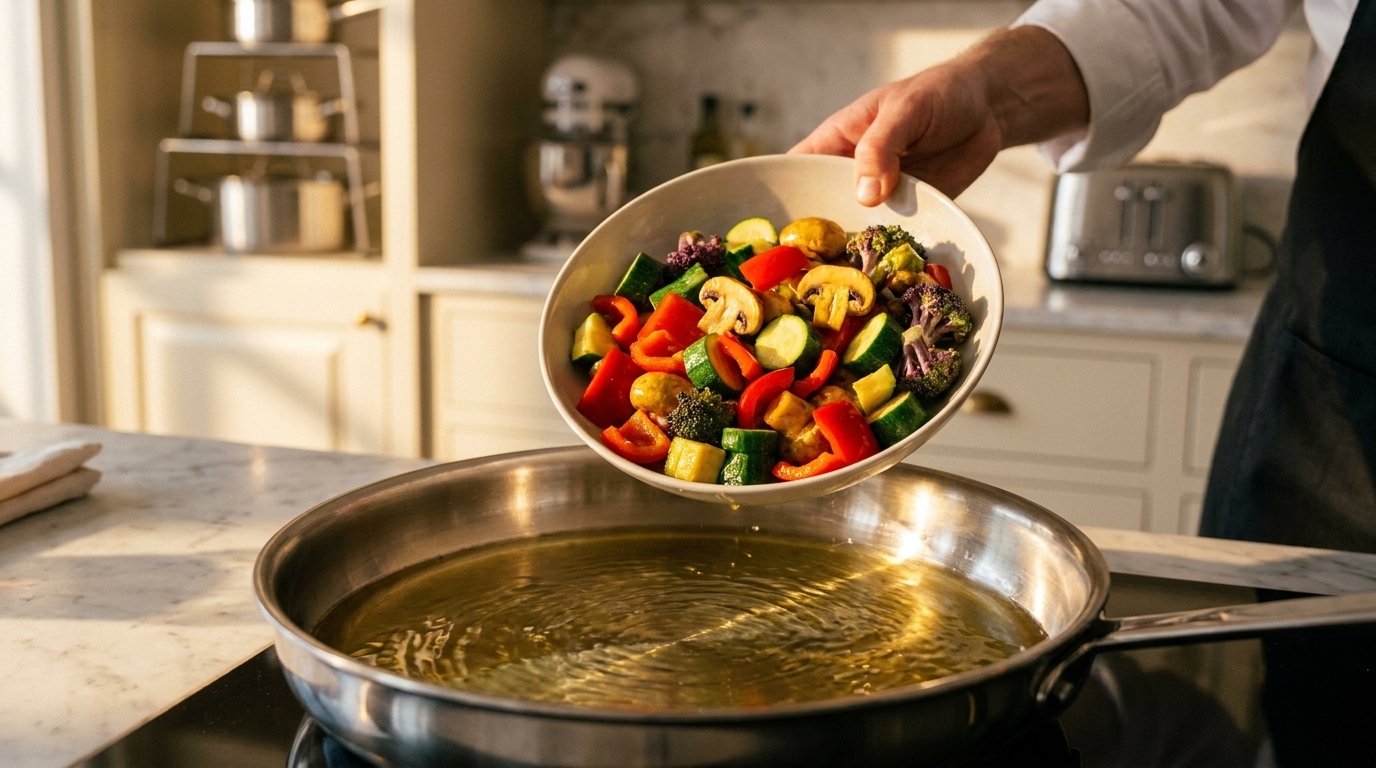
Soggy sautéed vegetables result from moisture pooling in the pan, which you can prevent by using the right cookware, proper heat, and technique. Keep vegetables bright and firm by patting them dry, using high heat with minimal oil, and letting them sit undisturbed long enough to brown rather than steam.
What Makes Sautéed Vegetables Soggy (And How to Prevent It)
Stainless steel and cast iron pans hold enough heat to evaporate moisture rather than let it pool, keeping your vegetables firm and bright instead of soggy.
The moisture problem: Why vegetables release water during cooking
Every vegetable is built from plant cells, each containing a water-filled compartment called a vacuole -- this internal pressure is what makes raw vegetables firm and crisp [1]. When heat breaks down the cell wall structure, particularly the pectin that holds those walls together, that stored water escapes into the pan [1].
The liquid pools faster than it can evaporate, which drops the pan's surface temperature and shifts the cooking environment from searing to steaming -- exactly how sautéed vegetables turn soft and dull instead of staying firm and bright. Managing this moisture release is the core problem every technique in this article is designed to solve.
How pan choice and heat control determine texture outcomes
Pan material and size work together to determine whether sautéed vegetables sear or steam. Stainless steel and cast iron hold heat well when cold food hits the cooking surface, keeping conditions consistent enough to evaporate released moisture rather than let it pool -- thin, lightweight pans lose temperature too quickly and develop uneven hot spots, both of which undermine searing [3].
Pan size matters equally: a 10-12 inch pan provides enough surface area to keep vegetables in a single layer, and overcrowding even a well-made pan will drop its temperature and undo the heat control you established during preheat [3]. Preheating until the oil shimmers -- but before it smokes -- signals that the pan has reached the dry, high-heat environment vegetables need to stay firm and bright [3].
The 5 Best Vegetables to Sauté and When to Add Them
Timing matters when sautéing vegetables--add dense ones first, then high-water varieties based on how quickly each releases moisture.
High-water vegetables: Bell peppers, zucchini, and mushrooms (timing matters)
Mushrooms, zucchini, and bell peppers all carry high water content, but each releases moisture at a different rate -- so their timing in the pan matters.
Mushrooms need 3-4 minutes of undisturbed contact with the hot surface before stirring; that uninterrupted time is what produces browning rather than steaming. [4] Zucchini releases water fast once heat is applied, and adding salt before a sear forms draws out excess moisture and turns it soft -- hold the salt until the last minute or two of cooking [5].
Bell peppers are slightly more forgiving and pair well with zucchini in a mixed sauté, as long as the pan stays uncrowded [6].
Dense vegetables: Broccoli, carrots, and asparagus (layer your cooking order)
Dense vegetables like broccoli, carrots, and asparagus take longer to cook than high-water vegetables, so they go into the pan first -- typically 2-3 minutes before softer additions [8]. Broccoli needs extra prep attention: stems cook slower than florets, so cut stems thinner to bring both to doneness at the same time [8].
Carrots work best sliced into thin rounds or batonnet-style strips -- thicker cuts won't soften fully in the short window a sauté allows [7]. Asparagus cooks faster than broccoli and carrots but still benefits from a 1-2 minute lead over zucchini or bell peppers, and its sugars caramelize quickly with direct pan contact [9].
The Secret to Perfectly Sautéed Vegetables: 4-Step Technique Essentials
Uniform cuts, dry surfaces, high heat, and uninterrupted pan contact are what transform steamed vegetables into browned, flavorful ones.
Step 1: Prep vegetables to uniform size and pat completely dry
Uniform size and dry surfaces are the two prep variables that most directly determine whether sautéed vegetables brown or steam. Cutting to consistent sizes means every piece cooks at the same rate -- pair a thick carrot chunk with a thin slice and one will be raw while the other overcooks [12].
After cutting, pat each piece dry with paper towels; surface moisture converts to steam on contact with hot fat, which drops pan temperature and stops browning before it starts [10]. For chopped or diced vegetables, this matters even more since smaller pieces have more exposed surface area and release moisture faster into the pan [11].
Step 2: Use high heat and the right amount of fat (not too much, not too little)
High heat is what separates sautéed vegetables from steamed ones -- the pan needs to be hot enough that oil shimmers and develops visible ripples before you add anything [13]. For a standard 12-inch pan, 1 to 2 tablespoons of oil coats the surface evenly without excess; too little creates hot spots that cause burning, while too much shifts cooking from searing to frying [13].
A neutral oil with a high smoke point -- avocado or canola -- handles the heat reliably, and a small amount of butter mixed in adds flavor without burning [14]. Cooking vegetables over low heat or in excess oil produces soft, dull results; use the minimum fat needed to prevent sticking and nothing more [13].
Step 3: Let vegetables sit undisturbed for 1-2 minutes before stirring
Giving sautéed vegetables uninterrupted contact with the pan is what triggers browning -- stirring too frequently prevents moisture from evaporating and disrupts the Maillard reaction before it produces color [15]. Undisturbed contact allows the surface to dehydrate while internal moisture migrates outward through the vegetable, and that dry surface is what browns rather than steams [15].
Aim for at least 30-60 seconds of still contact before stirring, and up to 1-2 minutes for denser vegetables like broccoli or snap peas; delicate pieces like zucchini need the shorter end of that range [16]. The practical cue to watch for: golden color appearing at the bottom edge of a piece means that side is ready to turn [16].
Step 4: Finish with acid and fresh herbs to brighten flavor
A small amount of acid added at the end -- lemon juice, wine vinegar, or a splash of dry white wine -- lifts the flavor of sautéed vegetables and cuts through the richness of cooking fat [18]. Citrus juice goes in after pulling the pan off heat, since high temperatures diminish its brightness; wine-based additions need about a minute over heat to cook off harsh alcohol notes first [17].
Fresh herb choice follows the same timing logic: hardy herbs like thyme and rosemary tolerate brief pan contact, while delicate herbs like parsley, basil, or cilantro go in off heat to preserve their color and aroma [19]. If you use basil or parsley often, the chiffonade technique maximizes surface area and releases more flavor than rough chopping [19].
Pan Type Matters: Choosing Cookware for Bright, Firm Vegetables
Stainless steel handles even heat and mixed sautés well, while carbon steel gives you faster temperature control for searing vegetables without burning delicate additions.
Nonstick pans: Best for delicate vegetables and minimal oil
Nonstick pans work well for delicate vegetables -- spinach, cherry tomatoes, and thin-sliced zucchini -- that cook quickly at medium heat and don't need a hard sear to develop flavor.
The coating reduces sticking without excess fat, so roughly 1 teaspoon of oil coats the surface adequately where other pan types might need more. [20] The main limitation is heat ceiling: nonstick coatings degrade at high temperatures, which makes these pans a poor fit for the aggressive browning that mushrooms or broccoli florets require. [20] Ceramic-coated nonstick options offer a PFAS-free surface that handles this medium-heat range without coating breakdown -- a practical choice if you regularly cook delicate vegetables with minimal oil and want easy cleanup without compromising surface integrity [21].
Stainless steel and carbon steel: Superior heat retention for high-heat searing
Stainless steel and carbon steel both handle the high heat sautéed vegetables need to brown, but they differ in responsiveness.
Stainless -- especially multi-ply pans with aluminum layers -- distributes heat evenly and holds temperature when cold food hits the surface, reliable for mixed sautés where you add ingredients in stages. [23] Carbon steel heats faster and responds to temperature changes more quickly, giving you tighter control when dropping heat immediately after a hard sear -- useful when adding garlic or delicate herbs without burning them. [22] Carbon steel requires initial seasoning and ongoing maintenance, while stainless steel is nonreactive to acids like wine or lemon juice and requires no seasoning -- making it the lower-maintenance option for most home cooks. [22]
- Heat breaks down cell walls and releases water; managing moisture escape prevents soggy vegetables.
- Stainless steel and cast iron pans hold heat better than thin pans, enabling proper searing.
- Pat vegetables dry and cut to uniform sizes so all pieces cook evenly and brown properly.
- Let vegetables sit undisturbed for 30-60 seconds before stirring to trigger browning, not steaming.
- High heat with minimal oil and proper pan size (10-12 inches) keeps sautéed vegetables firm.
- Add salt to zucchini only at the end; mushrooms need 3-4 minutes undisturbed for browning.
- Finish with acid and fresh herbs off heat to preserve brightness and flavor.
- https://foodcrumbles.com/vegetables-fruit-texture/
- https://parkcityculinaryinstitute.com/blog/how-to-avoid-burning-food-when-sauteing/
- https://www.dioro.com/blogs/news/sautee?srsltid=AfmBOoqkFp6mqfpE2U89ileh_SQxB_M2gws9h6YldISTVjuveoWebm2e
- https://www.rachelcooks.com/sauteed-mushrooms-with-garlic-butter/
- https://hiphipgourmet.com/sauteed-zucchini/
- https://shuangyskitchensink.com/zucchini-mushroom-stir-fry-gluten-free-vegan/
- https://thecarrotunderground.com/vegan-side-dishes/easy-vegan-sauteed-vegetables/
- https://learntocook.com/techniques/tips-for-the-perfect-stir-fry/
- https://simply-delicious-food.com/how-to-cook-vegetables-your-family-will-actually-eat/
- https://www.dioro.com/blogs/news/how-to-saute?srsltid=AfmBOoqlDFNQJ4hgs2CrFlhbDGY-sQdZesFxdHS0aEZWstYWrU2esfSG
- https://grokipedia.com/page/Saut%C3%A9ing
- https://www.thedailymeal.com/1364073/mistakes-avoid-roasting-vegetables/
- https://alittleandalot.com/perfect-sauteed-vegetables/
- https://sugargeekshow.com/how-to-saute/
- https://lifetips.alibaba.com/kitchen-hacks/saute-vegetables-to-tenderness-without-overcooking-them
- https://blog.chefitt.com/blog/how-to-cook-vegetables-perfectly
- https://www.dioro.com/blogs/news/sautee?srsltid=AfmBOoqhPrJiqQtCZBgaPJvE-SQrk8jcC8t-l3tE8AGUfNE67o-EuAPS
- https://reluctantgourmet.com/how-to-season-food/
- https://www.apurepalate.com/roasted-vegetables/
- https://shop.ttkprestige.com/blog/post/buying-guides/the-ultimate-guide-to-choosing-the-best-fry-pan?srsltid=AfmBOopwSmcgR21c5GXuuVWuHS2HcimVPPMKo_DnKIgSsu8kZQHcc-OZ
- https://www.bbcgoodfood.com/review/best-non-stick-frying-pans
- https://www.foodrepublic.com/2187461/carbon-steel-vs-stainless-steel-pan-cooking-difference/
- https://www.madeincookware.co.uk/blogs/care/carbon-steel-vs-stainless-steel-cookware-what-s-the-difference