

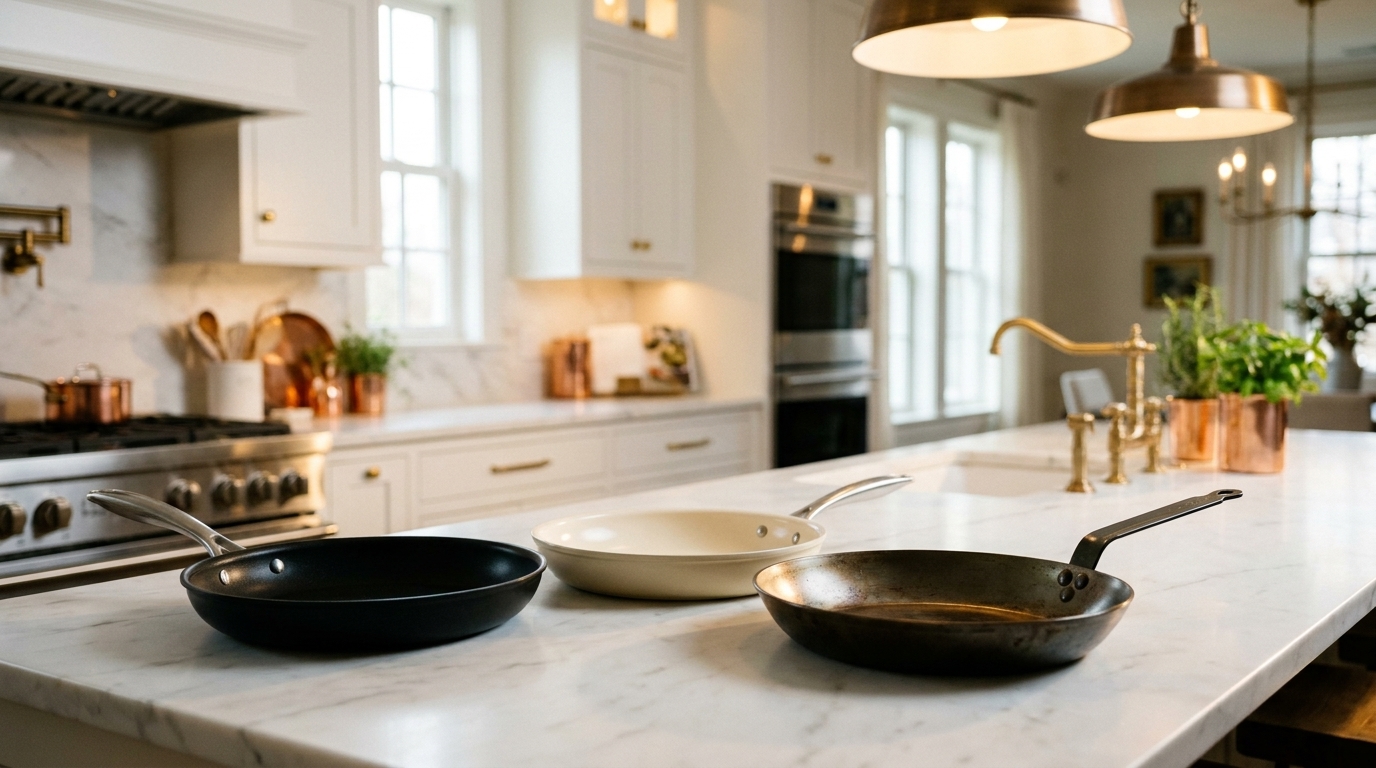
Understand how PTFE, ceramic, and carbon nonstick coatings compare in performance, safety, and lifespan to find the right pan for your kitchen. Nitrided carbon steel eliminates synthetic coatings entirely while delivering nonstick performance that improves with use rather than degrading over time.
Introduction
Nonstick coatings have evolved from PFOA-based formulas to ceramic alternatives, each carrying different safety tradeoffs that affect your choice of cookware.
The Evolution of Nonstick Frying Pans and Safety Concerns
Nonstick cookware traces back to 1938, when chemist Roy Plunkett accidentally discovered polytetrafluoroethylene (PTFE) while experimenting with refrigerant gases at DuPont.[1] PTFE-coated pans reached the market in the 1950s, and by the 1960s they were a household staple across the US and Europe.[1] Concerns about perfluorooctanoic acid (PFOA) -- a chemical used in PTFE manufacturing linked to cancer and developmental problems -- prompted the EPA to launch a phase-out program in 2006, and major manufacturers had eliminated PFOA from production by 2015.[1] Ceramic nonstick coatings followed as an alternative, but independent testing now suggests these "quasi-ceramic" surfaces may contain titanium dioxide, siloxanes, lead, and mercury -- raising a new set of safety questions for anyone searching for the best nonstick frying pan.[2]
Why Finding the Best Nonstick Frying Pan Matters for Home Cooks
Over 206 million nonstick units were sold in 2020, making it the most-used cookware category in home kitchens worldwide.[4] That volume reflects real utility -- nonstick pans handle delicate proteins, eggs, and low-fat cooking better than stainless or cast iron, which is why culinary professionals consistently list a nonstick skillet among the handful of pans every home cook actually needs.[4] But the choice of which pan to buy carries real health and performance stakes: most nonstick cookware lasts only one to five years, and a degraded or scratched coating can introduce unwanted compounds into your food.[4] With options ranging from PTFE to ceramic to coating-free materials like carbon steel, identifying the best nonstick frying pan for your kitchen means understanding what separates short-lived convenience from a surface that holds up over years of daily use.
The Emergence of Carbon Nonstick: A New Contender
Carbon nonstick -- specifically nitrided carbon steel -- represents a structurally different approach to the best nonstick frying pan problem.
Instead of bonding a chemical coating to the surface, the nitriding process diffuses nitrogen into the steel itself, hardening the metal and producing a naturally low-friction cooking surface with no separate layer to peel, scratch, or break down.[5] This means the pan handles high heat, metal utensils, and years of regular use without the degradation that limits PTFE and ceramic surfaces to a few years of useful life.[6] Newer nitrided versions, like our Carbon Nonstick(TM) Pan, arrive pretreated so they release food right out of the box -- no seasoning ritual required before the first cook.[5]

The Nonstick Landscape: Understanding Your Options
PTFE coatings degrade above 260 degreesC and release harmful particles, while ceramic pans often contain undisclosed additives, but carbon steel builds a stronger nonstick surface with every use.
Traditional PTFE Nonstick: How It Works and Safety Considerations
PTFE creates its nonstick surface through a long chain of carbon atoms each bonded to two fluorine atoms -- those strong carbon-fluorine bonds produce a coating that food can't chemically grip, leaving only weak van der Waals interactions at the surface. [7] The coating also repels oil and water, so liquids slide rather than absorb. [7] The primary concern isn't intact PTFE -- modern pans have been PFOA-free since 2012 -- but what happens when it degrades: the coating breaks down above 260 degreesC, releasing smaller PFAS molecules into food and air, and a 2022 study found that a single crack releases thousands of PTFE particles. [7] PTFE belongs to the broader PFAS family of "forever chemicals" that accumulate in body tissues including the brain, cardiac muscle, and kidneys. [8]
Ceramic Nonstick: A Safer Alternative or Clever Marketing?
"Ceramic nonstick" is largely a marketing label -- most pans sold under that name use a sol-gel coating, a silica-based spray applied to an aluminum substrate, not fired clay.[2] No legal definition of "ceramic" or "nontoxic" exists, giving manufacturers wide latitude in their claims.[2] Consumer Reports found no PFAS in two ceramic-coated pans it tested, a genuine advantage over PTFE -- but independent testing has detected titanium dioxide nanoparticles, siloxanes, lead, and mercury in popular brands like GreenPan, Caraway, and Always Pan.[9][2] As explored in our guide to ceramic coated vs bare ceramic durability, sol-gel coatings typically degrade within three years or less, sometimes much sooner.[10]
Carbon Steel Nonstick: Natural Properties Without Chemical Coatings
Carbon steel's nonstick properties build through polymerization -- as you cook with fat in the pan, oil molecules bond to the metal surface and harden into a protective layer that strengthens with every use.[11] Unlike coated pans, which start slippery and deteriorate from there, a carbon steel pan improves over time, provided you use the right oils and avoid extended contact with acidic ingredients like tomatoes or wine, which strip the seasoning.[12] The pan also transfers from stovetop to oven without temperature restrictions, tolerating heat levels that would degrade PTFE within minutes.[12] Pre-seasoned and nitrided versions reduce the initial learning curve by delivering a smoother base surface that releases food sooner, though some adjustment in technique is still expected during the first few weeks of use.[13]
Comparing Performance, Health Impact, and Durability Across Types
Across performance, health, and durability, the three nonstick types follow different trajectories.
PTFE delivers the slipperiest surface out of the box but carries unresolved PFAS health questions and degrades under heat; ceramic starts nearly as slick but fractures gradually through repeated heating and cooling cycles, typically lasting one to five years even with careful use. [14] Carbon steel starts with more friction than either coated option but improves over time and has no coating to break down -- making it the only option here without a defined end of life, which is one reason understanding how Carbon Nonstick(TM) compares to standard carbon steel helps clarify the decision. [14] Consumer Reports found ceramic-coated pans outscored traditional PTFE across overall testing, suggesting ceramic is the stronger choice among coated options -- but neither competes with carbon steel on longevity. [15]
Top-Rated Nonstick Frying Pans of 2025
Nitrided carbon steel pans earn their place through measurable performance, releasing eggs and proteins cleanly without chemical coatings.
Best Traditional Nonstick Frying Pans: Performance Champions
Among traditional PTFE nonstick pans, the Tramontina Professional Nonstick Fry Pan (10-inch) consistently tops independent testing: its thick cast aluminum body distributes heat evenly, the flared sides allow easy flipping, and it outperforms pans costing more than triple the price -- all for around $35. [6] Long-term owners report the PPG Eclipse coating still releases eggs cleanly after four or more years of regular use, making it one of the stronger values in this category. [6] For induction cooktops, the Tramontina Tri-Ply Nonstick Fry Pan's encapsulated steel base heats quickly and resists warping, with oven safety up to 450 degreesF -- though it's best kept off gas and electric-coil burners, where the base design can create hot spots. [6] When higher oven temperatures matter, the Cuisinart Chef's Classic Hard Anodized Nonstick Skillet handles up to 500 degreesF and uses a titanium-reinforced coating that performed well in cooking evenness tests. [16]
Leading Ceramic Nonstick Frying Pans: The Safety-Focused Options
Consumer Reports' most recent testing placed ceramic-coated pans in the top three overall slots, outscoring traditional PTFE options across every evaluated category. [15] The Caraway Ceramic-Coated Nonstick released eggs without resistance, heated evenly with no hot spots, and passed a 2,000-stroke steel wool durability test -- it's PTFE-free and induction-compatible, with oven safety up to 550 degreesF. [15] The OXO Ceramic Professional Non-Stick delivered excellent cooking evenness on a hard-anodized aluminum body, is oven-safe to 600 degreesF, and carries no PTFE in its coating. [15] For scratch resistance, the Le Creuset Essential Non-Stick Ceramic emerged as a top choice in independent testing -- eggs, crepes, and omelets lifted cleanly even after repeated contact with a metal spatula, and the coating showed no visible wear. [14]
Innovative Carbon Nonstick Frying Pans: The New Generation
Nitrided carbon steel pans earn their place through measurable performance, not just material claims: Bon Appétit testing found our Carbon Nonstick(TM) Pan released fried eggs, chicken thighs, and sautéed onions with minimal oil, with food director Chris Morocco describing it as "practically allergic" to eggs. [17] Serious Eats testing confirmed no visible damage after scraping with both a metal spatula and steel wool -- durability that ceramic and PTFE pans consistently failed in the same tests. [16] The pan is oven-safe to 1,100 degreesF, induction-compatible, and metal-utensil-safe, with a lifetime warranty that reflects its coating-free construction. [17] For a closer look at how it holds up through daily cooking, our 90-day real-world review of the Misen frying pan covers eggs, fish, and stir-fries across three months of use. [17]
Price-to-Performance Analysis: Where to Invest Your Money
Budget PTFE pans like the Tramontina Professional (~$35) have the lowest entry cost, and at a three-to-five-year lifespan, deliver a reasonable cost-per-year among coated options. [6] Ceramic pans cost more -- many top performers exceed $100, and splurge options climb higher still -- yet their lifespan is often shorter and less predictable, making the per-year cost worse despite Consumer Reports ranking them above PTFE overall in head-to-head testing. [15][15] Nitrided carbon nonstick carries a higher upfront price but has no coating to replace, which shifts the long-term math significantly: cooks who replace coated pans every two to three years will typically spend less over a decade with a single carbon nonstick pan that only improves with use. [6]
Carbon Nonstick Technology: A Deeper Dive
Nitriding creates a durable nonstick surface by diffusing nitrogen into the steel itself, making it resistant to scratching and rust in ways seasoning alone cannot match.
How Carbon Steel Creates a Natural Nonstick Surface
Carbon steel's nonstick surface forms through fat polymerization -- when cooking oil contacts hot metal, iron in the pan triggers the release of free radicals in the fat, which then crosslink to produce a tough, solid polymer that bonds directly to the metal surface. [18] This isn't grease accumulating on top of the pan; it's a structural transformation in the oil itself, turning liquid fat into a plastic-like coating that adheres at a microscopic level. [19] Oils high in polyunsaturated fatty acids -- particularly alpha-linolenic acid -- yield a harder, more durable polymer, which is why oil selection matters during the seasoning process. [18] Each cooking session deposits another micro-thin layer, which is why a carbon steel pan's food release improves with use rather than degrading. [20]
Nitriding Process: The Science Behind Modern Carbon Nonstick
Nitriding heats carbon steel in a furnace to approximately 800 degreesC (1,472 degreesF), at which point nitrogen atoms diffuse directly into the metal's surface rather than coating it. [13] This process -- technically called carbonitriding when both nitrogen and carbon atoms are involved -- closes microscopic pores in the steel, increasing hardness, corrosion resistance, and surface smoothness. [13] The resulting surface behaves similarly to hard-anodized aluminum: sticky foods release more easily, metal utensils won't scratch through to bare steel, and the pan resists rust even with more aggressive washing than traditional carbon steel tolerates. [21] Because the nitrided layer is structurally part of the metal rather than applied on top, it doesn't strip away under acid or abrasion the way a seasoned surface can. [22]
Misen, OXO, and Other Leading Carbon Nonstick Frying Pans
Among tested carbon nonstick pans, the OXO Obsidian Pre-Seasoned Carbon Steel Frypan earned top marks from multiple independent testers for its out-of-the-box nonstick performance -- Wirecutter found it as slick as Teflon on first use, while Serious Eats called it the most nonstick pan they'd ever tested, including ceramic- and PTFE-coated options. [12][23] Bon Appétit's testing identified our Carbon Nonstick(TM) Pan as the only nitrided carbon steel pan with an oleophobic surface, meaning it behaved like a true nonstick from day one rather than relying on seasoning buildup over time. [12] The Merten & Storck Pre-Seasoned Carbon Steel Frypan rounds out the category as a solid budget pick -- slightly less slick at first but reaching comparable nonstick performance after two weeks of regular cooking, making it a practical entry point for cooks new to carbon steel. [23]
Health Benefits: Cooking Without Chemical Concerns
Carbon steel's health advantage is structural: the material is only iron and carbon, with no synthetic coating to degrade, off-gas, or migrate into food at any temperature. [25] Consumer Reports testing found uncoated pans like carbon steel are unlikely to contain any of the 96 PFAS compounds their lab screened for -- a stark contrast to PTFE-coated pans, which showed measurable PFOA even when labeled PFOA-free. [9] A scratched carbon steel pan releases nothing harmful because there's no fluoropolymer layer present -- the pan's composition doesn't change whether it's pristine or well-worn. [25] Serious Eats identifies carbon steel, stainless steel, and cast iron as the clearest options for cooks who want to avoid chemical coatings entirely, offering more certainty than ceramic pans, whose full ingredient lists remain difficult to verify due to trade secrecy. [24]


Choosing and Maintaining the Best Nonstick Frying Pan
Proper cooling and hand-washing with mild soap protect your pan's coating and prevent premature failure from thermal shock.
Matching Frying Pan Type to Your Cooking Style and Health Priorities
Your cooking habits determine which surface makes the most practical sense.
Cooks who primarily make eggs, fish fillets, pancakes, and other delicate proteins get the most from a coated nonstick surface -- these tasks require minimal oil and easy cleanup, which is where PTFE and ceramic pans excel. [6] If regular high-heat cooking is part of your routine -- searing proteins, stir-frying over high flames, or finishing dishes in a very hot oven -- coated pans aren't the right tool for those tasks; carbon steel handles all of them without degradation risk. [16] For cooks who want to reduce PFAS exposure altogether, carbon steel and cast iron are the clearest options -- neither contains synthetic coatings, and both improve functionally with use rather than degrading over time. [26]
Proper Heat Management: Temperature Limits by Nonstick Type
Each nonstick surface type has a different thermal limit that shapes which cooking tasks it can handle.
PTFE coatings start breaking down above 500 degreesF -- at that point, the polymer chains fragment and release chemical compounds, including gaseous PFAS, into the air, and an empty pan left on a hot burner accelerates that process significantly. [27] Ceramic-coated pans offer slightly higher heat tolerance and can handle occasional oven use at elevated temperatures, though they still degrade gradually under repeated thermal cycling. [28] Carbon steel, including nitrided versions, has no coating to break down and handles the full stovetop-to-broiler range without a practical upper temperature limit affecting the cooking surface. [29]
Cleaning and Care: Extending Your Frying Pan's Lifespan
The most common way coated pans fail prematurely comes down to cleaning habits more than actual cooking.
Always let the pan cool fully before washing -- running cold water over a hot pan causes thermal shock that warps the base and weakens the coating. [31] Hand-wash with warm water, mild dish soap, and a soft sponge; dishwasher heat and harsh detergents wear down nonstick coatings faster than cooking ever will. [31] For stubborn residue, work a paste of baking soda and water in with a non-abrasive sponge, then rinse thoroughly -- avoid steel wool or any abrasive pad, which scratches the surface and accelerates degradation. [31] When stacking pans in storage, place a cloth, paper towel, or pan protector between surfaces to prevent contact scratches that shorten coating life. [30]
When to Replace Your Nonstick Frying Pan: Signs It's Time
Four signs reliably indicate a coated nonstick pan has reached the end of its useful life: visible scratches or chips, dark discoloration across the cooking surface, food that sticks despite correct technique, and a manufacture date before 2015. Consumer Reports cookware testing lead Breann Chai recommends discarding any pan with chips or scratches immediately, since coating particles can flake directly into food during cooking. [33] A 2022 study confirmed that scratched PTFE-coated surfaces release thousands to millions of microplastic and nanoplastic particles. [34] Dark discoloration beyond ordinary buildup signals the coating is actively coming off, and persistent sticking confirms it has lost its function entirely -- at either point, replacement is the practical choice. [32]
Conclusion
The Best Nonstick Frying Pan for Different Cooking Needs


Conclusion
The best nonstick frying pan for different cooking needs
The right pan depends on what you cook most often.
For eggs, fish fillets, pancakes, and other delicate foods requiring minimal oil, a PTFE or ceramic-coated skillet delivers the least friction out of the box. [6] Induction cookers need a pan with a magnetic base -- either a bonded steel plate or an encapsulated bottom -- to heat properly. [6] Cooks who want to avoid synthetic coatings entirely have a clear path: carbon steel and cast iron both develop nonstick surfaces through seasoning, are induction-compatible, and can last a lifetime -- none of which is true of coated alternatives. [36]
Is carbon nonstick the future of safe, effective cookware?
Nitrided carbon steel represents a meaningful shift in what's possible without a synthetic coating.
Most carbon steel pans build nonstick performance gradually through seasoning over weeks of use, but nitrided versions close that gap at first use -- our Carbon Nonstick(TM) Pan was the only nitrided carbon steel Bon Appétit's test kitchen found to have a true oleophobic surface, behaving more like Teflon from day one than any other carbon steel they'd tested. [35] Pre-seasoned carbon steel pans more broadly are becoming more widely available at accessible price points, making coating-free cooking a practical option without the learning curve of traditional unseasoned carbon steel. [6] How much that matters depends on whether your priority is upfront ease or long-term performance without replacement. [36]
Final recommendations based on performance, safety, and value
The decision comes down to three scenarios.
Budget-focused cooks unconcerned about PFAS exposure will find real value in the Tramontina Professional Nonstick Fry Pan at around $35 -- long-term owners report the PPG Eclipse coating still releases eggs cleanly after four or more years of regular use. [6] Cooks who want a PTFE-free coated option are better served by ceramic pans like the OXO Ceramic Professional or Caraway, which outperformed traditional nonstick in Consumer Reports testing and handle oven temperatures up to 550-600 degreesF. [6] For cooks who want to eliminate synthetic coatings entirely, nitrided carbon steel offers durability neither coated option can match -- no coating means nothing to degrade, scratch, or replace. [35]
Making an informed investment in your kitchen's most-used pan
Nonstick cookware is the most-purchased cookware category globally, which makes the replacement cycle a real cost -- financially and in terms of what ends up in landfills. [6] Coated nonstick pans have a defined end of life: the surface degrades, performance drops, and at that point you replace them; carbon steel, including nitrided versions, has no coating to replace and improves with use rather than declining from it. [36] Our 10" + 12" Carbon Nonstick(TM) Pan Set is a practical starting point for cooks ready to make that shift -- and if you need help deciding which size or configuration fits your kitchen, contact us and we'll point you in the right direction.
Is Carbon Nonstick the Future of Safe, Effective Cookware?
Nitrided carbon steel addresses the two core limitations of coated nonstick -- PFAS exposure and a finite coating lifespan -- by eliminating the coating entirely, a structural advantage no ceramic or PTFE pan can replicate. [6] Pre-seasoned carbon steel pans are becoming more accessible, and nitrided versions aim to close the gap between coating-free and ready-to-use from day one, though independent testing shows results vary: some nitrided pans deliver true out-of-the-box nonstick performance, while others perform closer to standard carbon steel and require seasoning buildup over time. [6] Whether Carbon Nonstick(TM) becomes the default for home kitchens depends on how consistently manufacturers can deliver that first-use experience -- the underlying technology is sound, but execution still differs across brands. [6]
Final Recommendations Based on Performance, Safety, and Value
Budget-focused cooks get solid value from the Tramontina Professional Nonstick Fry Pan at around $35 -- long-term owners report the PPG Eclipse coating still releases eggs cleanly after four or more years of regular use. [6] Cooks who want a PTFE-free coated option are well served by ceramic: the Caraway and OXO Ceramic Professional both outscored traditional nonstick pans in Consumer Reports overall testing and are oven-safe to 550-600 degreesF. [15] For cooks who want to eliminate synthetic coatings entirely, nitrided carbon steel is the most durable option -- no coating means nothing to degrade, scratch, or replace, with a surface that improves with use rather than declining from it. [6]
Making an Informed Investment in Your Kitchen's Most-Used Pan
All nonstick coatings -- whether PTFE or ceramic -- are delicate and will eventually wear out, making the replacement cycle a real, recurring cost both financially and in terms of what ends up in landfills. [6] Even with proper care, the best PTFE pan typically gives you three to five years before degradation warrants replacement, and ceramic pans can lose their nonstick surface in as little as a few months of regular use. [6] Carbon steel has no coating to replace and only improves with use -- that structural difference changes the long-term cost math significantly compared to any coated alternative. [15] Our Carbon Nonstick(TM) Pan is a practical starting point for cooks ready to make that shift; if you need help deciding which size or configuration fits your kitchen, contact us and we'll point you in the right direction.
- PTFE and ceramic coatings degrade within 1-5 years; carbon steel has no coating to replace and improves with use.
- Nitrided carbon steel diffuses nitrogen into metal itself, creating a naturally nonstick surface without synthetic coatings or PFAS chemicals.
- PTFE breaks down above 500 degreesF releasing PFAS compounds; ceramic degrades through thermal cycling; carbon steel handles unlimited heat without degradation.
- Scratched PTFE pans release thousands of microplastic particles; carbon steel composition doesn't change when worn, eliminating coating-flake risk.
- Long-term cost favors carbon steel: coated pans replaced every 2-3 years typically cost more over a decade than one durable carbon steel pan.
- Consumer Reports ranked ceramic-coated pans above traditional PTFE overall, but neither matches carbon steel's durability or health profile.
- https://shangchui-cookware.com/history-nonstick-pans/
- https://www.theguardian.com/lifeandstyle/2025/jun/09/ceramic-nontoxic-cookware
- https://xtrema.com/blogs/blog/everything-you-need-to-know-about-nonstick-cookware?srsltid=AfmBOorg1h7gJUoa2gQKrHE4EotDVZmtKjwX1BM-6IKhFQVBu568LTLm
- https://www.goodmorningamerica.com/food/story/back-basics-pans-home-cook-76084971
- https://www.bonappetit.com/story/best-nonstick-pans?srsltid=AfmBOoo-VEL-plcnGsDHbVjYwI3YtQBjrsWRPxG6rfZXZglcdZ91Zp1R
- https://www.nytimes.com/wirecutter/reviews/best-nonstick-pan/
- https://cen.acs.org/environment/persistent-pollutants/does-nonstick-cookware-work-should/103/web/2025/04
- https://www.aarp.org/home-living/pots-and-pans-safety-guide/
- https://www.consumerreports.org/toxic-chemicals-substances/you-cant-always-trust-claims-on-non-toxic-cookware-a4849321487/
- https://foodprint.org/blog/what-to-know-about-nonstick-cookware/
- https://brass-steel.com/blogs/tips-and-guides/carbon-steel-vs-nonstick?srsltid=AfmBOop3IiNqZFwCLXvhNpC1oDof9ZbsnM8stSclJC_yvZ8-A-NbpP3W
- https://www.seriouseats.com/best-carbon-steel-pans-7093873
- https://www.vietworldkitchen.com/blog/2025/12/nitrided-carbon-steel-nonstick-pans-review.html
- https://www.seriouseats.com/best-ceramic-cookware-8723380
- https://www.consumerreports.org/home-garden/cookware/best-nonstick-frying-pans-from-consumer-reports-tests-a1041724599/
- https://www.seriouseats.com/best-nonstick-skillets-6746059
- https://www.bonappetit.com/story/best-nonstick-pans?srsltid=AfmBOorZ2PeYodU1WU9m9Bux57xXWAGShxA6RLjCTU2WHIAfqzz-xoyA
- https://sherylcanter.com/wordpress/2010/01/a-science-based-technique-for-seasoning-cast-iron/
- https://www.seriouseats.com/how-to-season-carbon-steel-pans
- https://brass-steel.com/blogs/tips-and-guides/carbon-steel-vs-nonstick?srsltid=AfmBOoo_cBQ6wONYdghK9mtJcIU7BPeqf2aiZcq77AwVWaRwZZnr4ylt
- https://www.seriouseats.com/misen-carbon-nonstick-pan-review-11874480
- https://shopping.yahoo.com/home-garden/kitchen/article/best-carbon-steel-pan-185754140.html
- https://www.nytimes.com/wirecutter/reviews/best-carbon-steel-pan/
- https://www.seriouseats.com/best-non-toxic-cookware-7553352
- https://gastrotools.com/blogs/guides/are-carbon-steel-frying-pans-safe-to-cook-on
- https://www.theguardian.com/thefilter-us/2026/feb/21/best-non-toxic-pans
- https://www.foodandwine.com/nonstick-skillets-high-heat-11803742
- https://www.canada.ca/en/health-canada/services/household-products/safe-use-cookware.html
- https://www.kitchenmarks.com/cookware-material-matrix-how-to-choose/
- https://food52.com/story/25458-how-to-care-for-nonstick-pans
- https://www.bbcgoodfood.com/howto/guide/how-to-care-for-non-stick-cookware
- https://www.allrecipes.com/article/nonstick-cookware-safety/
- https://www.consumerreports.org/home-garden/cookware/make-your-nonstick-frying-pan-last-a1106078664/
- https://www.simplyrecipes.com/is-it-safe-to-use-scratched-nonstick-pans-7480071
- https://www.bonappetit.com/story/best-carbon-steel-pans?srsltid=AfmBOoogZRgKjiuLg9-dB5YRe905YMPj88QyEjRmaj7e2ckq3qb1nLRv
- https://www.americastestkitchen.com/articles/2299-which-type-of-nonstick-skillet-is-right-for-you