

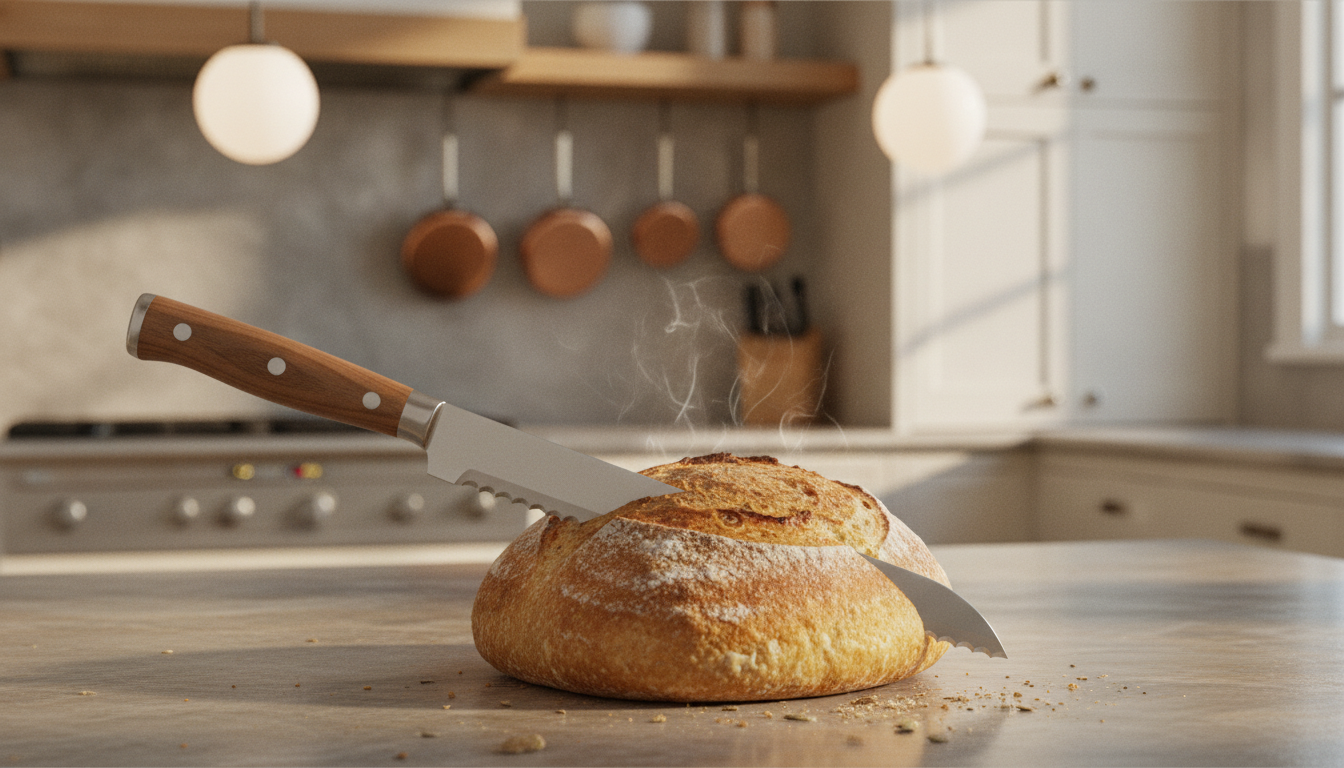
Learn why 58 HRC hardness makes bread knives hold their edge longer through crusty loaves compared to softer steel. A harder blade resists the constant wear of crust and seeds, reducing how often you need to sharpen while still remaining practical to maintain.
What Does HRC Mean and Why It Matters for Bread Knives
A blade's HRC rating between 58 and 62 determines how long its edge stays sharp before you need to sharpen it again.
HRC Hardness Scale Explained: The Rockwell Measurement Behind Every Blade
The knife hardness scale you'll see printed on blade specs is the Rockwell C scale, shortened to HRC or Rc [1]. The test presses a diamond-tipped cone into the steel, first with a light preload, then with a heavier load, and measures how far the tip sinks in [2]. A deeper penetration means softer steel, a shallower one means harder steel [2].
Hardened knife steels typically land between 58 and 62 HRC, with most everyday blades sitting closer to 58 to 60 HRC [1]. Manufacturers rarely publish one exact number because hardening isn't perfectly uniform across a blade, so specs usually list a range, like 56 to 58 HRC, with the real result falling somewhere near the middle [2]. A two-point spread looks small next to a 0-to-100 scale, but it can show up in how long an edge holds before it needs sharpening again [2].
Reading a hardness range tells you where a blade sits on the spectrum between edge retention and resistance to chipping, which matters more once you start comparing bread knives built for different cutting jobs.
How Steel Hardness Directly Affects Bread Slicing Performance and Edge Retention
Hardness controls how much resistance an edge has to rolling or deforming as it works through a crusty loaf, and that resistance translates directly into how many slices a blade delivers before it needs a touch-up [5]. A 2023 CATRA-style study on martensitic steels found that total cutting depth over repeated cycles depended on steel hardness combined with edge geometry, with harder blades sustaining higher cutting pressure at the tip across more cycles before dulling [4].
Softer steel yields at the microscopic level sooner, letting the apex round over rather than stay thin enough to shear through bread crust and crumb cleanly [5]. Higher hardness also means the tempered matrix resists plastic deformation and micro-chipping longer, so a 58 HRC edge holds its geometry through the abrasive contact of crust, seeds, and nuts that would quickly blunt a softer blade [5].
This matters more for serrated bread knives than for straight-edge blades, since each individual scallop tip is a small stress point that degrades faster if the steel underneath can't resist rolling [5]. The tradeoff is that pushing hardness too high raises brittleness risk, so bread knives are built in a range that favors edge stability over maximum wear resistance alone [5].
The Hardness Sweet Spot: Why 58 HRC Outperforms Softer Blades for Bread
A 58 HRC blade holds its edge roughly twice as long as softer steel, cutting crusty bread cleanly with far fewer sharpening sessions.
Comparing Soft Blades (52-56 HRC) vs. Hard Blades (58+ HRC) in Real Bread-Cutting TestsSoft steels in the 52-54 HRC range bend rather than break under stress, but that same softness means they're not simple to sharpen at home even with a whetstone [6]. Steels landing at 54-56 HRC, the range most French kitchen knives use, need regular honing with a steel rod to hold an edge, though they sharpen easily when the time comes [6]. Move up to 58-60 HRC and edge retention improves substantially.
Blades in this range, shared by quality pocket knives and some Japanese kitchen knives, hold sharpness for a noticeably longer stretch between touch-ups while still sharpening without much fuss [6]. One comparison put it in concrete terms: a knife at 60 HRC can stay sharp roughly twice as long as one at 55 HRC before it needs attention again [7]. That gap matters most on a crusty loaf, where the abrasive crust wears down a soft edge fast, forcing more frequent honing sessions just to keep cutting clean.
Harder steel resists that wear the way a brick wall resists chipping compared to a sandcastle, holding its geometry through repeated contact with crust and seeds instead of rolling over after a few loaves [7]. The tradeoff is that a 58+ HRC blade demands slightly more careful handling, but for bread work specifically, the extended edge life outweighs that added care.
Is 58 Rockwell Good for a Knife? What the Data Shows for Serrated Bread Blades
58 HRC lands squarely in the range manufacturers use for quality pocket knives and Japanese kitchen blades, where edges stay sharp substantially longer than softer 54-56 HRC steel while still sharpening without excess effort [8]. That answers the direct question: yes, 58 Rockwell is good for a knife, especially one built for repeated contact with crust and seeds. Real bread knives on the market back this up.
The Misono Molybdenum Steel Series Bread Knife tests at 57 HRc, the JCK Natures Blue Clouds BCA-6 comes in at 57-58 HRc, and the Kanetsugu Classic Hammered VG-10 pushes to 60-61 HRc using a San-Mai construction that sandwiches harder VG-10 steel between tougher outer layers [9]. That spread shows bread knives cluster near the 58 HRC mark rather than drifting toward the 60-64 HRC range common in single-bevel Japanese blades, which trade some edge stability for maximum wear resistance [8]. The reasoning holds for serrated geometry specifically: each scallop tip is a narrow stress point, and steel at 58 HRC resists rolling under repeated crust contact without the brittleness risk that climbs once hardness pushes past 62 [8].
Reviewers pairing these knives with crusty sourdough and baguettes note the harder blades hold a working edge across more loaves before needing a touch-up, which is the practical payoff of choosing 58 HRC over a softer 52-54 HRC alternative [9].
Common Hardness Misconceptions: What 50 HRC and Lower Really Means for Your Kitchen
A 50 HRC blade dulls faster against crusty bread because softer steel abrades more readily under both crust contact and sharpening stones.
What Does 50 HRC Mean and Why Softer Steel Fails on Crusty Loaves
A knife hardness scale reading of 50 HRC sits well below the 56-58 HRC range that bread knife makers treat as a baseline for lasting sharpness [11]. That gap explains why a 50 HRC blade struggles on crusty loaves: softer steel can't resist the kind of repeated contact that gradually reshapes an edge, whether from a hard cutting board, seeds and crust abrasion, or sideways stress while sawing through bread [10].
Mechanical wear turns sharp, V-shaped micro-edges into rounded U-shapes over time, and steel in the 50 HRC range succumbs to that reshaping faster than harder alloys do [10]. For a blade that spends most of its life pushing through dense artisan crusts, this means more frequent honing sessions just to keep slices from compressing or tearing [10]. 50 HRC isn't a defective number on its own -- plenty of everyday kitchen knives sit near there without issue -- but it's a mismatch for bread knife duty specifically, where crust abrasion is constant and the edge geometry needs to hold its shape without daily upkeep [11].
That's part of why quality bread knives generally skip steel this soft, favoring a higher HRC window that trades a bit of sharpening ease for an edge that survives more loaves between touch-ups [11].
The Trade-Off Trap: Why 'Easier to Sharpen' Doesn't Mean Better for Bread Knives
Easier to sharpen sounds like a win, but it trades away the one thing a bread knife needs most: an edge that survives repeated contact with crust. Softer steel abrades faster under a stone, which is exactly why it also abrades faster against a crusty loaf, since sharpening and dulling both come down to how readily the steel gives up material [3]. Toughness and edge retention pull in opposite directions, and pushing hardness down to gain sharpening ease means sacrificing the wear resistance that keeps a serrated edge intact through dozens of loaves [3].
Harder steel above roughly 60 HRC also supports a thinner edge angle without rolling, and that geometry advantage compounds the retention gain instead of just adding to it [12]. A knife that needs touch-ups every few weeks isn't saving effort overall; it's trading fewer minutes per sharpening session for far more sessions across a year of baking. The steels chosen for quality bread knives land at 58 HRC or above for this reason, accepting a slightly harder sharpening job in exchange for an edge that holds its scalloped geometry through crust, seeds, and repeated sawing motions [12].
Treating sharpening ease as the deciding factor ignores that the softer blade will be back on the stone far sooner, often before the harder blade needs anything beyond a quick honing pass.


Choosing and Maintaining a 58 HRC Bread Knife: The Misen Maintenance Advantage
Hand washing and proper storage protect your 58 HRC bread knife's hardness and edge retention far better than dishwasher cycles.
How to Select a Bread Knife with the Right Hardness for Your Baking Style
Matching a bread knife to your baking style starts with checking the hardness rating alongside blade length and serration pattern. Steel landing at 55-58 HRC, the range typical of 440A stainless blades, trades some edge retention for easier at-home sharpening and strong rust resistance [13]. That balance suits bakers who mostly cut soft sandwich loaves or occasional store-bought bread, since the softer edge won't struggle against thin crusts and quick touch-ups matter more than maximum wear resistance [13]. Bakers working with dense sourdough boules or crusty baguettes on a regular basis benefit from a blade closer to 58-60 HRC, since quality manufacturing specs for serrated blades commonly target the 56-60 HRC window for consistent edge retention [14]. Our serrated knife is designed for this kind of work, built to help hold a scalloped edge through repeated crusty loaves with proper care. Blade length should scale with loaf size, with 8-10 inches covering most home ovens and the upper end of that range handling large artisan rounds without excessive sawing [14]. Serration style adds another layer: pointed serrations bite into tough crusts, wavy edges stay gentler on soft pastries and delicate crumb, and double-serrated patterns split the difference for anyone slicing a mix of bread styles [15].
Quick match by baking habit:
- Occasional sandwich loaves: 55-58 HRC, easy sharpening [13]
- Daily crusty sourdough or baguettes: 58 HRC or higher [14]
- Blade length: 8-10 inches for most home loaves [14]
- Crust type: pointed serrations for tough crusts, wavy for soft bakes [15]
Hardness-Appropriate Care: Keeping Your High-HRC Blade Sharp and Durable Long-Term
Caring for a 58+ HRC bread knife means matching maintenance to the steel's hardness profile rather than treating it like a softer utility blade. Dishwasher heat can gradually alter the temper of high-carbon steel across hundreds of cycles, nudging hardness downward and softening the edge over time [16]. Hand washing with warm water and a soft sponge, then drying the blade immediately, prevents pitting corrosion that weakens serrations at a microscopic level [16][17]. Cutting surface matters too: wood or soft plastic boards preserve the edge, while marble, glass, or steel surfaces will damage a hardened edge regardless of the steel's rating [16]. Serrated blades also need less frequent sharpening than straight edges, since the pointed teeth absorb most of the contact with the cutting board and protect the scallops between them [18]. When an edge does need attention, a tapered serrated sharpener reaches into the scalloped gullets in a way a flat whetstone can't [18]. If sharpening serrations isn't your thing, our mail-in knife sharpening service can handle the job and send your blade back ready to slice.
Care checklist for high-hardness blades:
- Hand wash and dry immediately; skip the dishwasher [16]
- Use wood or soft plastic cutting boards only [16]
- Store in a block, on a magnetic strip, or in a sheath [17]
- Sharpen with a tapered serrated tool, not a flat stone [18]
Choosing the right bread knife comes down to matching steel hardness to how you bake. A blade at 58 HRC or above is built to hold its scalloped edge through crusty loaf after crusty loaf, and with proper care it can stay that way for a long time. Keep it off glass and out of the dishwasher, dry it after every wash, and it should keep slicing cleanly for a long time. Have questions about hardness, care, or sharpening? Contact us -- we're happy to help.
- 58 HRC hardness holds a bread knife's edge twice as long as softer 55 HRC steel between sharpenings.
- Serrated bread knives at 58 HRC resist the abrasive wear of crust and seeds without brittleness risk.
- Softer blades below 56 HRC need frequent honing because the same softness that makes sharpening easy causes faster dulling.
- Hand washing and wood cutting boards preserve a 58+ HRC blade's hardness; dishwashers and glass surfaces degrade the edge.
- Match blade hardness to your baking: 55-58 HRC for occasional soft loaves, 58+ HRC for daily crusty sourdough and baguettes.
- Tapered serrated sharpeners reach the scalloped gullets that flat whetstones cannot, or use a mail-in sharpening service.
- https://www.hudsontoolsteel.com/technical-data/knifesteelbasics
- https://agrussell.com/steel-articles/rockwell
- https://knifesteelnerds.com/2021/10/19/knife-steels-rated-by-a-metallurgist-toughness-edge-retention-and-corrosion-resistance/
- https://pmc.ncbi.nlm.nih.gov/articles/PMC10420138/
- https://yakushiknives.com/pages/knife-edge-retention-in-technical-detail?srsltid=AfmBOorAXdUxKi9YCPQ7HlZcDNKQi4b2_wTCSkX4Dd92UZi5ZyrDg9M4
- https://sharpedgeshop.com/blogs/knives-101/hardness-of-steel-according-to-the-rockwell-scale-hrc?srsltid=AfmBOor83hnkBmgyZWh9emo-Yg1HbBjZiqbfNrGf0v_7x_Ecf6epybTt
- https://zhangxiaoquan.au/blogs/key-factors-affecting-knife-performance/what-is-knife-hardness-how-hardness-affects-your-kitchen-knife-performance?srsltid=AfmBOooh4uePk0FCuhAT0nqJYYxmBUG5oKIh9RuvN4K6Lp5yY8ml5SQ_
- https://sharpedgeshop.com/blogs/knives-101/hardness-of-steel-according-to-the-rockwell-scale-hrc?srsltid=AfmBOor5RjKeGnGWeOq89RxfSiT6J6vI9zi3tUuZ0L0R9a05Mt3Nx58C
- https://japanesechefsknife.com/blogs/news/best-bread-knives-tested-reviewed-compared?srsltid=AfmBOooGE4qtxqGmiM0pfWYBVEkmO6GY2WEo0JWCGgIZ4HRTv3B8v9Nx
- https://seidoknives.com/blogs/news/how-to-sharpen-serrated-bread-knives?srsltid=AfmBOoqiS6RLy2myLtR6VBciK4MVpBhuNh_r9_dzwPmApirYvNoVOWUR
- https://m.joybuy.nl/blog/best-bread-knife-guide/ValD9gMJ
- https://blog.knife-depot.com/knife-steel-hardness-rockwell-scale-explained-simply/
- https://www.mymortuarycooler.com/blogs/news/the-complete-guide-to-comparing-440a-ss-bread-knives?srsltid=AfmBOorgYEBwAo3RivsDo2RdUKQKdgHKZ7Egh6VLx641xiJSu8eARAh6
- https://www.saafiknife.com/the-ultimate-bread-knife-guide-for-first-time-buyers.html
- https://kotaikitchen.com/blogs/more-about-knives/the-bread-knife-more-versatile-than-it-seems?srsltid=AfmBOor63S3_YKpqrZKZ7tRArW5RuZ1yWkfbpU1ZkGWD5CrxW_AnGyy7
- https://www.klausmeyerknife.com/blogs/know-your-knife/what-hrc-range-is-best-for-maintaining-the-sharpness-of-a-serrated-edge?srsltid=AfmBOorrIlaoemgptZelnj8fayNJFLa0Ejna4969JzSp81BjGDu1BOke
- https://kotaikitchen.com/blogs/more-about-knives/the-bread-knife-more-versatile-than-it-seems?srsltid=AfmBOopkMZ1g-q0fUQjpSQWSMwSx3FCLfecS761_Nf1R_j-w6iXKxXxT
- https://dalstrong.ca/blogs/news/what-is-a-serrated-knife-and-what-is-it-used-for?srsltid=AfmBOooVTGzgG-Nu-3aGxea5m7ht7ElJOygO0gKN-ULYY_A5em0ZIUK7
- Summary
- What Does HRC Mean and Why It Matters for Bread Knives
- The Hardness Sweet Spot: Why 58 HRC Outperforms Softer Blades for Bread
- Common Hardness Misconceptions: What 50 HRC and Lower Really Means for Your Kitchen
- Choosing and Maintaining a 58 HRC Bread Knife: The Misen Maintenance Advantage
- Key Takeaways
- References