

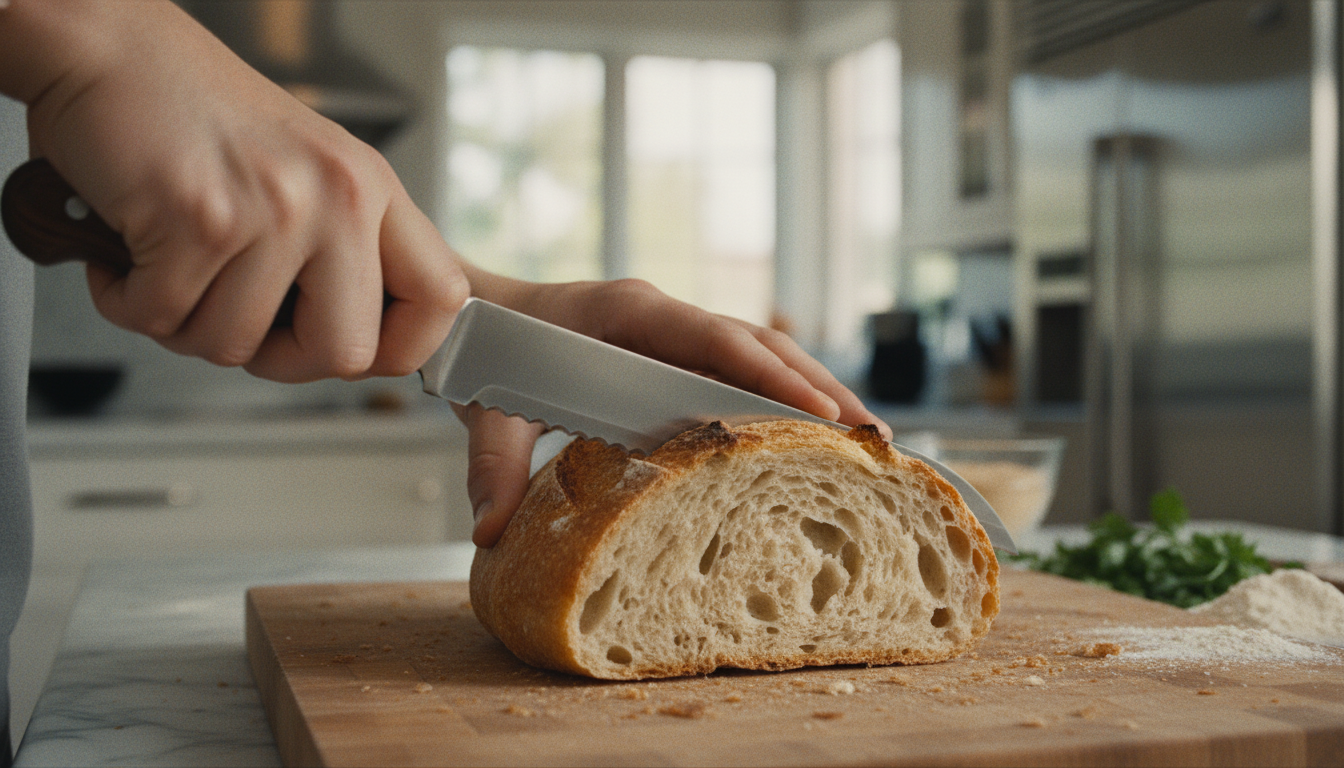
Wavy serrations and steel hardness between 55-60 HRC let you slice through crusty sourdough cleanly without crushing the crumb. Pair the right blade geometry with simple care--hand-washing, drying between teeth, and dedicated storage--to keep your knife sharp for months of perfect slices.
Why Serrated Teeth Matter More Than Blade Length for Sourdough
Wavy, rounded scallops glide through crusty sourdough and delicate foods without tearing, while pointy teeth tend to snag and compress the loaf.
How serration geometry grips and saws through hard crusts without crushing the crumb
A serrated bread knife works like a small saw: pointed teeth bite into the crust first, and the scalloped valleys behind them do the actual cutting with almost no downward pressure [1]. That matters for crusty sourdough crust, since a straight edge needs enough force to crush through the exterior before reaching the crumb, and that force flattens the soft interior in the process [2]. Most bread knives use an asymmetrical grind: one face carries visible angled bevels behind each tooth, while the opposite face stays flat [1].
The beveled side does the cutting as you saw back and forth; the flat side rides along the loaf and keeps the blade tracking straight instead of drifting off course [1]. This geometry also protects the edge over time. Because the teeth sit recessed from the knife's true cutting edge, only the tips touch the cutting board on contact, while the curves where the actual slicing happens stay shielded from wear [1].
The result is less pressure needed per stroke, a crust that shears cleanly instead of compressing, and a crumb that stays intact through repeated slices [2].
Comparing tooth patterns: Why wavy serration outperforms pointed teeth on crusty loaves
Serration shape falls on a scale from sharp, pointed teeth to broad, wavy scallops, and testers who compared both styles on crusty sourdough found that pointier teeth weren't the better crust-cutters they appeared to be [3]. Deep, closely-packed points tended to snag on tough exteriors, needing more sawing force and scattering crumbs across the board, while also squashing loaves down instead of cutting cleanly through them [3].
Wavy, rounded scallops worked differently: the curves let a sharpened bevel flow continuously along the whole edge, so the knife glided through hard crust and delicate tomato skin without the tearing that pointed teeth caused [3]. Separate testing on 35 knives reached a similar conclusion, noting that teeth which were too pointy risked snagging and tearing on bread interiors, while scalloped edges depended more on overall edge sharpness to ease into a loaf rather than relying on aggressive points to bite in first [4].
That distinction matters most on sourdough specifically, since its exterior is harder and less forgiving than a sandwich loaf's, so a serration pattern that's too aggressive fights the crust instead of shearing through it [3]. Moderately shallow serrations with rounded points struck the best balance in practice: sharp enough between the teeth to bite into crust, but not so deep that they ripped the surface apart [3].

Steel Hardness and Edge Retention: The 55-60 HRC Sweet Spot for Bread Knives
A bread knife between 55 and 60 HRC balances edge retention with durability, so it won't dull quickly on crusty sourdough.
What hardness scale means for sourdough cutting and how soft steel dulls faster on thick crusts
HRC (Rockwell C) measures how deep a diamond cone sinks into a blade under load, and a shallower dent means a harder, more wear-resistant edge [5]. Kitchen knives generally test between 50 and 65+ HRC, with most consumer blades landing in the 52-62 range, and that spread matters directly for a bread knife for crusty sourdough crust because a hard, dense crust wears down a soft edge the same way sandpaper wears down a dull chisel [5].
Steels below roughly 56 HRC are tough and resist chipping, but they lose their edge quickly and need frequent honing to stay effective on abrasive surfaces like a baked, blistered crust [6]. That's a real trade-off: a 52-54 HRC blade bends rather than snaps under stress, which sounds forgiving, but its structure isn't built to hold a fine edge through repeated sawing on thick, hard exteriors, so it dulls faster and feels rougher on the crust with every subsequent loaf [6].
Steels in the high 50s to low 60s strike a better balance for daily sourdough slicing, since they resist that gradual edge rounding without becoming so hard they turn brittle against a firm crust [5]. The practical takeaway is that a bread knife softer than the mid-50s HRC range will need touch-ups more often specifically because thick, crusty sourdough exteriors are harder on an edge than a soft sandwich loaf.
Stainless vs carbon steel trade-offs when slicing acidic fermented dough daily
Sourdough's fermentation produces lactic and acetic acid, and daily contact with an acidic crust pushes carbon steel toward its main weakness: reactivity with acid causes pitting and rust, and care guidance for carbon blades explicitly says to avoid acidic ingredients and apply oil after use [8]. That same trade-off shows up across steel comparisons generally--carbon steel is harder, sharper, and holds an edge longer, but it corrodes on contact with acidic foods like lemon or apple unless dried and oiled after every use [9].
Stainless steel flips those trade-offs: it resists rust, stays hygienic with minimal upkeep, and sharpens easily, though it doesn't hold an edge quite as long as carbon steel [9]. For a bread knife handling sourdough daily, that difference matters more than it would for an occasional-use blade, since acid exposure compounds with every loaf instead of happening once in a while.
High-carbon stainless alloys split the difference: they're built to hold an edge while resisting corrosion in wet environments and around acidic residue, which is closer to what a daily sourdough routine demands than pure carbon steel [7]. Practically, a carbon steel bread knife rewards a cook willing to wipe the blade dry immediately after each slicing session and oil it periodically, trading a few extra seconds of care for a longer-lasting edge; a stainless blade trades some edge life for one less maintenance step, which fits a kitchen slicing sourdough every day without wanting a rust-prevention ritual attached to it [8].
Bread Knife Selection Essentials: 5 Specs That Determine Crust-Cutting Success
Blade length, tooth spacing, and handle shape each affect how cleanly your bread knife cuts through a sourdough crust.
Blade length, tooth spacing, and handle ergonomics ranked by impact on sourdough performance
Blade length, tooth spacing, and handle shape don't carry equal weight for sourdough. Length sets the ceiling: bread knives typically run 8 to 12 inches, and a blade that's too short forces multiple choppy strokes across a wide boule, dragging the crumb with each restart [10]. Tooth spacing, measured as teeth per inch, comes next: fewer teeth per inch means bigger gullets, and a bigger gullet clears crust debris faster so the blade glides instead of chattering across a hard exterior [11]. Handle ergonomics matter less for the cut itself but more for consistency over a whole loaf, since a secure grip keeps sawing pressure even instead of tilting the blade off-plane mid-slice [10]. Ranked by impact on sourdough performance specifically:
- Blade length: clears the loaf's full diameter in one pass
- Tooth spacing (TPI): bigger gullets shed crust debris, ease the saw
- Blade curve: raises the tip for knuckle clearance on final strokes
- Handle grip: keeps pressure even so the blade doesn't drift
A curved profile, which lifts the tip and sometimes the handle above the heel, adds a secondary benefit worth folding into the length decision: it clears knuckles on the last strokes of a cut and gives a clearer sightline down the loaf, which matters most on the wide, dense crust of a full sourdough boule [11]. None of these specs fixes a mismatch in the others, so a long blade with tight, closely-packed teeth still fights a hard crust if the gullets can't clear it fast enough [11].
Comparison table: How professional and home-cook bread knives stack up on key metrics
Specs vary widely between professional-grade and budget-friendly bread knives, and comparing them side by side clarifies which trade-offs actually affect sourdough slicing. Blade length and edge type differ the most across price points, while weight and serration depth explain most of the performance gaps testers reported [13]. The table below draws from independent testing data on models spanning entry-level to premium price tiers [13][12].
| Knife | Blade Length | Edge Type | Notable Trait |
|---|---|---|---|
| Tojiro F-737 | 9.88 in | Straight | Light, 39 serrations, narrow handle [13] |
| Dexter-Russell Basics 10-inch | 10 in | Straight | Taller blade adds slicing stability [13] |
| Tojiro F-687 | 10.5 in | Curved | Longest blade tested, wavy scallops [13] |
| Mac Professional 10.5-inch | 10.5 in | Curved | Thin, full-tang, glides with minimal force [13] |
| Full-tang double-serrated (9-inch) | 9 in | Double-serrated | More teeth reduce per-serration wear [13] |
Budget models like the Dexter-Russell trade a bit of precision for a sturdier blade that resists flex under pressure, while premium picks like the Tojiro F-687 and Mac Professional combine longer blades with curvature for leverage on wide boules [13]. Double-serrated designs spread wear across more teeth, so the edge stays functional longer even under daily acidic-crust contact [13]. None of these differences make a budget knife unusable for sourdough; they simply shift where the compromises land, between raw slicing precision and long-term edge durability. If you'd rather skip the spec-by-spec comparison, Misen's serrated knife covers the essentials--a long, curved blade with wavy scallops built for crusty loaves.


Maintenance Secrets That Keep Your Bread Knife Sharp for Months of Sourdough Slicing
Hand-wash and dry your bread knife immediately, then store it in a dedicated slot to protect the serrated edge from chipping between uses.
Why hand-washing and proper storage prevent premature dulling on serrated edges
Hand-washing preserves a serrated edge that a dishwasher cycle quickly ruins, since the heat and detergent inside the machine damage both blade and handle, and the tumbling motion knocks the knife against other utensils, chipping the exposed tips of the serration pattern [15]. Drying the blade right after washing matters just as much, since leftover moisture in the tight recesses between teeth encourages rust on carbon steel and can still cause spotting on stainless [14]. Storage carries the same weight as washing habits: tossing a bread knife loosely into a drawer lets it bump into other tools every time the drawer opens, and that repeated contact chips the delicate high points where the serration does its cutting [14][15]. A dedicated slot protects those points from contact altogether, which matters more for a serrated edge than a straight one since each damaged tooth changes how the whole blade tracks through a crust [15]. Good storage options include:
- A knife block with a slot sized to the blade
- A magnetic strip, keeping serrations from touching neighbors
- A blade guard or sheath inside a drawer
For sourdough specifically, where a hard crust already stresses the tips of every serration with each slice, careless storage that dulls blades over time adds chipping risk on top of the wear the crust itself causes, shortening the stretch of clean slices between sharpenings [15].
When to hone vs sharpen a bread knife and how to recognize when your blade needs professional attention
A serrated bread knife rarely needs routine honing, since honing realigns a straight edge that has rolled slightly, but the scalloped points on a serrated blade sit recessed and protected from that kind of everyday wear [18]. Sharpening only becomes necessary once those points visibly round off, and even then it's a specialized job: each serration has to be worked individually with a tapered ceramic or diamond rod matched to its groove, sharpened from the beveled side at roughly 13 to 17 degrees, then checked for a burr along the flat back [16][17]. A few signs point toward professional attention rather than a home fix:
- Bread tears or shreds instead of slicing cleanly [18]
- Serration points look visibly rounded or flattened [18]
- A home attempt leaves an uneven, inconsistent edge [16]
- The knife has been pulled through a standard electric sharpener [17]
Electric sharpeners built for straight blades grind down the serration pattern itself rather than restoring it, which is a common way home cooks accidentally ruin a bread knife trying to fix it [16][17]. A practical cost test helps decide what's worth it: if a knife costs three to four times more than a sharpening service charges, professional service is worth the price, since a quality serrated blade can typically be restored several times before the pattern wears too small to hold an edge [18]. Misen's mail-in knife sharpening works serrated edges tooth by tooth, so you can skip the guesswork of a home fix and get a blade back that slices clean. Cheap, grocery-store bread knives rarely clear that threshold, making replacement the simpler call once the serrations are gone [16].
The right bread knife comes down to matching a few things to your loaf: wavy serrations that shear crust without crushing crumb, steel in the high-50s to low-60s HRC range that holds its edge, and a blade long enough to clear a full boule in one pass. Pair that with a few simple care & maintenance tips--hand-washing, drying between the teeth, and a dedicated storage slot--and you'll keep clean slices coming for months. Got questions about keeping your knives sharp? Contact us, and explore Misen's collection of knives when you're ready to upgrade.
- Wavy, rounded serrations cut sourdough crust cleanly without crushing the crumb inside.
- Steel hardness between 55-60 HRC holds an edge through hard crusts without becoming brittle.
- A blade long enough to clear your loaf in one pass prevents dragging and crumb damage.
- Bigger gullets between teeth shed crust debris faster, letting the knife glide instead of chatter.
- Hand-washing, immediate drying between teeth, and dedicated storage protect serrations from chipping.
- Carbon steel holds a sharper edge longer but requires immediate drying to prevent rust from acid.
- Professional sharpening restores serrated edges tooth-by-tooth--electric sharpeners ruin the pattern.
- https://seidoknives.com/blogs/news/how-to-sharpen-serrated-bread-knives?srsltid=AfmBOorJagjkh7GF4SKimrHBsom7crdnQk9vBIPxwH9S1o9mxwmMcaRk
- https://skwarehome.com/blogs/knife-education/what-is-the-best-bread-knife-the-buyer-s-guide
- https://www.seriouseats.com/best-bread-serrated-knives-equipment-review
- https://www.bonappetit.com/story/best-bread-knives?srsltid=AfmBOorlcOArl2afAeJrlbSBKjM0IXltz1xUnU4JS-n149CHiRdAab72
- https://blog.knife-depot.com/knife-steel-hardness-rockwell-scale-explained-simply/
- https://sharpedgeshop.com/blogs/knives-101/hardness-of-steel-according-to-the-rockwell-scale-hrc?srsltid=AfmBOop3x_3DEJ3Sl9HMQ3wFlg2FoMjQmvVGPvAtN0_9wPzN3BbNiBzH
- https://www.saafiknife.com/best-bread-knife-for-sourdough-cut-through-thick-crusts-with-ease.html
- https://www.musashihamono.com/fr/collections/japanese-stainless-steel/products/bread-knife-molybdenum-polished-western-handle-300mm?srsltid=AfmBOopHHR4SQ4wOSOmzV-G5XLyzJ9wYavCglDGACKPSnAqR65nrGFw3
- https://kazsknifeonline.com.au/blogs/knife-knowledge-and-information-1/what-is-the-difference-of-knife-by-steel?srsltid=AfmBOoppysaRGu1FyGYHpvuMuxte_8g-SxBeXZb6UarGV7ndzv8rXY1i
- https://grokipedia.com/page/Bread_knife
- https://foodal.com/kitchen/knives-cutting-boards-kitchen-shears/things-that-cut/bread-knives-reviewed/
- https://www.bonappetit.com/story/best-bread-knives?srsltid=AfmBOorXrqsN_jxIm_diROKelwgkI1Jx-yf6iQ7ix3ZgQp1ThsEbMaS6
- https://www.epicurious.com/expert-advice/best-serrated-knife-article
- https://wickedhandy.net/kitchen-knife-care-and-maintenance/
- https://lifebymikeg.com/blogs/all/easy-guide-how-to-sharpen-a-serrated-bread-knife-at-home
- https://www.knivesandtools.com/en/ct/sharpening-a-bread-knife.htm
- https://tsprof.us/blogs/news/how-to-sharpen-bread-knife?srsltid=AfmBOoqP1eC9mQJHrH_hULL4akixfkEfyhFCW_NB9GT6vUpjg9ZpR-YZ
- https://seriouslyfastsharpening.com/can-you-sharpen-serrated-knives
- Summary
- Why Serrated Teeth Matter More Than Blade Length for Sourdough
- Steel Hardness and Edge Retention: The 55-60 HRC Sweet Spot for Bread Knives
- Bread Knife Selection Essentials: 5 Specs That Determine Crust-Cutting Success
- Maintenance Secrets That Keep Your Bread Knife Sharp for Months of Sourdough Slicing
- Key Takeaways
- References