

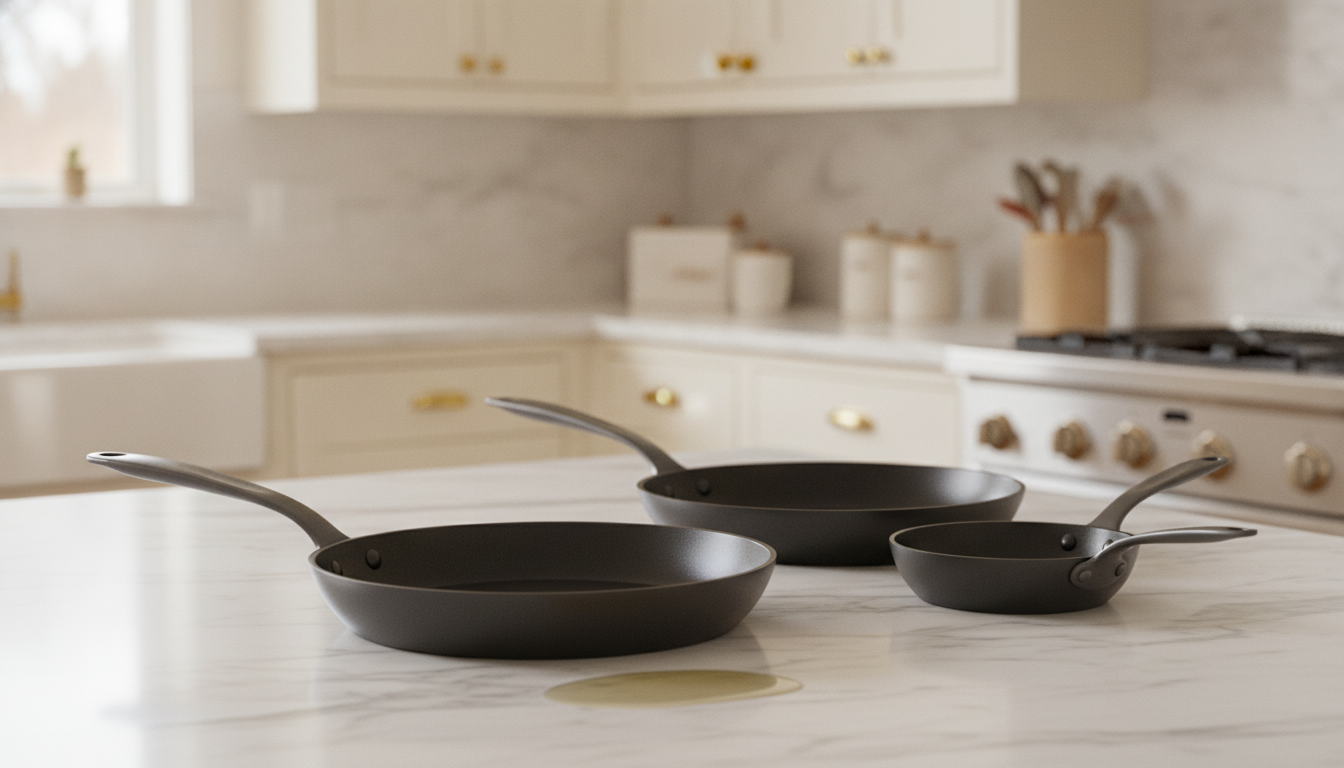
Choosing the right nitrided pan size--8, 10, or 12 inches--depends on your household size, cooking style, and stovetop setup rather than defaulting to what's already in your cabinet. Match the diameter to your actual portion sizes and cooking needs, then maintain consistent oiling and heat control to get reliable nonstick performance for years.
Why Pan Size Matters More Than You Think for Nitrided Carbon Steel
Matching pan diameter to your typical serving size prevents overcrowding that steams food and wasted energy heating unused steel.
How nitrided carbon steel responds differently to heat across sizes
The cooking surface area you actually need vs. what you think you need Most home cooks default to whatever pan is already in the cabinet, but matching diameter to portion size changes the outcome more than technique does. An 8-inch surface holds one or two eggs without crowding, while a 10-inch pan is the size most kitchens reach for daily since it balances surface area with easy handling on the stove [3].
Overcrowd a smaller pan and food steams instead of searing; oversize the pan for a light meal and you waste energy heating steel you don't need [4]. Before sizing up, ask how many servings you're actually cooking most nights, since that number, not the biggest pan available, should drive the decision [3].

The 8-Inch Nitrided Pan: Perfect for Single Servings and Precise Cooking
An 8-inch nitrided pan heats and cools fast enough to reward real-time flame adjustments, making it ideal for cooking eggs, fish, and sauces for one or two people.
Best uses: eggs, delicate proteins, and small-batch sauces
An 8-inch nitrided pan earns its space by handling small jobs well. One or two eggs cook evenly on this surface without the wide, cool margins that make heat management tricky on a bigger pan [5].
The reduced steel mass reacts fast to burner changes, which matters when a delicate protein like a fillet of fish needs a quick pull off high heat before it overcooks [5]. Small-batch pan sauces also benefit here since less surface area means less liquid gets lost to evaporation while you reduce a few tablespoons of wine or stock.
For anyone cooking mostly for one or two people, or finishing a single portion of eggs, scallops, or a quick sauce, the 8-inch size matches the job instead of asking a larger pan to work below capacity [5].
Why 8-inch nitrided pans heat faster and require different technique
Less steel mass means an 8-inch nitrided pan heats faster and cools faster than larger sizes, so burner adjustments show up in seconds rather than minutes. That speed rewards a hands-on approach: preheat over low to medium for a couple of minutes before adding oil, since jumping straight to high heat on a smaller pan can overshoot your target temperature fast [8].
Cold ingredients also matter more here, room-temperature food reduces the thermal shock that can warp thin steel and disrupt an early seasoning layer [8]. Because the pan reacts so quickly, staying near the stove and adjusting the flame in real time works better than setting a burner and walking away, which is the technique shift most cooks moving from cast iron need to make [7].
The 10-Inch Nitrided Pan: The Goldilocks Size for Most Home Cooks
A 10-inch nitrided pan gives you enough cooking space for two people without crowding, while staying light enough to handle with one hand.
Capacity, heat distribution, and stovetop compatibility explained
A 10-inch nitrided pan gives you enough surface area to sear two chicken breasts or a full omelet without crowding, while staying light enough to lift and swirl with one hand [1]. Misen's Pre-Seasoned 10" Carbon Steel Pan measures 10.8 inches across the cooking surface, which matters if you're feeding two to three people from one skillet [1].
Carbon steel's magnetic base makes this size fully compatible with gas, electric, and induction burners, since induction cooking requires a magnetic material to generate heat through the pan itself [9]. At 10 inches, heat still spreads unevenly compared to a clad stainless pan, but a heat-responsive aluminum core, like the one in Misen's Carbon Nonstick(TM) line, narrows that gap and keeps the center from outpacing the edges [10].
That balance of capacity, weight, and stovetop flexibility is why this size shows up most often in home kitchens.
Is carbon steel good for nonstick at this size? Real-world performance data
At 10 inches, nitrided carbon steel performs close to a coated nonstick pan but isn't identical to one. Independent testing found nitrided models needed only a quick wash before cooking, since the hardened surface skips the hour-long seasoning traditional carbon steel requires [11].
That head start fades with the first few weeks of use, and food can stick more than expected until a home cook adjusts preheat time and oil amount [11]. In blind egg tests, pre-seasoned 10-inch pans released over-easy eggs without issue, though testers noted nitrided coatings still need regular reseasoning once that initial slickness wears down [1].
A 10-inch surface also gives eggs room to spread without crowding into cooler edges, which reduces the sticking that shows up on undersized pans [12]. The takeaway: nitrided carbon steel earns real nonstick performance at this size, but only with consistent oiling and heat control, not as a set-and-forget coating.
The 12-Inch Nitrided Pan: Maximum Capacity and When You Actually Need It
A 12-inch nitrided pan needs generous oil and precise burner alignment to fry eggs evenly, since its larger surface amplifies heat inconsistencies.
Handling, storage, and burner compatibility for larger cookware
A 12-inch nitrided pan carries more steel than the 8- or 10-inch options, so lifting it one-handed while it's full of food gets harder, and a second hand on a helper handle or the pan's far edge helps control the tilt when plating [14]. Storage matters too: 12-inch skillets take up more cabinet depth, so a vertical pan organizer that slots pans sideways with handles facing out saves space compared to stacking [14].
Burner match matters more at this size than at 8 or 10 inches, since a 12-inch base needs to align closely with the heating element on gas, electric, or induction to avoid a hot center and cold edges [14]. On gas, keeping the flame within about half an inch of the pan's base edge avoids wasted heat and a handle that gets hotter than expected [14].
As a rough benchmark, a 12-inch pan built for even heat tends to land in the 3-pound range once it's full, which gives you a good sense of what one-handed handling feels like at this diameter [13].
Do eggs stick to carbon steel at 12-inch scale? Heat management differences
Eggs stick on a 12-inch carbon steel surface for the same reason they stick anywhere: uneven heat and insufficient oil, but the risk grows with diameter. Solid carbon steel conducts heat poorly and inconsistently even in well-made pans, and that variation shows up as cold spots near the edges, exactly where a spread-out egg white ends up on a 12-inch surface [15].
A nitrided finish, like the one on Misen's Carbon Nonstick(TM), ships with a slick factory seasoning that fries an egg cleanly at first, but that slickness fades with use and the pan starts behaving like traditional carbon steel underneath [15]. At that point, more oil matters more than usual.
Even well-seasoned carbon steel needs at least a tablespoon of oil or ghee for eggs, and skimping on fat at this larger scale, where heat is already less uniform, is the fastest way to end up with a stuck yolk instead of a clean release [12].


Size Comparison Chart: Which Nitrided Pan Fits Your Kitchen and Cooking Style
Pick your pan size based on household size and what you cook most, then protect the seasoning by avoiding acidic sauces, steel wool, and the dishwasher.
Decision table: household size, stovetop type, and primary dishes
Matching pan size to your kitchen comes down to three variables: household size, stovetop type, and the dishes you cook most. Carbon steel's magnetic base works across gas, electric, and induction burners, so stovetop type rarely rules out a size on its own [4]. Household size narrows the choice fastest, since portion count decides whether an 8-inch, 10-inch, or 12-inch surface gives food room to cook without crowding [17]. Use this quick reference to match your setup:
- 1 person, quick meals, eggs or small proteins: 8-inch [17]
- 2 people, daily cooking, fish or vegetables: 10-inch [16]
- 2-4 people, weeknight sautés or stir-fries: 10-inch [17]
- 4+ people, searing multiple portions or meal prep: 12-inch [16]
- Tight burner or cabinet space: stay with 10-inch [4]
Safety considerations and what you should not cook in each size
Acidic ingredients pose the same risk on every diameter: tomatoes, wine, and vinegar-based sauces strip a carbon steel pan's seasoning layer and dull its non-stick performance, so long-simmered sauces are better suited to a stainless steel pan [18]. That risk grows with surface area, since a 12-inch pan exposes more seasoning to acid at once than an 8-inch one, meaning restoring the coating afterward takes more oil and more passes over heat [18]. Abrasive scrubbing carries the same warning across sizes: steel wool can scratch the nitrided surface and remove seasoning, so a sponge and dish soap, followed by a full dry and light oil coat, protects the pan regardless of diameter [18]. Skimping on oil is the other consistent hazard, since any nitrided pan, from 8 to 12 inches, needs sufficient fat to prevent sticking and rust.
- Avoid: tomato sauce, wine reductions, vinegar-heavy braises
- Avoid: steel wool or metal scouring pads
- Avoid: dishwasher cycles on any size


How to Season and Maintain Your Nitrided Pan Regardless of Size
Nitrided pans ship ready to cook, but they need the same ongoing oil-based seasoning as traditional carbon steel once the factory finish wears down.
Nitrided vs. traditional seasoning: what makes nitrided pans differentNitriding differs from traditional seasoning at the chemical level. Traditional carbon steel builds nonstick performance through polymerization, where a thin layer of oil gets heated repeatedly until it bonds to the metal's surface, a process that typically takes three to five rounds of heating and oiling before the pan is ready to cook on [19].
Nitriding skips that buildup: manufacturers expose the raw steel to nitrogen at high heat, which hardens the surface and increases corrosion resistance without adding a separate coating on top of the metal [1]. Because nitrogen integrates directly into the steel rather than sitting on it, a nitrided pan like Misen's Carbon Nonstick(TM) ships ready to cook with, needing only a quick wash instead of hours of stovetop seasoning [20].
The tradeoff: nitriding hardens the surface, but it still needs the same ongoing oil-based seasoning as traditional carbon steel once that factory slickness wears down [1].
Misen's maintenance approach and why customer support matters for long-term ownership
Long-term carbon steel ownership comes with predictable questions: why seasoning looks spotty, what to do about rust, or how to fix stuck food after a well-seasoned pan suddenly starts sticking [21]. Clear, detailed troubleshooting, covering rust removal, reseasoning triggers, and storage between uses, saves you from guessing whether a scratched or uneven surface means the pan is ruined [22].
That kind of guidance matters most in the first few months, when seasoning still looks streaky or inconsistent and you need reassurance that the process, not a defect, is behind it [21]. We build our care & maintenance tips around those exact pain points, covering every nitrided size from 8 to 12 inches, so questions about oiling, storage, or reseasoning have a clear answer instead of a guess.
Match the diameter to how you actually cook, keep a light oil habit going, and the pan will reward you for years. If a question isn't covered, contact us directly rather than troubleshooting blind, and we'll help you get the most out of your pan.
Frequently Asked Questions
-
What size nitrided pan should I buy based on how many people I cook for?
The article's decision table ties pan size to household size: 8-inch for 1 person and quick meals, 10-inch for 2-4 people cooking daily meals or weeknight sautés, and 12-inch for 4+ people searing multiple portions or doing meal prep. If burner or cabinet space is tight, the article recommends sticking with the 10-inch size regardless of household count.
-
Do I need to season a nitrided carbon steel pan before cooking?
No — the article explains that nitriding hardens the steel's surface directly, so a nitrided pan like Misen's Carbon Nonstick ships ready to cook with after just a quick wash, unlike traditional carbon steel which needs three to five rounds of heating and oiling. That said, the factory slickness fades with use, and the pan still needs the same ongoing oil-based seasoning as traditional carbon steel once that initial ease wears off.
-
What foods or cleaning methods should I avoid with a nitrided pan?
The article warns against cooking tomato sauce, wine reductions, or vinegar-heavy braises in any size, since acidic ingredients strip the seasoning layer, and that risk grows with surface area — a 12-inch pan exposes more seasoning to acid at once than an 8-inch one. It also advises against steel wool, metal scouring pads, and dishwasher cycles on any size, recommending a sponge, dish soap, a full dry, and a light oil coat instead.
-
Is a 10-inch or 12-inch nitrided pan better for eggs without sticking?
The article notes a 10-inch surface gives eggs room to spread without crowding into cooler edges, which reduces sticking compared to undersized pans, and blind testing showed pre-seasoned 10-inch pans released over-easy eggs cleanly. At 12 inches, uneven heat and cold spots near the edges raise the risk of sticking as the factory slickness wears off, so the article recommends using at least a tablespoon of oil or ghee to compensate.
-
Will a nitrided pan work on my induction stove?
Yes — the article states that carbon steel's magnetic base makes it compatible with gas, electric, and induction burners across all three featured sizes, since induction cooking requires a magnetic material to generate heat through the pan. At 12 inches, though, it notes the pan's base needs to align closely with the heating element to avoid a hot center and cold edges.
- Match pan diameter to household size and portion count, not cabinet space or habit.
- 8-inch pans heat and cool fast, requiring close attention and quick burner adjustments.
- 10-inch is the most versatile size, balancing capacity, weight, and even heat distribution.
- 12-inch pans need precise burner alignment and more oil to prevent sticking on edges.
- Nitrided surfaces ship pre-seasoned but still require consistent oiling and maintenance like traditional carbon steel.
- Avoid acidic sauces, steel wool, and dishwashers on all sizes to preserve the seasoning layer.
- Cold ingredients and proper preheating prevent thermal shock and early seasoning damage on smaller pans.
- https://www.seriouseats.com/best-carbon-steel-pans-7093873
- https://www.cooksdirect.com/what-to-know-before-buying-a-carbon-steel-pan
- https://www.katom.com/learning-center/frying-pan-sizes.html
- https://www.all-clad.ca/en/blog/post/frying-pan-size-guide-how-to-pick-the-right-pan-for-your-cooking-needs
- https://cookerswar.com/carbon-steel-skillet/
- https://brass-steel.com/blogs/tips-and-guides/carbon-steel-pans-heat-faster-best-frying-pan-guide
- https://www.independentironware.com/blogs/articles/how-to-transition-from-cast-iron-to-carbon-steel-tips-for-cast-iron-lovers
- https://www.culinarydepotinc.com/blog/what-you-need-to-know-about-carbon-steel-frying-pans/
- https://www.kitchenaid.com/pinch-of-help/major-appliances/induction-compatible-cookware.html
- https://www.bonappetit.com/story/best-carbon-steel-pans
- https://www.vietworldkitchen.com/blog/2025/12/nitrided-carbon-steel-nonstick-pans-review.html
- https://www.nytimes.com/wirecutter/reviews/best-carbon-steel-pan/
- https://www.nytimes.com/wirecutter/reviews/the-best-skillet/
- https://www.solamexhome.com/your-pan-is-too-small-understanding-frying-pan-sizes-from-8-to-14-inches.html
- https://www.bonappetit.com/story/best-carbon-steel-pans
- https://www.everythingkitchens.com/blog/guide-to-cookware-shapes--sizes-types-of-pots-pans-and-their-uses.html
- https://stahlkitchens.com/blogs/news/the-ultimate-frying-pan-buying-guide
- https://www.yeti.com/carbon-steel-pan-faq.html
- https://www.debuyer-usa.com/blogs/guides/carbon-steel-vs-ceramic-pans-which-is-right-for-your-kitchen
- https://www.thekitchn.com/best-carbon-steel-pan-23788414
- https://matferbourgeatusa.com/education/black-steel-guide/
- https://www.madeincookware.co.uk/blogs/news/the-13-most-common-carbon-steel-faqs-explained
- Summary
- Why Pan Size Matters More Than You Think for Nitrided Carbon Steel
- The 8-Inch Nitrided Pan: Perfect for Single Servings and Precise Cooking
- The 10-Inch Nitrided Pan: The Goldilocks Size for Most Home Cooks
- The 12-Inch Nitrided Pan: Maximum Capacity and When You Actually Need It
- Size Comparison Chart: Which Nitrided Pan Fits Your Kitchen and Cooking Style
- How to Season and Maintain Your Nitrided Pan Regardless of Size
- Key Takeaways
- References