

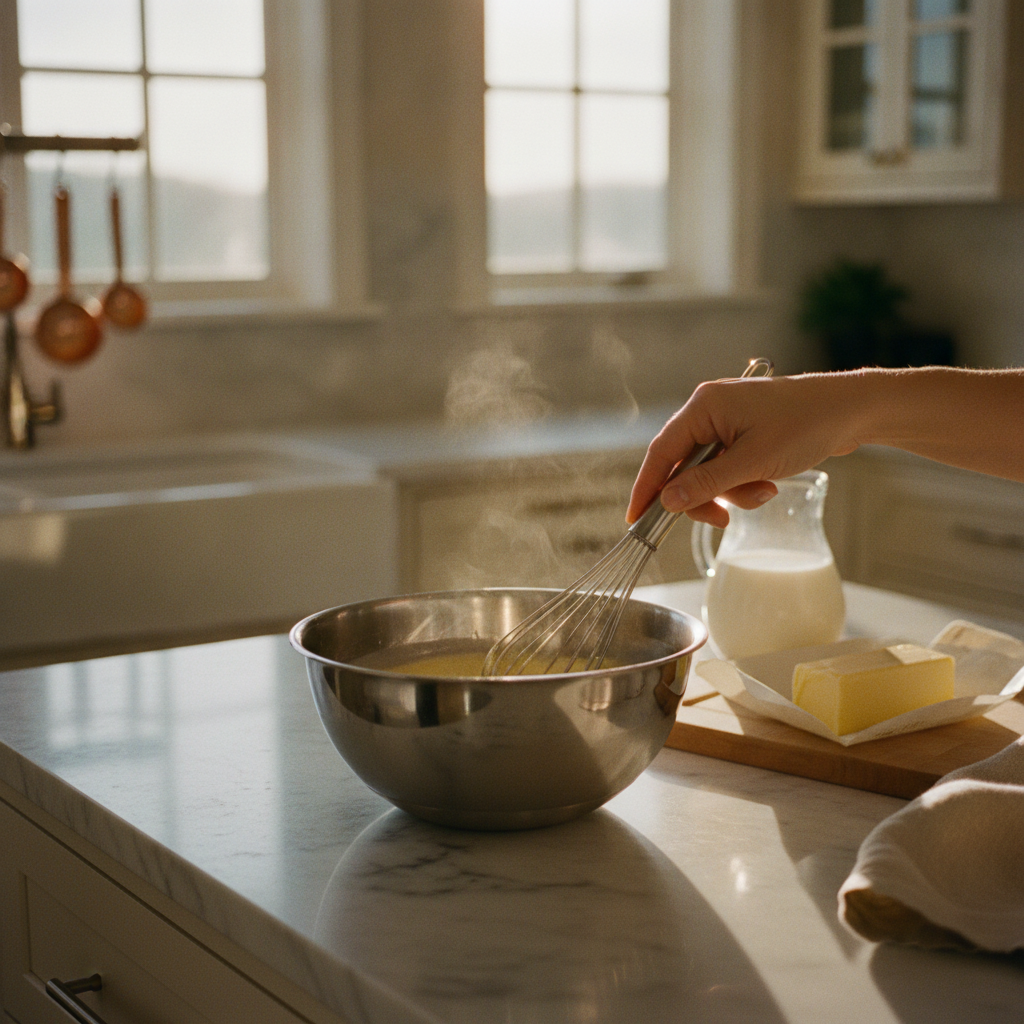
Learn how to make a milk and butter substitute that mimics heavy cream's fat content in just five minutes using a simple 3:1 ratio. This homemade version works reliably in sauces, soups, and baked goods, though it won't whip or froth like store-bought cream.
Why Heavy Cream Matters (And When You Can Make It at Home)
Heavy cream's high fat content stabilizes sauces and thickens without breaking, but homemade substitutes work best in scones, puddings, and ganache--skip them for whipped toppings.
What makes heavy cream different from milk: fat content and cooking behavior
Heavy cream and milk start from the same source, but the fat content sets them apart. Whole milk runs about 3.25% fat, while heavy cream must contain a minimum of 36% milkfat under U.S. standards [1].
That difference changes how each behaves on the stove: milk thins out sauces and can curdle when it hits acid or high heat, while heavy cream's fat coats proteins and stabilizes the mixture, letting it simmer, reduce, and thicken without breaking [1]. Fat also controls water content -- heavy cream sits around 57% water compared to milk's nearly 88%, which is why cream clings to a spoon and milk doesn't [1].
That same fat threshold is why heavy cream whips into stiff peaks: a minimum of roughly 30% fat is needed for the fat globules to trap air and hold their shape, something milk's fat percentage can't do on its own [1]. Understanding this fat gap is the starting point for any homemade substitute, since replicating heavy cream's cooking behavior means closing that fat and water gap, not just adding richness.
The 5-minute solution: When homemade heavy cream actually works in your kitchen
Homemade cream earns its place in recipes where cream adds richness and body, not structure. It performs well in scones, biscuits, cream pies, quiches, ganache, puddings, icings, glazes, and sauces like caramel or hot fudge, since the fat still coats proteins and thickens without curdling [3]. It's a fast fix when a soup or pasta sauce needs cream's richness but you're not building a delicate emulsion from scratch [3]. Skip the substitute for anything that needs whipping: mousse, whipped ganache frosting, and ice cream all rely on stabilizers this version doesn't have, so it won't trap air or hold peaks no matter how long you beat it [3]. For best results, reduce the substitute by about 25% by weight compared to the recipe's original cream amount, rather than swapping it in cup for cup [3].
- Works well: scones, biscuits, sauces, ganache, puddings, icings
- Skip it: whipped cream, mousse, ice cream, whipped toppings
- Adjust: use 25% less substitute by weight than the recipe calls for
This makes the swap a five-minute fix for recipes already underway, not a stand-in for every use of heavy cream [3].
The Milk + Butter Formula: Exact Ratios for Every Recipe Type
A 3:1 ratio of whole milk to melted butter creates a heavy cream substitute that scales up or down for any recipe you're making.
Standard ratio breakdown: 1 cup milk + 1/8 cup butter creates 36% fat substitute
The basic formula is simple: melt 1/4 cup (4 tablespoons) unsalted butter, cool it to room temperature, then whisk it into 3/4 cup whole milk [4]. That single cup of combined milk and butter stands in for 1 cup of store-bought heavy cream in most recipes [4]. The math behind it comes down to fat: whole milk carries about 8 grams of fat per cup, while a stick of butter packs 80 to 90 grams, so blending the two closes most of the gap between milk's roughly 3.25% fat and heavy cream's 36% minimum [2]. Some versions use a full stick of butter (1/2 cup) per cup of milk for an even richer result, so the exact ratio can flex depending on how much fat the recipe needs [2]. Either way, the technique stays the same:
- Melt butter, then cool to room temperature
- Whisk into whole milk until combined
- Use immediately or chill for later
Getting the butter to room temperature before whisking matters, since hot butter can cause the mixture to separate instead of blending smoothly [4].
Ratio Estimates: Input your recipe needs and get your custom measurement
Recipes rarely call for exactly one cup of cream, so scaling the base ratio matters more than memorizing a single measurement. The formula holds at roughly 3 parts whole milk to 1 part melted butter by volume, meaning 3/4 cup milk plus 1/4 cup butter always yields about 1 cup of substitute, and that same 3:1 split scales up or down for any quantity a recipe needs [5]. Because the substitute gets reduced by 25% by weight compared to store-bought cream, doubling a recipe means doubling both the milk-butter mix and that reduction math, not just the raw ratio. Context also shifts the numbers slightly: substitutes behave differently in baking, cooking, and sauces, so amounts that work for a pasta sauce may need small adjustments for a baked custard [6]. Weighing the mixture instead of measuring by volume keeps these conversions accurate, since the substitute stays frothy for a day or more after blending [5].
Use these common conversions as a starting point:
- 1/4 cup cream: 3 tbsp milk + 1 tbsp butter
- 1/2 cup cream: 6 tbsp milk + 2 tbsp butter
- 1 cup cream: 3/4 cup milk + 1/4 cup butter
- 2 cups cream: 1.5 cups milk + 1/2 cup butter
For odd amounts, like 1 1/3 cups, keep the same 3:1 milk-to-butter proportion and adjust both sides equally [5].
How to Make and Use Your Homemade Heavy Cream Substitute
Cool melted butter to room temperature before whisking with milk, then blend for 2 minutes to create a stable emulsion that won't separate.
Step-by-step technique: Melting, mixing, and cooling for best results
The technique itself is simple, but the order of operations affects whether the mixture stays smooth or separates. Melt the butter first and let it cool to room temperature before combining it with milk, since whisking in hot butter causes the fat to separate instead of blending [4]. Some methods heat the milk and butter together in a saucepan until the butter melts and the milk is hot, then let the mixture rest for 10 to 15 minutes until lukewarm [2]. From there, a quick whisk works for most recipes, but blending at high speed for about 2 minutes creates a frothy emulsion that resists separating once cooled [2]. Use it right away, or cover and refrigerate for later -- just expect the fat to rise and thicken slightly over a day or so, which a quick whisk or shake fixes before use [2].
- Melt butter, cool to room temperature
- Whisk or heat together with milk
- Rest 10-15 minutes if heated on stove
- Blend 2 minutes for a frothier, stable mix
- Whisk again before using if separated
What to watch for: When homemade cream works in sauces, soups, and baking--and when it doesn't
Homemade cream performs most reliably in sauces, soups, and savory dishes where fat adds body, not structure. It's ideal for Alfredo, gravies, mashed potatoes, scrambled eggs, and quiche, since the fat still coats proteins without breaking under heat [7]. Baking is less predictable -- cakes and cookies may need trial and error to nail the right texture, since the substitute lacks the native emulsifiers of true cream [7]. Acid and high heat remain the biggest failure points: uncontrolled heating or hot coffee (above roughly 160 degreesF) causes the mixture to curdle rather than blend smoothly [8]. For coffee specifically, this substitute only works black and either cool or lightly warmed, and it won't froth the way heavy cream does in espresso [8]. Watch for these situations:
- Sauces, soups, mashed potatoes: works well
- Scrambled eggs, quiche: works well
- Cakes, cookies: may need adjusting
- Hot coffee, espresso: curdles or won't froth
Skip it anywhere a recipe depends on stabilizers or delicate emulsification, since the substitute reconstructs fat content but not the native proteins that hold cream-based structures together [8]. Sticking to recipes where cream adds richness, rather than ones relying on whipped texture or precise emulsion science, keeps results consistent [7].
The Right Tools Make DIY Heavy Cream Easier (And Better)
A nonstick pan and precise spatula turn melting butter into a quick, reliable step that won't scorch or separate.
Why a quality nonstick pan and precise spatula matter when heating and combining
Melting butter for a milk-based substitute calls for the same gentle control needed for any small stovetop task, since scorched butter turns bitter and throws off the fat balance the recipe depends on. A nonstick surface requires little oil and lets butter melt evenly without sticking, which matters because a thin layer of browned residue left behind can carry bits of color and off-flavor into the mix [9].
Cast iron and stainless steel can handle butter too--a stainless steel pan or carbon steel pan both work--but they need more heat before releasing food cleanly, which raises the risk of scorching in a process that should stay low and slow [9]. Gentle heat is the same reason a small saucepan suits jobs like melting or browning butter: it gives the fat enough room to heat evenly without racing straight to burnt [10].
A precise spatula helps scrape butter from the pan's edges and corners into the milk, working the two together fully instead of leaving pockets of unmelted fat that separate once the mixture cools. Together, a nonstick surface and a spatula built for small-batch mixing turn a task that can otherwise scorch or separate into a five-minute, one-pan process.
Measuring accurately: Spoons, scales, and the Misen approach to consistent results
Getting the milk-and-butter ratio right depends on how you measure, not just what you measure. Butter sticks carry volume markings printed directly on the wrapper, so cutting to the tablespoon line for the 1/4 cup called for in the base formula stays reliable without a scale [11]. Milk behaves differently than flour or sugar: it's a liquid with no compressible structure, so a liquid measuring cup filled to the line gives an accurate 3/4 cup every time, with none of the packing variability that throws off dry ingredients [11]. Weighing both ingredients becomes more useful once a recipe scales up, since butter's weight stays fixed no matter how it's cut and milk weighs close to its liquid volume in grams, letting a scale confirm a measuring cup's accuracy rather than replace it [11]. A digital scale with a tare button makes this fast: add milk to a bowl, zero it out, then add butter on top, skipping a separate measuring cup entirely [11]. Quick reference for the base ratio:
- 3/4 cup whole milk ≈ 177 grams
- 1/4 cup butter = 1/2 stick ≈ 57 grams
- 1 cup substitute ≈ 234 grams combined
Sticking to one method, spoons or scale, matters more than which one you pick, since consistency is what keeps the fat ratio close to heavy cream's 36% minimum batch after batch.
Consistency is really the whole game here. Match the fat, keep the heat low, and whole milk plus butter stands in for heavy cream in about five minutes--no extra trip to the store. Save the real thing for anything you need to whip, and use the 3:1 ratio for everything else. For more care & maintenance tips and help picking the right pan for the job, explore our collection or contact us anytime.
- Heavy cream's 36% fat content stabilizes sauces and prevents curdling, unlike milk's 3.25% fat.
- Mix 3/4 cup whole milk with 1/4 cup melted butter to replace 1 cup heavy cream in most recipes.
- Use the substitute in sauces, soups, and baked goods, but skip it for whipped cream, mousse, and ice cream.
- Reduce the substitute by 25% by weight compared to store-bought cream for best results.
- Cool melted butter to room temperature before whisking into milk to prevent separation.
- A nonstick pan with low, gentle heat prevents scorching and ensures even butter melting.
- Avoid this substitute in hot coffee and high-acid recipes where it will curdle instead of blend.
- https://agriculture.institute/dairy-products-i/composition-quality-standards-types-cream/
- https://www.kingarthurbaking.com/blog/2025/11/17/heavy-cream-substitute
- https://www.mashed.com/1489765/milk-butter-key-makeshift-heavy-cream/
- https://www.thekitchn.com/heavy-cream-substitute-23004405
- https://summerandcinnamon.com/heavy-cream-substitute/
- https://ingredientsub.com/substitute/heavy-cream/
- https://www.tasteofhome.com/article/heavy-cream-substitute/
- https://lifetips.alibaba.com/kitchen-hacks/substitute-butter-and-milk-for-heavy-cream
- https://www.consumerreports.org/home-garden/cookware/best-frying-pans-for-the-way-you-cook-a6216472507/
- https://hexclad.ca/blogs/posts/6-ways-to-love-a-milk-pot?srsltid=AfmBOoqQ0FoB3UcPiEuX4I3ASF_RN1uMCxmlgiOG1xmmwOcvHn99DTtk
- https://preppykitchen.com/how-to-measure-ingredients-correctly/