

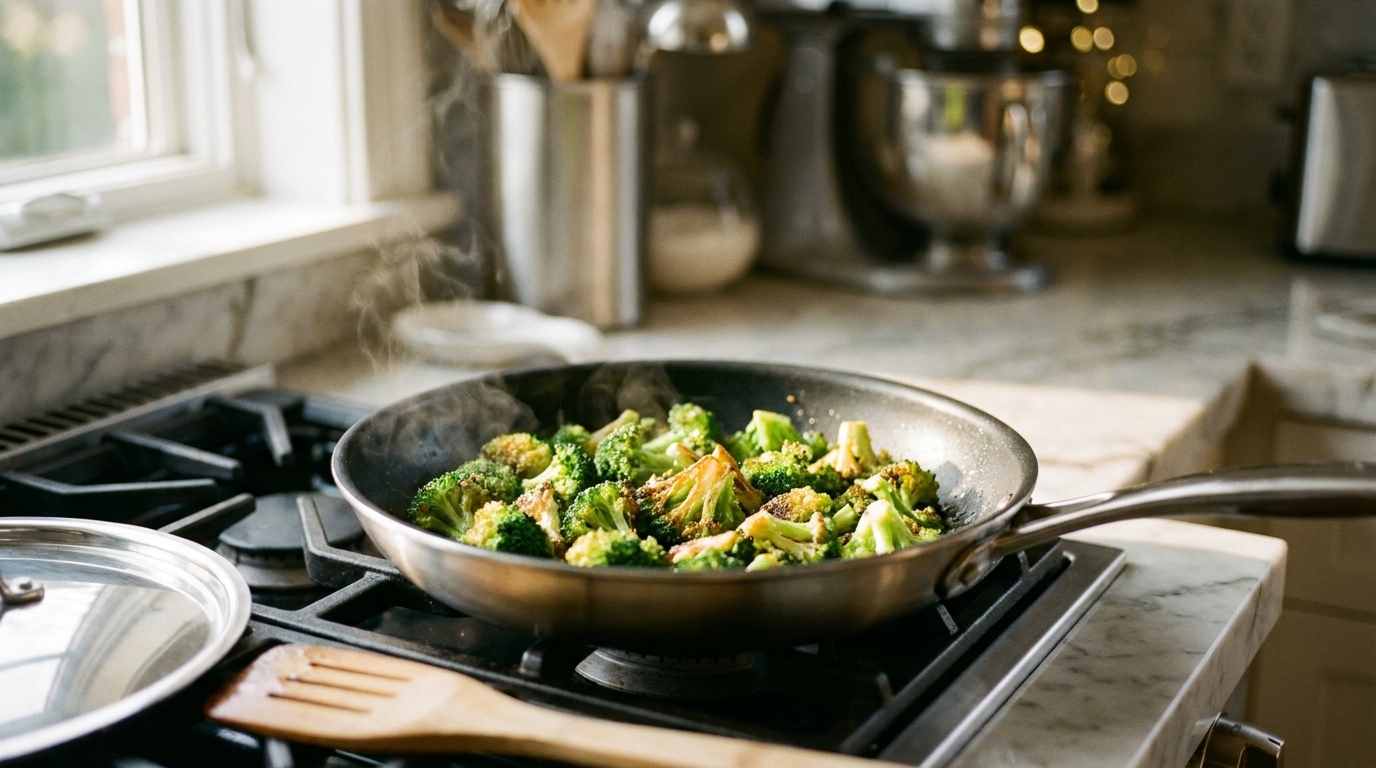
Master the 4-5 minute window that keeps broccoli crisp-tender instead of mushy by understanding how heat breaks down pectin in plant cells. Steaming, sautéing, and roasting each work well--choose based on your timeline and available cookware.
Why Broccoli Turns to Mush: The Science Behind Overcooking
Broccoli reaches peak texture in a narrow 3-to-6-minute window; once pectin breaks down, mushy florets and flat flavor cannot be recovered.
How heat breaks down broccoli's cell structure in 4-7 minutes
Broccoli stays firm because of pectin -- the structural glue that holds its plant cells together.
Heat softens pectin gradually, and somewhere between 3 and 6 minutes of cooking, it reaches the point where broccoli is tender but structurally intact. [1] Push past that threshold and continued heat degrades pectin further, causing cells to separate, release water, and collapse -- turning florets from crisp to mushy. [1] The cell walls are built from cellulose, hemicellulose, and pectin working in combination, so once heat dismantles too much of that network, there's nothing left to hold the texture together. [2]
The difference between tender-crisp and mushy: texture tells the story
Tender-crisp broccoli has clear markers you can observe as you cook: florets hold their shape, stems yield to a knife without collapsing, and the color stays bright green rather than shifting toward olive [1]. A fork pressed into the stalk should meet slight resistance -- not hardness -- which is the benchmark that separates properly cooked from underdone or overdone [4].
Once broccoli crosses into mushy territory, florets begin to slump, flavor turns flat and muted, and no amount of seasoning recovers the texture [1]. That window between done and overdone is narrow, and heat doesn't stop moving food through it just because the broccoli looks ready [4].
Three Cooking Methods Compared: Steam vs. Sauté vs. Roast
Sautéing broccoli in two phases--a quick sear followed by a covered steam--builds caramelized edges while keeping stems crisp-tender.
Steaming broccoli: 4-5 minutes for perfect doneness without water loss
Steaming keeps broccoli out of direct contact with water, which is why it preserves more nutrients and holds bright green color better than boiling does. [5] Place a steamer basket over about a half-inch of water in a covered pot, bring it to a simmer, then start checking florets at 4 minutes. [5] That 4-5 minute window is where crisp-tender happens -- florets hold their shape and stems yield to a fork with slight resistance. [5] Extending to 6-7 minutes produces softer texture that works for soups or younger eaters, though it also raises overcooking risk. [5] Our complete guide to steamed broccoli covers stovetop, microwave, and Instant Pot methods if you want additional setup options.
Sautéing in a nonstick pan: 6-8 minutes for caramelized edges and crisp stems
Sautéing uses a two-phase sequence that builds caramelization without losing crispness.
Heat oil in a nonstick pan over medium, add garlic for about 30 seconds, then raise to medium-high before adding the florets. [6] Stir-fry for 3-4 minutes until edges begin to brown, then add a small splash of water, cover with a lid, and cook another 3-5 minutes until stems are crisp-tender. [6] The covered phase uses trapped steam to drive heat into thick stems -- limiting it to that 3-5 minute window is what keeps the florets from going soft. [7] If water remains after removing the lid, another minute of open-pan cooking evaporates it and firms the texture back up. [6]
The Best Method for Your Kitchen: Decision Guide
Pick steaming for weeknight speed, roasting if you're already using the oven, or sautéing when you want hands-on control and have extra time.
Choose by cooking time: Which method fits your weeknight schedule
Steaming is the fastest path to cooked broccoli at 4-5 minutes, making it the practical default on nights when dinner needs to happen quickly. [5] Oven-roasting takes closer to 13 minutes plus oven preheat -- realistic if you're already running the oven for another dish or can use that window for other prep. [8] Sautéing runs just over 15 minutes and demands more active monitoring than roasting, since you're adjusting heat and stirring rather than setting a timer and stepping away. [8] Steaming fits a 20-minute dinner window; roasting and sautéing suit nights where you have a bit more runway.
Choose by equipment: What you already have in your kitchen matters
The method that works best often comes down to what you already own.
Steaming requires only a covered pot and either a steamer basket or a metal colander that fits inside the pot -- both deliver the same result, and no other specialty equipment is needed. [9] A microwave works just as well for steaming broccoli if you have neither. [9] Sautéing calls for a skillet with a lid to handle the covered steam phase, while roasting needs only a sheet pan and a working oven -- the lowest barrier of the three.
If you steam regularly, a stainless steel steamer basket is worth adding to your kit since it adjusts to fit different pot sizes and holds more volume than a colander. [10]
Essential Tools and Cookware for Broccoli That Stays Crisp
Nonstick pans with even heat distribution and lower cooking temperatures give you a wider window between crisp-tender broccoli and overdone florets.
Why nonstick pans prevent sticking without overcooking broccoli
A nonstick pan's aluminum core distributes heat evenly across the cooking surface, eliminating the hot spots that burn some florets while leaving others undercooked [11]. Because the coating reduces food adhesion, you need less oil to prevent sticking -- which keeps the cooking environment drier and more predictable [11].
Nonstick pans also perform well at medium heat, so you don't need to crank the burner to get browning, and that lower temperature gives you a wider margin between crisp-tender and overcooked [11]. For a real-use look at how nonstick holds up through repeated cooking sessions, see our Misen frying pan review.
Steamer baskets, colanders, and cutting boards: the complete toolkit
Between the two main basket types, collapsible stainless steel outperforms silicone bowl-style steamers for larger batches -- metal petals expand flat and hold roughly three times the capacity for items that need spacing, while silicone walls slant inward and limit usable surface area. [10] For most broccoli cooking, though, the silicone option is genuinely practical: it's naturally nonstick, cleans easily, and its side handles stay cool to the touch even after longer steam times. [10] A large cutting board rounds out the toolkit for broccoli prep, and keeping it properly oiled prevents moisture from wet vegetables from warping or cracking the surface over time.
- Broccoli turns mushy when heat degrades pectin beyond 3-6 minutes, causing cell collapse and loss of structure.
- Tender-crisp broccoli shows bright green color, firm florets, and stems that yield to a fork with slight resistance.
- Steaming takes 4-5 minutes and preserves nutrients better than boiling while keeping color bright.
- Sautéing uses a two-phase method: browning florets 3-4 minutes, then steaming covered 3-5 minutes to cook stems without softening florets.
- Nonstick pans distribute heat evenly and let you cook at lower temperatures, giving you a wider margin between crisp-tender and overcooked.
- Steaming is fastest at 4-5 minutes; roasting takes 13+ minutes; sautéing requires 15+ minutes and more active monitoring.
- https://www.seriouseats.com/best-way-to-steam-broccoli-11918946
- https://pmc.ncbi.nlm.nih.gov/articles/PMC8472173/
- https://myspicyspoon.com/Blogs/The-Science-Behind-Perfectly-Cooked-Vegetables/
- https://foodsciencetoolbox.com/understanding-overcooking-and-its-impact-on-food/
- https://www.feastingathome.com/steamed-broccoli-with-truffle-oil-lemon-zest-and-chili-flakes/
- https://www.wholesomeyum.com/sauteed-broccoli-recipe/?srsltid=AfmBOora-7l9PBDqsa7Wpgf6xwY96274Ee0yxz07a53T-lEVFzti8HbQ
- https://sweetpeasandsaffron.com/how-to-cook-broccoli/
- https://www.yahoo.com/lifestyle/tried-every-possible-method-cooking-173000092.html
- https://www.foodnetwork.com/how-to/packages/food-network-essentials/how-to-steam-broccoli
- https://www.seriouseats.com/best-steamer-baskets-6825227
- https://www.sensarte.com/blogs/all/unraveling-the-mystery-how-nonstick-cookware-perfects-the-science-of-heat-distribution