

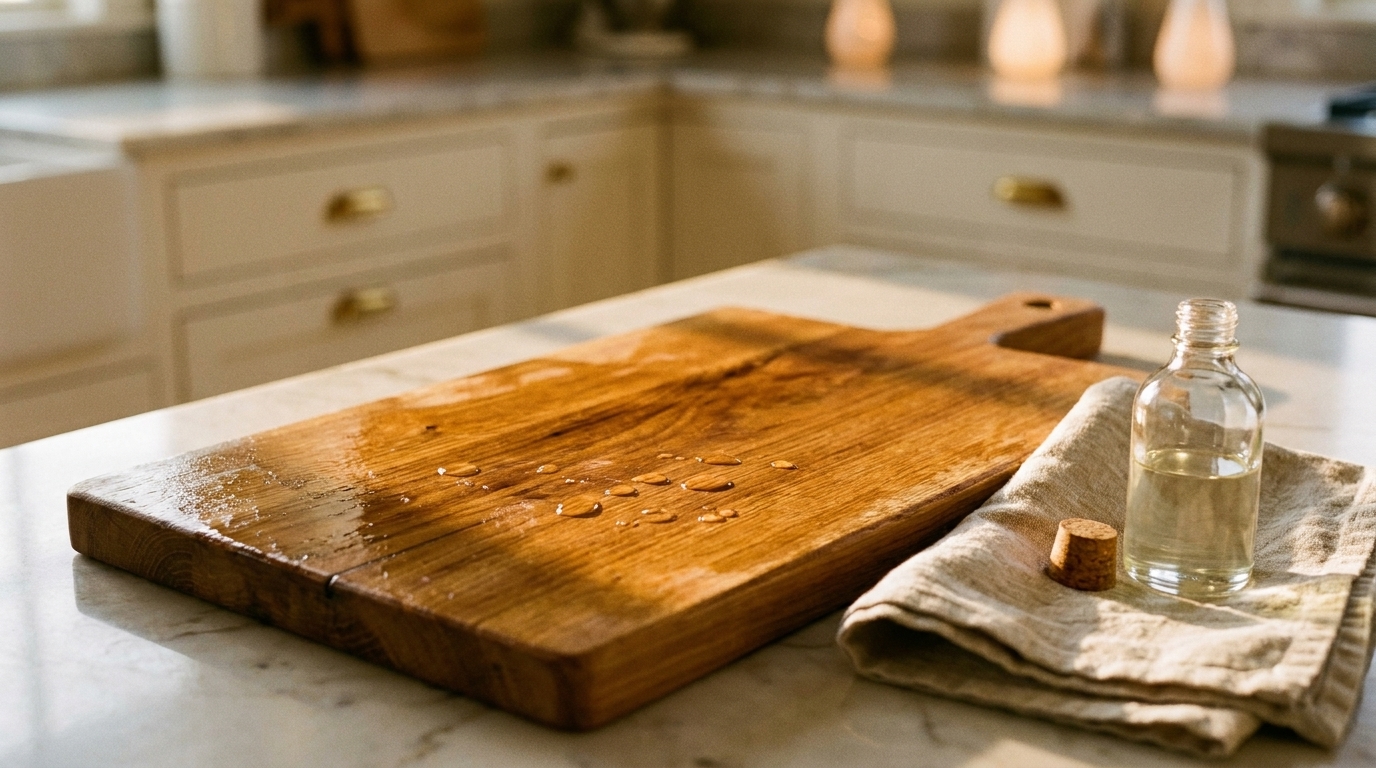
Learn how to oil your wooden cutting board in five minutes using food-grade mineral oil to prevent warping, cracking, and bacterial growth. Regular oiling keeps your board structurally stable and extends its lifespan while maintaining food safety.
Why Oiling Your Wooden Cutting Board Matters (And What Happens If You Skip It)
Oil creates a moisture barrier that prevents warping, cracking, and bacterial growth in wooden cutting boards.
How wood absorbs moisture and why that leads to warping, cracking, and bacterial growth
Wood is naturally hygroscopic, meaning it constantly absorbs and releases moisture from the air and any liquid it contacts -- including meat juices, produce, and rinse water.[1] When a board takes on water unevenly, the fibers on the wet side swell while the dry side stays rigid, which causes warping and, over repeated wet-dry cycles, cracking.[1] Cracked surfaces create deep crevices that trap food particles, giving pathogens like Salmonella, Listeria, and E. coli protected pockets where they can survive and multiply.[2] Understanding this moisture cycle is the core reason knowing how to oil a wooden cutting board properly matters -- oil slows water uptake, giving you a more stable, safer surface.[1]
The protective barrier oiling creates: moisture resistance, food safety, and longevity
Oil fills the wood's surface pores, creating a barrier that slows moisture penetration -- which reduces how quickly the board warps, cracks, or stains under daily use.[5] A conditioned board also resists absorbing strong odors from ingredients like garlic, onions, and raw meat, so less of that transfers to the next thing you prep.[4] You can verify protection with a simple water test: sprinkle a few drops on the surface and watch what happens -- if they bead up, the board is adequately protected; if they soak in, it needs oil.[5] Regular oiling keeps the wood fibers moisturized and structurally stable, which is what gives a well-made board its longevity.[5] What Should I Oil My Wooden Cutting Board With?
Comparing Your Options
Food-grade mineral oil: why it's the safest, most reliable choice for edible surfaces
Food-grade mineral oil is a clear, odorless oil derived from petroleum -- processed and purified to meet food-contact safety standards before it reaches store shelves.[7] Its key advantage over cooking oils is oxidation resistance: it stays fluid over time instead of turning sticky, rancid, or forming a residue that embeds itself in wood fibers.[6] Plant-based oils like olive and coconut oil eventually oxidize and can actively damage cutting boards over time, which is why food-grade mineral oil is the standard recommendation for food-prep surfaces.[6] When shopping, look for products specifically labeled food-grade -- industrial mineral oils contain additives that aren't safe for food contact.[6]
Why olive oil, coconut oil, and linseed oil fall short (and when to avoid them entirely)
Olive oil, coconut oil, and standard linseed oil all contain organic fats that oxidize on contact with air -- a process that leaves boards smelling rancid and looking yellowed and sticky over time.[10] Boiled linseed oil compounds this with added toxic drying agents like naphtha and heavy metal salts, making it unsafe for food-contact surfaces regardless of how it's labeled.[8] Regular coconut oil from your pantry behaves like other cooking oils; only fractionated coconut oil avoids rancidity by removing the fatty acids most prone to oxidation, though it works better as a periodic maintenance step than a primary finish.[9] Raw linseed oil is technically food-safe but cures in two to ten weeks, making it impractical for most kitchen use.[8]
The 5-Minute Oiling Process: Step-by-Step Instructions
Pour mineral oil onto your board, spread it evenly across all surfaces, and let it absorb overnight before wiping away excess residue.
What you'll need: supplies checklist and why quality tools make the difference
You only need three things to oil a cutting board: food-grade mineral oil, a clean cloth or paper towels, and time for overnight absorption.[11] Keep a dedicated cloth for board maintenance -- fabric softener residue from regular dish towels can interfere with how well the oil absorbs into the wood.[11] If you want added protection, a food-safe beeswax or wax blend applied after the oil fully absorbs creates a secondary moisture barrier and extends the interval between oiling sessions.[5] For anyone working with a quality wood cutting board, these tools -- oil, cloth, and optional wax -- are all you need to keep it performing well for years.[12]
Application technique: how to oil evenly, how long to let it absorb, and when your board is ready to use
Pour a generous amount of mineral oil directly onto the board and use a paper towel to spread it evenly across the top, bottom, and all four sides -- working with the grain where possible.[5] Let it absorb for at least eight hours, or overnight, then wipe off any remaining residue with a clean paper towel.[5] Don't rush this step: oil that hasn't fully penetrated will sit on the surface as a greasy film rather than conditioning the wood fibers where it provides structural protection.[13] The board is ready to use once the surface feels dry to the touch and a few drops of water bead up rather than soak in.[5]
Cutting Board Care Beyond Oiling: Maintenance Schedule and Best Practices
Proper cleaning and storage between oiling sessions directly affect how long the oil lasts and when your board needs conditioning again.
How often to oil based on wood type, usage frequency, and climate (with a printable maintenance tracker)
Oiling frequency depends on wood type, how often you cook, and your home's humidity level.
Dense hardwoods like maple, walnut, and cherry hold oil longer; lighter woods like acacia and bamboo dry out faster and need more frequent treatment -- our maple, acacia, and bamboo comparison breaks down the differences.[15] For daily-use boards, oil every three to four weeks; occasional use extends that to six to eight weeks; heavily used butcher's blocks may need conditioning every two to three weeks.[14] New boards require more upfront attention -- oil every couple of days for the first week, then weekly for a month before settling into a regular schedule.[5] The water-bead test is your most reliable indicator: if drops soak in rather than bead up, oil the board that day, regardless of when you last did it.[5]
Cleaning, drying, and storage habits that extend your cutting board's life between oiling sessions
How you clean and store your board between oiling sessions directly affects how long the oil lasts.
Always hand-wash with hot, soapy water -- never submerge the board or put it in the dishwasher, since prolonged water exposure causes wood fibers to swell unevenly and warp.[5] Wash both sides even if you only cut on one, so the board dries at an equal rate on each surface.[5] Dry it immediately with a clean kitchen towel, then stand it upright so air circulates and moisture doesn't pool underneath.[16] Store in a dry, ventilated spot -- never flat on a damp counter or stacked without airflow, which traps moisture and shortens the interval between oiling sessions.[16]
- Wood absorbs moisture unevenly, causing warping and cracks that trap harmful bacteria like Salmonella and E. coli.
- Food-grade mineral oil slows water absorption and prevents oxidation, unlike cooking oils that turn rancid and damage wood.
- Apply mineral oil to all sides of the board, let it absorb overnight, then wipe clean--takes just 5 minutes of active work.
- Use the water-bead test: if drops soak in instead of beading up, your board needs oil immediately.
- Oil every 3-4 weeks for daily-use boards; dense woods like maple hold oil longer than lighter woods like acacia.
- Hand-wash boards with hot soapy water, dry immediately, and store upright to prevent moisture pooling and warping.
- Optional beeswax or wax blend applied after oil fully absorbs extends the interval between oiling sessions.
- https://www.finewoodworking.com/2024/10/10/the-best-food-safe-finish-may-be-none-at-all?srsltid=AfmBOooPdPwDRfFYMrgJYWmnv43YxiQB5WJOwt165a0eGJqZBskTMFtm
- https://commonsensehome.com/wooden-cutting-boards/
- https://www.wholesalecuttingboards.com/news/food-safe-finishes-explained--mineral-oil-vs.-beeswax-vs.-tung-oil-259.aspx
- https://dalstrong.ca/blogs/news/how-mineral-oil-can-help-maintain-your-cutting-board?srsltid=AfmBOoquML4QkwSDWgDw_0GuBQyzhgCBACXz9ymSwe6aAxkLu2pPwc9f
- https://www.nytimes.com/wirecutter/guides/how-to-clean-wood-cutting-boards/
- https://www.seriouseats.com/mineral-oil-is-good-for-cutting-boards-and-knives
- https://cris.msu.edu/news/community-request/community-request-mineral-oil/
- https://vanduynwoodwork.com/2021/11/19/food-safe-wood-finishes/
- https://www.cuttingboard.com/blog/what-type-of-oils-are-safe-to-use-on-your-cutting-board/?srsltid=AfmBOoqnFwKNW4rp785y3MY3r5PoLelzEr-VeMa58h7rccF7mHDCFLsF
- https://www.earlywooddesigns.com/blogs/earlywood-wooden-utensils-blog/17633464-food-safe-oils-which-type-should-you-be-using?srsltid=AfmBOopW4b1JIv5BeR58oQUwAD0GkNND2-QQwgDu3UiBh9GDFr2tNsM_
- https://www.seriouseats.com/how-to-season-and-maintain-a-wood-cutting-board
- https://totallybamboo.com/blogs/news/how-to-oil-your-cutting-board-a-complete-guide?srsltid=AfmBOooa2M2W1Zjey0l6HdcUBFnpKbBDCVzhYeVt8DMvMuWwYmNgOqUw
- https://dalstrong.ca/blogs/news/how-to-oil-a-cutting-board-for-smooth-slicing?srsltid=AfmBOopBLFIGU_Hf0eTKwDugfQXpCDk7vdEqtMy3ms0HIFh3RlijMZeB
- https://www.deerandoak.co.uk/blogs/news/how-often-should-you-oil-a-wooden-cutting-board?srsltid=AfmBOoqWJA3hE0RoLSlauF_voe5wEBA1xzTUY6Hn3ISVM-85ok8yZhcC
- https://www.sealitgreen.com/blogs/seal-it-green-blog/how-long-should-cutting-board-oil-last-weeks-vs-years-explained-clearly?srsltid=AfmBOooy5Fnb9R72UJ8Z8opdJafcKePoExn_YIq6DMJVZ1r7Y2XK7JbO
- https://extension.umaine.edu/publications/3108e/