

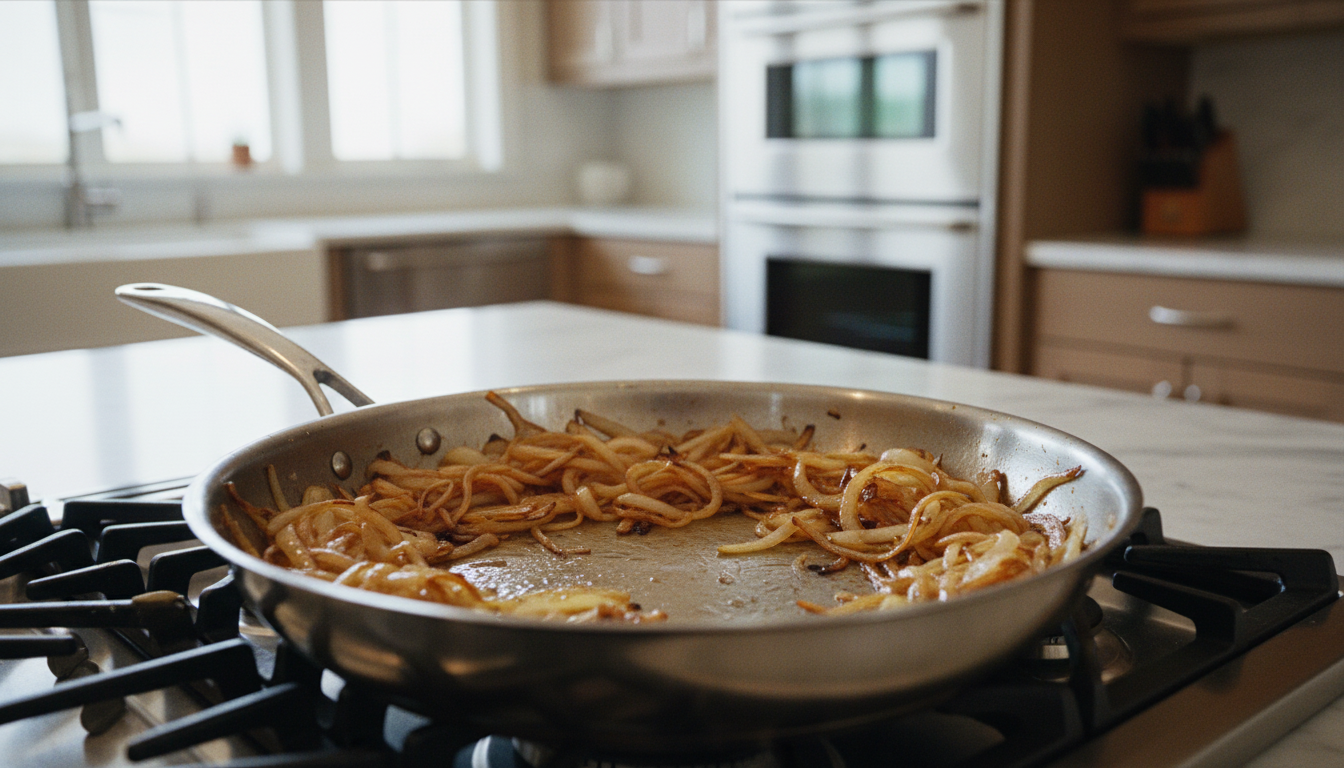
Skip the 45-minute wait and get golden, flavorful onions in about 15 minutes by using a heavy skillet, high heat, and the right fat. The key is preheating your pan, salting early, and stirring frequently to build color without burning.
Why Sautéing Onions Fast Still Delivers Deep Flavor
You can build real color and deep flavor in just 15 minutes by sautéing onions hot and fast instead of waiting 45 minutes.
If you've ever skipped a recipe because it called for 45 minutes of stirring onions, there's a faster way to get there.
Sautéing onions hot and fast, rather than low and slow, skips the long wait while still building real color and flavor, and the techniques below show how to get a result close to traditional caramelization without tying up the stove for the better part of an hour.
Every section ahead, from pan choice to fat selection to the step-by-step method, is built around cutting that wait down to about 15 minutes without sacrificing the deep flavor the long version delivers.
The difference between sautéed and caramelized onions explained
Sautéing onions means cooking them fairly quickly in a hot pan with a bit of fat, just enough to soften them and pick up some color on the edges. The onions stay a little firm, keep some of their sharp bite, and turn translucent to light golden in about 5 to 10 minutes. That's a different result than caramelizing, which is a slower process built around sugar, not just heat.
Caramelization happens when the natural sugars inside the onion melt and brown, shifting the flavor from sharp and pungent to deep, sweet, and almost rich in a way that's closer to a sauce than a raw vegetable [1]. Because that sugar breakdown takes time, true caramelized onions traditionally need low heat and a long cook, often 30 to 45 minutes, to fully convert that sharpness into sweetness without burning. The onion variety you start with also changes how far that flavor shift goes.
Onions with more natural sugar, like sweet onions or Cipollini, caramelize into something noticeably sweeter, while yellow onions land in a middle ground that keeps some savory depth alongside the sweetness [1]. Red and white onions behave differently in the pan too, since their sugar content and sharpness don't break down the same way [1]. Knowing this distinction matters before you try to speed up the process, because a quick sauté and a true caramelization are aiming for different textures and flavors, not just different cook times.
What skipping the wait actually costs and saves
Trading the traditional 30-to-45-minute caramelization for a 15-minute sauté means giving up some of that slow sugar conversion, since the deep, jammy sweetness of true caramelized onions depends on time at low heat that a fast method simply doesn't have [1].
What a hot, fast sauté buys back is real color and softened texture in a fraction of the time, without the onions needing to sit on the stove for the better part of an hour [1][2].
The trade-off is worth understanding upfront: a 15-minute batch won't taste identical to a 45-minute batch, but it gets close enough for burgers, steak, and weeknight dinners where the long wait isn't practical in the first place.
How high heat and the right pan cut cooking time in half
The pan you choose has more influence over cooking time than most home cooks realize. According to chef Dennis Littley of Ask Chef Dennis, the best pan for the job is a shallow one that distributes heat evenly across its base and gives onions enough width to spread into a single layer [2]. Cooking in a single layer, rather than piling onions into a deep pot, lets them release their water content quickly and develop a deep brown color without burning, which is what shortens the process [2]. Littley recommends stainless steel or cast iron for this reason, since both materials carry heat evenly across the surface [2]. A heavy-bottomed stainless steel skillet is a dependable pick here, giving onions the flat, even surface they need to brown fast. Lightweight pans, including Teflon-coated nonstick cookware, work against speed because they develop hot spots that scorch some onions while others stay pale [2]. Beyond heat distribution, the right pan also builds fond, the browned bits that stick to the bottom as moisture cooks off, and Littley notes that fond adds a depth of flavor the onions won't develop without it [2]. Skipping that fond by using a pan that can't hold heat evenly just means a longer cook with a flatter result.
A few pan traits worth checking before you start:
- Shallow and wide enough to hold onions in a single layer [2]
- Stainless steel or cast iron for even heat distribution [2]
- Heavy gauge metal that resists developing hot spots [2]
If your pan is too small, Littley suggests splitting the onions across two pans rather than crowding one, since overcrowding traps steam and keeps the onions from browning properly [2].
Should you sauté onions in butter or oil? A side-by-side comparison
Use refined, high-heat oils like avocado or peanut for a quick sauté, or start with oil and finish with butter for flavor without burning.
Butter vs. oil: flavor, smoke point, and browning speed
Butter and oil hit a hot pan differently, and that difference decides how fast onions start to brown. Refined oils carry a higher smoke point than unrefined ones because refining strips out the impurities and free fatty acids that cause scorching, which is why a refined, light olive oil can handle heat up to about 486 degrees Fahrenheit compared to roughly 410 degrees for extra virgin olive oil [3]. That gap matters for a quick sauté: a fast, hot cook calls for an oil that can take the heat without smoking, while a true low-and-slow caramelization has more room to use a gentler fat.
Oils like avocado, canola, grapeseed, peanut, and sunflower all sit in the high-smoke-point range, making them steadier choices for getting onions moving quickly in a hot pan [3]. Butter brings a different advantage. It's prized for flavor rather than heat tolerance, and because it contains milk solids, it tends to brown and scorch sooner than a refined oil would at the same temperature.
A practical middle ground many cooks use is starting onions in oil to get color fast, then stirring in a bit of butter near the end so the dairy flavor comes through without burning. For a straightforward quick sauté, the guidance on medium-heat cooking points toward using a less refined olive oil, peanut oil, or any of the high-heat options rather than reaching for raw, unheated extra virgin olive oil [3]. Matching the fat to the heat, instead of grabbing whatever's closest, is what keeps a 15-minute pan of onions from stalling halfway through.
Why your choice of fat matters more than you think
Fat choice affects more than how fast onions brown. Oils and fats break down before they ever reach their visible smoke point, producing oxidation byproducts like aldehydes, so a fat pushed too close to its limit changes flavor even before smoke appears [4].
That's part of why a refined, high-heat oil works better for a fast sauté than butter, which is roughly 65% fat along with water and milk proteins that scorch once the water cooks off, capping its usable heat around 350 degrees Fahrenheit [5]. A common kitchen myth claims mixing oil into butter raises its smoke point, but the proteins that burn are still there, and the oil only masks the burnt taste rather than preventing it [5].
Ghee sidesteps the problem entirely: removing those milk proteins through clarification pushes butter's usable range up to around 450 degrees Fahrenheit, close to canola oil, while keeping a rich flavor [5]. For a 15-minute sauté, that means picking a fat suited to the heat you're actually using, not just the flavor you want, is what keeps onions browning evenly instead of smoking or stalling.
Common mistakes when sautéing onions and how to fix them
Crowding the pan, skipping the preheat, using cold oil, and covering the lid all sabotage browning--fix them before onions hit heat.
Crowding the pan, wrong heat, and 3 other errors that extend cook time
Crowding the pan tops the list because it drops the pan's temperature the moment onions hit it, and piling on more than the pan can hold drags that temperature down even further, which stalls browning before it starts [6]. Skipping the preheat causes the same stall from a different angle: a cold pan means no sizzle, and no sizzle means the onions cook unevenly in both texture and color instead of starting to brown right away [6]. Cold oil creates a third version of the problem, since onions dropped into lukewarm oil soak it up instead of browning, leaving them soft and greasy rather than golden [6].
Skipping salt until late in the cook is another common slip. Salting onions as soon as they hit the pan draws water out of them faster, which helps them soften and brown sooner instead of sitting in their own moisture [7]. Covering the pan rounds out the list of easy-to-fix errors: a lid traps the steam a hot pan naturally produces, that steam condenses and drips back onto the onions, and the extra moisture blocks the browning you're trying to build [6].
A few fixes to run through before the onions ever hit heat:
- Let the pan heat fully until a piece of onion sizzles on contact [6]
- Warm the oil in the pan before adding onions [6]
- Salt onions right after they go in, not at the end [7]
- Leave the pan uncovered the entire time [6]
The cookware mistake that sabotages caramelization
Reaching for a nonstick skillet is the most common cookware mistake in this process, since caramelization depends on scraping up the fond that forms as onions release moisture, and that scraping wears down a nonstick coating fast [10]. A thin, lightweight pan creates a second problem: it heats unevenly and develops hot spots, so some onions scorch while others barely color [8]. Disc-bottom pans, which weld an aluminum core only to the base rather than cladding it through the walls, run into the same issue, since heat stops traveling evenly once it reaches the sides [9]. A cast iron or stainless skillet with a heavy, thick bottom and high sides solves both problems at once, holding steady heat across the entire surface while standing up to the stirring and scraping that builds flavor [10]. A carbon steel pan works well for the same reasons: it holds heat, takes a scraping, and has no delicate coating to worry about. Before swapping pans, a quick checklist helps:
- Skip nonstick, since scraping for fond damages the coating [10]
- Avoid thin, lightweight skillets prone to hot spots [8]
- Pass on disc-bottom pans with aluminum only at the base [9]
- Choose cast iron or a fully clad stainless skillet instead [10]
Getting the pan right from the start can help onions brown more evenly on the first pass instead of needing constant repositioning to dodge scorched patches, which is often what drags a quick sauté closer to that 45-minute caramelization timeline.
The 15-minute sautéed onion method that works for burgers, steak, and more
Salt the onions immediately to release moisture fast, then butter at the 10-minute mark for deeper flavor and a glossy finish.
Step-by-step technique for perfectly golden onions every time
Start with onions sliced thin and even, since uneven cuts cook at different speeds and leave some pieces pale while others scorch [12]. Heat a heavy skillet, cast iron or stainless, on high before the oil goes in, then add the oil and let it shimmer for about a minute so the onions start sizzling the second they hit the pan [11]. Add the onions and salt right away. Salt pulls moisture out fast, which speeds up softening instead of letting the onions sit in a dry pan [12]. Stir frequently for the first five minutes on high heat to build color without burning, then drop to medium once the onions start releasing water and the oil is mostly absorbed [11]. Around the 10-minute mark, stir in a small amount of butter. It melts into the onions and keeps them moist while adding flavor the oil alone won't give [11][12]. From there, keep stirring every couple of minutes rather than constantly, since onions need time sitting against the hot pan to actually brown [12]. The onions are done once they've gone soft, golden, and glossy with no raw bite left, usually within 15 minutes total:
- Slice onions thin and uniform [12]
- Preheat pan on high, then add oil [11]
- Add onions and salt immediately [12]
- Stir often, dropping to medium after 5 minutes [11]
- Stir in butter at the 10-minute mark [11]
Pull them off the heat as soon as they hit that golden color, since a few extra minutes on high heat is the difference between glossy onions and scorched ones.
Adapting the method for onions and peppers, onions and garlic, and other combinations
Pairing onions with other vegetables or aromatics means adjusting when each ingredient hits the pan, since peppers, garlic, and onions don't soften or brown at the same rate. One approach sautés onions alone in oil for 15 to 20 minutes until browned, then stirs in julienned bell peppers, salt, and pepper for a shorter 10-minute finish, which keeps the onions deeply colored while the peppers stay slightly firmer [13]. Garlic behaves differently again. Because it burns fast at high heat, one recipe keeps garlic out of the skillet entirely, chopping it into a marinade for steak instead of sautéing it alongside the onions and peppers [14]. When onions and peppers share a pan after another ingredient, like seared steak, has already cooked, the vegetables go in together with salt and only need about 5 to 6 minutes to turn tender, a much shorter window than onions cooked alone need to fully caramelize [14]. That shorter cook works because the pan is already hot from the previous step, so the vegetables start softening immediately rather than needing time to build heat from scratch.
- Brown onions first, then add peppers for a 10-minute finish [13]
- Keep garlic out of early high heat; add it through a marinade instead [14]
- Onions and peppers together need only 5 to 6 minutes in an already-hot pan [14]
Good sautéed onions come down to two things: the right pan and a little attention to heat. Get a heavy stainless steel or carbon steel skillet hot, keep the onions moving, and salt them early, and you can land soft, golden, glossy onions in about 15 minutes instead of waiting out a 45-minute caramelization. Match your fat to the heat you're actually using, skip the nonstick and thin, lightweight pans, and you can brown onions more evenly on the first pass. For more care & maintenance tips on getting the most from your pans, explore our cookware collection, or contact us with any questions.
Frequently Asked Questions
-
What's actually the difference between sautéed onions and traditionally caramelized onions?
Sautéed onions cook hot and fast, turning translucent to light golden in about 5 to 10 minutes while keeping some bite. True caramelized onions rely on slow sugar breakdown over 30 to 45 minutes at low heat, which shifts the flavor to deep, sweet, and almost sauce-like. The article's 15-minute method lands in between, aiming for color and softness close to caramelization without the full time investment.
-
Can I really get caramelized-onion flavor in 15 minutes, or am I giving something up?
You're trading some of the slow sugar conversion for speed, so a 15-minute batch won't taste identical to a 45-minute one. What you get back is real color and softened texture in a fraction of the time, which the article says is close enough for burgers, steak, and weeknight dinners where the long wait isn't practical.
-
What's the best pan for fast sautéed onions?
Look for a shallow, wide pan in stainless steel or cast iron, since both distribute heat evenly and let onions sit in a single layer to release moisture and brown quickly. Avoid lightweight nonstick pans and disc-bottom pans, since they develop hot spots and make scraping up flavorful fond harder. If your pan is too small, the article suggests splitting onions across two pans instead of crowding one.
-
Should I sauté onions in butter or oil for a faster result?
Refined oils like avocado, canola, grapeseed, peanut, or sunflower have higher smoke points and hold up better in a fast, hot sauté than butter, which scorches sooner because of its milk solids and caps out around 350°F. The article suggests a middle ground: start onions in oil to build color quickly, then stir in a bit of butter near the end for flavor without burning.
-
What's the most common mistake that drags a quick sauté closer to a 45-minute cook?
Crowding the pan is the top mistake, since piling on too many onions drops the pan's temperature and stalls browning before it starts. Other slip-ups the article flags are skipping the preheat, adding onions to cold oil, salting too late, and covering the pan, all of which trap moisture or uneven heat and work against fast browning.
- A 15-minute hot sauté delivers real color and softened texture, though it trades some deep sweetness of true 45-minute caramelization.
- Heavy stainless steel or cast iron pans with even heat distribution brown onions faster than lightweight or nonstick options.
- Refined, high-smoke-point oils like canola or avocado oil handle fast cooking better than extra virgin olive oil or butter alone.
- Salting onions immediately after they hit the pan draws out moisture faster, speeding up softening and browning.
- Preheating the pan and oil, stirring frequently for the first five minutes, then switching to medium heat produces consistent results.
- Adding butter around the 10-minute mark adds flavor without burning, while keeping onions moist and glossy.
- Crowding the pan, covering it, or using cold oil all trap steam and stall browning, undoing the speed advantage.
- https://www.foodrepublic.com/1694733/best-worst-onions-for-caramelizing/
- https://www.thetakeout.com/2161202/best-type-pan-caramelized-onions/
- https://bellisaris.com/blogs/food-for-thought/oils-and-smoke-points
- https://ntischool.com/cooking-oils/
- https://www.yahoo.com/lifestyle/mixing-oil-butter-does-really-175535467.html
- https://www.tastingtable.com/1428033/mistakes-everyone-makes-sauteing/
- https://www.mashed.com/813432/mistakes-everyone-makes-when-cooking-onions/
- https://www.bonappetit.com/story/best-stainless-steel-pan-skillet
- https://www.epicurious.com/expert-advice/the-best-frying-pans-stainless-steel-article
- https://www.foodrepublic.com/1471617/best-pan-cook-caramelized-onions/
- https://sweetcaramelsunday.com/quick-caramelised-onions/
- https://platedfocus.com/the-best-way-to-caramelize-onions/
- https://www.grit.com/departments/sauteed-onions-and-peppers/
- https://mealplans.cooksmarts.com/recipes/2295-sauteed-sirloin-tips-with-bell-peppers-and-onions