

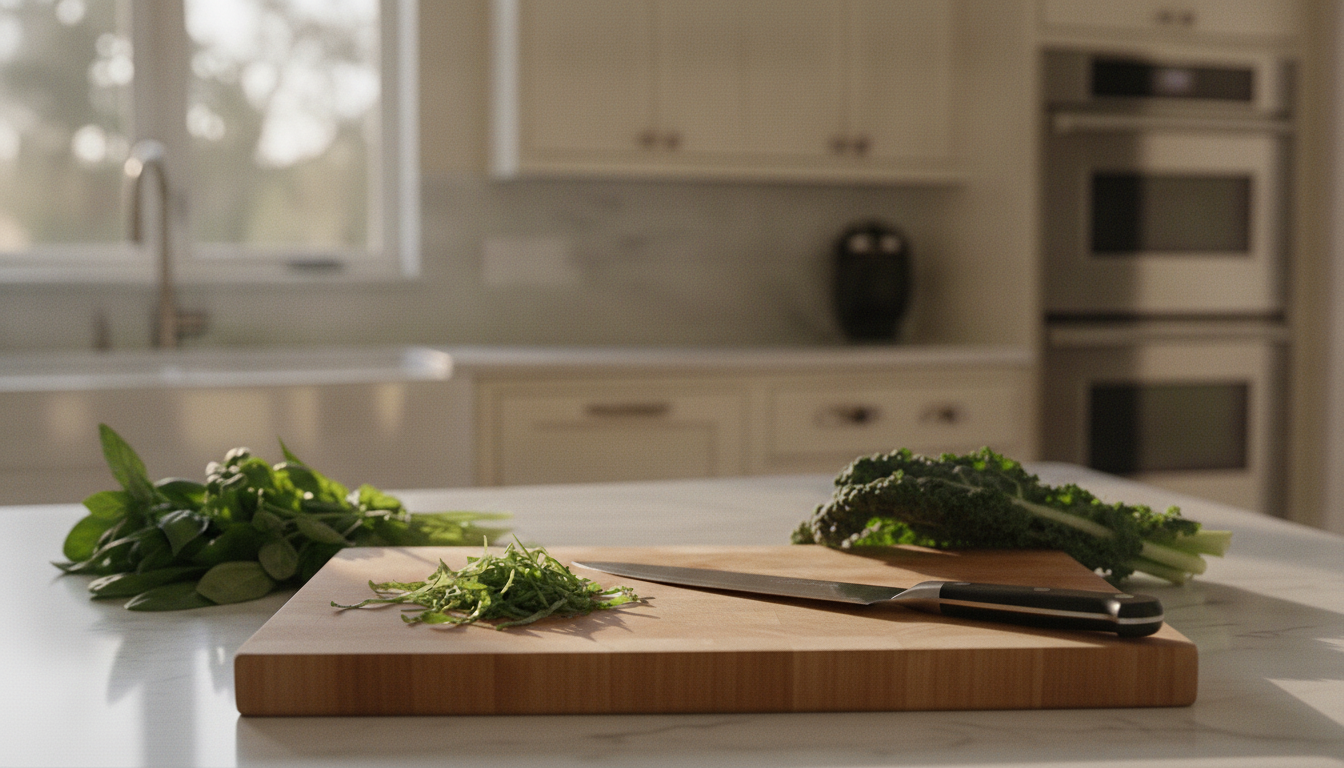
Master the chiffonade cut to prep vegan meals efficiently while keeping herbs and greens bright and flavorful across multiple days. This stack-and-roll technique prevents bruising, distributes flavor evenly, and stretches fresh ingredients further in your weekly prep routine.
What Does Chiffonade Mean in Cooking: The Fine Ribbon Cut Explained
Stack, roll, and slice leafy greens crosswise to create even ribbons that stay bright and bruise-free for days.
Chiffonade definition: A stack-and-roll slicing technique that creates thin, uniform ribbon strips
Chiffonade means cutting leafy herbs or greens, like basil, spinach, or lettuce, into thin ribbon strips [1]. The name comes from the French term for "made of rags," a nod to the fabric-like shreds the cut produces.
The process itself is simple: stack the leaves with the largest on the bottom, roll them tightly like a cigar, then slice crosswise through the roll with a sharp knife [2]. Keeping the knife tip anchored on the cutting board while you work through the roll helps you produce clean, even strips instead of torn or uneven pieces [2].
This stack-and-roll method separates chiffonade from other knife cuts like julienne, since it's built specifically for soft, flat leaves rather than firmer vegetables cut into matchsticks [3]. Once you've got the rolling motion down, the cut works the same way whether you're prepping a few basil leaves for a garnish or working through a full bunch of kale for a week of vegan meal prep.
Why chiffonade matters for vegan meal prep and delicate vegetable preservation
Batch-cutting vegetables days ahead of eating them means texture loss is the biggest risk, and chiffonade addresses that directly: the rolling and slicing motion avoids the bruising that tearing or rough chopping causes, which keeps basil bright green and spinach intact rather than darkened and limp days later [4]. That matters more in vegan cooking than in dishes built around meat or dairy, since herbs and greens often carry the main flavor and visual interest on the plate, and uneven, bruised ribbons show up immediately in a grain bowl or salad with no protein to distract from them [4].
Chiffonade also distributes flavor evenly through a dish instead of leaving pockets of concentrated herb taste, which is useful when you're portioning a single batch of sautéed greens across five days of lunches and want each container to taste consistent [4]. Finely cut leaves also release more aromatic compounds than torn or coarsely chopped ones, so a chiffonade of basil or mint stretches further in a weekly prep without needing more product [4].
For high-volume prep, treating the cut as its own station task, rather than repeating it dish by dish, keeps the workflow efficient when you're working through kale, cabbage, and herbs in the same session [4].
What Does a Chiffonade Cut Look Like: Visual Guide and Real-World Examples
Chiffonade creates loose, feathery ribbons that look completely different from matchsticks or cubes, making it instantly recognizable on the plate.
Chiffonade appearance: Thin, consistent ribbons versus julienne and other knife cuts comparison table
Chiffonade looks nothing like the other standard knife cuts once it's on the board: it's a pile of loose, feathery ribbons rather than uniform sticks or cubes, which makes it easy to spot even before you taste it. Julienne, by contrast, produces thin matchstick-shaped strips cut from firmer vegetables, commonly used in salads and stir-fries where a crisp bite matters [5]. Brunoise reduces those same matchsticks into a small, uniform dice, typically reserved for fine garnishes or aromatic bases [5]. Batonnet sits between julienne and a full dice, a thicker stick cut often used as a prep step before cubing [5]. Large, medium, and small dice are cube cuts sized for soups, stews, and roasted vegetable mixes rather than fresh, raw presentations [5]. Seeing these cuts side by side makes the differences concrete:| Cut | Shape | Typical use |
|---|---|---|
| Chiffonade | Thin, loose ribbons | Leafy herbs, greens, garnish |
| Julienne | Thin matchsticks | Salads, stir-fries |
| Batonnet | Thick sticks | Prep step before dicing |
| Brunoise | Small, fine dice | Garnish, aromatics |
| Dice (L/M/S) | Cubes | Soups, stews, roasting |
Common vegan ingredients perfect for chiffonade--basil, spinach, kale, cabbage, and leafy greens
Basil, spinach, kale, cabbage, and other leafy greens are the vegan staples best suited to a chiffonade cut, since the technique depends on broad, pliable leaves that stack and roll cleanly [6]. Lacinato kale is a strong candidate: its long, flat leaves come off the stem in one motion, stack neatly, and roll into a tight bundle that slices into clean ribbons consistently [6]. Curly kale works too, though its ruffled edges mean you'll sometimes need to snap off stray leaves before rolling [6].
Spinach and baby lettuces chiffonade well in smaller batches, since their leaves are thinner and bruise faster under a knife, while sturdier cabbage leaves hold their shape through a longer roll and a thicker stack [6]. For vegan meal prep, this range matters: basil and spinach ribbons are best cut close to serving, while kale and cabbage ribbons, being more fibrous, can handle a few days in the fridge without breaking down as quickly [6]. Mixing textures like this is also why learning to break down a cabbage head first pays off, since once the leaves are separated, they chiffonade the same way other greens do.
Swiss chard and collards, while not basil-family herbs, follow the identical stack-and-roll method and round out a vegan prep session built around this one knife skill [6].
Step-by-Step Chiffonade Cutting Process for Batch Vegetable Prep
A sharp knife and a stable cutting board are your foundation for clean, consistent chiffonade ribbons across any batch of greens.
Essential tools for chiffonade work: Knife selection, cutting boards, and prep utensils that matter
A chiffonade cut depends more on a clean, sharp edge than any single knife brand, and a sharp chef's knife or santoku handles the stack-and-roll motion well for most leafy greens [7]. A santoku's moderate length and flatter belly suit cooks who prefer less rocking motion through the roll, while a standard chef's knife stays the more flexible pick if you're switching between chiffonade, mincing, and rough chopping in the same prep session [8].
Whatever blade you reach for, it needs to be genuinely sharp: a properly maintained edge cuts with less force and produces cleaner ribbons, so sharpen as soon as it stops starting cuts cleanly instead of waiting for it to drag [7]. If you're not sure your knife is up to the job, running it through a quick sharpness check before a big batch-prep session saves you from fighting a dull blade through a stack of kale.
The cutting board matters just as much as the knife: work on a clean wood or food-safe plastic board that doesn't slide, since a board that shifts mid-roll throws off your slice width and risks your guide hand [7]. A damp towel or nonslip mat underneath adds stability for longer prep sessions, giving the blade a safe, consistent path through the rolled leaves (we'll cover exact hand position in the next section) [7].
Executing the perfect chiffonade cut: Rolling technique, hand positioning, and safety for high-volume prep
Begin by stacking three to four leaves flat on the board, largest on the bottom, then roll them lengthwise into one tight cylinder before you make a single cut [9]. Keep your guide hand curled into a claw with fingertips tucked under and knuckles forward, so the blade travels against your knuckle rather than your fingertip as it works through the roll [10].
With the tip of the knife resting on the board, rock the blade down through the cylinder in one continuous motion instead of sawing back and forth, which keeps the cut edges clean rather than frayed [9]. Aim for ribbons in the 1/16- to 1/8-inch range, spacing each slice evenly down the length of the roll so the batch cooks or plates consistently [9].
For high-volume prep, finish rolling and slicing one bundle completely before starting the next, rather than alternating steps across several bundles at once; this keeps your hand position consistent and cuts down on how often you have to reset your grip [10]. As ribbons pile up, sweep them into a holding bowl rather than letting them accumulate under your rolling hand, since a cluttered board is where a knife is most likely to slip during a long prep session [10].
Building Your Vegan Meal Prep Workflow with Chiffonade-Cut Vegetables and Tofu
Keep marinated tofu and prepped vegetables fresh across five days by storing components separately and saving fresh-cut herbs for final assembly.
Organizing batch prep: Chiffonade vegetables, marinated tofu, and storage strategy for 5-day meal plans
Organizing a five-day vegan prep session works best when tasks are separated by how long each component holds up in storage. Marinate tofu early in the session using a mixture like soy sauce, garlic powder, ground ginger, brown sugar, sesame oil, and a dusting of cornstarch, then let it sit in that marinade in a sealed container until you're ready to sear it [11].
A stainless steel skillet or carbon steel pan gives those marinated cubes crisp, golden edges when it's time to cook. Build grain and vegetable bases around the same time: cooked quinoa, steamed sweet potato, and steamed kale or spinach hold up across multiple days and form the backbone of a bowl that only needs a drizzle of tahini dressing before serving [12].
Save chiffonade-cut herbs like basil for the final assembly step rather than batching them with everything else, since rolling and slicing fresh leaves right before eating preserves color and aroma better than storing them pre-cut for days [13]. Across the five-day stretch, keep components in separate containers rather than one combined dish, reseal partially used bags with clips or zipper closures to limit air exposure, and group marinated tofu with grain bases while holding delicate greens and chiffonade herbs apart until the day they're served [13].
Maintenance and care for your prep tools to keep blades sharp and cutting boards food-safe
Keeping a knife chiffonade-ready comes down to routine care more than any single tool. Hone the blade regularly to realign its edge, and turn to sharpening only once honing stops restoring a clean cut; the paper test is a quick check, if the blade tears or snags instead of slicing through, it needs a true sharpening session [14]. Hand wash knives with mild soap and dry them immediately, since leftover moisture invites rust on both carbon and stainless blades [14]. Store knives in a block, on a magnetic strip, or in a drawer insert rather than loose in a drawer, which protects the edge from nicks that dull it faster [14]. Your cutting board needs similar attention: wood and plastic surfaces are gentler on a blade than glass, stone, or metal, which quickly dull an edge and reduce control [15]. Wash boards by hand and dry them fully; if you're working with a wood board, oiling it on a regular schedule keeps the surface from drying out and cracking, a step covered in more detail in our guide to oiling a wooden cutting board. Keeping a separate board for produce versus raw proteins, even in a vegan-leaning kitchen prepping tofu, limits cross-contamination and keeps your prep station food-safe across a full batch session [15].
Chiffonade is one small skill that pays off across a whole week of vegan prep: brighter herbs, more even flavor, and greens that hold their color days after you slice them. Pair the cut with a sharp knife, a steady board, and solid storage habits, and your batch sessions get faster while your lunches taste more consistent. Explore our collection of knives and cook tools when you're setting up your prep station, and reach out to contact us if you need care & maintenance tips for any of your gear.
Frequently Asked Questions
-
How long do chiffonade-cut herbs and greens actually last in a 5-day vegan meal prep?
It depends on the leaf: basil and spinach ribbons bruise and brown fastest, so the article recommends cutting them right before serving rather than storing them pre-cut. Kale and cabbage ribbons are more fibrous and can hold up in the fridge for a few days without breaking down as quickly, so they can be batched earlier in the session.
-
What's the difference between chiffonade and julienne, and which one should I use for meal prep?
Chiffonade produces thin, loose ribbons from soft, flat leaves like basil or kale and is meant for herbs, greens, and garnish. Julienne produces thin matchstick strips from firmer vegetables and is typically used in salads and stir-fries where a crisp bite matters. Because chiffonade-cut greens don't hold up in storage as well as a julienne cut would, the article suggests adding them closer to serving time rather than storing them at the bottom of a prep container.
-
How do I cut chiffonade safely when I'm prepping a big batch of greens?
Keep your guide hand curled into a claw with fingertips tucked under so the blade runs against your knuckle, not your fingertip, as it works through the rolled leaves. Rock the knife tip-down through the roll in one continuous motion instead of sawing, and sweep finished ribbons into a holding bowl so the board doesn't get cluttered - the article notes a cluttered board is where a knife is most likely to slip during a long prep session.
-
Which vegan vegetables and herbs actually work well with a chiffonade cut?
The article lists basil, spinach, kale, cabbage, Swiss chard, and collards as the staples suited to chiffonade because the technique needs broad, pliable leaves that stack and roll cleanly. Lacinato kale and cabbage hold their shape through a thicker stack and longer roll, while spinach and baby lettuces work best in smaller batches since their thinner leaves bruise faster under the knife.
-
Do I need a special knife for chiffonade, and how often should I sharpen it?
The article doesn't call for a specific brand - a sharp chef's knife or santoku both handle the stack-and-roll motion well, with the santoku suiting a flatter, less rocking cut and the chef's knife staying more flexible if you're switching between chiffonade and other cuts in the same session. Hone the blade regularly, and move to a true sharpening once honing stops restoring a clean cut (the paper test - tearing or snagging instead of slicing - is the signal it's time).
- Chiffonade cuts leafy greens into thin ribbons using a stack-and-roll method, avoiding bruising that darkens herbs and greens during storage.
- Sharp knives produce cleaner ribbons with less force; dull blades require more pressure and create frayed, uneven cuts.
- Basil and spinach ribbons hold color best when cut close to serving, while kale and cabbage can stay intact for several days refrigerated.
- Keeping guide hand fingers curled into a claw with knuckles forward protects against blade contact during the rolling motion.
- Organizing prep by storage longevity works best: marinate tofu early, cook grain and vegetable bases together, and reserve chiffonade herbs for final assembly.
- Honing realigns a blade's edge regularly; only sharpen once honing stops restoring a clean cut, checked with the paper test.
- Separate cutting boards for produce and proteins prevent cross-contamination and keep prep stations food-safe across batch sessions.
- https://www.basilinstincts.com/kitchenary-1/chiffonade
- https://en.wikibooks.org/wiki/Cookbook:Knife_Skills
- http://www.schsculinaryarts.com/techniques.html
- https://www.cliffsnotes.com/tutors-problems/Health-Science/53158804-sa-BASIC-KNIFE-SKILLS-1-Show-the-different-basic-cuts-which/
- https://dokumen.pub/the-vegetable-eater-the-new-playbook-for-cooking-vegetarian.html
- https://yakushiknives.com/pages/vegetable-breakdown-techniques
- https://www.lagostina.ca/en/blog/knives-complete-guide
- https://www.vegetariantimes.com/skills/chop-chop/
- https://oishya.com/journal/faster-chopping-knife-skills-and-understanding-chopping-terms/
- https://thedinnerwinner.com/recipes/special-diets/vegetarian-recipes/
- https://takeextinctionoffyourplate.com/recipes-2
- https://ca-en.florahealth.com/blogs/articles/family-friendly-healthy-eating-while-camping
- https://wickedhandy.net/kitchen-knife-care-and-maintenance/
- https://www.victorinox.com/en-CN/Best-Cutting-Boards/cms/best-cutting-boards/
- Summary
- What Does Chiffonade Mean in Cooking: The Fine Ribbon Cut Explained
- What Does a Chiffonade Cut Look Like: Visual Guide and Real-World Examples
- Step-by-Step Chiffonade Cutting Process for Batch Vegetable Prep
- Building Your Vegan Meal Prep Workflow with Chiffonade-Cut Vegetables and Tofu
- Key Takeaways
- References