

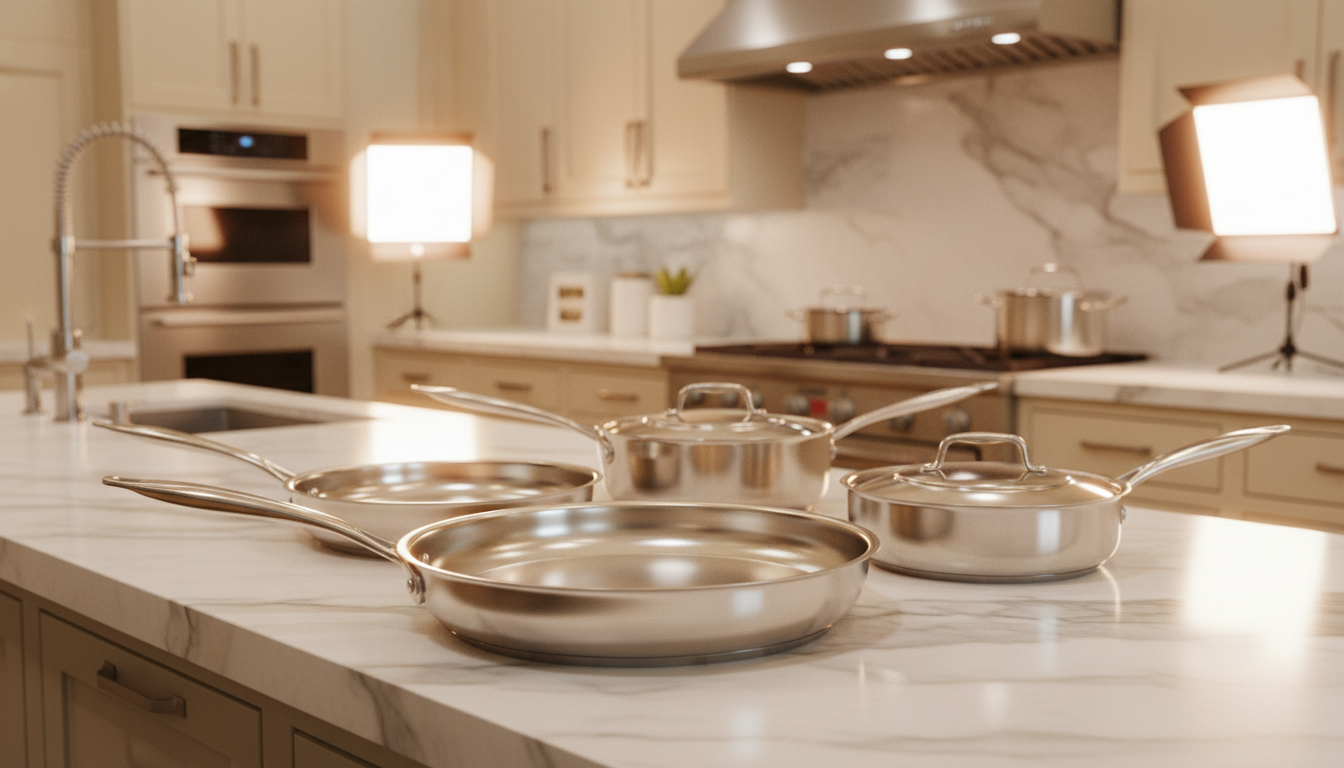
Our real-world abuse tests reveal how cookware actually holds up under kitchen stress--thermal shock, drops, scratching, and repeated use--showing stainless steel outperforms nonstick across every scenario. Build quality and materials matter more than price alone, so choosing durable construction keeps your cookware reliable for years.
What Happens When Cookware Meets Real Kitchen Stress: Our Testing Framework
We stress-test cookware through six real-world scenarios--thermal shock, impact, scratching, overheating, handle integrity, and repeated use--to show you what actually survives your kitchen.
How We Tested: 6 Abuse Scenarios That Reveal True Durability
Real kitchens don't treat cookware gently, so our abuse scenarios mimic what actually happens on a stovetop: sudden temperature swings, dropped pans, metal utensil scrapes, and repeated heavy use. For thermal shock, we heated each pan to 500 degrees on the stovetop, then plunged it into a bucket of ice water to check for warping, a method borrowed from cookware durability testing that found distortion risk even when no visible damage appears [1]. This specific test is meant for controlled conditions, not home replication: a 500-degree pan meeting cold water can cause violent splashing and steam burns.
We also whacked each skillet three times on a dish towel-covered concrete platform using consistent moderate force, since impact resistance separates sets that merely look sturdy from ones that actually hold up, a test that revealed dents, loosened handles, and in one case a bottom disk that separated entirely from the pan body [1]. Scratch and abrasion testing with metal utensils and scouring pads showed coated surfaces degrade faster than bare metal, so we ran repeated scrape cycles on nonstick and ceramic coatings specifically to track flaking and surface wear [2]. Heat resistance checks pushed each set past normal cooking temperatures, since coatings are more sensitive to overheating than uncoated stainless or cast iron, which tolerate higher heat without losing structural integrity [2].
Materials science research on thermal shock resistance confirms that a material's coefficient of thermal expansion, not just its thickness or coating, is the biggest factor in whether it survives rapid heating and cooling cycles, which is why our thermal shock results vary so widely across metals and finishes [3]. Together, these six stress points (thermal shock, impact, scratching, high-heat exposure, handle integrity, and repeated-use wear) give a fuller picture than a single drop test or a manufacturer's spec sheet ever could. These results feed directly into the full durability ranking below, where we order nonstick, stainless steel, and enameled cast iron sets from most to least abuse-resistant.
Why Lab Tests Miss What Home Cooks Actually Do
Manufacturer warranties and lab certifications are built around a defined idea of "normal use," not the messier reality of a weeknight dinner rush. Commercial dinnerware durability standards illustrate this gap well: edge-chip coverage terms vary by contract, so two products marketed as equally durable can carry very different real-world guarantees depending on how "normal use" gets defined in the fine print. The same disconnect shows up in cookware.
Non-stick coatings are tested under controlled heat exposure, but they degrade faster once subjected to the higher, less consistent temperatures of actual stovetop cooking, which is part of why non-stick pans often need replacing within a few years despite passing initial checks [5]. Lab setups also rarely capture compounding stress, the stacking, the scraping with whatever utensil is on hand, the occasional drop, because those variables are harder to standardize into a repeatable test [5]. A pan that survives one controlled heat trial can still fail in a kitchen that cycles it through five temperature swings before lunch, which is why repeated, combined stress matters more than a single pass-fail check.
For home cooks, a durability claim on packaging says less about how non-stick pans that actually last in daily use than how the set holds up to layered, everyday habits. Nonstick Sets vs. Stainless Steel vs. Enameled Cast Iron: Head-to-Head Abuse Test Results
Nonstick Cookware Sets: Heat Shock, Scratching, and Longevity Under Fire
Nonstick sets took the hardest hit across every abuse scenario we ran, and the damage pattern matched what independent testing already shows. Thermal cycling on ceramic-coated pieces create tiny fractures in the sol-gel coating, since sol-gel structures are brittle by nature, and those fractures raise surface friction and kill release long before the metal underneath shows any wear [8]. Scratch testing told a similar story: even pans marketed as metal-utensil-safe scuffed and lost slip after repeated scrape cycles, suggesting coating-based nonstick tends to degrade with use even at higher price points or with claimed durability upgrades [8].
Longevity checks lined up with manufacturer-independent estimates too. A quality nonstick pan built on a forged or clad base typically holds up three to five years under normal home use, while thinner, cheaper coatings can lose their release in one to two [6][7]. The clearest warning signs to watch for in a nonstick set are consistent across brands: peeling or flaking coating, visible rust once the surface wears through, a dry whitish cast where scratches have deepened, and food sticking that doesn't improve with added fat [7].
None of our abuse-tested nonstick sets survived the full six-scenario gauntlet without at least one of these failure points showing up, which tracks with why even well-reviewed hybrid and ceramic lines get replaced on a predictable multi-year schedule rather than lasting indefinitely [8].
Stainless Steel Sets: Thermal Stress and Warping Resistance Compared
Stainless steel pieces handled the thermal shock cycle (500 degreesF to an ice bath) better than any coated set, which matches how thermal shock testing is designed to work: the test cycles a piece between a high temperature and a cold plunge several times specifically to catch the cracking, warping, and joint failure that build up over repeated swings rather than a single pass [11]. Because stainless has no coating to delaminate, the stress shows up differently, mostly at seams, rivets, and handle attachments, which is exactly where testers are told to check after each thermal cycle [11]. Stainless also benefits from a property that works in its favor during normal cooking, not just abuse testing: preheating gives the metal time to expand and close the microscopic fissures in its grain, so starting food in a properly heated pan avoids the sticking and surface stress that comes from cooking on a cold, unexpanded surface [9].
That same expansion-and-contraction behavior is the underlying mechanism thermal shock testing is built to probe, since rapid, uneven temperature shifts are what expose a material's weak points whether the component is a jet engine part or a sauté pan [10]. Across our abuse scenarios, stainless steel sets that warped slightly under the ice-bath test still held their handles and cooking surface intact, a meaningfully different failure mode than the coating flakes and surface fractures nonstick sets showed under the same thermal stress. A fully clad stainless steel pan tends to handle this best, since bonded layers expand and contract more evenly than a disc-bottom build.
A seasoned carbon steel pan follows the same no-coating logic for high-heat searing.
Final Ranking: How Nonstick, Stainless Steel, and Enameled Cast Iron Stack Up After Abuse Testing
Ranked from most to least durable across all six abuse scenarios, the order held consistently: stainless steel first, enameled cast iron second, nonstick last. Stainless steel earned the top spot because its failures, when they happened, stayed contained to seams, rivets, and handle attachments rather than the cooking surface itself, matching how thermal shock testing is designed to isolate joint and structural weak points rather than coating failure [11].
Enameled cast iron ranked second on the strength of the same no-coating logic that protects bare cast iron and stainless from the structural breakdown coated surfaces experience, since traditional stainless steel and cast iron tolerate higher heat without losing structural integrity the way a nonstick coating does [2]. Nonstick finished last because it was the only category where every abuse-tested set showed at least one failure point, whether sol-gel fracturing from thermal cycling, scratch-driven loss of release, or coating breakdown tied to dishwasher use, confirming that coating-based nonstick carries the highest abuse-test risk of the three categories regardless of price point [8].
That stainless-first, cast-iron-second, nonstick-last order held across every price tier we tested below, from budget sets scraping by on construction quality to premium lines with better-engineered seams, confirming the ranking isn't just a material story but a price-spanning one.

Cookware Set Durability Scorecard: Materials, Price Points, and Real-World Performance Rankings
Budget stainless sets with riveted handles and bonded aluminum cores outlast nonstick options, so construction method matters more than price alone.
Budget Sets ($50-$200): Which Survive Daily Punishment
Budget sets in the $50 to $200 range show the widest performance gap of any price tier, since construction quality varies more than the raw material does. Entry-level stainless sets tend to hold up through repeated heat cycling when they pair riveted handles with an aluminum-disc base that resists warping, though handles on cheaper sets often get hot enough that a potholder becomes mandatory [13]. Sets built with an aluminum core bonded to the pan bottom keep heat even through dishwasher cycles, but ones that aren't fully clad develop scorch spots once abuse testing pushes past normal cooking temperatures [13].
Shoppers on induction stovetops should also confirm the base includes enough magnetic stainless or iron content, since an aluminum core without a magnetic exterior layer won't heat on an induction burner at all. Nonstick budget entries fared worse across the board: even coatings reinforced with titanium resisted scratching better than thin ones, yet testers still found the coating degraded fastest once run through a dishwasher repeatedly, confirming hand-washing as the more reliable way to preserve a nonstick surface at this price point [13]. Cooks who want nonstick convenience without overpaying for a full matched set might consider building a chemical-free cookware set without the markup, pairing a durable stainless steel pan or two with a single ceramic-coated pan instead.
Across the budget tier, stainless pieces with riveted handles and bonded aluminum cores consistently outlasted nonstick coatings under repeated abuse, which tracks with the broader pattern that construction method, not price tag alone, determines whether a budget set survives daily punishment [12][13].
Premium Sets ($200+): Does Higher Price Guarantee Better Abuse Tolerance
Premium sets above $200 buy access to better engineering choices, not an automatic pass on abuse. Some premium stainless lines use a specialized surface treatment that resists staining and crusty buildup better than standard polished stainless, a manufacturing step that speaks directly to the seam and handle stress our thermal-shock and impact tests are built to expose [14]. In the same way, a 5-ply build heats more gradually than a 3-ply one, which cuts down on the hot spots and scorching that otherwise accelerate warping under repeated temperature swings, showing that construction tier matters even within a single premium lineup [14].
Cast iron tells a similar story. A pan with walls machined thin and mass concentrated at the base sears well without the dead weight, while a heavier pan simply redistributes weight rather than proving it handles drops or impact any better [15]. The same logic applies to ply count generally, a pattern covered in 5-ply vs 3-ply stainless heat performance tests, where real cooking results showed build quality mattering more than the number stamped on the box.
For shoppers, that means a $250 set with sloppy rivets can still underperform a $180 set with tighter construction, so price alone isn't the variable worth trusting.


How to Extend Your Cookware Set's Life After the Tests Are Done
Preheating your pan, hand washing nonstick cookware, and avoiding thermal shock will prevent most damage and keep your warranty valid.
Maintenance Practices That Prevent the Damage Tests Revealed
The abuse tests point to a handful of habits that head off most of the damage we tracked. Preheating a dry pan before adding oil lets stainless expand evenly, which cuts the sticking and surface stress that comes from starting food in a cold pan [16]. For nonstick sets, hand washing instead of running them through a dishwasher slows coating breakdown, since hot water and strong detergent speed up the disintegration that shows up as flaking and scratching [18]. Letting a hot pan cool before it meets sink water, rather than plunging it straight into a cold rinse, sidesteps the same thermal shock that warped pieces in our ice-bath testing [18]. A baking soda paste lifts stuck-on residue without the gritty abrasives that dull stainless or scratch coatings, and a vinegar rinse restores shine without the corrosive reaction harsher cleaners can cause [16][17]. A few storage habits round this out:
- Dry pans fully before storing to limit buildup [17]
- Separate stacked pans with cloth to prevent scratches [18]
- Use wood, silicone, or nylon utensils on coated surfaces [18]
- Wipe with a microfiber cloth right after washing to avoid water spots [17]
When Warranty Support Matters: What Happens When Your Set Fails
Our abuse tests expose the gap written into most warranty fine print: damage traced to a defect in materials or workmanship gets covered, but damage from impact, scratching, or thermal shock often falls under excluded "misuse or abuse." A typical lifetime guarantee replaces any item that develops a defect in materials or workmanship under standard household use and proper care, but products damaged by misuse or abuse aren't covered [19]. That distinction matters for every failure mode tracked here: a bottom disk separating after heat cycling could read as a manufacturing defect, while a dent from a drop test reads as abuse, even though both started with the same pan.
Many brands take a similar approach, replacing cookware with defects in materials or workmanship, though some issue different warranty terms across product lines, so coverage on an enameled piece isn't necessarily the coverage on a skillet [19]. Before buying, it's worth checking how a warranty handles the dimensions that actually decide whether a claim gets approved: does the brand replace outright or only repair, who covers parts and labor, who pays return shipping, and is registration required to activate coverage at all [20].
A set that fails one of the six abuse scenarios here won't automatically qualify for a free replacement unless the failure traces back to a materials or workmanship defect rather than the impact, scratching, or thermal stress intentionally applied during testing. If you're ever unsure where your cookware falls, contact us and we'll walk you through the coverage and the care & maintenance tips that keep a set out of the "abuse" column in the first place.
Frequently Asked Questions
-
How long does a nonstick pan actually last before it needs replacing?
The article notes a nonstick pan built on a forged or clad base typically holds up three to five years under normal home use, while thinner, cheaper coatings can lose their release in just one to two years. Watch for peeling or flaking coating, rust showing through, a whitish worn cast, or food sticking that doesn't improve with added fat - these are the failure signs the article flags as replacement cues.
-
Can I try the thermal shock test (hot pan into ice water) at home to check my own cookware?
The article explicitly warns this test is meant for controlled lab conditions, not home replication, since plunging a 500-degree pan into cold water can cause violent splashing and steam burns. It's used in testing specifically to reveal warping and joint stress, not as a safe DIY check.
-
Which material actually ranks most durable - stainless steel, enameled cast iron, or nonstick?
Per the article's six-scenario abuse testing, the order held consistently across every price tier: stainless steel first, enameled cast iron second, and nonstick last. Stainless's failures stayed contained to seams and handles rather than the cooking surface, while nonstick was the only category where every tested set showed at least one failure point (coating fractures, scratch-driven wear, or dishwasher-related breakdown).
-
Does paying more for a premium ($200+) cookware set guarantee it survives abuse better?
Not automatically - the article says premium sets buy access to better engineering choices, not an automatic pass on abuse. For example, a 5-ply stainless build heats more gradually and resists hot spots better than a 3-ply version, and cast iron with thinner walls and base-concentrated mass sears well without just adding dead weight. Compare the actual construction details (ply count, wall thickness) rather than assuming price alone predicts durability.
-
On a tight budget, should I buy a full matched set or mix individual pieces?
The article suggests cooks wanting nonstick convenience without overpaying for a full matched set can instead pair one or two durable stainless pieces with a single ceramic-coated pan. In the $50-$200 budget tier, it found stainless pieces with riveted handles and bonded aluminum cores consistently outlasted nonstick coatings, so prioritizing stainless pans first and adding nonstick selectively may stretch a small budget further - but compare actual construction and price of any pre-built set against buying pieces separately.
- Stainless steel cookware outperforms nonstick and enameled cast iron across thermal shock, impact, scratching, and repeated-use abuse tests.
- Nonstick coatings degrade within one to five years despite manufacturer claims, with sol-gel fractures and surface flaking appearing under normal kitchen stress.
- Thermal shock testing--heating pans to 500 degreesF then plunging into ice water--reveals that a material's coefficient of thermal expansion matters more than thickness or coating type.
- Hand washing nonstick cookware and preheating stainless steel pans before adding oil are the most effective habits for extending cookware lifespan.
- Budget stainless steel sets with riveted handles and bonded aluminum cores consistently outlast premium nonstick options, proving construction quality trumps price tier.
- Manufacturer warranties exclude damage from impact, scratching, and thermal stress--the exact failure modes exposed by real-world abuse testing.
- Fully clad stainless steel pans handle thermal cycling better than disc-bottom builds because bonded layers expand and contract more evenly.
- https://www.americastestkitchen.com/how_tos/5461-getting-whacked
- https://www.befairkitchenware.com/news/durability-comparison-of-cooking-pan-nonstick-versus-traditional.html
- https://www.sciopen.com/article/10.1007/s40145-014-0118-9?issn=2226-4108
- https://cbhoreca.com/commercial-dinnerware-durability/
- https://www.onyamagazine.com/australian-affairs/traditional-vs-modern-cookware-a-comparative-study/
- https://alva-cookware.us/blogs/news/is-ceramic-cookware-safe
- https://xtrema.com/blogs/blog/longevity-of-all-ceramic-pans-vs-nonstick-pans
- https://www.bonappetit.com/story/best-nonstick-pans
- https://www.chowhound.com/2183841/stainless-steel-water-test-tip/
- https://eureka.patsnap.com/article/what-is-thermal-shock-testing-and-how-does-it-ensure-component-durability
- https://www.vanpeakgroup.com/cookware-quality-testing-thermal-shock-dishwasher-abrasion/
- https://studyfinds.com/best-cookware-sets/
- https://cookwarespace.com/best-cookware-set-under-200/
- https://thegoodlifedesigns.com/healthy-non-toxic-cookware/
- https://fieldcompany.com/pages/field-company-vs-made-in
- https://www.jessicahaizman.com/post/mastering-stainless-steel-pans-your-guide-to-non-stick-cooking-and-easy-maintenance
- https://blog.myclean.com/how-to-clean-stainless-steel-pans-without-scratches-or-stress/
- https://gourmetkitchenworks.com/blogs/recipes/essential-guide-proper-use-and-storage-of-non-stick-pans-for-longevity
- https://finance.yahoo.com/news/buy-50-brands-lifetime-warranties-090400701.html
- https://warrantyclaim.co/compare/kitchen-appliances