

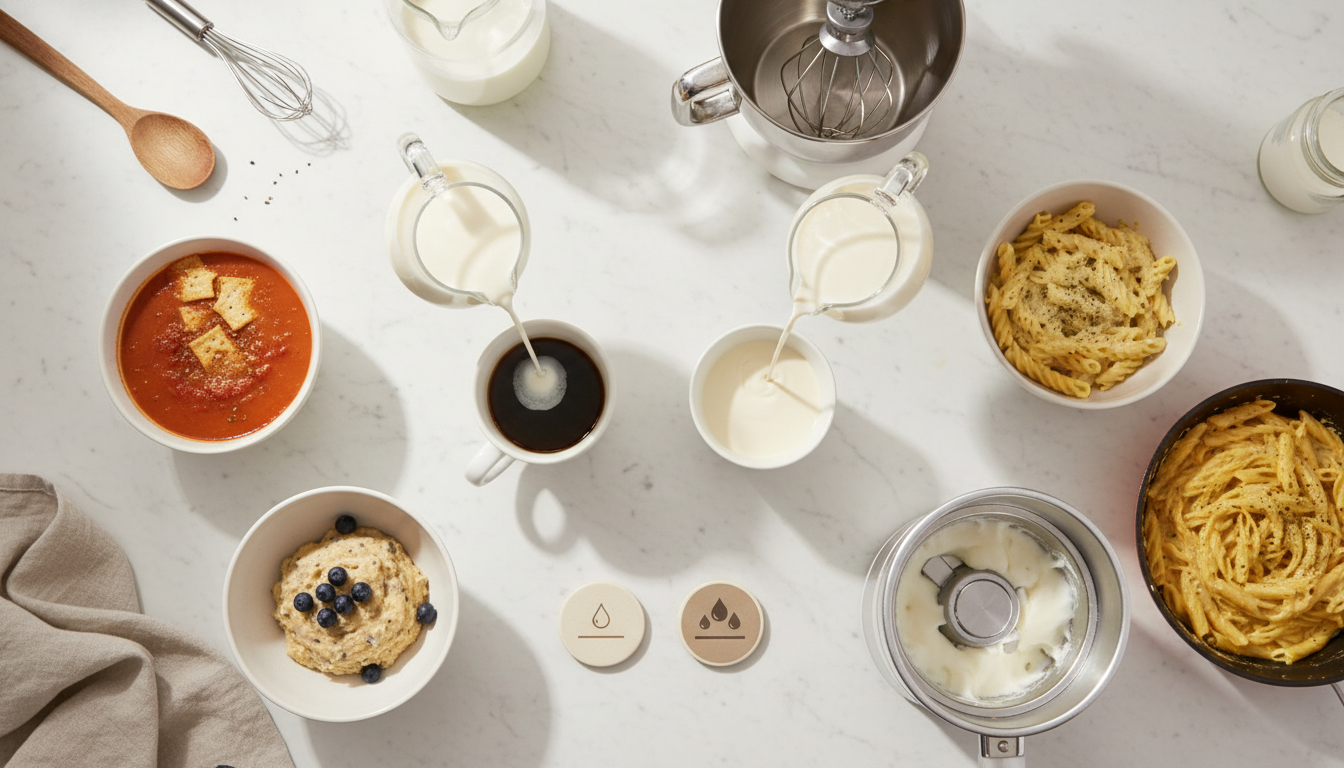
Half-and-half works as a direct swap for heavy cream in soups, sauces, baked goods, and everyday dishes where creaminess matters but structural fat doesn't. The swap fails in whipping applications, ice cream, and emulsified sauces--where you can add melted butter to half-and-half or reach for full-fat coconut cream instead.
Introduction
Half-and-half works well in many creamy dishes, but fat content determines whether it can truly replace heavy cream in your recipe.
The Common Kitchen Dilemma: Out of Heavy Cream?
Running out of heavy cream mid-recipe is a familiar frustration -- and half and half is usually sitting right there in the fridge.
Whether you can use half and half instead of heavy cream comes down to fat content: heavy cream's milkfat sits at or above 36%, while half and half contains significantly less. [1] That gap has real cooking consequences -- below 36%, cream becomes more susceptible to destabilization from heat, acid, or agitation, which changes how it performs in everything from pan sauces to whipping cream. [1] Some recipes handle the lower fat content without issue; others depend on that fat for structure, texture, and stability.
Why People Consider Half-and-Half as a Substitute
Half-and-half sits between milk and heavy cream in fat content -- legally defined at 10.5-18% milkfat -- making it a logical option when a recipe needs more richness than milk but less than full cream. [4] Most home cooks already keep it on hand for coffee, so it's a natural first reach when heavy cream runs out mid-recipe. [4] It performs well in dishes like quiche, French toast, mashed potatoes, and casseroles -- recipes where creaminess matters but ultra-rich texture doesn't. [4] The fat gap still has real consequences in certain applications, which is what limits how far the swap can go. [4]
What This Article Will Cover: When the Swap Works (and When It Doesn't)
The fat gap between half-and-half and heavy cream plays out differently depending on what you're making.
Half-and-half substitutes well in sauces, soups, batters, puddings, and fondues -- though the result may be slightly thinner or less rich -- but should not replace heavy cream in ice cream, whipped applications, or recipes where higher fat content is structurally necessary. [6] This article walks through which recipes tolerate the swap, which ones require you to boost half-and-half's fat content using butter, and when you're better off reaching for a different substitute entirely. [5]
Understanding the Difference: Half-and-Half vs. Heavy Cream
Heavy cream's 36% fat content whips into stable foam and coats dishes richly, while half-and-half's lower fat delivers a lighter body closer to whole milk.
Composition and Fat Content (10-15% vs. 30-40%)
Half-and-half is legally defined as containing 10.5% to 18% milkfat, while heavy cream must contain at least 36% -- a difference that determines how each behaves under heat, during whipping, and in emulsified sauces.[7] Fat is the structural backbone of cream: as milkfat rises, water content drops, and the concentrations of protein and lactose decrease proportionally.[9] Heavy cream's fat content enables stable foam formation -- a process that requires at least 30% fat to function at all -- while half-and-half's lower fat level simply can't support that structure.[9] Both share the same core components (milkfat, protein, lactose, and minerals), but the ratio between them makes them behave like different ingredients once heat or agitation enters the picture.[8]
Texture and Consistency Differences
Heavy cream is noticeably thicker than half-and-half -- a difference in viscosity that shows up immediately when you pour either into a pan or bowl. [11] The density of tiny fat globules suspended in liquid is what creates that smooth, mouth-coating sensation in cream-based dishes; fewer globules mean less of that effect. [12] Half-and-half behaves closer to whole milk in terms of body, so dishes made with it will taste lighter and feel thinner on the palate, even when used in equal quantities. [11] That textural gap matters most in applications like cream sauces, custards, and chowders, where the finished dish is expected to coat the back of a spoon or carry a certain weight -- half-and-half can provide some richness, but not the same body that full-fat cream delivers. [10]
Flavor Profiles and Culinary Properties
Heavy cream delivers a distinctly rich, buttery flavor that comes through in finished dishes -- it adds noticeable depth to custards, ganache, and sauce-based recipes in a way that half-and-half doesn't replicate. [7] Half-and-half sits closer to whole milk on the flavor spectrum, with a milder richness that enhances without overpowering, which is why it has become the standard addition to coffee and tea. [7] Unlike heavy cream, which can leave a greasy film on the surface of beverages, half-and-half blends smoothly and adds creaminess without that residue. [13] For recipes where dairy plays a supporting role -- soups, batters, quiches -- the flavor difference between the two is smaller and more workable with straightforward adjustments. [7]
How Each Behaves When Heated (Curdling Concerns)
Heavy cream's high fat content makes it stable under heat -- you can bring it to a full boil and it won't separate.[14] Half-and-half behaves more like milk under the same conditions: high temperatures cause it to curdle and separate, which is why it's best added at the end of cooking over low heat rather than simmered throughout.[15] To reduce curdling risk, temper the half-and-half first by slowly whisking a small amount of hot liquid into it before adding it to the pan -- this gradual temperature increase gives the emulsion time to stabilize.[15] Adding a small amount of flour or cornstarch beforehand can also help prevent separation in longer-cooked dishes.[16]
When You Can Successfully Substitute Half-and-Half
Half-and-half blends smoothly into beverages and soups without the density of heavy cream, and works cup-for-cup in baked goods for added tenderness.
Coffee, Tea, and Beverage Applications
Half-and-half is the default dairy choice for coffee and tea, and it performs better than heavy cream in most beverage contexts. [4] It blends smoothly into both hot and cold drinks, adds creaminess without overpowering, and doesn't require the extra mixing that heavy cream needs to fully integrate in cold applications like iced coffee. [17] When using heavy cream in coffee, a tablespoon goes much further than the equivalent amount of half-and-half -- it's significantly richer, so less is needed to achieve the same effect on bitterness, and the higher fat content can make cold drinks harder to blend without a frother or shaker. [17] For smoothies and other blended beverages, half-and-half also adds light richness without the dense, coating mouthfeel that full cream creates. [4]
Soups, Chowders, and Lighter Sauces
Half-and-half works well in soups, chowders, and lighter cream-based sauces -- dishes where richness matters but a thick, coating texture isn't the primary goal.
In seafood chowder, substituting half-and-half for heavy cream reduces fat while still producing a creamy, satisfying base. [18] The critical technique is timing: add half-and-half at the end of cooking over low heat rather than simmering it throughout the recipe, which reduces the risk of curdling and separation. [16] When reheating cream soups made with half-and-half, use low heat and stir frequently -- dairy with lower fat content separates more easily when brought back to temperature. [18]
Certain Baking Recipes (Muffins, Quick Breads, Some Cakes)
Half-and-half works as a cup-for-cup substitute for milk in muffins, quick breads, and some cakes -- baked goods where fat contributes to tenderness and moisture rather than structural stability. [19] Because half-and-half is made up of roughly equal parts whole milk and heavy cream, baked goods come out slightly richer than if made with milk alone, without noticeably altering the crumb or rise. [19] Baking batters tolerate the lower fat content because leavening agents and gluten development carry the structure -- unlike stovetop sauces, where emulsion stability depends on higher fat levels. [6] Scones are another strong candidate: their tender interior benefits from half-and-half's fat content in the same way muffins and quick breads do. [6]
Everyday Cooking Where Texture Isn't Critical
Dishes like mashed potatoes, quiche, casseroles, and French toast tolerate the swap well because richness is a preference rather than a structural requirement in these recipes. [20] In mashed potatoes, half-and-half still delivers a creamy result -- the potatoes just come out slightly less dense than they would with full cream. [21] The same holds for pasta dishes with lighter cream-based sauces, scrambled eggs, and egg-based custard fillings, where the dairy blends into a larger mixture and the fat difference is less perceptible. [22] A 1:1 substitution works in most of these everyday applications, with a small amount of melted butter added if you want to bring the fat content closer to heavy cream. [20]
When to Avoid Using Half-and-Half Instead of Heavy Cream
Half-and-half lacks the 30% fat content needed to whip into peaks, churn into ice cream, or stabilize emulsified sauces like hollandaise and Alfredo.
Whipping Applications (Why Half-and-Half Won't Whip)
Whipping applications are where the fat-content gap becomes a hard limit, not just a quality trade-off.
Whipped cream forms when agitation traps air bubbles inside a network of fat globules -- that process requires a minimum of 30% milkfat to function.[23] Half-and-half's fat content of 10.5-18% falls well short of that threshold, so no amount of chilling, whisking, or technique adjustment will produce stable peaks.[24] The same constraint applies to homemade butter: because butter forms from cream whipped past stiff peaks, half-and-half can't reach that point in the first place.[24]
Ice Cream and Frozen Desserts
Ice cream creaminess depends directly on fat content -- fat doesn't freeze, which keeps churned ice cream scoopable rather than rock-hard and icy. [26] Swapping heavy cream for half-and-half cuts that fat significantly, producing a base that freezes firmer and grows noticeably icy over time. [25] Custard-based recipes can compensate: increasing sugar slightly and churning for less time both help, since sugar -- like fat -- also resists freezing. [26] For no-cook Philadelphia-style recipes where dairy flavor is the focus, the lower fat base tends toward iciness faster, particularly after the first day in the freezer. [25]
Rich, Stable Sauces (Alfredo, Hollandaise)
Alfredo and hollandaise are both emulsified sauces where fat plays a direct structural role -- which is why substituting half-and-half creates problems. In cream-based Alfredo, fat content keeps the sauce cohesive as it coats pasta; lower-fat dairy produces a thinner result that separates more readily under heat.
In butter-emulsified sauces, a small amount of cream stabilizes the emulsion -- the fat in heavy cream prevents the sauce from breaking and creates more margin for error when the emulsion comes together [27]. Hollandaise is built on egg yolks and hot butter with no cream in the base, but any dairy added to extend or thin it needs sufficient fat to avoid destabilizing the emulsion [28].
Recipes Where Fat Content Is Crucial for Structure
Ganache, custards, and mousse are dessert applications where heavy cream's fat content directly controls structure, not just richness.
In ganache, fat determines how the mixture emulsifies with chocolate -- lower-fat dairy produces a thinner result that resists setting into a sliceable or pipeable consistency. [7] Custards and tarts depend on fat to produce a smooth, set texture; without sufficient fat, the mixture turns grainy rather than silky. [12] Mousse folded with whipped cream holds its airy structure only because the whipped base requires at least 30% fat to form a stable foam -- half-and-half can't reach that threshold, so the mousse deflates rather than sets. [12]
Upgrading Your Half-and-Half: Methods to Make It Work Like Heavy Cream
Butter raises half-and-half's fat content to mimic heavy cream, while thickeners and careful timing with acid and salt prevent separation in cooked dishes.
The Butter Method: Adding Fat to Half-and-Half (Ratios and Techniques)
Adding melted butter to half-and-half raises its fat content enough to function like heavy cream in most cooked applications.
The ratio is ⅞ cup half-and-half combined with ⅛ cup melted butter -- mix until fully combined before adding to your recipe. [5] Butter's fat content exceeds 80%, so even a small addition meaningfully shifts the fat balance, making the mixture suitable for pan sauces, soups, and casseroles where heavy cream's density matters. [5] This combination won't whip, since the adjusted fat content still doesn't reach the minimum threshold required for foam formation -- that limit holds regardless of how much butter you add. [29]
Thickening Agents to Improve Consistency (Cornstarch, Flour)
Cornstarch is the more practical thickening agent for half-and-half: dissolve 1 to 2 teaspoons per cup in a small amount of cold half-and-half before adding it to the recipe, then heat slowly over medium while stirring constantly -- boiling breaks the starch and reverses the thickening effect. [30] Flour works better as a roux, cooked briefly with butter before the half-and-half is added, which distributes the starch evenly and prevents separation in longer-cooked dishes like soups and casseroles. [30] Both thickeners address viscosity, not fat content, so the result will be thicker but still lighter in body and flavor than a dish made with heavy cream -- thickening agents compensate for texture, but can't replicate the structural role fat plays. [31]
Stabilizing Techniques for Hot Applications
The two biggest destabilizers for half-and-half in hot applications are acid and salt -- both accelerate protein coagulation and can cause separation even at moderate heat.
If your recipe includes wine, tomatoes, or lemon juice, add a starch slurry to the pan before incorporating the half-and-half, since the starch acts as a buffer against the acid's effect on the emulsion. [32] Salt compounds the problem when cooked in from the start, so season at the very end -- adding it early and reducing the liquid alongside it pulls moisture from the dairy proteins and speeds up curdling. [32] Keeping the burner at medium-low throughout and never allowing the mixture to reach a full boil remains the baseline rule: lower-fat dairy separates quickly once it crosses into a strong simmer. [16]
Recipe-Specific Adjustments for Best Results
Recipe-specific adjustments come down to matching your technique to the dish.
For pan sauces, combining the butter method with a starch slurry addresses both fat content and viscosity -- producing a result closer to what heavy cream delivers. [5] In custard-based recipes like quiche or flan, a straight 1:1 swap works without any additions, though the texture will be slightly lighter; for crème brûlée or ganache, no adjustment fully compensates for the fat gap. [5] Baked goods -- muffins, quick breads, and French toast batters -- perform well with a direct 1:1 substitution and require no further modification. [30]
Beyond Half-and-Half: Other Substitutes for Heavy Cream
Milk blended with butter, Greek yogurt, sour cream, and coconut cream all work as heavy cream stand-ins depending on your recipe's needs.
Milk and Butter Combinations
Combining whole milk with melted butter produces a functional heavy cream substitute when half-and-half isn't available either.
The ratio is one stick of butter (113 grams) blended with 1 cup (227 grams) of milk -- emulsified at high speed for two minutes until frothy, which prevents the fat and liquid from separating once cooled. [31] Because this mixture lacks cream's stabilizers, use 25% less by weight than the recipe calls for: a recipe requiring 1 cup of heavy cream needs only about 170 grams of the substitute. [31] It performs well in ganache, puddings, scones, and cooked sauces -- but won't whip into peaks, since the mixture doesn't reach the minimum fat threshold required for foam formation. [31]
Greek Yogurt, Sour Cream, and Other Dairy Alternatives
Greek yogurt and sour cream are practical dairy substitutes for heavy cream in soups, sauces, and baked goods.
Greek yogurt substitutes at a 1:1 ratio in pasta sauces, casseroles, and soups -- it adds protein and mild tang while keeping creaminess, and can be thinned with a small amount of milk if the texture needs adjusting. [33] Sour cream contains roughly 18-20% milkfat, making it richer and less tangy -- it produces a more tender crumb in cakes, muffins, and quick breads, while Greek yogurt delivers a lighter result with more protein. [35] In most baking recipes, the two are interchangeable at a 1:1 ratio since both contribute acidity and moisture in similar proportions. [34]
Non-Dairy Options (Coconut Cream, Nut Creams)
Coconut cream contains 25-35% fat -- close enough to heavy cream's 36% minimum that it can whip into soft peaks and substitute 1:1 in most cooking applications. [37] The label matters: "coconut cream" is pure and thick, while "cream of coconut" is sweetened with lower fat content and is made for cocktails, not cooking -- the two are not interchangeable. [37] When coconut cream isn't available, refrigerate a sealed can of full-fat coconut milk overnight, then scoop the solidified cream layer from the top and use it the same way. [37] Cashew cream -- made by soaking raw cashews and blending them smooth with water -- is a milder-flavored alternative that substitutes 1:1 in soups, sauces, curries, and baked goods, though it won't whip. [36]
Choosing the Right Substitute Based on Your Recipe
The substitute that works best depends on what the recipe needs -- richness, body, or structural fat.
For whipping, only full-fat coconut cream reliably forms peaks among the non-dairy options; half-and-half and milk-based combinations won't reach the fat threshold required for foam formation. [38] For cooked sauces, soups, and casseroles, the half-and-half-plus-butter combination and cashew cream are the most versatile choices, adding fat and creaminess without competing flavors. [21] Baked goods are the most flexible category -- Greek yogurt blended with milk, half-and-half, or evaporated milk all work at a 1:1 ratio with minimal adjustment, since structure comes from leavening rather than fat. [39]
Conclusion
Summary: When Can You Use Half-and-Half Instead of Heavy Cream?Half-and-half substitutes for heavy cream in soups, sauces, baked goods, and everyday dishes like mashed potatoes and quiche -- anywhere creaminess matters but structural fat doesn't. [15] The swap fails in whipping applications, ice cream, ganache, and emulsified sauces like Alfredo, where fat content controls texture and stability rather than just flavor. [23] Adding ⅞ cup half-and-half with ⅛ cup melted butter raises the fat level enough to cover most cooked applications, though the adjusted mixture still won't whip. [15] For non-dairy needs, full-fat coconut cream is the only substitute that reliably reaches the fat threshold required for foam formation. [23]
Key Takeaways for Successful Substitution
- Half-and-half contains 10.5-18% milkfat versus heavy cream's minimum 36% -- that gap determines where the swap works and where it fails. [24]
- A 1:1 substitution works in soups, chowders, baked goods, mashed potatoes, quiche, and pasta dishes where richness matters but structural fat doesn't. [24]
- Half-and-half will never whip into peaks -- stable foam requires at least 30% milkfat, and no technique adjustment changes that hard limit. [2]
- To mimic heavy cream in cooked applications, combine ⅞ cup half-and-half with ⅛ cup melted butter -- this raises fat content enough for most sauces and casseroles. [24]
- Add half-and-half at the end of cooking over low heat and temper it first to prevent curdling; acid and salt both accelerate separation. [2]
- For non-dairy needs, full-fat coconut cream (not cream of coconut) is the only substitute that reliably whips and functions like heavy cream across most applications. [24]
Confidence in the Kitchen: Experimenting with Cream Alternatives
Adaptability is the most practical kitchen skill there is, and cream substitutions are a direct way to build it. [40] Each swap teaches you something about how fat, texture, and heat interact -- lessons that carry across sauces, custards, and baked goods far beyond this one ingredient. [40] By considering texture, flavor, and cook time rather than treating substitutions as guesswork, you expand your options and may end up with a dish you prefer. [40] Home cooks managing dietary restrictions often develop the sharpest substitution instincts precisely because necessity forces them to understand what each ingredient actually does rather than just following a recipe. [41]
- Half-and-half contains 10.5-18% milkfat versus heavy cream's 36% minimum--this gap determines where substitution works.
- Use 1:1 half-and-half in soups, baked goods, mashed potatoes, and quiche where creaminess matters but structural fat doesn't.
- Half-and-half cannot whip into peaks; stable foam requires at least 30% milkfat, a hard limit no technique can overcome.
- Combine ⅞ cup half-and-half with ⅛ cup melted butter to raise fat content for sauces and casseroles.
- Add half-and-half at the end of cooking over low heat and temper it first to prevent curdling from acid or salt.
- Never substitute half-and-half in whipped cream, ice cream, ganache, Alfredo, or hollandaise--these require heavy cream's fat for structure.
- https://lifetips.alibaba.com/kitchen-hacks/heavy-cream-vs-heavy-whipping-cream
- https://www.seriouseats.com/half-and-half-substitutes-11863871
- https://www.simplyrecipes.com/heavy-cream-vs-half-and-half-expert-8718907
- https://www.realsimple.com/food-recipes/recipe-collections-favorites/popular-ingredients/half-and-half-vs-heavy-cream
- https://www.chowhound.com/1528603/heavy-cream-substitute-butter-half-and-half/
- https://www.landolakes.com/faqs/whipping-cream-and-half-half/traditional-half-half/can-i-cook-and-bake-with-half-half/
- https://www.usdairy.com/news-articles/the-types-of-cream-and-their-uses
- https://opentextbc.ca/ingredients/chapter/milk-products/
- https://agriculture.institute/dairy-products-i/chemical-composition-of-different-creams/
- https://www.davidlebovitz.com/what-is-half-and-half/
- https://www.aol.com/whats-difference-between-half-half-033942450.html
- https://www.seriouseats.com/the-science-of-whipped-cream-butter-creme-fraiche
- https://www.finedininglovers.com/explore/articles/what-difference-between-heavy-cream-and-half-and-half
- https://www.thespruceeats.com/what-is-half-and-half-995712
- https://www.eatingwell.com/article/8048612/half-and-half-vs-heavy-cream/
- https://www.allrecipes.com/article/rules-for-heating-dairy-ingredients/
- https://onegreatcoffee.com/blogs/latest-news/using-heavy-cream-in-coffee-the-ultimate-guide?srsltid=AfmBOoodR9U1sBFsrxYQIzBW6ARF1HBl_Ienkq1zCtDl7wWpR63q_RcS
- https://www.simplejoy.com/seafood-chowder-recipe/
- https://www.tasteofhome.com/collection/milk-substitute-for-baking/
- https://bloomandskillet.com/can-i-use-half-and-half-instead-of-heavy-cream/
- https://www.epicurious.com/expert-advice/heavy-cream-substitute
- https://www.evolvingtable.com/substitute-heavy-cream/
- https://www.seriouseats.com/the-best-ways-to-make-whipped-cream-recipe-6755273
- https://www.foodnetwork.com/how-to/packages/food-network-essentials/half-and-half-vs-heavy-cream
- https://www.kingarthurbaking.com/blog/2018/08/24/ice-cream-two-ways
- https://www.davidlebovitz.com/tips-for-making-1/
- https://simply-delicious-food.com/creamy-lemon-butter-sauce/
- https://downshiftology.com/recipes/hollandaise-sauce/comment-page-1/
- https://www.thespruceeats.com/heavy-cream-substitute-4154289
- https://foodess.com/article/heavy-cream-substitute/
- https://www.kingarthurbaking.com/blog/2025/11/17/heavy-cream-substitute
- https://www.thespruceeats.com/prevent-milk-from-curdling-when-cooking-996067
- https://www.usdairy.com/news-articles/how-to-substitute-greek-yogurt-into-recipes
- https://chelsweets.com/baking-substitutions-guide/
- https://kmariekitchen.com/sour-cream-vs-greek-yogurt-for-baking/
- https://food52.com/story/24344-best-heavy-cream-substitutes
- https://veganinthefreezer.com/vegan-substitute-for-heavy-cream/
- https://www.bonappetit.com/story/heavy-cream-substitute?srsltid=AfmBOoqCnvpFS-LpRyxDl-iWb0KJgmROQT8sESYMGT5IpgCp3L5bEfmn
- https://www.allrecipes.com/article/heavy-cream-substitutes/
- https://cooking.nytimes.com/article/ingredient-substitutions
- https://www.davidlebovitz.com/baking-ingredients-and-food-substitutions/
- Summary
- Introduction
- Understanding the Difference: Half-and-Half vs. Heavy Cream
- When You Can Successfully Substitute Half-and-Half
- When to Avoid Using Half-and-Half Instead of Heavy Cream
- Upgrading Your Half-and-Half: Methods to Make It Work Like Heavy Cream
- Beyond Half-and-Half: Other Substitutes for Heavy Cream
- Conclusion
- Key Takeaways
- References