

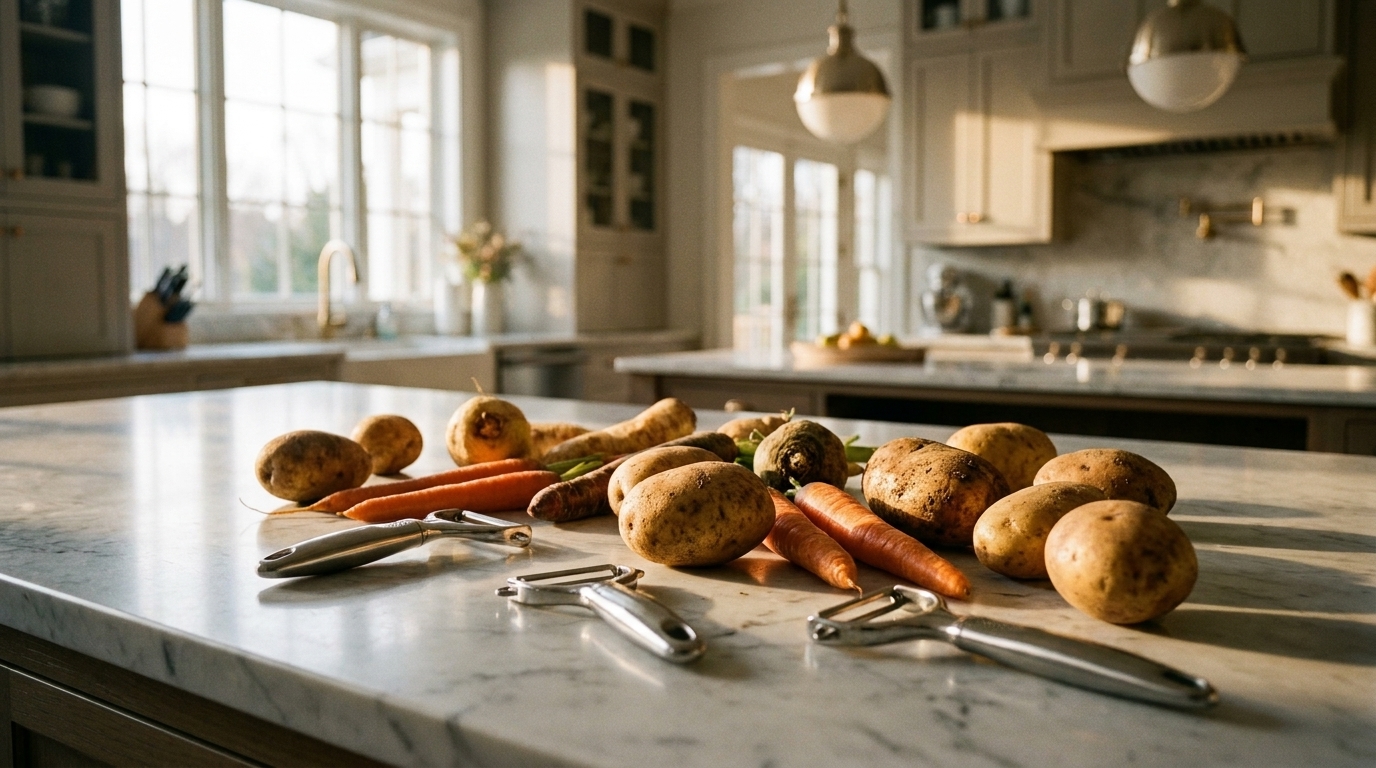
Choosing the right potato peeler depends on understanding blade type, material, and handle design to match your cooking style and needs. High-carbon stainless steel with a comfortable grip and proper maintenance habits will deliver clean peels and lasting performance.
Understanding Potato Peeler Types
Y-shaped peelers work faster on large vegetables, while straight peelers give you more control on smaller or delicate produce.
Straight peelers vs. Y-shaped peelers
The main practical difference between straight and Y-shaped potato peelers is blade orientation, which changes your entire peeling motion.
A straight peeler has a vertical blade aligned with the handle -- you scrape laterally across the vegetable's surface, a motion most home cooks find immediately familiar.[1] A Y-peeler positions the blade horizontally at the top of the handle, so you pull downward along the vegetable's length rather than across it, which most professional chefs prefer for speed and reduced wrist movement.[1] Straight peelers offer more control on small or delicate produce, while Y-peelers cover more surface area per stroke -- making them noticeably faster for larger vegetables like potatoes and carrots.[2]
Swivel vs. fixed blade designs
The swivel blade pivots to follow the contours of a vegetable's surface, making it forgiving on irregular shapes like knobby potatoes or curved squash.[3] A fixed blade stays rigid -- you manually hold the angle consistent, which gives more control on smooth, uniform produce but demands more technique on bumpy surfaces.[4] Swivel designs are also more accessible for left- and right-handed cooks, since the blade adjusts to your stroke direction rather than requiring a specific grip orientation.[4] Fixed-blade peelers, like crosswise dual-blade models, can cut in both directions, but without any flex in the blade, consistent pressure matters more to achieve even peels.
Ceramic vs. stainless steel blades
Stainless steel blades resist rust and hold up to rough handling, but they dull faster than carbon steel alternatives.[5] Ceramic blades won't corrode and help slow food browning -- useful when peeling large batches of potatoes or apples in a single session.[5] In practice, though, ceramic peelers tend to underperform on harder vegetables like butternut squash, struggle to make long consistent cuts, and break easily when dropped.[6] For most home cooks, a stainless steel potato peeler handles a wider range of tasks without the fragility -- and if you're curious how these materials compare more broadly, our ceramic vs stainless steel cookware guide covers the full picture.

Key Features to Consider
Blade material, handle grip, and weight all work together to reduce hand fatigue and give you control through large batches of vegetables.
Blade sharpness and durability
Blade sharpness directly affects how much pressure you need to apply -- a dull blade requires more force, which increases the risk of slipping and uneven peels.[7] High-carbon stainless steel holds an edge better than standard stainless, handles tougher vegetables without dulling quickly, and resists rust without any special upkeep.[8] If long-term sharpness matters to you, stainless steel is the right material -- ceramic blades can chip or break under heavy use, and carbon steel needs careful drying after every wash to avoid rust.[8] When your potato peeler starts producing ragged strips instead of clean peels, replacement is usually the smarter move: the double-blade design makes resharpening awkward and rarely produces consistent results.[7]
Ergonomic handle design
Handle material directly affects how long you can peel before your hand fatigues -- a thermoplastic rubber grip stays secure when hands are wet or slippery, reducing the pressure needed to maintain control throughout a full prep session.[9] Soft-grip handles achieve the same result and are worth prioritizing if you regularly work through large batches of potatoes or root vegetables.[10] An ambidextrous handle design means both left- and right-handed cooks can use the same potato peeler without adjusting grip orientation, which matters more than it sounds when you're moving quickly.[9] Tool weight also plays a role -- a lighter peeler, around 0.12 pounds, reduces wrist strain without sacrificing the stability needed for clean, consistent strokes.[10]
Additional functionalities (e.g., julienne blades)
Most potato peelers now offer blade options beyond a standard straight edge -- julienne blades create thin matchstick strips from carrots or cucumbers without a mandoline, serrated blades grip slippery skins on tomatoes and peaches, and built-in eye removers let you clear blemishes mid-peel without switching tools.[12] A julienne peeler also handles zucchini ribbons and vegetable noodles efficiently -- if you want to see how these cuts compare to knife techniques, our chiffonade vs julienne difference guide covers when each approach applies.[11] Multi-blade sets typically bundle a straight, serrated, and julienne peeler together, giving you one purpose-built tool per task rather than adapting a single blade to every job.[13]
Top-Rated Potato Peelers in the Market
The OXO Good Grips Pro Swivel Peeler combines rust-resistant stainless steel with a stable handle, while budget options like the Kuhn Rikon deliver sharp performance at half the price.
Best overall: OXO Good Grips Pro Swivel Peeler
The OXO Good Grips Pro Swivel Peeler earns its top ranking through consistent performance and build quality -- its stainless steel swivel blade cuts in both directions and averaged around 30 seconds per potato during testing, with peels falling away cleanly rather than clogging the blade.[7] A die-cast zinc bridge gives the tool a solid, stable feel that most competing models lack, and the silicone handle stays comfortable through extended prep sessions.[14] The built-in metal eye removes potato blemishes without switching tools, and the blade's shallower cut makes it more precise for delicate work like peeling citrus rind without the pith.[14] Unlike carbon steel alternatives, the stainless blade resists rust and handles both hand-washing and dishwasher cleaning without issue.[7]
Best budget option: Kuhn Rikon Original Swiss Peeler
The Kuhn Rikon Original Swiss Peeler costs under $10 and consistently outperforms peelers at twice the price in head-to-head tests.[15] Its carbon steel blade -- the same material used in high-end chef's knives -- holds a sharp edge through extended use and glides through everything from carrots to tough butternut squash without clogging.[14] Nearly an inch of clearance between the blade and the body keeps peels moving away cleanly, and the lightweight Y-shape reduces hand fatigue even through large batches.[15] The trade-off is rust sensitivity: carbon steel corrodes quickly when left wet, so hand-wash it and dry thoroughly before storing.[4]
Best premium choice: Rösle Stainless Steel Wide Crosswise Peeler
The Rösle Stainless Steel Wide Crosswise Peeler sits at the higher end of the price range, but its all-stainless construction justifies the cost for cooks who want a potato peeler built to last.
Its dual blades cut cleanly in both directions, the round satin-finish handle conceals fingerprints and includes a hanging loop for hook storage, and the tool is fully dishwasher-safe -- a practical combination for busy kitchens.[4] In testing, it moved smoothly through potatoes and lemon rinds, though its narrower blade requires more strokes on larger vegetables like butternut squash, where it showed marginally more skidding than the competition.[16] The blade is also replaceable, so you're investing in a frame that outlasts the cutting edge itself.[17]


Peeling Techniques and Tips
Proper grip, blade angle, and a flat cutting surface make peeling efficient and safe, while keeping your peeler sharp through hand-washing extends its life.
Proper grip and peeling motion
Grip matters more than most cooks realize -- holding your potato peeler too tightly increases wrist fatigue, while a loose grip causes the blade to skip rather than cut cleanly.
The most efficient technique is to hold the handle like a razor: blade parallel to the vegetable surface, consistent pressure, using a back-and-forth stroke rather than a single downward drag.[18] Both peeling directions work equally well -- away from you or toward you -- and which you choose depends entirely on what feels most comfortable.[19] Resting the vegetable flat on a cutting board instead of holding it freehand gives you more control and reduces the risk of the potato slipping mid-stroke.[18]
Peeling different vegetables efficiently
Different vegetables call for different peeling approaches -- root vegetables like carrots, beets, and potatoes generally need it, while summer squash, asparagus, and zucchini can go straight to the cutting board without peeling.[22] For large carrots, removing the outer skin eliminates the bitterness that builds in older produce; younger, smaller carrots just need a firm scrub.[21] Winter squash skin is thick and usually peeled before roasting, though baking it whole and scooping out the flesh afterward sidesteps the task entirely.[20] Cucumbers with waxy or thick skins benefit from peeling, but thinner-skinned varieties don't require it.[21]
Maintaining blade sharpness
A potato peeler blade is dull when you find yourself pressing harder than usual or passing over the same spot twice to get a clean peel.[23] You can restore the edge with a metal nail file or honing rod: draw it along the blade at a 15- to 20-degree angle several times, then wipe off any metal debris before peeling again.[23] This method works on stainless steel and carbon steel blades but will damage ceramic or serrated edges, which need professional attention if dulled.[23] Hand-washing rather than running your peeler through the dishwasher is one of the most practical care & maintenance tips for slowing blade dulling -- dishwasher detergent is abrasive, and the water pressure causes tools to knock against each other during cycles.[24]
Care and Maintenance of Potato Peelers
Hand-wash and dry your peeler immediately after each use, avoid the dishwasher, and store it separately from other metal tools to preserve the blade's edge.
Cleaning and storage best practices
After each use, rinse your potato peeler under warm water to remove loose debris, then scrub the blade and handle with mild dish soap -- paying attention to crevices where residue collects.[25] Avoid soaking peelers with plastic handles for extended periods, as prolonged moisture causes warping and handle degradation.[26] Hand-washing and immediate drying beats the dishwasher for any blade: dishwasher detergent is abrasive, and water pressure causes tools to knock against each other during cycles, dulling the edge faster.[25] Store your peeler in a clean, dry location away from heat; if it came with a blade guard, use it -- it protects the edge and prevents accidental cuts when reaching into a drawer.[26]
Sharpening or replacing blades
Replacement is almost always the smarter call when a potato peeler consistently drags, leaves ragged strips after multiple sharpening attempts, or shows rust or visible blade damage -- most quality peelers sell for under $20, making repeated restoration attempts a poor use of time.[27] If you peel daily and want to avoid replacing the entire tool every season, a few models support replaceable blades: the Forever Peeler and Suncraft Ever Peeler both offer swap-out blades sold separately for roughly $15 each, so you keep the handle and replace only the cutting edge.[23] For high-volume users, this is a practical middle ground between disposable tools and frequent sharpening cycles.[23] When buying a replacement, look for blades labeled high-carbon stainless steel -- they hold an edge significantly longer than budget alternatives before dulling again.[28]
Extending the lifespan of your peeler
Three habits extend a peeler's lifespan beyond what basic cleaning provides: avoid leaving any blade in contact with acidic foods -- lemon juice, vinegar, or tomatoes -- for more than a couple of minutes, since prolonged acid exposure accelerates corrosion at the blade's tip on both stainless and carbon steel.[29] Store peelers separately from knives and graters, as metal-on-metal contact during storage causes micro-chips that shorten blade life and can't be reversed through sharpening.[29] Carbon steel blades need the most attention here -- hand-wash, dry immediately, and keep them well away from acidic produce to prevent the rust buildup that a stainless steel potato peeler naturally resists without any extra upkeep.[30]
- Y-shaped peelers cover more surface area per stroke and are faster for large vegetables than straight peelers.
- Swivel blades adapt to irregular shapes, while fixed blades demand more technique but offer greater control on smooth produce.
- High-carbon stainless steel holds an edge significantly longer than standard stainless or ceramic without rust concerns.
- Hand-wash and dry immediately after use--dishwasher detergent and water pressure dull blades faster than normal wear.
- Grip the peeler like a razor with consistent pressure and back-and-forth strokes, resting vegetables flat for control.
- Replace rather than sharpen when peelers drag or leave ragged strips; quality models cost under $20.
- https://www.seriouseats.com/the-best-vegetable-peeler
- https://homekitchentech.com/y-peeler-vs-straight-peeler/
- https://www.allrecipes.com/article/why-peeler-type-matters/
- https://www.foodandwine.com/lifestyle/kitchen/best-vegetable-peelers
- https://www.thespruceeats.com/best-potato-peelers-4175941
- https://www.epicurious.com/expert-advice/epi-tested-best-vegetable-peeler-review-article
- https://www.thespruceeats.com/best-vegetable-peelers-4164913
- https://dtdfhomeandkitchen.com/best-peelers/
- https://www.restaurantware.com/products/comfy-grip-teal-stainless-steel-vegetable-peeler-7-1-2-1-count-box?srsltid=AfmBOoqswAu6HKgQaTvNblXUDYPSw5H-r3cZvXCH9S72eViA3S798iI0
- https://thefarmyardstore.com/p/stainless-steel-peeler-with-ergonomic-handle-length-848974278939
- https://dalstrong.ca/blogs/news/potato-peeler?srsltid=AfmBOopt36z1g4G_4i47H8WH25ITDg1JA23zCQY32eODPjLOnrZxmbrG
- https://grokipedia.com/page/Peeler
- https://microplane.com/products/3pc-professional-peeler-set?srsltid=AfmBOoo7WEXDz5pG1Q83S4Nkjuo7m43OkITDFrF5kwNKKPSSavBfQOo1
- https://www.nytimes.com/wirecutter/reviews/best-vegetable-peeler/
- https://www.americastestkitchen.com/equipment_reviews/2592-the-best-vegetable-fruit-peelers
- https://www.seriouseats.com/best-vegetable-peelers-6892175
- https://www.roesle.com/en/swivel-peeler-crosswise/?srsltid=AfmBOopplRBOaYYHHaW4mVPwc4ElaLIvMPajuNOHZfALdjiwqWlUT-PO
- https://homemaking.com/maka/heres-how-to-use-a-potato-peeler-the-right-way/
- https://justeatrealfoodnow.com/foodword/peel/
- https://www.cookingmanager.com/need-peel-vegetable/
- https://jenniferskitchen.com/to-peel-or-not-to-peel/
- https://www.bhg.com/recipes/how-to/cooking-basics/how-to-shred-vegetables/
- https://www.foodrepublic.com/1512714/best-way-sharpen-vegetable-peeler/
- https://www.tastingtable.com/1196420/the-trick-to-sharpening-your-vegetable-peelers-without-any-special-tools/
- https://misen.shop/blogs/news/potato-peelers-the-essential-guide-to-choosing-the-best-potato-peeler
- https://blog.brandstokitchen.com/maintenance-guide-for-potato-peelers/
- https://www.mashed.com/1581251/why-shouldnt-sharpen-vegetable-peeler/
- https://lifetips.alibaba.com/kitchen-hacks/how-to-sharpen-a-dull-vegetable-peeler
- https://lifetips.alibaba.com/kitchen-hacks/kitchen-tool-school-the-humble-y-shaped-vegetable-peel
- https://www.cooksinfo.com/peelers