

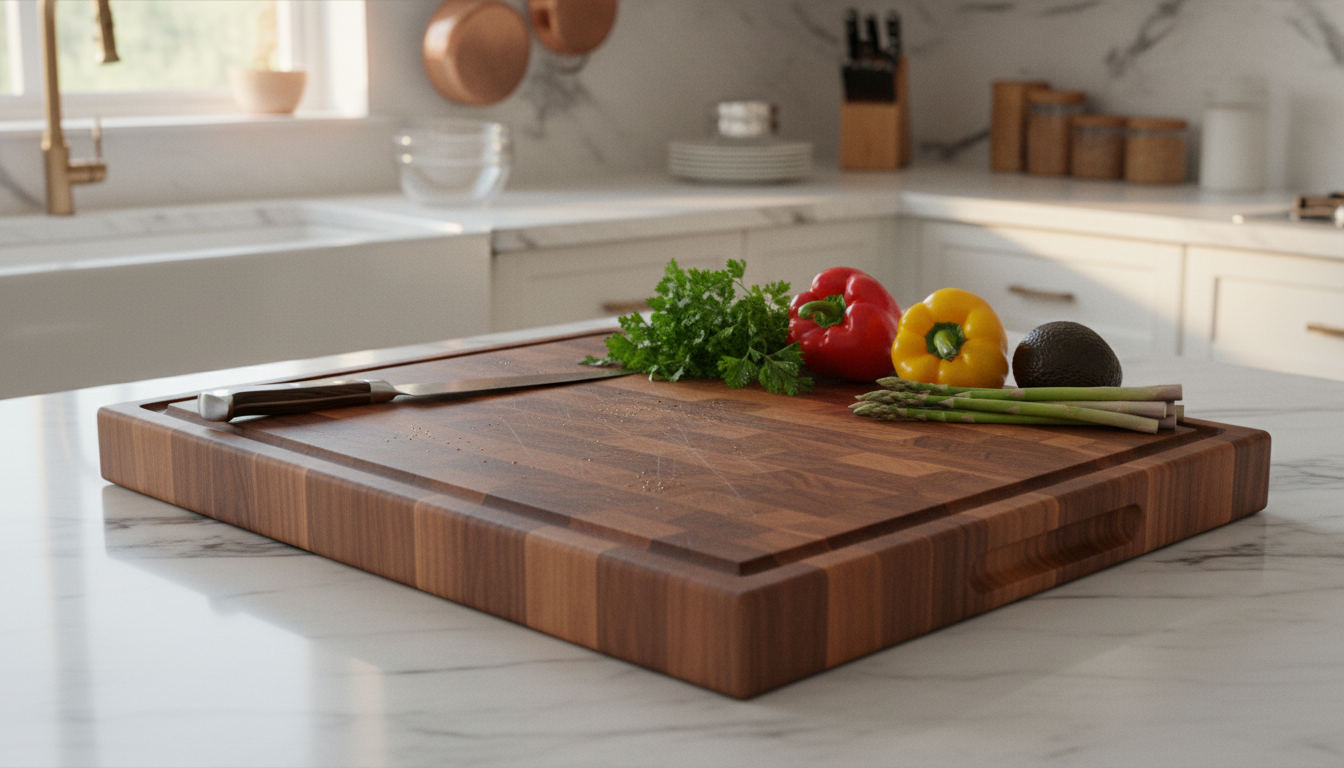
Choosing the right cutting board size directly affects your prep speed and safety by giving you adequate workspace and knife control. Match board dimensions to your cooking volume--small for garnishes, medium for weeknight dinners, large for whole proteins and shared prep--then maintain it with proper cleaning and monthly oiling.
Why Cutting Board Size Matters More Than Wood Type Alone
Matching your cutting board's dimensions and thickness to the volume of food you're prepping keeps your knife control steady and your prep rhythm uninterrupted.
How board dimensions affect prep efficiency and knife control
The dimensions of your cutting board directly shape how much room you have to work, and that space affects both speed and safety. A larger board gives you more surface area to spread ingredients, keep raw proteins separated from produce, and move your knife freely without bumping into bowls or trimmings piled at the edge [1][2]. Thickness matters just as much as length and width: a thicker board resists warping and sits more stable on the counter, which keeps the blade tracking true instead of wobbling mid-cut [1].
A board sized for a quick garnish works fine for herbs or a single lemon, but it becomes a liability once you're breaking down a chicken or prepping a week's worth of vegetables, where ingredients need room to rest before moving to a pan [2]. When a board is too small for the task, food crowds together, forcing repeated pauses to clear space instead of maintaining a steady chopping rhythm. That stop-start pattern slows prep and raises the odds of an awkward knife angle or a slip.
Matching board size to the volume of food you're actually cutting, rather than grabbing whatever's within reach, keeps knife control consistent from the first cut to the last.
The relationship between task type, board size, and wood selection
Task type drives both dimensions and wood choice at the same time, so the two decisions aren't separate. An 18" x 12" end-grain board handles frequent chopping for a household of four to six because it gives enough room to keep diced vegetables from spilling off the edge, while a smaller 9" x 12" board suits single-portion prep or sandwich-making where speed matters more than space [3]. Meat prep changes the calculus further: a reversible 18" x 14" board with a sloped side for catching juices works better for butchering or carving than a flat board sized the same way, since the task itself calls for a feature beyond square footage [3].
Wood density factors in here too. Harder woods like maple, walnut, and cherry hold up to the repeated, heavy knife contact of breaking down proteins or chopping dense vegetables, while a board's grain orientation (explored in our guide to grain direction and knife wear) affects how well it resists scarring under that same workload [4]. Wood is often described as having natural antibacterial properties, but what actually keeps raw meat and poultry prep safe is washing the board in hot, soapy water after each use, which matters more as board size and task intensity increase together [5].
In practice, matching size to task means asking how much food needs to rest on the surface at once, and matching wood to task means asking how much repeated knife contact that surface will absorb before it shows wear.
The Best Woods for Cutting Boards: Hardness, Durability, and Knife-Friendliness
Maple's tight grain resists knife marks better than walnut or cherry, making it the top choice for heavy daily kitchen use.
Maple, walnut, and cherry: Hardwood comparison for longevity and performance
Maple, walnut, and cherry all qualify as hardwoods, but they don't perform identically under a knife. Maple is the densest of the three, with a tight, closed grain that resists deep knife scratches and surface scoring better than almost any other wood used for boards, which is why it shows up most often in heavy daily-use kitchens [8]. That same density is often cited for giving maple added resistance to bacteria, since a tight grain structure is harder for bacteria to penetrate, and it holds up to repeated chopping without warping as quickly as softer options [6][8].
Walnut sits a notch softer than maple, and that slight give actually works in its favor for knife care: a walnut board is gentler on blade edges, helping knives stay sharp longer between sharpenings, while still offering enough density to resist nicks and warping over years of use [7][8]. A surface that spares the edge pairs well with a quality blade like the Misen chef's knife, so the two work together instead of against each other. Cherry is the least dense of the group and doesn't match maple or walnut for sheer hardness, but its fine, uniform grain still minimizes knife marks and scoring, and it holds up fine for general-purpose cutting rather than heavy butchering [7].
All three develop their own character with use and oiling, with cherry in particular taking on a deeper patina over time, but if long-term resistance to scarring and heavy knife contact is the priority, maple's density gives it a durability edge over both walnut and cherry [6][7][8].
Why hardwood outperforms softwood and bamboo for professional-grade boards
Softwoods like pine and cedar lack the density and durability required for food preparation surfaces, and their open, soft grain offers little resistance to a blade, which leads to deeper scoring and faster board wear [10]. Hardwoods counter this with higher density, closed grain, and better moisture resistance, which together mean fewer knife marks and a longer working life under repeated cutting [10]. Bamboo gets marketed as an eco-friendly swap for hardwood, but it's technically a grass with a Janka hardness around 1380, just shy of maple's 1450 and well above walnut's 1010, so it ends up harder than most of the hardwoods it's compared against [9]. That extra hardness works against the knife rather than the board: the denser surface accelerates blade dulling over time, the opposite of what a cutting surface should do [9]. For boards used daily to break down proteins or produce, maple, walnut, and cherry strike a better balance, hard enough to resist scarring but soft enough to spare the edge, which is why they remain the standard for professional-grade surfaces [10].
- Hardwood: high density, excellent knife-friendliness, superior durability [10]
- Softwood: low density, poor knife-friendliness, inferior durability [10]
- Bamboo: Janka hardness ~1380, harder than walnut, dulls blades faster over time [9]
Matching Board Size to Your Cooking Task: A Decision Framework
Small boards handle quick tasks, but a 12 to 16 inch board becomes your workhorse for weeknight dinners mixing vegetables and protein.
Small boards (8-10 inches): Herbs, garnishes, and prep work
A small board in the 8 to 10 inch range is built for quick, low-volume tasks rather than full meal prep. Think slicing a lemon, mincing a handful of herbs, cubing cheese, or trimming a single stalk of broccoli, jobs where you need a clean surface fast, not acreage [11]. This size works well tucked beside the stove or in a narrow strip of counter between the sink and the coffee maker, since it's compact enough to stay within arm's reach during everyday cooking [11].
Testing from America's Test Kitchen confirms a small board can still handle a wide range of prep, including dicing carrots, mincing herbs, or even pounding chicken breasts, as long as you work in small batches rather than piling everything on at once [12]. The tradeoff shows up the moment volume increases: once diced onion or chopped garlic starts piling past the edges, you're pausing to clear space instead of keeping a steady rhythm. A simple test for fit: mince a bunch of herbs or dice one onion and see if pieces stay contained on the surface.
If they do, an 8 to 10 inch board covers your daily garnish and light prep needs. If you're constantly catching runaway food or clearing the board mid-task, it's a sign you need a larger surface for anything beyond quick, single-ingredient jobs.
Medium boards (12-16 inches): Everyday vegetables, proteins, and general prep
A board in the 12 to 16 inch range is the workhorse size for most kitchens, big enough to handle a chopped onion, a few carrots, and a chicken breast without pieces sliding onto the counter. Boards around 14.5" x 11.25" or a slightly larger 17.5" x 13" sit right at this threshold, giving you enough surface for weeknight dinners that mix vegetables and protein in the same prep session [13]. This range also covers reversible boards that add a second usable face without taking up more counter space [13].
For households that cook most nights but don't need commercial-scale surface area, a medium board avoids the constant pausing that happens on an 8 to 10 inch board while still fitting in a standard dish rack or cabinet slot. Once you settle on this size, keeping the surface conditioned matters as much as the dimensions themselves, which our wood care comparison guide covers in more detail. A good test: if you can dice two onions and butterfly a chicken breast on the board without food spilling past the edges, 12 to 16 inches is covering your daily prep load correctly.
For holiday-scale cooking, breaking down a whole turkey, or counters where two people prep side by side, sizing up to 18 inches or larger gives clearance the medium range can't offer.
Large boards (18 inches and up): Holiday cooking, whole proteins, and shared prep space
A board 18 inches or larger earns its place in kitchens that regularly take on more than a weeknight dinner for two. An 18" x 12" end-grain board or an 18" x 14" reversible board with a sloped juice-catching side gives enough room to break down a whole chicken, carve a roast, or spread out a holiday-scale prep session without crowding ingredients against each other [3]. This size also solves a problem the medium range can't: two people working the same prep session at once. With that much surface area, one cook can dice vegetables on one side while another breaks down a protein on the other, without knives colliding or cutting boards competing for the same stretch of counter. The tradeoff is storage; a board this size needs a dedicated spot in a cabinet, an oversized dish rack, or a vertical slot near the counter, since it won't tuck into the same spaces that work for a small or medium board. If you find yourself reaching for two separate cutting boards during a single meal, or constantly repositioning food to keep knife swings clear, that's the signal it's time to size up to 18 inches or beyond.
- Small (8-10 inches): herbs, garnishes, single-ingredient jobs, cooking for one or two [12]
- Medium (12-16 inches): everyday vegetables and proteins, weeknight dinners for a household
- Large (18 inches and up): whole proteins, holiday-scale prep, shared counter space for two cooks [3]
Caring for Your Hardwood Cutting Board: Maintenance Tips for Long-Term Performance
Monthly oiling with food-grade mineral oil or beeswax cream prevents warping and keeps your board looking its best for years.
Proper cleaning and drying techniques to prevent warping and bacterial growth
A few simple care & maintenance tips keep a hardwood board safe to use and looking good. Rinse the board with equal parts vinegar and water after each use, and wipe it down with hydrogen peroxide any time raw meat touches the surface, since knife scratches can trap bacteria that plain rinsing won't remove [14]. Dish soap and a sponge handle routine washing fine, but skip the dishwasher entirely: the heat and prolonged water exposure strip the wood's natural oils, crack the surface, and can break down the glue seams on multi-piece boards [16]. Soaking is just as damaging, since standing water works into the wood pores and sets up the same warping and bacterial growth that dishwashing causes [15][16]. Drying technique matters as much as the wash itself. Lay a board flat and moisture gets trapped underneath, warping or cracking the wood over time; standing it on its edge lets both faces dry evenly [15][16].
- Hand wash only, dish soap and sponge [16]
- Never dishwasher, never soak in water [15][16]
- Dry standing on edge, not flat [15][16]
- Use vinegar rinse, hydrogen peroxide for raw meat [14]
Seasonal conditioning: Why hardwood boards need regular oil and how to do it right
Hardwood pulls moisture from the air and releases it as humidity shifts, and unprotected wood responds by shrinking and swelling, which is the main cause of warped boards [19]. Oiling saturates the wood fibers so they hold a steady moisture level regardless of the room around them, keeping the board from expanding and contracting unevenly [19]. Manufacturers typically recommend oiling monthly, more often if the surface looks dry, dull, or noticeably lighter in color [17][18]. Mineral oil handles routine upkeep, while a beeswax-blended board cream adds a thicker, water-resistant layer once the oil has soaked in, and both are worth keeping on hand [17][18]. Skip standard hardware-store mineral oil, since it's made for machine lubrication rather than food contact, and reach for a product labeled food-grade instead [19]. To do it right, start with a clean, fully dry board, then work a generous, even coat of oil into the surface with a soft cloth, paying extra attention to the end grains where it absorbs fastest [17][19]. Let the oil sit for a few hours or overnight, since a longer soak means deeper penetration, then buff off any excess with a dry cloth so the board doesn't feel sticky [17][19]. A new or heavily dried-out board benefits from two or three rounds of this treatment before regular use settles in [19].
Matching board size to the task, picking a hardwood that balances durability with knife-friendliness, and staying consistent with cleaning and oiling all work together to keep a board performing for years. Choose the size that fits how you actually cook, treat the surface well, and the board will return the favor. For more care & maintenance tips, explore our collection of kitchen knives and cutting tools, and contact us if you have questions about keeping your gear in top shape.
Frequently Asked Questions
-
What cutting board size should I buy for everyday dinners versus holiday cooking?
For weeknight meals, a 12-16 inch medium board (examples cited include 14.5" x 11.25" or 17.5" x 13") handles a chopped onion, a few carrots, and a chicken breast without food sliding off. For holiday-scale prep, whole proteins, or two people cooking at once, size up to 18 inches or larger, such as the article's 18" x 12" end-grain or 18" x 14" reversible sloped board.
-
Is a bamboo cutting board a good swap for maple, walnut, or cherry?
Not according to the article's comparison: bamboo has a Janka hardness around 1380, close to maple's 1450 and above walnut's 1010, so it's actually harder than most of the hardwoods it's marketed against. That extra hardness works against your knife, accelerating blade dulling, which is the opposite of what the article says a cutting surface should do.
-
Can a small 8-10 inch cutting board handle more than just herbs and garnishes?
Yes, within limits - the article cites America's Test Kitchen testing showing a small board can dice carrots, mince herbs, or even pound chicken breasts if you work in small batches. The simple fit-test it suggests: mince a bunch of herbs or dice one onion and see if the pieces stay contained; once diced onion or chopped garlic piles past the edges, it's a sign you need a larger board.
-
How many cutting boards do I actually need, and what sizes?
The article doesn't give a fixed number, but its size tiers suggest covering three use cases: an 8-10 inch board for herbs, garnishes, and single-ingredient jobs; a 12-16 inch board as the workhorse for everyday vegetables and proteins; and an 18-inch-or-larger board for whole proteins, holiday prep, or two cooks working side by side. If you're reaching for two boards during one meal, that's the article's cue to size up rather than add another small one.
-
How do I clean and dry a hardwood cutting board so it doesn't warp?
Hand wash with dish soap and a sponge, rinse with equal parts vinegar and water after each use, and wipe with hydrogen peroxide any time raw meat touches the surface. Never put it in the dishwasher or let it soak in water, and dry it standing on edge rather than laying it flat, since trapped moisture underneath is what causes warping and cracking.
- Larger boards reduce prep time by keeping ingredients contained and maintaining steady knife rhythm without pausing to clear space.
- Maple resists knife scratches better than walnut or cherry due to its tight grain, making it ideal for heavy daily use.
- Walnut's slight softness spares blade edges and keeps knives sharper longer while still resisting nicks and warping.
- Small boards work for herbs and single ingredients, medium boards handle weeknight dinners, large boards suit whole proteins and shared prep space.
- Hand wash with dish soap, dry standing upright, and oil monthly to prevent warping and bacterial growth in wood pores.
- Bamboo's hardness dulls blades faster than hardwood, making it less suitable despite eco-friendly marketing.
- Hydrogen peroxide after raw meat contact removes bacteria trapped in knife scratches that plain rinsing misses.
- https://hkjhjkhghj.pixnet.net/blog/post/181038556
- https://knives.shop/blogs/kitchen-knives/what-is-the-function-of-a-cutting-board
- https://wordswithboards.com/blogs/stories/cutting-board-size-choose-the-right-size-for-every-kitchen-task
- https://girlandthekitchen.com/blog/types-of-cutting-boards-choosing-the-best-material-and-shape-for-your-kitchen/
- http://www.fsis.usda.gov/food-safety/safe-food-handling-and-preparation/food-safety-basics/cutting-boards
- https://tayfus.com/blogs/news/choosing-the-right-wood-for-your-cutting-board-maple-walnut-or-cherry/
- https://suraisu.co/blogs/all-about-knives/which-wood-is-best-for-cutting-board
- https://woodworkingguys.com/walnut-vs-maple-which-hardwood-is-best-for-your-cutting-board/
- https://kitchenwaremanufacturer.com/blog/chopping-board-material-comparison-which-one-is-best-for-you-wood-plastic-bamboo-or-stainless-steel.html
- https://mykitchenhints.com/best-hardwoods-for-cutting-boards/
- https://teakhaus.com/blogs/why-teakhaus/what-size-cutting-board-do-you-need
- https://www.americastestkitchen.com/articles/2489-which-cutting-board-is-right-for-you
- https://williamsfoodequipment.com/knives/cutting-boards/?page=8
- https://thrivemarket.com/blog/wooden-cutting-board
- https://www.chowhound.com/1775794/how-to-prevent-wooden-cutting-board-drying-out/
- https://www.benhamdesignconcepts.com/design-standards/how-to-care-for-your-wooden-cutting-boards-and-kitchen-utensils/
- https://www.thekitchn.com/how-to-oil-and-maintain-a-wooden-cutting-board-lessons-from-the-kitchn-195642
- https://www.wholesalecuttingboards.com/news/food-safe-finishes-explained--mineral-oil-vs.-beeswax-vs.-tung-oil-259.aspx
- https://www.cuttingboard.com/how-to-oil-and-maintain-a-cutting-board/
- Summary
- Why Cutting Board Size Matters More Than Wood Type Alone
- The Best Woods for Cutting Boards: Hardness, Durability, and Knife-Friendliness
- Matching Board Size to Your Cooking Task: A Decision Framework
- Caring for Your Hardwood Cutting Board: Maintenance Tips for Long-Term Performance
- Key Takeaways
- References