

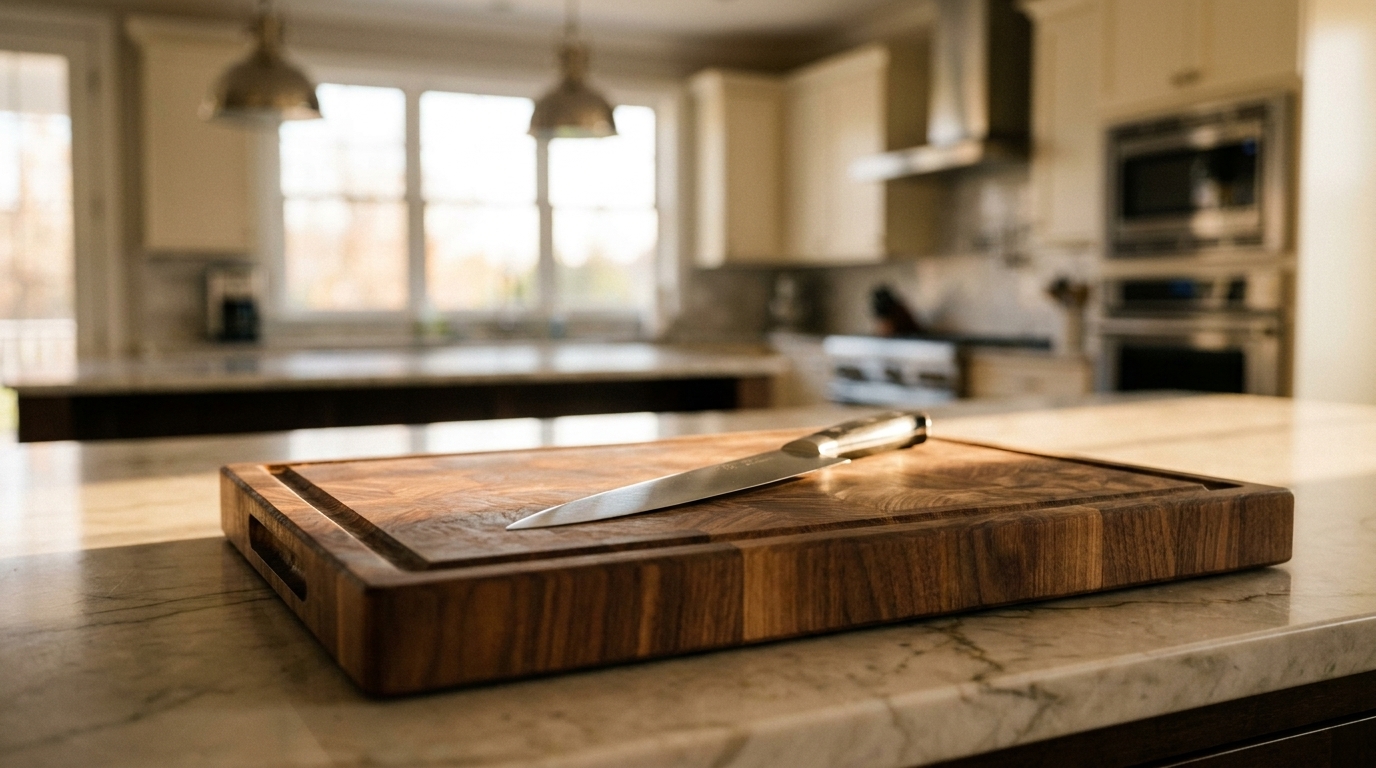
End-grain cutting boards keep your knives sharp roughly 40% longer than edge-grain boards because wood fibers flex and absorb blade impact rather than resist it. Pair a quality knife with the right board thickness, wood type, and maintenance routine to maximize edge retention and minimize sharpening trips.
Why Grain Direction Matters More Than Wood Type
End-grain boards keep your knives sharp 40% longer because their fibers flex and self-heal instead of getting severed with every cut.
End-grain vs. edge-grain: How fiber orientation protects your bladeWood fibers run along the length of the tree, and how a board exposes those fibers determines what happens to your knife edge with every cut.[1] On edge-grain boards, fibers run horizontally -- your blade slices across them, creating friction that gradually dulls the edge over time.[2] End-grain boards flip that orientation 90 degrees, exposing fiber ends on the cutting surface, so the knife slides between them instead of severing them; those fibers spring back after each cut, a behavior called "self-healing."[1] Research confirms that knives stay sharp roughly 40% longer on end grain than edge grain -- a real difference if you own quality blades and want fewer trips to the sharpening stone.[3]
The science behind why knives last longer on certain grain patterns
The key mechanism isn't just friction -- it's incremental metal removal.
Every pass on an edge-grain surface grinds the blade's thin bevel against cross-cut wood fibers, accelerating edge wear in a way that compounds with daily use.[3] End-grain's vertical fibers respond to the blade differently: they flex inward under load -- a property called micro-compression -- absorbing impact rather than resisting it, which dramatically reduces abrasive wear on the steel.[3] That difference is why knives used consistently on end-grain boards retain their edge two to three times longer than those used on edge-grain surfaces.[3]
Which Wood Works Best for Your Kitchen and Knife Collection
Hard maple resists knife dulling best, while walnut and cherry work better for delicate prep--pick your board based on what you're cutting.
Hardness ratings: maple, walnut, cherry, and acacia compared
Hard maple rates 1,450 lbf on the Janka scale -- at the top of the 900-1,500 lbf sweet spot for wood cutting boards, hard enough to resist deep scoring without accelerating blade wear.[4] Walnut (1,010 lbf) and cherry (950 lbf) sit lower in that range, making both genuinely gentler on knife edges while still holding up to daily use.[4] Acacia is the outlier: Janka ratings vary by species from roughly 1,100 to over 2,000 lbf, and boards on the upper end dull knives measurably faster than maple or walnut.[5] If your chef knife is losing its edge quicker than expected, checking your board's hardness is a practical first step before adjusting your sharpening routine.[4]
Best wood for meat, vegetables, and delicate prep work
For raw meat, maple's closed-grain structure resists moisture absorption and handles heavy repetitive cuts well -- end-grain maple is the strongest choice for butchering and carving.[6] Walnut and cherry suit vegetables and delicate prep better: both fall on the softer end of the ideal hardness range, reducing abrasion on thin knife edges during fine work like chiffonade cuts, and all three woods carry natural antimicrobial compounds that make them food-safe across prep tasks. [7] Walnut's dark grain also hides stains from beets and pigmented vegetables that would be visible on lighter maple. [6] Keeping a separate board for raw proteins and another for produce is the most reliable way to prevent cross-contamination, regardless of wood species.[6]
The Complete Cutting Board Care Guide That Keeps Blades Sharp
Regular oiling with food-safe mineral oil prevents cracking and blade friction, while the water-bead test tells you exactly when your board needs conditioning.
How often should you oil your board and why it matters for knife longevity
A dry wood cutting board doesn't just risk cracking -- its surface becomes rougher as fibers dry out, increasing blade friction and accelerating edge wear.
For a new board, oil every couple of days for the first week, then weekly for a month, then once monthly for regular use; in dry climates, condition more often to prevent the wood from losing surface integrity.[8] The water-bead test is the most reliable indicator of when your board needs oil: sprinkle a few drops on the surface -- if they soak in rather than bead up, condition the board before your next session.[8] Our guide to oiling a cutting board walks through the process in detail; always use food-safe mineral oil, not olive or vegetable oil, which go rancid inside the wood over time.[8]
Daily cleaning, deep maintenance, and seasonal conditioning routines
Daily cleaning means hand-washing both sides with hot, soapy water, then standing the board upright to air-dry before storing -- washing only one side causes uneven drying and warping.[8] For persistent garlic or onion odors, scrub with kosher salt and a halved lemon, let the paste dry on the board, then scrape and rinse.[8] Deep maintenance for scarred or gouged surfaces means sanding from 100-grit up to 220-grit in the direction of the grain, then oiling immediately; our guide to restoring a dry cutting board covers this process in detail.[8] In dry winter months, condition more aggressively -- two or three mineral oil applications on consecutive days, then a wax coat -- to hold moisture through low-humidity periods.[8]
Choosing Your First Wood Cutting Board: A Decision Framework
Match your board's thickness, size, and wood type to your knife's hardness to protect both tools and get the most from your investment.
Size, thickness, and handle options for different cooking styles
Board size should match your cooking volume: an 18 x 12-inch board suits most home kitchens, giving enough workspace for full meal prep without crowding the counter, while a 9 x 12-inch board handles quick tasks like slicing fruit or building a sandwich.[9] Thickness matters more than most buyers expect -- boards over 1 inch stay flatter under daily use, with 1.5 to 2 inches offering the best stability for end-grain construction without becoming too heavy to manage.[10] Handles ease repositioning during active cutting, and juice grooves contain liquid runoff when carving meats or slicing tomatoes -- our guide on how many cutting boards you actually need can help you decide how many boards to buy before committing to size or features.[10]
Essentials: matching board specs to your knife and kitchen setup
The knife you're already using should influence which board you buy.
Harder steel knives -- Japanese VG or carbon steel grades at Rockwell 60 and above -- are more brittle and chip more easily on dense wood surfaces, so walnut or end-grain maple is the safer match over acacia.[11] Standard stainless steel knives in the Rockwell 55-59 range handle harder surfaces with less chipping risk, giving you more flexibility when choosing a board.[11] Our ACUTO 440 steel knives sit at the higher-hardness end of that range, so pairing them with an end-grain walnut or maple board -- at least 1.5 inches thick, sized to your prep volume -- gets the most out of both tools.[6]
- End-grain boards keep knives sharp 40% longer than edge-grain by allowing fibers to flex rather than resist blade pressure.
- Hard maple (1,450 lbf) is ideal for raw meat; walnut and cherry suit vegetable prep and are gentler on thin blade edges.
- Dry wood surfaces increase blade friction and accelerate edge wear--condition monthly with food-safe mineral oil or when water stops beading.
- Board thickness over 1 inch prevents warping; 1.5-2 inches offers best stability for end-grain construction without excess weight.
- Harder steel knives (Rockwell 60+) chip more easily on dense wood, so pair them with walnut or end-grain maple instead of acacia.
- Hand-wash both sides and air-dry upright to prevent uneven drying and warping that dulls blades faster.
- Sand scarred surfaces with 100-220 grit in grain direction, then oil immediately to restore blade-friendly cutting surface.
- https://www.honeyhone.com/blogs/news/why-end-grain-wood-cutting-boards-preserve-knife-sharpness?srsltid=AfmBOoq-ltkNO7phxwn9MPJRCmf_YnMIQagmEXP8lfjOzbPakTcWjwd1
- https://www.keyhomegoods.com/post/why-end-grain-is-the-gold-standard-of-cutting-boards
- https://www.chopflowboards.club/blog/materials-craftsmanship-history/grain-orientation-science-every-cut-type
- https://www.forestsource.io/blog/janka-hardness-chart-complete-guide
- https://www.bladeandburnish.com/blog/what-wood-is-best-for-a-cutting-board
- https://www.nytimes.com/wirecutter/reviews/best-cutting-board/
- https://www.ruvati.com/wood-vs-bamboo-cutting-boards/
- https://www.nytimes.com/wirecutter/guides/how-to-clean-wood-cutting-boards/
- https://wordswithboards.com/blogs/stories/cutting-board-size-choose-the-right-size-for-every-kitchen-task?srsltid=AfmBOoriJtQ80NGRlmM1kFvNDbZ03_kNIMbB1u6e6U_t5dmIeO4Q64HD
- https://theknottylumberco.ca/blogs/hardwoods-101/end-grain-maple-cutting-board?srsltid=AfmBOoogl80Jl4SosoytlZyjMhdXQX3gF0SQA66DrY2d_UvSdQkNH1Bm
- https://www.cuttingboard.com/blog/which-cutting-boards-are-best-for-knives/?srsltid=AfmBOorC0p0oYiAV-Wv8mFvGb4-BN8LN74cVPRrkh6XE6bR86zQZVVLa