

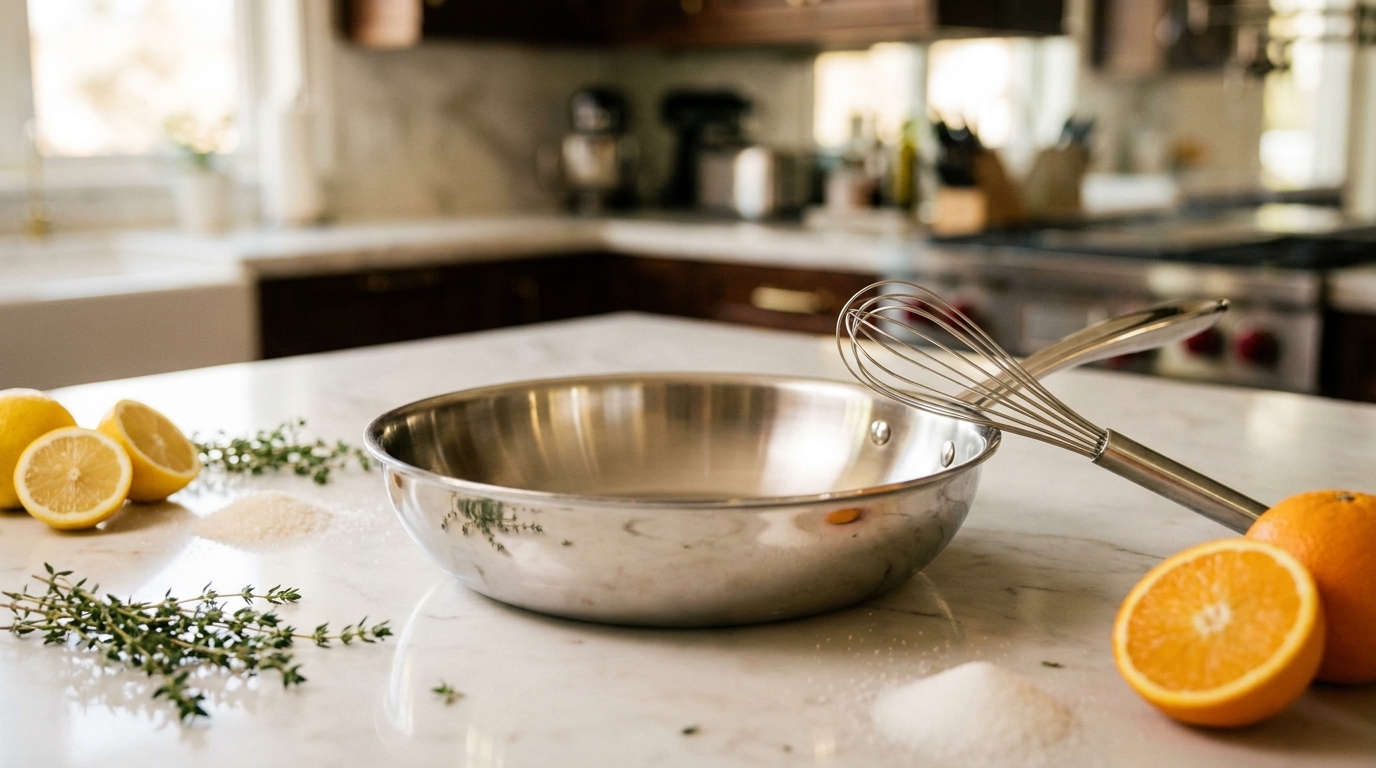
A 3-quart saucier strikes the ideal balance for home cooks, offering enough capacity for four to six servings while remaining light enough to handle with confidence. Its curved interior and responsive heat distribution make it the most-reached-for pan in any kitchen, handling everything from delicate sauces to everyday grains.
Why a 3-Quart Saucier Is the Ideal Size for Most Home Kitchens
A 3-quart saucier handles everything from risotto to pan sauces without the bulk of a larger pot, making it the most-reached-for size in most home kitchens.
How the 3-quart capacity bridges the gap between small and large cookware
Sauciers range from two to five quarts, and the 3 qt saucier sits at the most practical point in that range -- big enough for four to six servings of soup, risotto, or pan sauce, but compact enough to heat quickly and maneuver with one hand. [1] A two-quart model is fine for one or two people but runs out of room the moment you scale a recipe or need extra liquid.[2] Four-quart pans gain capacity but lose agility -- heavier construction means longer preheat times and less confidence when tossing or pouring.[2] Most cooks who own a three-quart reach for it more than any other size, because it covers the widest range of daily tasks without pushing you toward a larger pot.[3]
Common cooking tasks that prove a 3-quart saucier's versatility
The 3 qt saucier earns its place on the stovetop by handling tasks that demand constant movement -- stirring risotto, whisking pastry cream, reducing a pan sauce -- without letting ingredients escape into corners or stick along sharp edges.[4] Its wide, shallow base speeds up evaporation, making it more effective at reducing liquids than a straight-walled saucepan.[4] Beyond classic sauces, the same pan handles cooking grains, making caramel, or warming soups for two to four people without scaling down a full batch.[4] That range -- from delicate custards to everyday reheating -- is what separates a saucier from single-purpose pots.

What Makes a Great Saucier: 5 Key Features That Matter
The curved base and responsive material of a saucier let you control temperature precisely, preventing scorched edges and lumps in delicate sauces.
Curved sides and sloped design: why shape affects your cooking results
The lack of a 90-degree corner where the base meets the wall is what physically separates a saucier from a straight-sided saucepan -- a balloon whisk follows the curved interior without losing contact, while the same tool skips right past the seam in a saucepan and leaves food behind to scorch.[1] The sloped walls also pull ingredients back toward the center during stirring, so thicker mixtures like roux or béchamel stay in motion with less effort.[5] For anything with a consistency heavier than broth, that continuous contact between utensil and surface is the difference between a smooth result and one with lumps or burnt spots at the edges.[1] In a 3 qt saucier specifically, the proportions keep the curved surface close enough to the heat source that this advantage holds across the full base -- not just in the center.[5]
Heat distribution and material choices that separate good sauciers from excellent ones
The material under a saucier's cooking surface determines how quickly it responds to temperature changes -- for sauce work, responsiveness matters more than raw heat output.
Copper heats and cools faster than any other common cookware metal, which works in your favor when pulling a delicate sauce off the burner before it overcooks.[6] Multiclad stainless -- an aluminum core bonded between stainless steel layers -- is the more practical choice for most home cooks: aluminum spreads heat evenly while the stainless exterior stays non-reactive with acidic ingredients like wine or citrus.[7] For sauce-focused pans, thinner overall construction improves responsiveness to temperature adjustments, while thicker builds favor heat retention for searing -- so knowing how to cook with stainless steel helps you get the most from whichever material you choose.[7] 3-Quart Saucier Size Comparison: 2-Qt vs. 3-Qt vs. 4-Qt Decision Matrix
Interactive sizing guide to determine if 3-quart is right for your household
Choosing the right size comes down to three variables: how many people you cook for regularly, what you typically cook, and how often you cook double batches.
A 2-qt works for one or two people making sauces or grains but runs short the moment you scale up.[8] A 3 qt saucier is the best-selling size at specialty retailers precisely because it covers households of two to four without requiring the heavier build of a 4-qt.[8] If you regularly cook for five or more, or need volume for pasta or soups, a 4-qt is more practical -- but for most home cooks, the 3-quart handles the daily range without excess.[9]
When to choose smaller or larger alternatives based on cooking frequency and family size
Household size is only part of the equation -- cooking frequency changes the math.
A couple who batch-cooks on weekends, doubling grain or sauce recipes for weekday reheating, will outgrow a 2-qt faster than their household size suggests.[10] Solo cooks who cook daily find a 3-qt more practical than a 2-qt because it handles scaling without adding meaningful weight or preheat time.[10] For households that entertain regularly or cook for fluctuating guest counts, a 4-qt becomes the more sensible anchor -- batch-cooking flexibility prevents having to switch vessels when recipes double.[11] Is a Saucier Pan Worth the Investment?
Long-Term Value for Home Cooks
How proper maintenance extends a quality saucier's lifespan by decades
A quality multiclad stainless saucier can last a lifetime with consistent care -- specifically, hand washing over the dishwasher, since harsh detergent degrades the chromium oxide layer that protects steel from rust, and unsealed rims can corrode over time from repeated dishwasher cycles.[12] Dry the pan immediately after washing to prevent water spots and the chalky oxidization film that hard water leaves on the cooking surface.[12] For stubborn burned-on buildup, a baking soda paste or Bar Keepers Friend removes residue without damaging the steel -- apply, scrub, and rinse within a minute, since prolonged contact can cause discoloration.[12] Our guide on how to clean stainless steel pans covers these care and maintenance tips in full detail for every type of stain.[13]
Building your cookware foundation: where a 3-quart saucier fits into a complete kitchen
A complete home kitchen typically needs five or six core pieces -- a large skillet, a nonstick pan, a saucier, a Dutch oven, and a stockpot -- and the 3 qt saucier fills a role none of those others can replace. [14] Where a Dutch oven handles long braises and a stockpot handles volume, the saucier covers the everyday middle ground: sauces, grains, and smaller batches that don't justify pulling out heavier equipment. [14] For cooks building out their kitchen in stages, a saucier makes the most immediate impact on daily cooking -- more so than a second skillet or specialty pan. [14] It pairs naturally with a 10-inch skillet as a starting two-piece foundation before adding a Dutch oven or stockpot as the next logical step.


- A 3-quart saucier is the most practical size, handling 4-6 servings while heating quickly and maneuvering easily with one hand.
- The curved interior with no 90-degree corners lets whisks maintain contact with the surface, preventing lumps and burnt spots in sauces.
- Multiclad stainless steel offers the best balance for home cooks: even heat distribution with non-reactive properties for acidic ingredients.
- A 3-quart saucier covers the daily middle ground that larger Dutch ovens and stockpots can't replace in most kitchens.
- Hand wash and dry immediately to prevent rust and oxidation; use baking soda paste or Bar Keepers Friend for stubborn buildup.
- The wide, shallow base speeds evaporation, making it more effective at reducing liquids than straight-walled saucepans.
- https://www.seriouseats.com/saucepans-vs-sauciers-whats-the-difference-7550331
- https://www.seriouseats.com/best-sauciers-5219503
- https://www.foodandwine.com/sauciers-8786976
- https://www.nytimes.com/wirecutter/reviews/the-best-small-saucepan/
- https://www.centurylife.org/pick-one-straight-vs-curved-saucepan-saucier-sauteuse-sidewalls/
- https://www.seriouseats.com/buying-copper-cookware
- https://www.heritagesteel.us/blogs/cookware-knowledge/the-5-rules-of-good-cookware?srsltid=AfmBOoq2nFVIjCp63MNCe0LqljAxxcqIjur-Vg_N8QS7nwzD9gisla6l
- https://prudentreviews.com/saucepan-sizes/
- https://www.wayfair.com/sca/ideas-and-advice/guides/your-guide-to-saucepan-sizes-T21626
- https://www.solamexhome.com/how-many-pots-and-pans-do-you-need-kitchen-cookware-guide-for-every-lifestyle.html
- https://www.solamexhome.com/how-many-pots-and-pans-do-you-need-the-5-piece-rule-for-every-kitchen-2025-guide.html
- https://www.bonappetit.com/story/how-to-clean-stainless-steel-cookware-so-it-shines-like-new?srsltid=AfmBOopr8reRLb-UkFqmmmEjc4mxCQpWAjnTSBy3dPHjo8aMXrEXF3Oi
- https://www.bobsredmill.com/articles/how-long-do-stainless-steel-pots-last
- https://www.seriouseats.com/most-essential-pots-and-pans
- Summary
-
What Makes a Great Saucier: 5 Key Features That Matter
- Curved sides and sloped design: why shape affects your cooking results
- Heat distribution and material choices that separate good sauciers from excellent ones
- Interactive sizing guide to determine if 3-quart is right for your household
- When to choose smaller or larger alternatives based on cooking frequency and family size
- How proper maintenance extends a quality saucier's lifespan by decades
- Building your cookware foundation: where a 3-quart saucier fits into a complete kitchen
- Key Takeaways
- References