

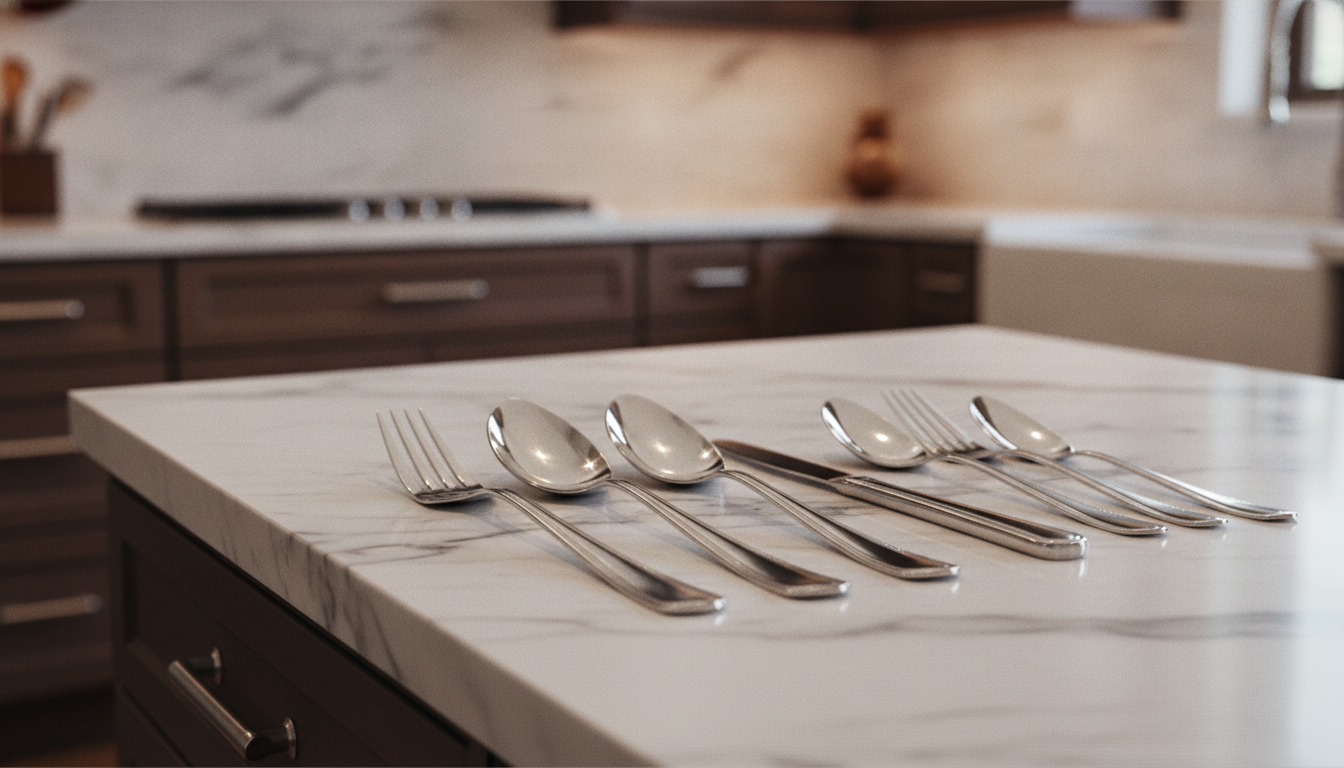
Learn why flatware, cutlery, and silverware mean different things across regions and how material grades affect quality and durability. Knowing what to look for on the handle--like 18/10 stainless markings--matters far more than the name on the box.
Why These Three Terms Exist: Geography, History, and Regional Naming Conventions
British cutlery terminology spread globally through Sheffield's stainless steel innovation and trade dominance, shaping how different regions still name eating utensils today.
How British English Created 'Cutlery' as the Universal Term
Cutlery started out as a narrower term in British English than it is today. Historically, "cutlery" referred only to knives, while forks and spoons were classified as silverware, with all three grouped under the broader category of flatware or tableware [1]. That knife-specific root traces back through Middle English "cuteler" and Old French "coutelier," derived from "coutel," meaning knife, which itself comes from the Latin "culter" [1].
Britain's cutlery-making reputation grew out of Sheffield, Yorkshire, a manufacturing hub so central to the trade since the 17th century that a London-bound passenger train was named the Master Cutler in its honor [1]. Sheffield's dominance solidified in 1913, when British metallurgist Harry Brearley discovered stainless steel there by chance, a breakthrough that made durable, affordable cutlery available to ordinary households rather than just the wealthy [1][2]. Before that discovery, knives were built by welding strips of steel onto iron, since steel was too costly to use on its own, and blades needed regular sharpening on a grindstone or cutler's wheel [1].
As stainless steel spread, "cutlery" expanded from its knife-only origins to cover the full knife, fork, and spoon set, and the term traveled with British trade and language conventions to become the standard word used across the UK and much of Europe for all eating utensils [1][2]. That history is why British English speakers default to "cutlery" as a catch-all term, while the older, narrower meaning still lingers in the etymology.
Why Americans Adopted 'Flatware' and When It Became Standard
Americans moved away from British cutlery partly because that word kept a narrower, knife-focused feel, tied to cutting tools rather than a full set of eating utensils [3]. In the United States, silverware and flatware became the more common substitutes, with cutlery surviving mainly as a term for knives and other cutting implements [3]. So do Americans say cutlery or silverware?
Both show up in everyday speech, but flatware is now the term most retail catalogs, registries, and etiquette guides default to for knives, forks, and spoons as a group [3]. The split between the two American terms comes down to material, not shape: silverware technically means a utensil actually contains silver, while flatware came into use specifically to signal that a piece is not made of silver, even when it's shaped exactly like a traditional fork or spoon [3]. That distinction mattered once stainless steel started showing up at American tables alongside sterling sets, since shoppers needed a neutral word that described the form of the utensil without making a claim about its metal content.
Silverware kept a more formal, heirloom-tinged connotation in the U.S., often reserved for sterling sets passed down through families, while flatware sounded more practical and everyday, covering stainless steel and silver-plated sets alike [3]. That practical framing is why flatware became the standard American term rather than cutlery.

Flatware, Cutlery, and Silverware Defined: What Each Term Actually Means
Flatware is defined by its shape and function--knife, fork, and spoon--regardless of whether it's stainless steel or sterling silver.
Flatware: The American Term for Eating Utensils (and Why It's Not About Silver)
Flatware describes the knives, forks, and spoons used at the table, and the name refers to shape, not metal content. A set qualifies as flatware whether it's stainless steel, silver-plated, or solid sterling, which is why the term works as a neutral catch-all in a way 'silverware' never could.
This shape-based definition also answers a common point of confusion: flatware doesn't include plates, bowls, or serving platters, since those fall under dinnerware or tableware instead. At its core, a flatware set needs just three pieces, a knife, a fork, and a spoon, though most retail sets add a salad fork and teaspoon to round out a five-piece place setting.
Because the word describes function rather than material, it's become the default term you'll see on registries, in retail catalogs, and in most American kitchens, regardless of whether the pieces are everyday stainless or an inherited sterling set reserved for holidays. That practicality is also why flatware sits apart from 'cutlery' in everyday American speech, where cutlery more often narrows down to cutting tools rather than the full eating-utensil lineup, and apart from broader terms like 'utensils,' which can stretch to cover cooking tools as well as eating ones.
Cutlery: The Broader European Term Covering Knives, Forks, and Spoons
Cutlery, in British and much of European English, still works as the umbrella term for the same three-piece core Americans call flatware: knife, fork, and spoon. That answers a common search question directly, the three types of cutlery are:
- Knife, for cutting and spreading
- Fork, for lifting and holding food
- Spoon, for scooping liquids and soft foods
Everything else, serving pieces, fish knives, cheese knives, counts as specialty additions built around that core trio rather than a fourth category. This function-based grouping is the opposite instinct from silverware, which specifies what the metal actually is, and it lines up closely with how flatware describes shape rather than material. American English usually narrows cutlery back down to cutting tools, pocketknives, and kitchen knives, separating it from the fork-and-spoon lineup, so shoppers browsing European retailers or travel menus should expect cutlery to include forks and spoons even though American habit points first to knives. Cutlery also differs from the broader word utensils, which stretches to cover cooking tools like spatulas and whisks alongside anything used at the table, while cutlery and flatware both stay focused specifically on the pieces used to eat a meal rather than prepare one.
Silverware vs. Flatware: Material Matters More Than the Name
Check the hallmark stamped on the back of your flatware to identify the actual metal composition and durability grade.
Silverware: Sterling Silver, Silver-Plated, and Stainless Steel All Qualify
"Silverware" works less like a function word and more like an umbrella term for finish, and in everyday American use it covers three different materials: sterling silver, silver-plated metal, and even stainless steel pieces that contain no silver at all. Sterling is a silver alloy, legally assayed and marked "925" to show 92.5 percent silver with the remainder typically copper for added strength [6]. Silver-plated pieces get their identity from electrolysis, a process patented by Christofle in 1842 that deposits a thin layer of silver onto a base-metal core rather than using solid silver throughout [5]. Stainless flatware technically holds no silver, yet many households still call the whole drawer "the silverware" out of habit, since the word has long doubled as a catch-all name for table settings regardless of metal. Because these three materials can look nearly identical but age very differently, checking the back of the handle for a hallmark matters more than trusting the name on the box:
- "925," "ster," or "sterling" signals solid silver [6]
- No mark, or a brand stamp, often signals plate or stainless [4]
- A magnet test offers a clue, not proof [4]
How to Identify Quality Flatware Regardless of What You Call It (Material Grades Explained)
Whatever you call the drawer, the fastest way to judge quality is to flip a piece over and look for a stamped grade number, since that mark tells you the actual metal composition rather than relying on the name on the box. Stainless flatware is graded by its chromium and nickel percentages, and nickel content is the variable that determines corrosion resistance and how well a piece keeps its shine over years of use [7]. 18/10 stainless (18% chromium, 10% nickel) offers the strongest corrosion resistance and the brightest finish, which is why it's treated as the standard for premium kitchenware and flatware [7]--the same grade you'll find in Misen's stainless steel cookware. 18/8 sits one step down, with less nickel but still solid durability, and it's the same composition commonly labeled 304 stainless [7]. 18/0 skips nickel entirely, which lowers cost and makes the metal magnetic, a plus for induction cooktops, but trades away some corrosion resistance and formability [8]. A quick way to sort the three:
- 18/10: highest nickel, best shine, best corrosion resistance
- 18/8: moderate nickel, durable, common in flatware and cookware
- 18/0: no nickel, budget-friendly, less corrosion resistant
Checking for one of these stamps on the handle matters more than whether the set is marketed as flatware, cutlery, or silverware.


Choosing Your Flatware: A Decision Framework for Home Cooks and Entertaining
Matched sets cost roughly 30 percent less than buying pieces individually, making them ideal for starting your flatware collection from scratch.
Flatware Selection Essentials: Match Your Needs to the Right Set
Building Your Flatware Collection: When to Buy Matched Sets vs. Open Stock Matched sets make sense for anyone starting a collection from scratch: buying a full run of place settings may cost less than assembling pieces individually--flatware sold as a set can run roughly 30 percent cheaper than open stock or single place settings, but compare the actual set's contents and price against the individual pieces you'd need to confirm the savings [12]. Open stock, sold piece by piece, is the better move once a set already exists and just needs supplementing, whether you're replacing a lost spoon or adding settings for a growing household. It's also the only path when a pattern gets discontinued, so choose a timeless design with classic blade shapes when you buy new, since that makes future open-stock matches easier to find years later [12]. Serving pieces like gravy ladles or pie servers can come with the original set, get added individually, or be purchased together as a hostess set [12]. Misen's stainless steel flatware set works well as a matched starting point, and individual forks or spoons can be bought later if a piece goes missing. A quick way to decide:
- Building a full collection: buy a matched set
- Replacing a lost or bent piece: buy open stock
- Expanding for guests: confirm your pattern is still sold
- Adding serving pieces: consider a hostess set
Whatever you call the drawer--flatware, cutlery, or silverware--the words matter far less than knowing what you're actually buying and how to keep it in good shape. Flip a piece over, check the grade stamp, and match the set to how you cook and how often you host. For more care & maintenance tips, or if you need help choosing a set, contact us anytime.
Frequently Asked Questions
-
What's the actual difference between flatware, cutlery, and silverware?
Flatware is the American term for knives, forks, and spoons, based on shape rather than metal. Cutlery is the British/European umbrella term for the same three-piece core, though American English often narrows it back down to cutting tools. Silverware describes finish rather than shape and can refer to sterling silver, silver-plated, or even stainless pieces with no silver at all.
-
How can I tell if a piece is real silver or just stainless steel?
Flip the piece over and check the back of the handle for a hallmark: '925,' 'ster,' or 'sterling' signals solid silver, while no mark or a brand stamp often signals plate or stainless. A magnet test can offer a clue but isn't proof, since some stainless grades are also magnetic.
-
How many pieces are in a basic flatware set?
A flatware set needs just three core pieces: a knife, a fork, and a spoon. Most retail sets expand on that by adding a salad fork and teaspoon to create a standard five-piece place setting.
-
Is it cheaper to buy a matched flatware set or build one piece by piece?
According to the article, flatware sold as a matched set can run roughly 30 percent cheaper than buying the same pieces as open stock or individual place settings. Compare the actual set's contents and price against what you'd need individually to confirm the savings before buying.
-
What do stamps like 18/10 or 18/8 mean on flatware?
These stamps indicate the chromium and nickel content of stainless flatware, which determines corrosion resistance and shine. 18/10 has the most nickel and offers the best shine and corrosion resistance, 18/8 (also labeled 304 stainless) is a step down but still durable, and 18/0 skips nickel entirely, making it more budget-friendly and magnetic but less corrosion resistant.
- Flatware describes shape, not material, so it covers stainless steel, silver-plated, and sterling pieces equally.
- British English uses cutlery as the umbrella term for knife, fork, and spoon, while American English defaults to flatware.
- Check the handle stamp for grade numbers like 925, 18/10, or 18/8 to know actual metal composition, not the box label.
- 18/10 stainless offers the best corrosion resistance and shine, while 18/0 costs less but trades durability for magnetic properties.
- Buying a matched set costs roughly 30 percent less than assembling pieces individually, but open stock works better for replacements.
- Choose a timeless design with classic blade shapes when buying new flatware, since discontinued patterns become harder to match later.
- https://www.google.com/goto?url=CAESYAHrOzAVpd1xULOiiXnlT2cgksKMOw3opV3fIIBLCkEhh7HlJkG2UxiIe5julQmcZxLmB-oJdH2HIjrNhJyZD4h-JTbPzss1IecwlO1FjCpGS-hI3MurInszeLwdUYuURw
- https://www.google.com/goto?url=CAEScAHrOzAVoKtizO8YnR0l74qYH8mdYprkxajoucvRWtG8kh4kWHUgyiyFynSdaozp4uVtgmMeLWZnSkr7pzWvAFRgKOFnuZmZFfScLrD32dHzUYMEK6x0EEwSFUSrOCLOIULDYRIcOTWvrRWYbCeLxIo
- https://silver.vegas/how-where-sell-silverware-las-vegas-buyer/
- https://www.aquastarcleaning.com/house-cleaning-articles/190-how-to-shine-silverware
- https://www.aucties.com/en/estimation-value-brand/christofle-history-of-the-company-value-and-appraisal
- https://nevadacoinmart.com/we-buy/how-where-sell-silver-best-buyer-las-vegas-nv/silverware-flatware-buyer-las-vegas-nv/sell-sterling-silver-knives-buyer-las-vegas-nv/
- https://rapidprecise.com/what-is-18-8-stainless-steel/
- https://alloy-materials.com/18-0-stainless-steel-cookware/
- https://www.google.com/goto?url=CAESfQHrOzAVXml6kjzpFsKRBj-j7TTdfyBle3-S5KBEq-LU3_DQqTcUj3xfReOKBJDx7fEqd6CdHYL63WbM-heuApI6IfNdxOmFXIvywqjAHMq-0m7GK5WgZ48gcOW-ibAPctKBMgArH-u_gR_0_Qn23Aez3whh-z3GgWJdfT0I
- https://www.google.com/goto?url=CAESggEB6zswFe0YxrUhqw6WpUFnlkkYBKNXGUsaYnvJVIzjZ8jTw2e1-2OELix8C94gYwNusTbnU-i8niu8Tm5qaNplJD0czsD65lKKIX22GGs8Kiin5toIpYEDv-R0wF3vYOJalrsELiR44g7hAzFqcjGYJWHLf0ZM535NH0uq-bK-hCM2
- https://www.google.com/goto?url=CAESeQHrOzAVJ4rKouEswFFNSKx6DPFNyUYtmkddRA-OYQllwCYGE2Ok3uxKuft5MPhMcjZ6wquJE4e1upSt2jidqrB79ZIMZWGHF6cF15Ann57fHqbmsw8w52jtfV6iAAaZ6WVjLqnTGn9ptYEQvONKoWVg0NjW3WXazss
- https://www.etiquettescholar.com/dining_etiquette/table_setting/place_setting/flatware/buy_flatware.html
- Summary
- Why These Three Terms Exist: Geography, History, and Regional Naming Conventions
- Flatware, Cutlery, and Silverware Defined: What Each Term Actually Means
- Silverware vs. Flatware: Material Matters More Than the Name
- Choosing Your Flatware: A Decision Framework for Home Cooks and Entertaining
- Key Takeaways
- References