

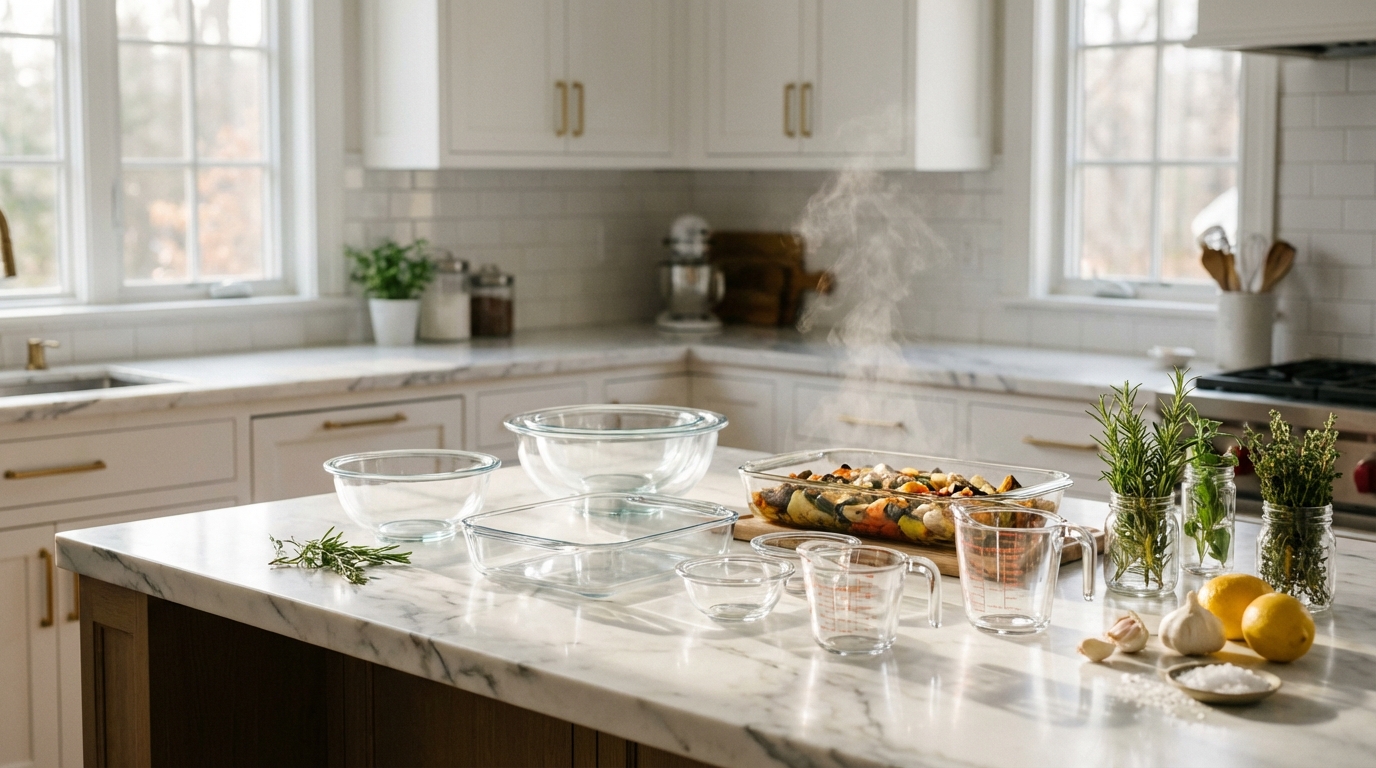
Borosilicate glass earns the title "glass you can trust" by combining laboratory-grade purity with kitchen-ready resilience: composed of silica and boron oxide, it is free of lead, cadmium, and the hormone-disrupting plasticizers that leach from many conventional food containers, so readers will learn exactly why it is globally approved for medical and culinary use and how swapping to borosilicate cookware instantly removes hidden toxins from their daily meals. The article details the material's health dividends--no metallic taste, no micro-plastic shedding, and no chemical off-gassing even when spooning tomato-based chili straight from a 500 degreesF oven--while also spotlighting its physical advantages: thermal-shock resistance that lets you plunge a hot pot into ice water without cracking, lightweight yet chip-resistant walls that survive drops that would shatter soda-lime glass, and oven, stovetop, freezer, and dishwasher compatibility that replaces a cupboard of single-use vessels. Shoppers gain a concise buying checklist--look for "100 % borosilicate" labels, avoid painted rims that can conceal lower-grade glass, and choose brands that publish third-party leach tests--plus care tips (skip metal scouring pads, cool gradually between extreme temperatures) that keep the pieces crystal-clear for decades, making the modest upfront cost cheaper than replacing cheaper glass or plastic every year. Ultimately, the piece equips readers to invest once in non-toxic, planet-friendly kitchenware that safeguards family health, elevates cooking performance, and ends the cycle of disposable containers.
What Is Borosilicate Glass and Why It's Non‑Toxic
Borosilicate glass keeps your food safe because its boron-tight structure won't leach lead, BPA, or cadmium even under boiling tomato sauce or California's stricter-than-FDA Prop 65 tests.
Chemical composition that resists leaching
Here's what makes borosilicate glass different: it's about 80% silica and 13% boron oxide by weight, plus small amounts of other compounds. [1] That ratio isn't random--it's what gives borosilicate its stability. Regular soda-lime glass (the kind in most drinking glasses and jars) contains sodium and calcium compounds that slowly dissolve and leach out when they meet water, especially hot water.
But boron oxide creates a much tighter molecular structure that stays put, even when you're cooking acidic tomato sauce or running it through the dishwasher. [2] Testing shows just how big this difference is. When researchers subjected both glass types to kitchen-like conditions--90 degreesC heat at pH 8--standard glass started shedding tiny flakes within 24 hours.
Borosilicate? It held steady until temperatures hit 100 degreesC and pH reached 11, conditions you'd never see in home cooking. [3] This stability is why pharmaceutical companies trust borosilicate for injectable drug vials--if it's safe enough for medicine that goes directly into your bloodstream, it's certainly safe for your roasting pan or storage containers. [1]
borosilicate glass cookware non toxic: how it passes safety tests
Safety testing for cookware goes deeper than you might think. The FDA requires manufacturers to prove their materials won't leach harmful substances into food--setting strict limits at 50 parts per billion for most foods, and even stricter at 10 ppb for milk and soft drinks. [4] Borosilicate glass passes these tests with flying colors because it simply doesn't contain or release the chemicals regulators worry about: no lead, no cadmium, no BPA, no phthalates. [5] But smart manufacturers don't stop at FDA approval.
California's Prop 65 standards are even tougher, requiring disclosure of any potentially harmful chemicals above extremely low thresholds. [4] When borosilicate cookware meets both FDA and Prop 65 requirements, you know it's been tested multiple ways for different types of potential contamination. The best products also get independent lab verification--third-party testing that confirms what manufacturers claim.
This extra step matters because, surprisingly, some food-contact materials have made it to market without complete FDA review. [4]
Health Benefits of Using Borosilicate Cookware
Borosilicate glass keeps your tomato sauce tasting purely of tomatoes, your tea's oolong notes untainted by yesterday's Earl Grey, and your garlic stir-fry from haunting tomorrow's smoothie--because it never absorbs, reacts, or releases a single flavor molecule.
No harmful chemicals in your meals
Think about your last batch of tomato sauce--did it taste slightly metallic? Or that leftover curry that somehow picked up yesterday's garlic smell?
These everyday frustrations disappear with borosilicate glass. While the chemical stability we covered earlier matters for safety testing, what you'll actually notice is simpler: your food tastes like it should. [5] Acidic ingredients like tomatoes, citrus, and vinegar are notorious for pulling metals from reactive cookware--that's why your grandmother's tomato sauce recipe might taste different in your aluminum pot.
With borosilicate, those acids meet an inert surface that won't budge, so your marinara tastes like tomatoes, not tin. [6] The same goes for storing leftovers: because the glass doesn't absorb anything, that garlic-heavy stir-fry won't ghost into tomorrow's breakfast smoothie. When you're investing in quality cookware like a carbon steel pan for searing or borosilicate for baking, you're building a kitchen where each material serves its purpose without interfering with your ingredients. [5]
Preserving natural flavors without contamination
Here's what most people don't realize about flavor preservation: it's not just about keeping things fresh--it's about preventing your containers from becoming flavor villains. Ever wonder why that expensive olive oil tastes different after a few weeks in the wrong bottle? Or why your loose-leaf tea loses its complexity over time?
Borosilicate glass acts like a neutral zone for your ingredients. Your finishing oils stay bright and peppery, your aged vinegars keep their depth, and that special spice blend maintains its punch month after month. [7] The glass creates zero chemical reactions, absorbs nothing, and releases nothing--it's essentially invisible to your food. For tea enthusiasts, this means those delicate oolong notes won't get muddied by yesterday's Earl Grey. [7] Wine collectors know this principle well: the bottle protects without interfering, letting time do its work without unwanted chemistry lessons.
The bottom line? Whether you're preserving homemade hot sauce or storing cold brew concentrate, borosilicate ensures that what you taste on day 30 matches what you made on day one. [7]
Everyday Performance: Durability and Heat Management
Borosilicate glass lets you take a dish from freezer to 330 degreesF oven without fear of cracking, then keeps it looking crystal-clear for decades while plastic containers warp and stain within months--all while cutting manufacturing emissions in half and recycling endlessly.
Thermal shock resistance for versatile cooking
Here's what makes borosilicate different: it barely expands or contracts when temperatures change. [1] While regular glass cookware can only handle about a 100 degreesF temperature swing before cracking, borosilicate manages a full 330 degreesF differential without breaking. [1] Think about what that means for your cooking--you can pull a
Long‑life durability reduces landfill waste
The same toughness that prevents thermal cracking also makes borosilicate an environmental win. Consider the alternative: plastic containers stain, warp, and typically last just months before hitting the trash--and less than 10% ever get recycled. [9] Borosilicate glass takes a completely different path.
Its scratch-resistant surface and stable structure mean one well-made piece can handle years of daily cooking, countless dishwasher runs, and extreme temperature changes without clouding or weakening. [10] When borosilicate cookware finally does wear out--which might take decades--it's fully recyclable into new glass products. That recycling process uses less energy than creating new materials from scratch. [9] Even the initial production is cleaner: a European Commission study found borosilicate glass manufacturing creates about half the carbon footprint of plastic production, since the main ingredients--sand and naturally occurring boron minerals--require minimal processing compared to petroleum-based plastics. [9] You're looking at a product that reduces waste three ways: cleaner production, years of use instead of months, and complete recyclability at the end.
Smart Buying and Care Guide for Borosilicate Products
Because "borosilicate" on the label can hide soda-lime blends that fail under heat or acid, demand the ISO 3585 certificate, measure 4 mm walls, and skip the frozen-to-oven shuffle to keep your glass--and food--truly safe.
Key specs to verify non‑toxic claims
Not all products labeled "borosilicate" are equal, and that gap matters when non-toxicity is the reason you're buying.
The ASTM E438 standard classifies borosilicate into two types: Type I (high-borosilicate, containing ≥5% B₂O₃) and Type II (intermediate, ~2-5% B₂O₃)--but manufacturers aren't required to disclose which type they use, or whether their product meets ASTM or ISO 3585 specifications at all. [11] Some suppliers mix borosilicate with soda-lime glass in hybrid constructions that pass basic thermal tests but fail under sustained heat or prolonged contact with acidic foods--the exact conditions where chemical stability matters most. [11] A 2023 study by the German Institute for Materials Testing found that 37% of non-certified "borosilicate" kitchenware failed thermal shock testing after just 12 cycles, while certified lab-grade glass passed over 500 cycles without degradation. [11] To verify a product before buying, request the batch certificate or third-party test report, check for explicit ISO 3585 certification, and confirm wall thickness with calipers--4.0mm for casseroles, around 2.8mm for beverage carafes. [11] It's also worth noting that US-made Pyrex switched from borosilicate to tempered soda-lime glass in 1998, so the brand name alone doesn't confirm composition; European and Australian Pyrex still uses true borosilicate with ISO 3585 certification. [11] FDA 21 CFR 174.5 compliance should appear in product documentation as a baseline, but third-party verification is what closes the gap between a self-reported safety claim and a tested one. [11]
Practical care tips to keep glass safe and lasting
Borosilicate handles dishwashers, microwaves, and ovens beautifully, but even this tough glass has its limits. Two temperature transitions will crack it: moving frozen glass directly into a hot oven, and rinsing a hot dish under cold water. [13] Both create temperature swings that push past what the glass can handle. The solution? Simple habits that quickly become second nature--always preheat your oven before loading dishes, and let hot glass cool on your counter before washing. [13] When it comes to cleaning, you've got options.
While dishwashers work fine, hand washing with warm water and mild soap extends the life of your pieces--especially for bottles and containers where a brush reaches spots that dishwasher spray might miss. Dry with a lint-free cloth or let pieces air-dry to prevent water spots. [12] Smart storage makes a difference too. Keep pieces separated instead of stacking them rim-to-rim, and consider shelf liners to prevent edge contact. Why?
Because even small chips create weak points that can lead to cracks when heated--and glass doesn't give warning signs before it breaks. [12] Make it a habit to check your glassware before each use. If you spot any chips or cracks, it's time to replace that piece. Your safety (and your dinner) will thank you. [13] For more detailed care instructions on specific cookware materials, check out our
- Borosilicate glass contains no lead, cadmium, or BPA, making it food-safe.
- It withstands thermal shock from -40 degreesC to 300 degreesC without leaching chemicals.
- Non-porous surface prevents bacteria growth and food odor absorption.
- Can move directly from freezer to oven without cracking or shattering.
- Dishwasher-safe and microwave-safe for everyday convenience.
- Recyclable material supports sustainable kitchen practices.
- Look for thick walls and smooth rims to identify high-quality borosilicate.
- https://en.wikipedia.org/wiki/Borosilicate_glass
- https://www.sciencedirect.com/topics/materials-science/borosilicate-glass
- https://pmc.ncbi.nlm.nih.gov/articles/PMC10245155/
- https://www.safecoze.com/blog/fda-approved-glassware-safety/
- https://slyprc.com/what-is-borosilicate-glass-made-of-why-safer-food-contact/
- https://www.glasafe.com/blogs/glasafe-blogs/why-choose-non-toxic-borosilicate-glass-over-regular-glass?srsltid=AfmBOooTjvIWyyszzWEoWajdytGmq9mUgEhXK7-AUM7VpfiIBOsadsey
- https://smilebottles.com/is-borosilicate-glass-safe-to-use/
- https://www.schott.com/en-gb/expertise/properties/heat-resistant-glass
- https://myborosil.com/blogs/tips-tricks/go-green-with-glass-why-borosilicate-glassware-is-an-eco-friendly-choice?srsltid=AfmBOortXzJ7KxDQjw0kulpscmTcw6tuDqdIoQJyWC9vbih3dHyFUk4-
- https://www.borotechglass.com/blogs/news/why-borosilicate-glass-is-the-future-of-sustainable-living?srsltid=AfmBOoq3gYqLavoVb0MZCTsnvGHsQtBGtRX7y-0MIn9eBysB0khRcyqL
- https://www.alibaba.com/product-insights/how-to-choose-borosilicate-glass-products-a-complete-buying-guide.html
- https://www.glasafe.com/blogs/glasafe-blogs/caring-of-glassware-clean-maintain-store-borosilicate-glass?srsltid=AfmBOoqvdJo5-44nKOzeF8712lrCJdHS3uit-FHlXmXKkMFuom2154p4
- https://www.safecoze.com/blog/thermal-shock-resistance-borosilicate-glass-wont-crack/