

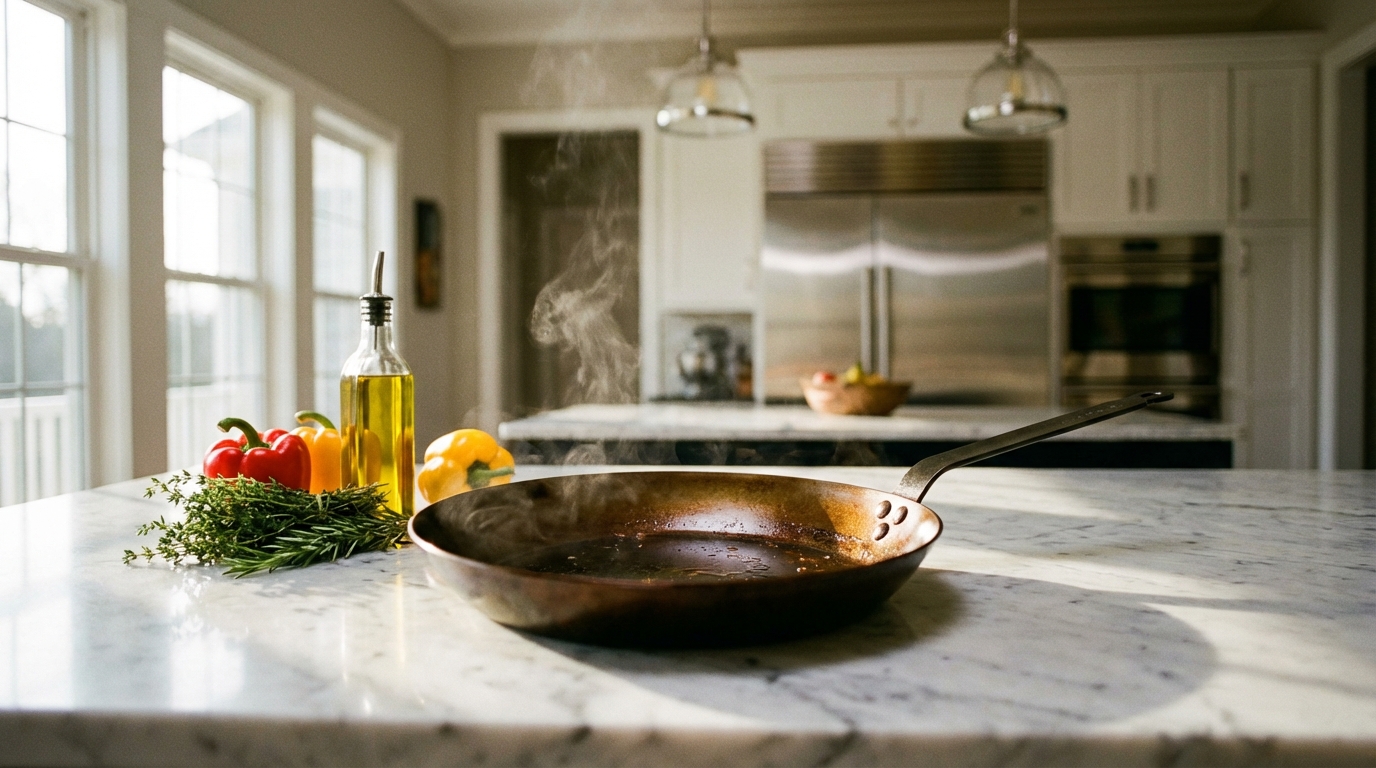
Ditch the flaking Teflon and embrace carbon steel--the naturally non-toxic, forever-slick pan that only gets better with age. This article shows you how a single, affordable carbon-steel skillet outperforms coated non-stick on every front: it sears like cast iron, flips like Teflon after a quick seasoning, and never leaches micro-plastics or PFAS into your food. You'll learn the simple steps to buy, season, and maintain the pan so it develops that glossy, jet-black patina, plus the exact heat-control tricks (pre-heat until oil shimmers, use a thin fat film, deglaze while warm) that make eggs glide and fish release effortlessly. It also unpacks the bigger picture: carbon steel lasts generations, recycles as scrap metal, and keeps one more disposable, chemical-coated pan out of landfills--saving your health, your wallet, and the planet in one smart swap.
Why Carbon Steel Beats Teflon: Health, Performance, and Sustainability
Carbon steel develops a natural non-stick surface through seasoning, delivering the slickness of PTFE without synthetic coatings, off-gassing, or microplastic shedding.
Understanding the non-toxic alternative to Teflon pans carbon steel
Carbon steel is a direct non-toxic alternative to Teflon pans, made from 99% iron and 1% carbon with no synthetic coatings, PFAS, or PTFE in its construction [1]. Its non-stick surface isn't applied -- it develops naturally through seasoning, as cooking oils bond to the metal and polymerize into a patina that strengthens with every meal [1].
Unlike PTFE pans, which off-gas compounds under high heat and can shed microplastics as the coating degrades over time, carbon steel doesn't rely on any chemical layer to function [2]. It heats fast like stainless and retains heat like cast iron -- for a full breakdown of how it performs across different pan styles, our carbon steel cookware guide covers the details [1].
How carbon steel's natural slickness reduces the need for harmful coatings
The slickness of a seasoned carbon steel pan comes down to surface chemistry. Uncoated metals have high surface energy, which causes food molecules to form strong bonds with the surface -- but oils heated repeatedly on carbon steel polymerize into a hydrophobic layer that only allows weak, temporary contact with food molecules, so they release cleanly without force [4].
This is the same basic mechanism that makes PTFE slippery, achieved here without fluorine chemistry or any applied coating [4]. Because the polymerized layer builds rather than degrades with use, it replaces the need for a synthetic coating entirely -- and unlike PTFE, it won't off-gas or shed particles when the pan gets hot [4].

Getting Started with Carbon Steel Cookware
Thin oil layers and low heat build seasoning properly, while excess oil and high temperatures create sticky, uneven coatings that won't polymerize.
Essential tools and first-time seasoning guide
Seasoning a carbon steel pan requires just three things: a neutral oil (canola, vegetable, or grapeseed -- butter and flax seed oil both undermine the process), paper towels, and a burner or oven set to 450 degreesF [5]. Before any oil touches the pan, remove the factory protective coating per your manufacturer's instructions, wash thoroughly, and dry immediately -- bare steel can begin rusting within minutes of being wet [5].
Apply a thin film of oil across the entire surface, then buff until the pan looks almost dry; excess oil is the most common first-time mistake and leaves a sticky, uneven coating rather than a clean polymer layer [5]. Heat until the smoking stops -- that signals full polymerization -- then repeat the oil-and-heat cycle two or three times to build a stable base before your first cook [6].
Everyday maintenance to keep your pan performing
After each cook, wipe the pan while it's still warm -- mild dish soap won't strip a properly polymerized seasoning layer, so a quick wash is fine [8]. Dry completely on the burner, then wipe on a thin film of high smoke-point oil (grapeseed, canola, or avocado) and heat until it just smokes, adding a fresh micro-layer to the patina [8].
For stuck-on residue after searing or cooking sticky foods, kosher salt with a folded paper towel provides gentle abrasion without stripping the surface [7]. Flaking black specks, rust spots, or food sticking where it didn't before are signs the pan needs a reseason -- a quick oil-and-heat cycle is usually enough [8].
Cooking Techniques that Shine on Carbon Steel
Proper preheating and adequate fat are the two adjustments that make carbon steel perform as well as nonstick for delicate proteins like eggs and fish.
High-heat searing, sautéing, and stir-frying tips
Carbon steel's fast response to temperature changes makes it well-suited for high-heat methods where timing matters most. [9] Preheat the pan gradually over medium heat before raising the temperature -- adding food to an under-heated pan is the most common reason proteins stick rather than sear. [9] The pan is ready when water drops bead and dance across the surface; add a thin film of high smoke-point oil, let it shimmer, then place your protein and leave it until it releases naturally. [9] For stir-fries, cut ingredients to uniform size, avoid crowding the pan, and add the longest-cooking items first -- the sloped sides of a carbon steel wok help you toss without spillage while sustained heat keeps vegetables blistered rather than steamed. [10]
Adapting favorite Teflon recipes for a carbon steel surface
Most Teflon recipes translate to carbon steel with two adjustments: use more fat and preheat the pan properly. Carbon steel isn't quite as slick as Teflon at low temperatures, so eggs, fish fillets, and pancakes -- the classic Teflon staples -- benefit from a preheated surface and a thin film of butter or oil before the food goes in [11].
Proteins stick when the pan is under-heated; once it's up to temperature, food makes contact, forms a crust, and releases on its own without force [12]. For delicate foods like scrambled eggs, run slightly lower heat than you would for searing and keep enough fat in the pan -- carbon steel handles it, just with more intention than Teflon requires [11].


Long-Term Value: From Kitchen to Landfill
A carbon steel pan lasts decades and can be recycled, while nonstick pans end up in landfill every few years along with their toxic manufacturing waste.
Durability and cost-effectiveness compared to disposable non-stick pans
A carbon steel pan purchased today can realistically outlast a dozen non-stick replacements. Most Teflon-coated pans need replacing every few years as the coating degrades -- and once it's gone, the pan is unusable regardless of the condition of the metal underneath [13].
Carbon steel lasts practically indefinitely with basic maintenance; rust spots and worn seasoning reverse with a re-seasoning cycle rather than a replacement purchase [13]. That changes the cost equation: a single pan that improves with use costs less over ten years than the recurring cycle of buying and discarding degraded non-stick pans [14].
Reducing waste: why a lasting pan is a sustainable choice
Every nonstick pan that wears out ends up in landfill -- and at a replacement rate of every few years, one household can discard 3-10 pans over a decade [15]. The environmental damage doesn't stop at disposal; PFAS manufacturing generates air and water contamination that persists long after the pan is gone [15].
Carbon steel sidesteps both problems: an uncoated pan can serve for decades and can be recycled at end of life rather than trashed [3]. As one environmental chemist puts it, "an uncoated pan is a good choice because it can last decades, whereas any nonstick pan will become trash a lot sooner" [3].
- Carbon steel pans become naturally nonstick through seasoning, eliminating toxic PTFE coatings.
- They withstand temperatures above 800 degreesF, far exceeding Teflon's 500 degreesF limit.
- A well-seasoned carbon steel pan can replace multiple nonstick pans over decades.
- Simple hot water and a soft sponge clean the pan; soap and dishwashers strip seasoning.
- Oven-safe carbon steel transitions seamlessly from stovetop searing to oven finishing.
- Recyclable carbon steel reduces landfill waste compared to disposable nonstick pans.
- https://misen.com/blogs/news/best-non-toxic-cookware-introducing-carbon-non-stick?srsltid=AfmBOorjYnkACDfPeOntx20R-5I8gSqMiz-wR_ZBCgey1Ay0V00yuEzx
- https://healnourishgrow.com/pfas-free-cookware/
- https://cen.acs.org/environment/persistent-pollutants/does-nonstick-cookware-work-should/103/web/2025/04
- https://misen.com/blogs/news/best-non-toxic-cookware-introducing-carbon-non-stick?srsltid=AfmBOoplWIKccWm4RtLZNEUpmbKiIkAF4ZT4uE3_sYNx5gosEfnBmWYf
- https://www.seriouseats.com/how-to-season-carbon-steel-pans
- https://www.americastestkitchen.com/articles/2279-how-to-season-carbon-steel-cookware
- https://www.vollrathfoodservice.com/culinary-experience-inspiration/vollrath-food-service-blog/how-to-season-and-maintain-carbon-steel-cookware
- https://misen.com/blogs/news/maintaining-pan-seasoning-tips-for-long-lasting-nonstick?srsltid=AfmBOoog0_aqkpMCWx-oNOm0zTUNhxVzCXArFl5guHK-zVx8_QKC_f5U
- https://misen.com/blogs/news/carbon-steel-pan-ultimate-guide-to-cooking-mastery-today?srsltid=AfmBOoradzp21t6Qrh1bS61UoMO4L9hOjM7E4IikFVdsRminLRGQqcNe
- https://www.restaurantware.com/blogs/cooking-equipment/the-ultimate-guide-to-carbon-steel-woks?srsltid=AfmBOorypfj3MpG_aRUfIpc4Yf-ZjdAS1V3TobzzFngLzMT5c9rWBZIk
- https://howtomakedinner.com/blog/cooking-with-carbon-steel-pans/
- https://foragerchef.com/cooking-with-carbon-steel-pans/
- https://gastrotools.com/blogs/guides/carbon-steel-vs-non-stick-pans-8-differences
- https://brass-steel.com/blogs/tips-and-guides/carbon-steel-pan-vs-nonstick?srsltid=AfmBOoqHCC1ApftTFOXkiIOs36mijzKhQ6ZLPqBYkhY3Nh8fQHWHkVsV
- https://misen.com/blogs/news/crispy-skin-salmon-sans-pfas-carbon-steel-keeps-it-together?srsltid=AfmBOopAiW7DWM--i1laWk5v81Wz2vsVp1JpXG2WHVRcTAgRaItBzRzm