

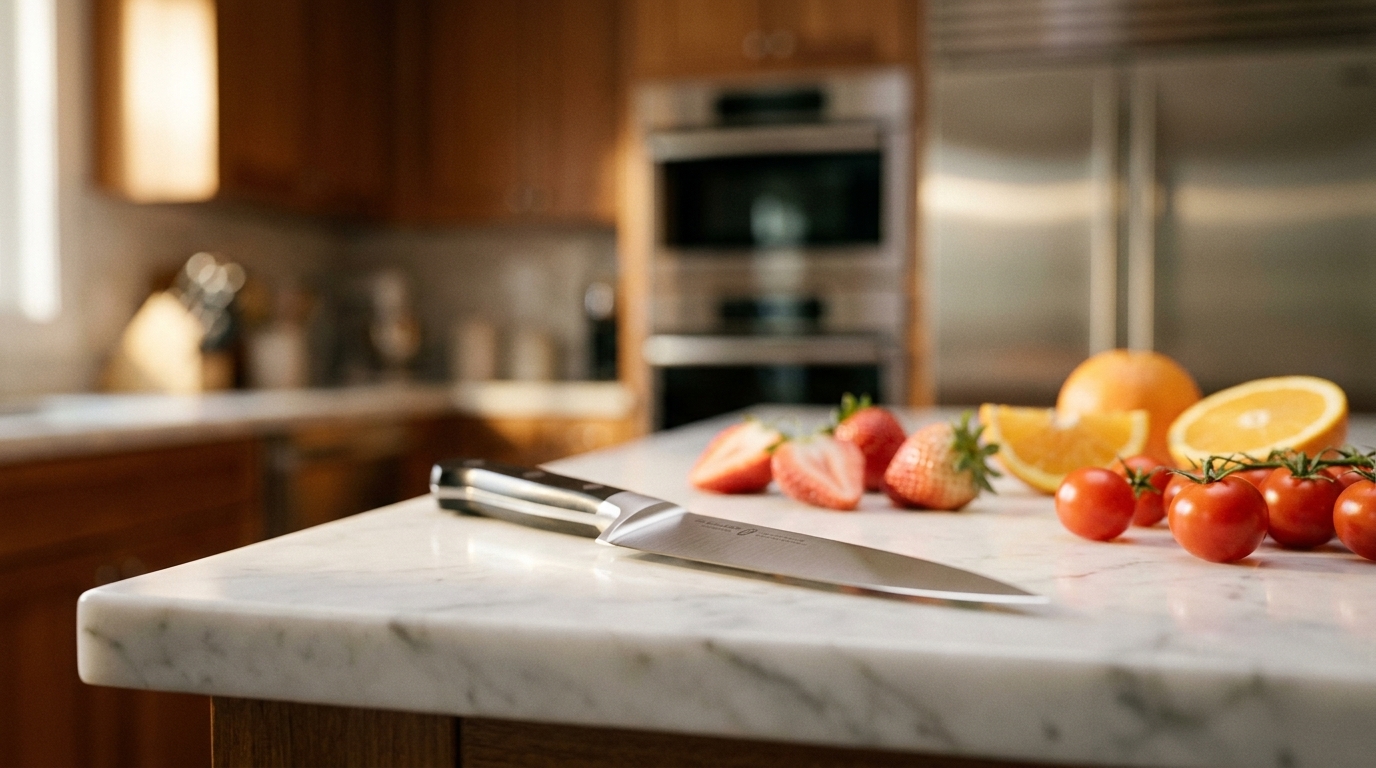
A paring knife's compact blade gives you precise control for detailed tasks like peeling, hulling, and deveining that longer knives can't match. Weekly honing and proper storage keep your blade sharp and ready for the intricate cuts that define good cooking.
What Is a Paring Knife and Why Every Cook Needs One
A paring knife's compact blade keeps your fingers close to the food, letting you follow curves and make precise cuts that a longer utility knife cannot replicate.
The anatomy of precision: blade length, shape, and why 3 to 4 inches matters
Paring vs. utility knife: understanding the control difference for detailed work The clearest distinction between a paring knife and a utility knife is where you use each one: a paring knife works in-hand, off the board, while a utility knife stays on the board for tasks like slicing sandwiches, trimming proteins, and chopping vegetables. [6] Utility blades run 4 to 7 inches, and that extra length trades off the close-grip control a paring knife provides when peeling fruit, hulling strawberries, or navigating around seeds and membranes. [4] A paring knife's compact blade keeps your fingers near the food so you can follow curves and make precise cuts that a longer blade simply can't replicate in-hand. [5]

Master 7 Essential Cuts You'll Use Every Week
Precision blade control and uniform cuts ensure even cooking and consistent flavor release in every dish you prepare.
Brunoise, julienne, and chiffonade: why blade control transforms vegetable prep
Brunoise, julienne, and chiffonade each rely on precise blade control rather than speed.
Julienne strips run 2½ inches long and 1/8 inch wide; you bundle and cross-cut those strips into 1/8-inch brunoise cubes, where any inconsistency tips the result into a mince. [7] Chiffonade follows the same logic: roll leafy herbs or greens into a tight bundle and slice thin ribbons in one clean motion -- the chiffonade herbs technique guide covers the rolling method that prevents tearing and bruising. [8] Uniform size isn't decorative: evenly cut pieces cook at the same rate and release flavor more consistently into soups, stocks, and garnishes. [9]
Deveining shrimp, coring tomatoes, and peeling fruits--cuts where size saves time
Three tasks -- deveining shrimp, coring tomatoes, and peeling curved fruits -- show why a short blade gives you more control than a longer one.
For shrimp, use the knife's pointed tip to make a shallow slit along the back, then work the vein out without cutting through the flesh. [10] Coring a tomato uses the same tip-first approach: angle the tip in a small circle around the stem and lift it cleanly out. [10] Fruit peeling works toward your body -- hold the piece in your non-dominant hand, peel toward your thumb, and rotate as you go -- giving you more precision around curves than a vegetable peeler can manage mid-air. [11]
Paring Knife Styles: Straight Blade, Serrated, and Curved--Which Cuts What
A straight-edge paring knife excels at in-hand detail work like coring and hulling, while serrated and curved blades handle slippery skins and rounded produce that a flat blade struggles with.
Straight-edge paring knives for precision slicing and detail work on delicate produce
A straight-edge paring knife -- defined by a flat blade and sharp pointed tip -- is the most common profile for in-hand detail work, and for good reason.
The pointed tip lets you pierce directly into food rather than drag across it, which makes it the default choice for coring strawberries, hulling tomatoes, and making controlled incisions on small produce without bruising the flesh. [13] Straight blades track predictably when slicing delicate items like citrus segments or grape tomatoes, giving you clean, consistent cuts where a curved belly would add unnecessary resistance. [12] The one trade-off: without a curved belly, rocking cuts on the board are harder -- so this profile is best reserved for the in-hand paring tasks it was designed for, not board-based mincing. [14]
Serrated and curved options: when specialty blade shapes outperform the standard
Serrated and curved paring knives solve specific problems a straight edge handles poorly.
A serrated blade grips slippery skins on tomatoes, soft fruits, and small rolls without crushing the interior, and scores bread dough or pie crusts where a smooth blade drags -- our serrated knife guide explains how tooth spacing determines cut behavior. [15] The bird's beak -- a short curved blade, also called a tourné knife -- is the go-to for peeling round produce and making curved decorative cuts, because a straight blade loses contact mid-stroke on spherical surfaces. [15] Neither replaces a straight-edge as your primary blade, but having one serrated option alongside your paring knife covers the tasks where skin texture or rounded geometry works against a flat profile. [16]


Care, Maintenance, and Storage: Keep Your Paring Knife Sharp and Ready
Weekly honing and annual sharpening, plus proper hand-washing and storage, keep your paring knife sharp and ready for years of precise cuts.
Honing vs. sharpening: a 2-minute routine that extends blade life by yearsHoning and sharpening are different steps that work together to preserve your paring knife's edge.
Honing realigns the microscopic edge that bends out of alignment with regular use -- no metal is removed, just the existing edge straightened back -- while sharpening removes a small amount of metal to create a fresh edge when honing alone no longer restores performance. [17] To hone, hold the blade at roughly a 15-16 degrees angle and pull it heel to tip along a honing steel using light, controlled pressure. [17] For most home cooks, honing weekly and sharpening once or twice a year is enough to keep a paring knife responsive -- and the 3-test method helps you identify which step your knife actually needs at any given moment. [18]
Safe storage and hand-washing practices that prevent rust and edge dulling
Always hand-wash your paring knife with warm water and mild soap -- dishwashers expose blades to high heat, harsh detergents, and jostling that damage both the edge geometry and handle integrity over time. [19] Dry it completely right after washing; even stainless steel develops water spots when left wet, and carbon steel can begin to rust within hours of moisture exposure. [20] For storage, a knife block, magnetic strip, or individual blade guard each protect the edge from contact with other utensils -- loose drawer storage is one of the fastest ways to dull a paring knife outside of actual use. [19] Carbon steel blades also benefit from a thin coat of food-grade mineral oil after drying to prevent oxidation between sessions. [19]
- Paring knives work in-hand for precise detail work; utility knives stay on the board for longer cuts.
- A short blade keeps your fingers near food, letting you follow curves and make cuts longer blades can't replicate.
- Brunoise, julienne, and chiffonade cuts require blade control and uniform sizing so pieces cook evenly.
- Straight-edge blades pierce into food with their pointed tip; serrated blades grip slippery skins without crushing.
- Hone weekly at 15-16 degrees to realign the edge; sharpen once or twice yearly when honing stops working.
- Hand-wash and dry immediately to prevent water spots and rust; store in a block or on a magnetic strip.
- Carbon steel benefits from a thin coat of food-grade mineral oil after drying to prevent oxidation.
- https://seidoknives.com/blogs/news/paring-knife-recommendations-how-to-choose-and-the-best-options-to-buy-now?srsltid=AfmBOopuWBMmRwjiHSKFG_3NNQlMFBqdG1RJQZfRx2N9E_IpGQiOP2gv
- https://kyokuknives.com/blogs/kyoku-chef-blog/how-long-should-a-paring-knife-be?srsltid=AfmBOooswkVkYPJ10wy2IXsV4edzpV4xCpYJrN3Viv6otBq3a6jnoNDW
- https://www.shokuninusa.com/blogs/news/essential-knife-styles-chef-paring?srsltid=AfmBOop1L82zLAImQ2sk1C7rAEJXLRRIT9HklpT8yzutm32RwyiSTnXK
- https://seidoknives.com/blogs/news/utility-knife-vs-paring-knife?srsltid=AfmBOortvulVCLiTPBg5eF1Ib9yHjdRNYa3CYtpfRIqiXl_N-T-ViwAQ
- https://yokashi.com/blogs/news/paring-knives-vs-utility-knives
- https://blog.gunterwilhelm.com/utility-knife-vs-paring-knife-when-to-use-each/
- https://www.escoffier.edu/blog/culinary-arts/8-knife-cuts-every-professional-cook-should-know/
- https://www.webstaurantstore.com/article/796/types-of-knife-cuts.html?srsltid=AfmBOoqsoCROpQCBXKj_0_TofZ1a7RAXFDCJvp29j3D3bZf_5o4udsC0
- https://dalstrong.ca/blogs/news/all-you-need-to-know-about-brunoise-cut?srsltid=AfmBOoqdQEmQCVYu4MB8LiP8Kwcg_0634Xpo4Hhg5-3omD9-vwuqwLu3
- https://www.escoffier.edu/blog/recipes/paring-knife-101/
- https://www.epicurious.com/expert-advice/best-paring-knife-article
- https://www.seriouseats.com/the-best-paring-knives
- https://wusthof.de/en-ie/blogs/the-chefs-table/right-knife-for-the-job-paring-knife
- https://seidoknives.com/blogs/news/paring-knife-recommendations-how-to-choose-and-the-best-options-to-buy-now?srsltid=AfmBOoppbJ18u1WEU8jXbeAhDeVDqUR-qZ1SkHTS73J0hHOyeqjc5ijM
- https://trueknife.com/blogs/news/what-is-a-paring-knife-used-for?srsltid=AfmBOoqLxXRDDpuVZ0_QFyZy5qL9u730OIKLitA5RKL2q8bYDv0Tj8k7
- https://seidoknives.com/blogs/news/paring-knife-recommendations-how-to-choose-and-the-best-options-to-buy-now?srsltid=AfmBOopSUWtQDWaHS7qzwlf0fxsN3XR6H4u8C2UR7LMnqAVXFkYlxdf2
- https://shun.kaiusa.com/sharpening-vs-honing?srsltid=AfmBOoqN9_UYt-K_SQGA-GQODuf5xlUAciEQlQcbEcEsdqzUht5UhA4x
- https://www.messermeister.com/blogs/news/how-often-should-you-sharpen-and-hone-your-knives?srsltid=AfmBOoonZQJ_hBKz5URL18Mh6gzZc0j-r0VlBWZZ56KjqSQo53BTQpp4
- https://www.saafiknife.com/best-practices-for-storing-and-handling-your-paring-knife-safely.html
- https://wickedhandy.net/kitchen-knife-care-and-maintenance/