

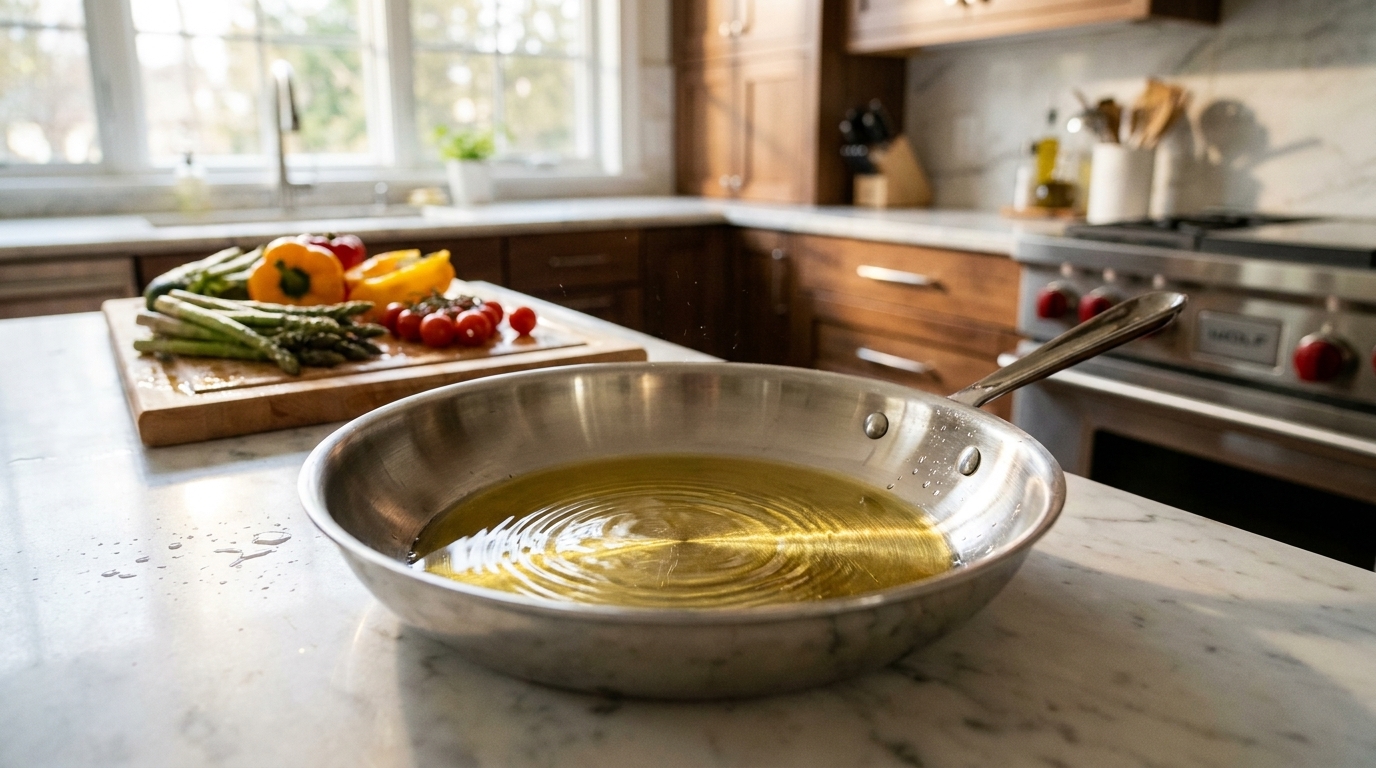
Master sautéing by understanding heat order, pan selection, and oil timing--three controllable variables that determine whether food browns or steams. Preheating your pan, adding cold oil to hot metal, and choosing the right pan size and material transform ordinary cooking into consistently excellent results.
What Is Sautéing and Why Heat Order Matters First
Preheating your pan and adding oil after--not before--creates a vapor layer that prevents sticking and browns food evenly.
The definition: Quick cooking in shallow oil at medium-high heat
Sautéing is a direct dry-heat method using a small amount of fat to cook food quickly in a shallow pan over medium-high heat. [1] The name comes from the French "sauter," meaning "to jump" -- a nod to the tossing motion that keeps ingredients moving and in contact with the heat. [2] Unlike pan-frying, which uses more oil and lower heat over longer periods, sautéing uses just enough fat to coat the pan -- roughly one to two tablespoons -- and relies on high heat to brown the exterior while keeping the interior tender. [3] The technique suits a wide range of ingredients: vegetables, thinly sliced proteins, grains, and fruit all respond well to a properly heated pan.
Why the sequence matters: Heat pan, then oil, then food (not the other way around)
Adding oil to a cold pan means both heat up together slowly, giving the fat time to degrade before any food touches it. When you add cold oil to a properly preheated pan, it immediately thins out due to lower viscosity, spreads across the surface, and fills the microscopic gaps in the metal within seconds [4].
That rapid heat transfer creates a thin vapor layer between the oil and the food -- sometimes called the steam effect -- which physically lifts food off the pan surface and is what actually prevents sticking [4]. Skip the sequence and the oil never reaches temperature fast enough to form that barrier; food proteins then bond directly to the pan's metal atoms [4].
Nailing this order is the single most controllable variable in a sauté.

Choosing the Right Pan for Sautéing Success
Carbon steel heats fast and builds a natural nonstick surface with seasoning, while pan size determines whether food sears or steams instead of stewing.
Nonstick vs. stainless steel vs. carbon steel: Which handles sautéing bestFor sautéing, pan material directly affects heat responsiveness, browning ability, and food release. Carbon steel heats fast, responds instantly to temperature changes, and its sloped sides make tossing easy -- all advantages at medium-high heat [5].
With seasoning, carbon steel builds a natural nonstick surface that improves with every cook, making it worth considering if you're comparing best nonstick frying pan options [6]. Stainless steel takes longer to reach temperature but distributes heat evenly with a copper or aluminum core, making it reliable for proteins that need a clean sear -- though it requires enough fat and correct heat timing to prevent sticking [5].
Nonstick pans handle delicate items at lower temperatures, but their coatings degrade under the sustained high heat that sautéing demands [6].
Pan size and shape: Why a 10-inch or 12-inch skillet outperforms smaller cookware
Pan size directly determines whether food sears or steams -- a real factor in any sauté. Too small a pan, and food releases moisture faster than the surface can evaporate it, so ingredients stew rather than brown [8].
A 10-inch skillet suits vegetables or single-serve proteins well; a 12-inch gives you room to cook multiple chicken breasts or a larger batch without crowding the surface [8]. A 12-inch skillet's effective cooking area is roughly 79 square inches -- enough for most home cooks to work without splitting into batches [7].
If you want data on how these sizes hold up in daily use, the Misen frying pan tested over 90 days covers real-world performance across eggs, fish, and stir-fries.
Oil Timing and Temperature: The Complete Sauté Sequence
Match your oil to your heat level--refined oils handle 450 degreesF sautéing, while unrefined oils and butter work best below 375 degreesF to protect flavor.
How to know when your pan is hot enough: Visual cues and the water droplet test
Smoke points explained: Matching your oil to your heat level (350 degreesF to 450 degreesF range) The smoke point is the temperature at which a fat breaks down into visible smoke, releasing free radicals and acrolein -- compounds that produce bitter, acrid flavors in food. [10] Refined plant oils like canola, avocado, and refined olive oil smoke around 450 degreesF and hold up across the full sautéing range without degrading; unrefined oils and whole butter smoke closer to 350 degreesF-375 degreesF, putting them at real risk above medium heat. [11] Clarified butter and ghee solve the butter-flavor problem by removing milk solids, which raises the smoke point into a workable sautéing range. [10] Oil degrades faster the closer it gets to its smoke point, so picking the right fat for your target temperature protects both flavor and pan performance. [11]
Common Sautéing Mistakes and How to Fix Them Instantly
Avoid overcrowding, pat food dry, and wait for natural release before flipping to achieve proper browning every time.
Crowding the pan, wet food, and premature flipping: What derails results
Three mistakes consistently derail sauté results: overcrowding, wet food, and flipping too soon.
When too much food fills the pan, released moisture can't evaporate quickly enough, so ingredients stew in their own liquid rather than brown. [12] Surface moisture from rinsing or refrigerator condensation creates the same problem, which is why patting food dry before it hits the pan matters -- especially for proteins coming straight from the fridge. [13] Premature flipping tears food and pulls the browning off with it: if a piece needs force to move, it hasn't released naturally and isn't ready. [13] Our guide on how to sauté vegetables covers spacing and surface prep in more detail.
Pan care after sautéing: Maintenance tips to extend cookware life and performance
Pan care varies by material but shares three consistent steps: clean promptly, dry completely, and protect the surface before storing.
For stainless steel, hot soapy water with a non-scratch scrubber handles most post-sauté cleanup; Bar Keepers Friend -- which contains oxalic acid -- lifts stubborn polymerized oil and burn marks without damaging the metal. [14] Carbon steel requires hand washing only, followed by thorough drying and a thin coat of oil to preserve the seasoning layer and prevent rust. [14] Storing carbon steel and cast iron pans separately rather than stacked prevents the contact scratches that degrade seasoning fastest -- carbon steel scratches carbon steel most easily. [15] Our guide on how to clean stainless steel pans covers full stain removal and shine restoration for post-sauté care.
- Heat your pan first, then add cold oil--this creates a vapor barrier that prevents sticking and enables proper browning.
- Carbon steel heats fastest and responds instantly to temperature changes, making it ideal for sautéing at medium-high heat.
- A 12-inch skillet provides 79 square inches of cooking surface, enough to sauté multiple proteins without crowding.
- Refined plant oils like canola and avocado oil smoke around 450 degreesF and work across the full sautéing temperature range.
- Pat food dry before sautéing, avoid overcrowding the pan, and wait for food to release naturally before flipping.
- Carbon steel requires hand washing and a thin oil coat after drying to preserve seasoning and prevent rust.
- https://www.thechoppingblock.com/blog/saut%C3%A9ing-101
- https://www.kitchenaid.com/pinch-of-help/major-appliances/what-is-sauteing.html
- https://www.dioro.com/blogs/news/sautee?srsltid=AfmBOorDlwVg26VBIHhGoVA2nDfkjnIMTGBkusjNPFS_kz6BvE0QUD2c
- https://www.scienceofcooking.com/why_food_sticks.htm
- https://www.independentironware.com/blogs/articles/carbon-steel-vs-stainless-steel-cookware-pros-cons-and-when-to-use-each?srsltid=AfmBOoqb-25raZ-rJ0lmZUV9-Yoqbgnz5oIiyMTfhAgMBCO0J1myqwHK
- https://www.seriouseats.com/best-carbon-steel-pans-7093873
- https://www.seriouseats.com/equipment-whats-the-difference-between-a-skillet-a-fry-pan-and-a-saute-pan
- https://www.all-clad.ca/en/blog/post/frying-pan-size-guide-how-to-pick-the-right-pan-for-your-cooking-needs
- https://parkcityculinaryinstitute.com/blog/how-to-avoid-burning-food-when-sauteing/
- https://www.seriouseats.com/cooking-fats-101-whats-a-smoke-point-and-why-does-it-matter
- https://blog.thermoworks.com/oil-smoke-point-temps/
- https://www.ckitchen.com/blog/2026/1/vegetables-that-don-t-steam-technique.html?srsltid=AfmBOooj_7Tqn7JOnv01EVsWkjz8nAPNrsxq7RHRExZj7Rl5rxk8Ac8Q
- https://www.tastingtable.com/2088860/common-mistakes-cooking-stainless-steel/
- https://www.seriouseats.com/how-to-clean-stainless-steel-pots-and-pans
- https://foodal.com/kitchen/pots-pots-skillets-guides-reviews/cast-and-carbon/cleaning-and-caring-for-your-iron-and-steel/