

Learn which kitchen towel materials work best for different tasks and how to choose the right size and color for your cooking style. Organic cotton towels deliver safety around high heat, lasting absorbency, and a practical alternative to disposable paper towels.
Identify the Right Kitchen Towel Material for Your Cooking Style
Organic cotton towels handle high-heat cooking safely while resisting pilling and lasting hundreds of wash cycles, replacing disposable paper towels.
Cotton vs. Linen vs. Microfiber: Performance, absorbency, and care requirementsCotton, linen, and microfiber each handle kitchen tasks differently, and knowing where each falls short saves you from buying the wrong kitchen towel for the job.
Cotton is the most versatile -- basket and waffle weaves absorb over 2 cups of water in controlled testing and hold up safely around hot cookware. [1] Linen absorbs around 1 cup, dries faster, resists pilling due to its longer fibers, and is the cleaner choice for polishing glassware or covering proofing dough. [1] Microfiber absorbs well by weight but can melt near high heat and doesn't function as a pot holder, so it belongs in a supporting role -- surface cleaning and polishing -- rather than daily dish or hand drying. [1][2]
Why Misen's 100% Organic Cotton Kitchen Towels excel for high‑heat prep and delicate plating
Organic cotton carries a certified production profile that reduces water usage, energy consumption, and greenhouse gas emissions relative to conventional cotton -- a meaningful difference when kitchen towels go through the wash dozens of times a year. [4] Our 100% organic cotton kitchen towels bring that same base material into tasks where both performance and cleanliness matter: handling high-heat prep safely and providing a soft, lint-free surface for wiping down delicate plated dishes without leaving marks or residue.
Organic cotton is also washable and reusable across hundreds of cycles, reducing reliance on disposable paper towels that accumulate cost and waste -- making it one of the more practical swaps you can make in a working kitchen. [4]

How to Choose the Perfect Kitchen Towel Set for Your Kitchen
Match your kitchen towel color to your cookware to create one unified palette across all the tools you reach for daily.
Sizing, color, and texture guide for prep, drying, and polishing tasks
Size and texture both map directly to the task at hand: a 20x30-inch terry-weave kitchen towel handles dish drying without feeling waterlogged mid-sink, while a 14x25-inch flat cotton towel is easier to manage during active prep without getting in the way. [5] For polishing glassware, a lint-free 12x16-inch microfiber or linen cloth prevents streaking that thicker, looped textures tend to cause. [5][6] Color is worth treating as a functional variable -- designating one color for prep surfaces and another for drying dishes is a low-effort way to avoid cross-contamination when you're moving quickly between tasks. [6]
Coordinating Misen towel sets with our nonstick pan and stainless‑steel collection for a unified kitchen look
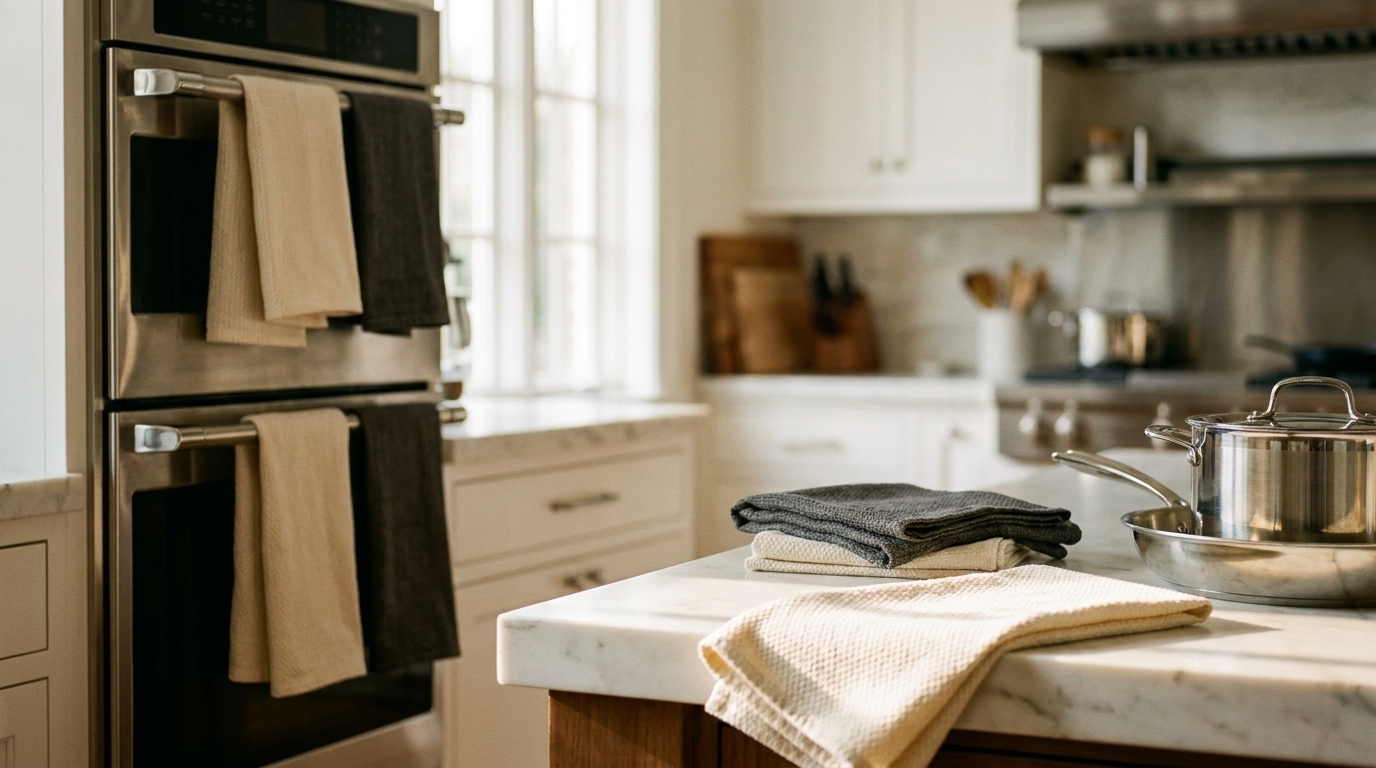
Matching kitchen towel colors to your cookware is one of the most direct ways to create visual consistency -- pots, pans, utensil handles, and linens all read as part of the same space when they share a palette.[7] For kitchens built around stainless steel or dark nonstick surfaces, neutral tones like cream, charcoal, or white pair well with both finishes without competing for attention.[8] Folded or rolled towels on open shelving or draped from an oven handle reinforce the palette and keep the setup looking intentional rather than accidental.[9] Our organic cotton towels pair naturally with our nonstick pan and stainless-steel cookware -- one consistent palette across the tools you reach for every day.[7]
Everyday Use & Safety: Best Practices for Kitchen Towels
Assign separate kitchen towels to different tasks--one for food prep, another for drying dishes--to prevent bacteria from raw meat contaminating ready-to-eat surfaces.
Preventing cross‑contamination: separating prep towels from dishcloths and using Misen's dedicated prep towel
Kitchen towels are the most contaminated surface in the average home kitchen -- more than cutting boards, sink faucets, or countertops -- because people touch them constantly, often right after handling raw meat or before washing their hands. [10] The fix is simple: assign separate kitchen towels to separate tasks, keeping one for food prep surfaces and another strictly for drying clean dishes. [10][11] Using the same towel for both transfers bacteria from raw meat onto ready-to-eat surfaces, one of the most direct paths to foodborne illness -- see our guide on sanitizing kitchen towels with vinegar for disinfection steps. [12] Our dedicated prep towel is designed for active cooking: absorbent enough for spills during prep, but kept separate from your dish-drying rotation to break the contamination cycle.
Effective disinfecting methods - vinegar soak, boiling, and Misen's care tips for a hygienic kitchen
Three disinfecting methods work for cotton kitchen towels: a vinegar soak, boiling, and an oxygen bleach wash.
For the vinegar soak, submerge towels in a gallon of hot water with 1 cup of distilled white vinegar for at least 30 minutes -- this cuts through grease, lifts odors, and disrupts bacterial growth without damaging cotton fibers. [13] Boiling is more thorough but harder on fabric: fill a pot two-thirds with water, add 1/8 cup of baking soda, and boil cotton towels for 15 minutes using tongs -- reserve it for severely soiled or odorous towels rather than every wash. [13] For routine upkeep, adding 1/2 cup of baking soda or a capful of oxygen bleach to each hot-water cycle keeps towels fresh between deep cleans. [13][14]


Maintenance, Longevity, and a Printable Checklist
Cotton kitchen towels typically last 100-150 wash cycles; track absorbency and wear with a simple test to know exactly when replacement is due.
Washing frequency, temperature, and air‑drying to preserve absorbency and color
Wash kitchen towels daily in an active kitchen -- or immediately any time one contacts raw food -- and every 2-3 days if your cooking is lighter. [15] Set the machine to 60 degreesC or higher, which is the threshold needed to kill bacteria and cut through grease buildup; cold cycles fall short on both counts. [16] Skip fabric softener in every load: it coats cotton fibers with a residue that reduces absorbency over time, which is the opposite of what a kitchen towel is there to do. [16][17] After washing, let towels air dry completely before folding -- hanging them outdoors adds UV disinfection as a bonus, and a fully dry towel won't develop mildew or odor between uses. [16]
Printable care checklist and cost‑per‑use calculator for Misen kitchen towels
The cost-per-use framework is simple: divide the purchase price by your towel's estimated wash cycles to see what each use actually costs you.
Cotton kitchen towels last approximately 100-150 wash cycles before absorbency or structure meaningfully declines -- at that rate, a $12 set used daily runs under $0.10 per use. [18] A quick absorbency test tells you exactly where each towel stands: pour 1/4 cup of water on the surface and time how long absorption takes; under 5 seconds is good, over 10 seconds means it's time to replace. [19] The printable checklist tracks wash cycle count, absorbency test results, and odor or discoloration flags so you can make replacement decisions based on actual wear rather than guesswork. [18][19]
- Cotton absorbs over 2 cups of water; linen absorbs 1 cup but dries faster and resists pilling.
- Assign separate towels to prep and dish drying to prevent bacteria transfer from raw meat to ready-to-eat foods.
- Wash kitchen towels daily in 60 degreesC+ water and skip fabric softener, which reduces absorbency over time.
- Organic cotton reduces water usage and emissions compared to conventional cotton across hundreds of wash cycles.
- Cotton towels last 100-150 wash cycles; test absorbency by timing water absorption--under 5 seconds is good.
- Designate towel colors by task and match them to cookware for visual consistency and functional clarity.
- https://www.americastestkitchen.com/equipment_reviews/2707-the-best-dish-towels
- https://www.seriouseats.com/best-kitchen-towels-7372334
- https://wazoodle.com/collections/organic-cotton-eco-pul-fabrics?srsltid=AfmBOoroiBOAvOytBxkd8Z58-ENEnEBU2FX9HOOFfkBgDNSW0gvlQwOm
- https://theberkey.com/blogs/water-filter/25-best-sustainable-eco-friendly-kitchen-products?srsltid=AfmBOornWHuV8BlYhv8aGh4gE2MV3IYIGKdh26SN_-RE68I5ojp4VHqV
- https://www.thekitchn.com/best-kitchen-towels-test-23200327
- https://cosmoappliances.com/how-to-choose-and-maintain-kitchen-towels-for-different-cleaning-tasks/
- https://www.housedigest.com/1588115/airbnb-cohesive-kitchen-design-tips-towel-matching-crockery/
- https://coton-colors.com/blogs/toast-the-blog/7-simple-swaps-to-transform-your-kitchen?srsltid=AfmBOor2jH4oGcCZeXBY_TkBsDdWSC5908ufDKDWG2Rc7iCOVGBCM__g
- https://www.homestyler.com/article/innovative-black-and-white-kitchen-towel-ideas
- https://www.infectioncontroltoday.com/view/towels-top-kitchen-contamination-hazards-list
- https://absorb-lumen.com/blogs/blogs/exploring-the-role-of-kitchen-towels-in-food-safety
- https://share.upmc.com/2025/12/prevent-kitchen-cross-contamination/
- https://wiselymarket.com/blogs/news/5-step-guide-to-deep-cleaning-cotton-kitchen-towels?srsltid=AfmBOoqbvtCTQvBurSPwT2BH76Qx7xAWAU1VGf0AkQc4IFSGTQx2yfBB
- https://thecinnamonhollow.com/how-to-clean-kitchen-towels/
- https://wiselymarket.com/blogs/news/how-often-should-you-wash-cotton-kitchen-towels-to-avoid-bacteria?srsltid=AfmBOor8jgvAz2Jo8amPxDEkirT-6rbmM65ppoI5YY1mcslYZj0EbR9D
- https://www.wildandstone.com/blogs/eco-tips-and-tricks/how-wash-tea-towels-properly-guide
- https://www.mamaslaundrytalk.com/proper-care-of-dish-cloths-and-kitchen-towels/
- https://bostontextile.com/blogs/news/cost-saving-tips-maximizing-linen-lifespan-in-hospitality?srsltid=AfmBOoqqPDPlj6CwleIl5cU3azU1QnHZAnT2F0ZqiWIntEk7I3k0hcqm
- https://thetoweldepot.com/lifespan-calculator