

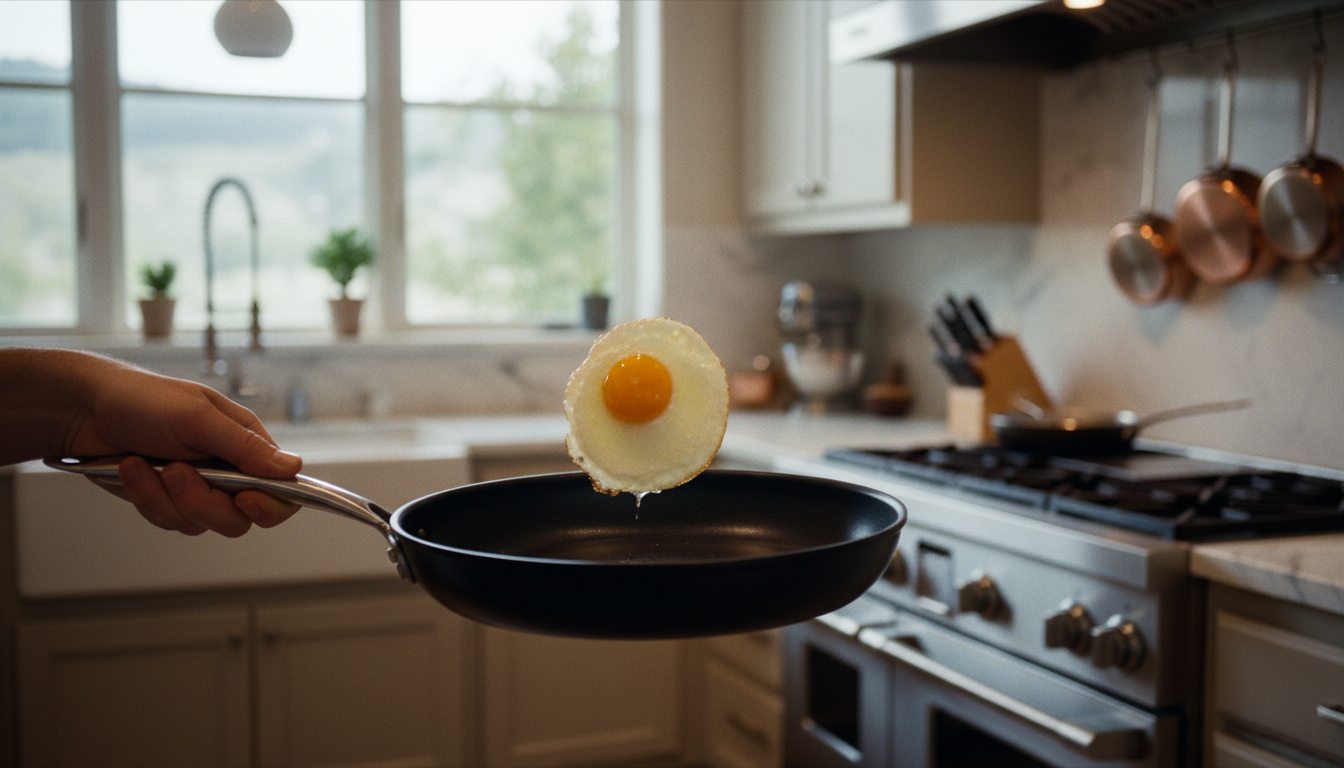
Master the wrist flick technique by understanding how timing, pan angle, and weight work together to lift eggs cleanly without dragging them across hot metal. A quality nonstick pan paired with proper preheating and medium heat makes the flip reliable and repeatable, turning technique into second nature.
Why the Egg Flip Matters: The Test of a True Non-Stick Pan
A fried egg that releases cleanly without tearing is the real proof your nonstick pan's coating is doing its job.
At its core, the wrist flick explained throughout this article is the same motion every skilled cook relies on: a quick, controlled snap of the wrist that lifts food clear of the pan surface instead of dragging it across the metal.
Understanding why that motion works, and what it demands from both the cook and the cookware, starts with understanding why eggs are the toughest test a nonstick pan can face.
The Delicate Food Challenge: Why Eggs Expose Poor Nonstick Performance
Eggs are the fussiest food you can put in a pan. Egg proteins bond directly to metal, so any weak spot in a coating, any dulled patch, shows up instantly as a stuck mess instead of a clean release. That's why eggs work as a stress test for nonstick performance: a pan that releases a fried egg whole will likely handle pancakes, fish, or crepes too, but a pan that fails on eggs tends to struggle with other delicate foods too.
The frustration is familiar to anyone who has gone from picturing golden, crisp-edged eggs to chiseling them off a pan like dried cement [1]. Nonstick coatings promise an easy release, but that promise often exists mainly on the box, since many home cooks find their pans lose slipperiness well before the coating itself wears out [1]. Concerns about PFOA and PTFE have pushed some cooks toward other materials, even though PFOA has already been phased out of nonstick manufacturing in the US, and everyday use hasn't been shown to be clearly harmful [1].
Still, the real test for a pan sold as nonstick is simple: does a fried egg lift cleanly at the edges without tearing, leaving lace-thin whites and a yolk that slides free when you tilt the pan? If it can't do that without a flood of butter, the coating, not your technique, is the problem.
How Surface Quality Determines Flip Success Without Sticking or Sliding
Surface quality determines whether an egg releases in one clean motion or tears apart mid-flip, and the physics behind that comes down to how evenly heat and oil move across the pan. Researchers from the Czech Academy of Sciences found that uneven heating creates thermocapillary convection, a process where surface tension differences pull oil away from the center of the pan and toward the edges, leaving a dry spot where food grips the metal instead of sliding free [3]. That dry spot forms fast, expanding at roughly 5.5 cm per second once it passes a critical size, which explains why an egg that looked fine seconds earlier suddenly locks onto the surface right before you try to flip it [3].
The same study found four practical fixes: thicker oil films, moderate heat, full surface wetting, and pans with thick bottoms that resist uneven heating [3]. A worn or inconsistent nonstick coating makes this problem worse since any dulled patch gives the dry spot a place to start, which is also why cleaning habits matter: residue left behind from previous cooking sessions changes how oil spreads on the next use [2]. Good surface quality, then, isn't just about the coating being new.
It's about the pan distributing heat evenly enough that oil stays put long enough for the flip.
Mastering the Wrist Flick Technique on a Quality Nonstick Frying Pan
Master the wrist flick by timing your snap to when the egg loosens, tilting the pan slightly forward, and matching your wrist force to the pan's weight.
The Physics of the Flip: Timing, Angle, and Pan Weight
A clean egg flip depends on three variables working together: the timing of the wrist motion, the angle of the pan, and how the pan's weight responds to a quick snap. The biggest mistake home cooks make is treating a flip like a stir, dragging the egg across the metal surface instead of lifting it free in one motion. Professional cooks use a flick and flip instead of stirring because it moves food in a single efficient motion rather than repeatedly scraping it against the pan floor, which reduces the friction that causes sticking in the first place [4]. Timing the flick matters just as much as the motion itself.
The egg needs a moment to loosen from the heat and oil before you attempt to send it airborne, so flicking too early just forces a still-stuck egg to tear. Angle plays a supporting role: tilting the pan slightly forward before the snap gives the food a clear path to travel up and land back inside the pan rather than catching on the rim. Pan weight changes how much wrist force the flip requires. A pan that's too light wobbles unpredictably when snapped, while a heavier pan demands a stronger, more deliberate wrist motion to get the same lift.
Professional kitchens treat the flick as a repeatable technique built on this coordination between timing, angle, and weight, not a one-off trick that works by luck [4]. Put simply, the wrist flick explained in one motion: a short, sharp snap sends the egg into a brief arc while the pan catches up beneath it, trading a risky drag across hot metal for one controlled, airborne moment.
Step-by-Step Wrist Motion for Confident, Clean Egg Flips
With the mechanics behind the flip now explained, the wrist flick breaks down into a repeatable sequence worth practicing with an empty pan before you risk a real egg. Start with a loose grip on the handle, wrist cocked slightly downward and elbow tucked close to your body rather than extended outward. Snap the wrist upward in one short, sharp motion, just enough to send the egg a few inches off the surface, then drop the wrist back down to meet it as it falls. Professional cooks treat this motion as its own skill, distinct from plating or presentation, which is why instructional demonstrations isolate the flip and walk through it step by step rather than folding it into a longer recipe [5]. A few checkpoints make the motion easier to learn:
- Loosen your grip; a tight fist limits wrist travel.
- Tilt the pan slightly away from you before flicking.
- Snap from the wrist alone, not the whole arm.
- Catch low, letting the pan meet the egg gently.
- Practice with dried rice or beans before using a real egg.
Repeating this sequence slowly, without rushing the catch, builds the muscle memory that makes the flip look effortless once it becomes routine [5].
What Makes a Nonstick Frying Pan Reliable Enough for Delicate Foods
PTFE coatings release food reliably after hundreds of cook cycles, while ceramic coatings degrade faster and require significantly more force to release food over time.
Coating Durability and Release Performance: Beyond First-Use Promise
A pan's performance in the box means little if it can't repeat the release after dozens of uses, which is why coatings makers run cook cycles instead of single tests. The industry's dry-egg test cooks a plain egg for 2.5 minutes and scores how easily it lifts, repeating the cycle until release fails. Five passes is considered acceptable for most manufacturers, but PTFE coatings like PPG's ETERNA line have held up for hundreds of cycles before failing, showing how much variance exists even within supposedly similar coatings [6].
Independent lab testing backs up the gap between coating families: after 90 pancake-baking cycles, PTFE and PFA coatings needed less than 3 kPa of force to release food, while ceramic sol-gel coatings needed 15 to 34 kPa, meaning the food gripped far harder as the ceramic surface aged [7]. That same research flagged sol-gel's abrasion resistance as a weak point still needing improvement, even though it holds up well against high heat [7]. Sol-gel coatings actually fail differently than PTFE in the first place: their non-stick layer depends on a silicone-oil release agent that heat and dishwasher chemicals strip away over time, not scratches, so a sol-gel pan can look pristine and still release poorly [6].
ILAG's combination tests reflect this split by pairing abrasion cycles with a real omelette release check, since a coating can pass a scratch test and still fail the food release it's meant to guarantee [8]. The practical upshot is that first-use slickness tells you almost nothing about how a pan performs after a few months of regular cooking. Durability over hundreds of cook cycles, not a slick first fry, is what makes a nonstick pan worth keeping, and it's a standard we aim to meet with our own cookware.
Pan Construction Features That Support Consistent Flipping Success
Coating quality matters less if the pan's shape works against the flip itself. Sidewalls with a gentle slope, rather than a sharp interior corner, give an egg a ramp to ride up during the snap instead of a wall to catch on, which is part of why skillet-style pans with flared edges tend to flip more predictably than straight-walled sauté pans. A flat, evenly built base supports the heat distribution that keeps oil from pooling unevenly, the same convection problem that creates dry spots and causes food to grip the metal mid-flip.
A rolled or rounded rim reduces the odds that an egg catches on its way back down, turning a clean flip into a torn one at the last second. Handle balance plays a role too: a pan that feels front-heavy or back-heavy forces the wrist to overcorrect, while one with weight centered closer to the pan's base makes the short, sharp snap easier to control. None of this replaces a reliable coating, but a well-shaped, well-balanced pan gives technique room to succeed instead of fighting it on every attempt, which is worth weighing alongside coating durability when choosing pans that hold up over repeated use.
Reliable sourcing on exact construction specifications for specific nonstick models wasn't available for this section, so these points reflect general cookware design principles rather than a single tested product.
Maintaining Your Nonstick Pan to Keep the Flip Perfect Every Time
Keep your nonstick pan on medium or low heat, use soft sponges and wood utensils, and preheat before cooking to maintain a perfect flip every time.
Daily Care Practices That Preserve Nonstick Coating Integrity
Daily habits do more to protect a nonstick coating than any one-time fix, and the routine is simpler than most cooks assume. Stick to medium or low heat since high heat accelerates coating breakdown over time, which directly undermines the even heat distribution the flip depends on [9]. Let the pan cool before washing, then clean it with a soft sponge and mild detergent, skipping anything abrasive that can dull the surface and create the uneven patches that cause food to grip mid-flip [9]. Swap metal spatulas and tongs for wood or silicone, since metal utensils scratch the coating with repeated contact [9]. A few storage habits matter just as much as cleaning:
- Separate stacked pans with a cloth or paper towel.
- Avoid cooking sprays, which leave residue that degrades the surface over time [9].
- Wipe a light film of oil into the surface occasionally to recondition it [9].
None of these steps require special products, just consistency. Skipping them doesn't ruin a pan overnight, but the cumulative effect shows up exactly where it matters most: in a flip that starts catching instead of releasing clean.
Common Mistakes That Degrade Flipping Performance and How to Avoid Them
The flip often fails before the wrist ever moves, usually because of a mistake made minutes earlier at the stove. Adding eggs to a pan that hasn't preheated creates a temperature shock that bonds egg proteins to the surface almost instantly, which is why warming the pan for a minute or two before adding fat matters as much as the flick itself [10]. Cooking over heat that's too high speeds up that same bonding, while heat that's too low leaves the egg wet and loose, so neither extreme gives it a chance to set enough to release cleanly [10]. Skipping fat, or adding it before the pan is warm, strips away the thin barrier that keeps proteins from touching metal directly, and aerosol sprays make this worse by leaving a gummy residue that builds up with repeated use [10]. Trying to flip before the edges firm up and the bottom fully sets forces the egg off the surface before it's ready, tearing it instead of lifting it free [10]. A few checks catch these mistakes before they ruin a flip:
- Wait for oil to shimmer before adding eggs.
- Keep heat at medium or medium-low throughout.
- Shake the pan gently; if the egg sticks, wait longer.
- Skip aerosol sprays in favor of butter or oil.
None of these fixes require new equipment, just adjusting the order and timing of steps already built into the cooking routine [10].
A clean egg flip comes down to three things working together: a coating that keeps releasing after months of use, a pan shaped and balanced to support the snap, and daily habits that protect both. Get those right and the flick stops feeling like luck and starts feeling like second nature. We build cookware around exactly that kind of everyday reliability, and the same thinking carries across our carbon steel pan and stainless steel skillet for the dishes that aren't eggs. For more care & maintenance tips on keeping any pan flipping clean, our guides have you covered.
Frequently Asked Questions
-
Is it safe to cook eggs in a PTFE or PFOA nonstick pan?
The article notes that PFOA has already been phased out of nonstick manufacturing in the US, and everyday use of PTFE coatings 'hasn't been shown to be clearly harmful.' Concerns have still pushed some cooks toward other materials, but the article frames the real performance test as whether a fried egg releases cleanly, not a safety failure.
-
How many times can I flip eggs before a nonstick coating wears out?
According to the article's industry dry-egg test, a pan cooks a plain egg for 2.5 minutes repeatedly until release fails, and five passes is considered acceptable for most manufacturers. Some PTFE lines, like PPG's ETERNA, held up for hundreds of cycles, while independent testing found ceramic sol-gel coatings needed 15–34 kPa of force to release food after 90 cycles versus under 3 kPa for PTFE/PFA - so durability varies a lot by coating type.
-
Does a heavier or lighter pan make the wrist-flick egg flip easier?
The article explains that pan weight changes how much wrist force the flip needs: a pan that's too light wobbles unpredictably when snapped, while a heavier pan requires a stronger, more deliberate wrist motion for the same lift. It also notes handle balance matters - a front- or back-heavy pan forces the wrist to overcorrect, while weight centered near the base makes the snap easier to control.
-
What pan shape works best for flipping eggs without tearing them?
Per the article, sidewalls with a gentle slope (rather than a sharp interior corner) give the egg a ramp to ride up during the flip instead of a wall to catch on, which is why flared-edge skillet-style pans tend to flip more predictably than straight-walled sauté pans. A rolled or rounded rim also reduces the chance an egg catches on its way back down.
-
Do I need to practice the flip before trying it with a real egg?
The article recommends practicing the wrist-flick sequence with an empty pan first, then with dried rice or beans before using a real egg, to build the muscle memory for a clean catch. It doesn't give a set number of practice reps, just that repeating the motion slowly and without rushing the catch is what makes the flip feel effortless over time.
- Eggs test nonstick pan quality because egg proteins bond directly to metal, exposing any weak spots in the coating instantly.
- Uneven heating creates dry spots where oil pulls away from the pan center, causing food to stick within seconds of forming.
- The wrist flick works by lifting food in one controlled motion rather than dragging it across the surface, reducing friction that causes sticking.
- PTFE coatings maintain release performance for hundreds of cook cycles, while ceramic sol-gel coatings degrade faster and need 15-34 kPa of force to release food after 90 cycles.
- Preheating the pan, using medium heat, and adding fat before cooking prevents egg proteins from bonding to the surface before the flip.
- Pan shape matters: gentle sidewall slopes and rounded rims help eggs slide up and back down cleanly without catching.
- Daily maintenance like using soft sponges, avoiding metal utensils, and storing pans with cloth separators directly protects coating durability and flip performance.
- https://www.aol.com/articles/worried-nonstick-pan-method-makes-020000620.html
- https://favorflav.com/en/food/heres-the-deal-with-nonstick-coating/
- https://www.sciencetimes.com/articles/29453/20210202/physicists-explain-why-food-sticks-nonstick-frying-pan.htm
- https://mattersoftaste.com.au/learn/how-to-nail-the-pan-flip/
- https://www.snapchat.com/topic/how-to-flip-an-egg
- https://www.ppg.com/en-US/industrialcoatings/industrial-blog/non-stick-coatings-performance
- https://www.sciencedirect.com/science/article/pii/S0260877424000256
- https://www.ilag-group.com/en/coatings-for-consumer-goods/retail-brands/test-methods/
- https://insights.made-in-china.com/Mastering-Non-Stick-Care-The-Complete-Guide-to-Prolonging-Your-Fry-Pan-s-Life_MAzGegFjbJDc.html
- https://siraatskitchen.com/blogs/care-use/why-are-eggs-sticking-to-your-non-stick-pan-and-what-can-you-do-about-it