

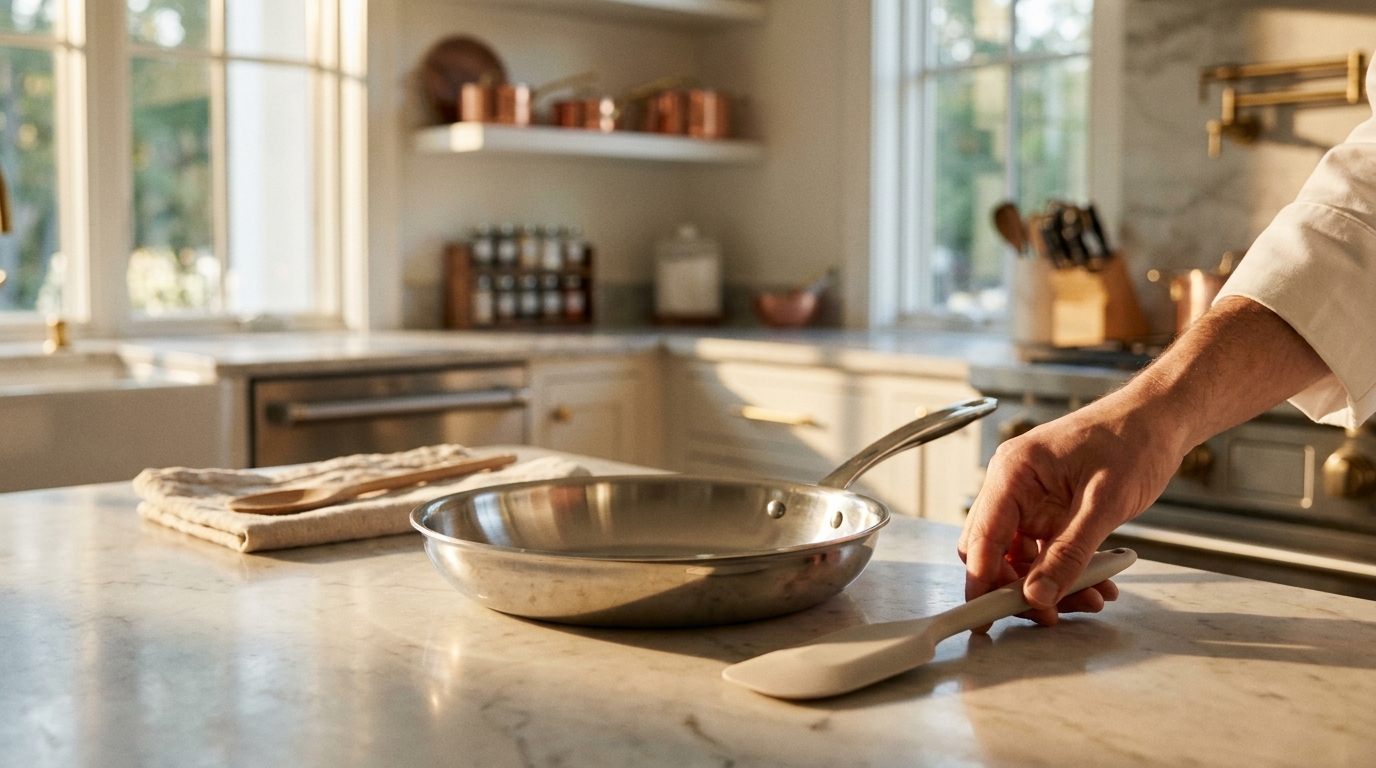
Learn what non-stick pan labels actually mean and which construction details determine real durability over time. The right base material, coating thickness, and daily care habits matter far more than marketing claims.
Decoding Non-Stick Labels and What They Really Mean
Most non-stick labels carry no legal standards, and coating type--not brand name--determines how long your pan actually lasts.
Marketing terms vs real performance
Most labels on non stick pans -- 'non-toxic,' 'PFOA-free,' 'ceramic,' 'chemical-free' -- carry no enforceable legal standard. Terms like 'non-toxic' are unregulated, meaning manufacturers can apply them without meeting any defined threshold [1].
Consumer Reports testing found measurable PFOA in a pan explicitly labeled 'PFOA-free,' because the compound can form as a byproduct during manufacturing even when it isn't deliberately added [2]. Many pans marketed as 'ceramic' aren't traditional ceramic at all -- they use a sol-gel quasi-ceramic coating sprayed onto an aluminum substrate, and producers routinely withhold their exact formulas under confidential business information laws [3].
Understanding what separates ceramic-coated from PTFE-coated pans matters before you can evaluate any label on the shelf.
Key durability factors for non stick pans
The coating system itself -- not the brand name -- determines how long a non stick pan holds up. PTFE coatings typically last one to five years, while ceramic coatings average one to three, largely because ceramic loses its release properties faster under repeated heat cycling [4].
Thickness also matters: pans with a thicker gauge base and multiple coating layers resist warping and surface wear longer than single-coat designs [5]. Heat management, utensil choice, and cleaning habits compound these material differences -- the same pan used correctly can outlast a higher-priced one that's regularly overheated or scoured [4].
How to Pick Non Stick Pans That Stand the Test of Time
Anodized aluminum, clad construction, and a coating thickness of at least 25μm are the design specs that separate durable non-stick pans from ones that wear out quickly.
Materials and construction that matter
The base material beneath a non-stick coating affects how evenly the pan heats and whether it warps over time. Aluminum is the most common core because it conducts heat quickly and distributes it evenly -- but thin aluminum pans warp under high heat or sudden temperature changes, which degrades the coating above it [8].
Anodized aluminum is harder and bonds coatings more securely, making it a stronger base for longer-lasting non-stick surfaces [6]. Pans with clad construction -- aluminum sandwiched between stainless steel layers -- heat more evenly and resist warping better than single-metal designs, which applies to any non-stick pan you're considering [7].
Specs and features that indicate lasting quality
Beyond base construction, a few design specs reliably separate durable non-stick pans from ones that wear out early. A flat cooking surface is non-negotiable -- even slight convexity causes oil and eggs to pool at the edges, stressing the coating unevenly [9].
Coating thickness should reach at least 25μm, and multi-layer systems outperform single-coat designs because each added layer increases abrasion resistance [11]. Flared sides and a bent lip reduce mechanical stress on the coating by allowing spatulas to glide under food rather than scrape across the surface.[9] Oven-safe ratings above 400 degreesF add cooking flexibility without pushing the coating into degradation range during normal use [10].
Everyday Care Tips to Keep Your Non Stick Pans Working Longer
Soft silicone, wood, and nylon utensils protect your coating, while proper cooling and hand-washing with mild soap extend pan life by years.
Cooking temperatures, utensils, and safe usage
PTFE coatings begin releasing fumes above 260 degreesC, a temperature an empty pan can reach in minutes on high heat -- always add oil before heating, since fat smokes visibly around 350-400 degreesF and signals when the pan is close to its limit [12]. Metal utensils and aerosol sprays both shorten coating life: metal scratches directly, while lecithin in most spray oils builds up into a sticky layer that defeats the release surface [12].
Silicone, wood, and nylon protect the coating and tolerate temperatures up to 400 degreesF -- see our comparison of silicone vs. stainless tongs for a practical breakdown of which tool handles what [14]. Save searing and broiling for stainless or cast iron, where sustained high heat won't damage a coating [13].
Cleaning, storage, and routine maintenance
Always let your non-stick pan cool completely before washing -- plunging a hot pan into cold water causes thermal shock that warps the base and loosens the coating [17]. Hand-wash with warm water, mild dish soap, and a soft cloth; dishwashers expose coatings to high heat and harsh detergents that shorten their lifespan [15].
For stuck-on residue, a paste of baking soda and water left for 10-15 minutes loosens buildup without scratching [15]. Store pans by hanging them or placing cloth protectors between stacked pieces, since direct metal-on-metal contact scratches coatings faster than almost any cooking error -- a consistent post-cook routine like our daily two-minute habit for PFAS-free pans keeps all of these steps from becoming friction [16].


When to Repair, When to Replace: Getting the Most Value
Visible coating damage, persistent sticking, and dark discoloration all signal your pan has lost its nonstick function and should be replaced.
Warning signs of coating failure
The clearest signal that a non-stick pan needs replacing is visible coating damage: flaking pieces, deep scratching, or a surface that looks whitish and dry -- all of which show the coating has worn past the point of effective release [20]. Consumer Reports recommends discarding any pan with chips or scratches, since coating particles can shed into food during cooking [19].
Dark discoloration that persists after cleaning confirms the coating is breaking down, while food that sticks consistently -- even after lightly oiling and warming the surface -- means the pan has lost its function [18]. If you're unsure whether visible chipping poses a real risk, our closer look at chipped ceramic pans separates cosmetic wear from actual health concerns.
Extending life with Misen support and warranty
Most cookware warranties cover manufacturing defects -- handle separation, structural failure, or coating degradation under normal use -- but explicitly exclude damage from misuse, overheating, or commercial use [21]. The line between 'manufacturing defect' and 'normal wear and tear' isn't always obvious; a coating that flakes after years of use sits in a gray area that manufacturers interpret differently [23].
KitchenAid's lifetime warranty follows the same pattern: it covers material defects under normal household use but excludes accidents, abuse, and general wear [22]. If you're unsure whether your pan qualifies for a claim, contact us with photos -- our support team can help determine whether the issue is a coating defect or use-related wear, and the Carbon Nonstick(TM) help center covers care specifics that can prevent many avoidable warranty situations.
- Unregulated label claims like 'non-toxic' and 'PFOA-free' carry no legal standard and don't guarantee safety.
- Coating type determines lifespan: PTFE lasts 1-5 years, ceramic 1-3 years; thickness and multi-layer designs extend durability.
- Anodized aluminum and clad construction (aluminum between stainless steel) resist warping and bond coatings more securely.
- Never heat empty non-stick pans; always add oil first since PTFE releases fumes above 260 degreesC.
- Metal utensils and aerosol cooking sprays damage coatings; use silicone, wood, or nylon instead.
- Hand-wash only with mild soap and soft cloth; dishwashers and thermal shock from hot-to-cold water degrade coatings.
- Visible flaking, deep scratches, or persistent sticking signals coating failure and warrants replacement.
- https://www.homesandgardens.com/solved/experts-explain-cookware-labels-to-question
- https://www.consumerreports.org/toxic-chemicals-substances/you-cant-always-trust-claims-on-non-toxic-cookware-a4849321487/
- https://www.theguardian.com/lifeandstyle/2025/jun/09/ceramic-nontoxic-cookware
- https://en.pfluon.com/evaluating-the-lifespan-and-durability-of-non-stick-coatings/
- https://www.esiuo.com/blog/best-non-stick-frying-pan-features-to-look-for-in-2025/
- https://www.kitchenkapers.com/pages/cookware-materials-and-why-they-matter?srsltid=AfmBOorPRjoq-0m8RDv9B0rT8n5_9xOwxHv5p2R5PZodTw4qWhleuTYh
- https://www.americastestkitchen.com/articles/4032-the-four-core-skillets-you-should-own-according-to-science
- https://www.kitchenmarks.com/cookware-types-explained/
- https://www.nytimes.com/wirecutter/reviews/best-nonstick-pan/
- https://www.seriouseats.com/best-nonstick-skillets-6746059
- https://www.esiuo.com/blog/best-nonstick-frying-pan-technology-long-lasting-performance/
- https://www.americastestkitchen.com/articles/2021-the-dos-and-don-ts-of-nonstick-cookware
- https://www.sfa.gov.sg/food-safety-tips/food-risk-concerns/risk-at-a-glance/safe-practices-for-non-stick-pans
- https://girlandthekitchen.com/blog/which-utensils-should-you-use-with-nonstick-cookware/
- https://www.marthastewart.com/how-to-clean-a-nonstick-pan-8722912
- https://www.sensarte.com/blogs/all/prolonging-the-longevity-of-your-nonstick-cookware-best-practices-for-care
- https://www.boroughkitchen.com/blogs/news/caring-for-non-stick-pans
- https://www.allrecipes.com/article/nonstick-cookware-safety/
- https://www.consumerreports.org/home-garden/cookware/make-your-nonstick-frying-pan-last-a1106078664/
- https://www.americastestkitchen.com/articles/5117-how-often-should-i-replace-my-nonstick-pan
- https://circulon.com/pages/warranty?srsltid=AfmBOoozdkCLxSsTWqmOryi_Q7lELwSxDomNOrdWYlfrziGubevdIvr4
- https://producthelp.kitchenaid.com/Kitchenware/Cookware/Cookware_Warranty_Coverage
- https://www.chefsuccess.com/threads/is-normal-wear-and-tear-covered-under-lifetime-cookware-guarantees.60658/