

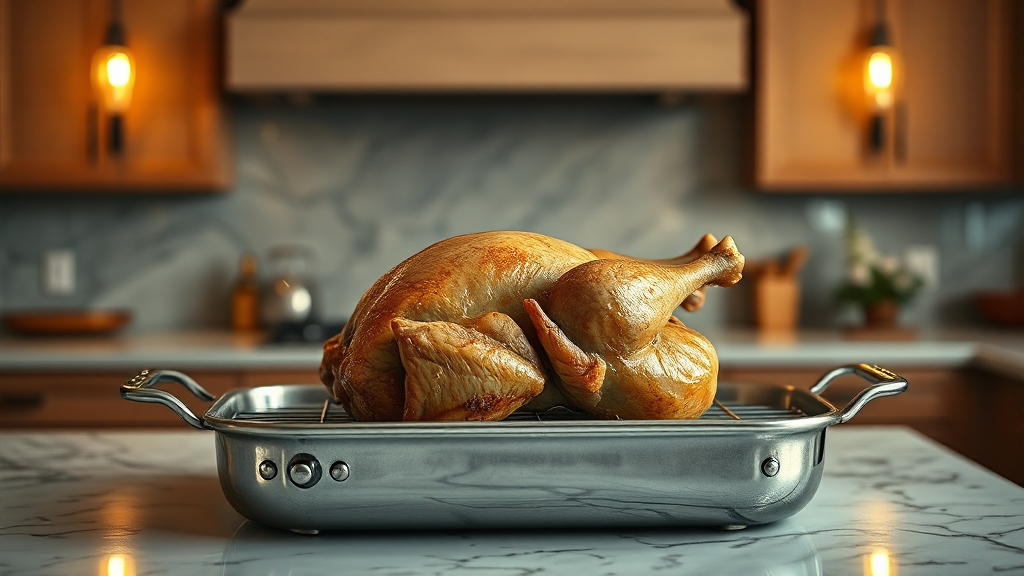
Choosing the right roasting pan requires matching the interior dimensions to your bird's weight and confirming the pan fits your oven cavity. For most home cooks, a 13-inch stainless steel pan offers the best balance for weeknight mains, while an 18-inch pan is necessary for holiday feasts and large birds [1]. Stainless steel is the most durable and stovetop-safe option, though adding a silicone liner can simplify cleanup without sacrificing the pan's structural benefits [4].
Choosing the Right Size for Your Kitchen
Matching Pan Dimensions to Bird and Roast Weight
Start with the weight of your bird or roast. Pan size determines airflow and browning, so an ill-fitting pan directly affects the quality of your meat. If the pan is too large, juices can burn; if it is too small, airflow is restricted and cooking is uneven [1]. Use these interior dimensions as a starting point:
| Bird/roast weight | Minimum interior pan size (L x W x D) |
|---|---|
| 12 lb | 14" x 10" x 2" |
| Up to 16 lb | 15" x 12" x 3" |
| 20 lb | 16" x 13" x 3" |
| Up to 25 lb | 16" x 13" (roaster) |
These figures refer to the interior of the pan, because that is the space that actually holds the meat. Some pans have thick walls, which can make the usable interior a couple of inches smaller than the exterior label suggests [1]. A depth of about three inches is the average for optimal roasting: too shallow and braising suffers, too deep and the food steams instead of roasts [1].
For the Misen lineup, the 9" pan is best for single servings, sides, and smaller roasts that do not need a full-size pan taking over your oven. The 13" pan is a year-round workhorse for weeknight mains, while the 18" pan is the choice for cooking for a crowd or planning on leftovers. If your guest count changes from holiday to holiday, a medium-size pan is the safe option; you can always cook in two shifts for a larger group [1]. If you use a medium pan and have excess room, tuck vegetables at the bottom to fill the space and smooth out the cooking process.
Fitting Your Oven Rack and Counter Space
Before you buy, confirm the pan fits your oven with the handles included. A standard countertop oven, for example, may have a usable rack of about 11.5" x 12.5" with only 6" of clearance in the lower position [2]. That means an 18" pan will not fit in a compact oven, so measure your oven interior before ordering. For a full-size home oven, the 18" pan should clear the rack, but always verify the handle-to-handle width against your oven cavity.
Counter and storage space matter just as much. A 17" to 20" pan will not fit in most kitchen drawers, so plan a spot on top of the fridge or in a deep cabinet before you commit [3]. If storage is tight, the 9" or 13" pans are easier to tuck away. Keep the pan level and away from the oven's heating elements so the handles do not get scorched. If you are buying the 9" Stainless Steel Roasting Pan + Silicone Liner, 13" Stainless Steel Roasting Pan + Silicone Liner, or 18" Stainless Steel Roasting Pan + Silicone Liner, measure your oven first and confirm the pan slides in and out without hitting the door or side walls.
Comparing Materials for Heat and Durability
Stainless Steel vs. Nonstick Coatings
Heavy-gauge stainless steel is the classic roasting pan material. It is durable, dishwasher-friendly, and the rack lifts a big bird off the floor so air circulates underneath. The trade-offs: stainless sheds heat quickly once the oven door opens, browning on the pan floor is lighter, and without the rack most stainless roasters do little else [4]. Stainless is ideal if you want a pan that goes from oven to stovetop for deglazing and gravy, and it handles high-heat searing well [5].
Nonstick roasting pans are lighter and easier to clean, with a coating that lets food release with minimal scrubbing. They heat evenly, which makes them good for large turkeys, poultry, and vegetables [5]. The catch: nonstick coatings are high-maintenance. Avoid metal utensils, keep temperatures below 260°C, and hand-wash with a soft sponge. The coating will deteriorate if you use abrasive tools or run the pan through the dishwasher [6]. If you want the durability of stainless with easier cleanup, the Misen Silicone Roasting Pan Liner covers the pan surface so it stays spotless without affecting the cook. Available in 9", 13", and 18" sizes, it fits each Misen Roasting Pan and gives you the best of both materials.
Enamel and Carbon Steel Options
Enameled cast iron is the heaviest common roasting material, and that mass is the point: it maintains steady, even heat for consistent roasting and keeps browning the underside of meat and vegetables even as the oven cycles. The enamel surface requires no seasoning, is non-reactive (so tomato, wine, and citrus pan sauces are fine), and is stovetop-safe over moderate heat. The downsides: it is heavy, hand-wash only, and enameled roasters do not come in giant-turkey sizes [4]. For daily cooking, enamel-coated pans are easier to maintain than nonstick, with stains wiped off using mild soap and a sponge [7].
Carbon steel heats quickly and evenly, which makes it responsive to temperature changes during cooking. It is well-suited to quick techniques like sautéing and stir-frying, though longer roasting requires a greater application of heat to maintain temperature [8]. Carbon steel is lighter than cast iron and more reactive to heat, so it is a good option if you want a pan that adjusts quickly as you change the oven temperature. If you are comparing materials for a holiday roast, stainless steel and enameled cast iron are the two most versatile choices; carbon steel is better for everyday high-heat cooking.
Selecting the Best Use Case for Your Cooking Style
Whole Poultry and Large Meat Cuts
For a whole turkey or a large roast like prime rib or pork shoulder, you need a pan with enough depth and a rack that lifts the meat off the floor. A V-rack holds a whole turkey steady and lifts it higher for airflow; a flat rack is better for roasts and vegetables; a U-rack is in between [3]. Capacity and even heat distribution are paramount: a pan that does not comfortably fit a standard-sized turkey, or one prone to hot spots, will not deliver consistent results [9].
Lodge recommends matching the pan to the bird: a less-than-10-pound turkey fits a 12" skillet or 7-quart Dutch oven; a less-than-15-pound bird needs a 14.5" to 15" pan; a less-than-20-pound turkey calls for a 17" dual-handle pan [10]. For the Misen lineup, the 18" Stainless Steel Roasting Pan is the right size for a 20-pound-plus bird, while the 13" pan handles a 12- to 16-pound turkey. If you want the pan to double as a gravy maker, choose one the maker says is stovetop safe, and check induction compatibility if that is your cooktop [3]. A well-fitting lid is also crucial for retaining moisture and achieving juicy meat, so if you plan to baste or steam the bird, look for a lid that vents steam to prevent sogginess [9].
Vegetables and Smaller Roasts
For roasting vegetables and smaller roasts, you do not need a full-size pan. The 9" Misen pan is designed for single servings, sides, and anything that does not need a full-size pan taking over your oven. It gives you enough surface area to spread vegetables in a single layer, which is key for even browning.
If you are roasting a smaller roast, such as a chicken breast or a rack of lamb, the 13" pan is the sweet spot. It is big enough for weeknight mains but easy enough for everyday cooking without overcommitting your oven. Use a flat rack or a Silicone Roasting Racks - 2 Pack - Green to lift the food so it crisps instead of steams. The silicone racks are oven-safe and gentle on the pan surface, so they are a good alternative to metal racks if you want to avoid scratching a nonstick or enameled surface. For a full spread of sides and a main roast, the 13" pan can hold a roast rack of pork with potatoes and vegetables, or a turkey breast with stuffing, without any risk of food falling overboard [11].
Practical Buying Decisions and Care
Essential Features: Racks and Handles
A rack is not optional if you want even cooking. Racks help elevate your roast above the pan surface so hot air can circulate around it and help it cook evenly [11]. Most roasting pans come with a dedicated rack, but if yours does not, a standard wire rack does the same job as a V- or U-shaped roasting rack [11]. The Misen Silicone Roasting Racks - 4 Pack - Green are oven-safe and come in 2- and 4-packs in several colors. They gently lift your food while it roasts, so it crisps instead of steams.
Handles matter more than you think. Large, upright handles are easier to grab with thick oven mitts, and riveted handles hold up best to a heavy load [3]. If you are buying a pan for a 20-pound turkey, make sure the handles are sturdy enough to support the weight without bending. The Misen roasting pans have handles designed for this kind of load, and the Stainless Steel Roasting Pan Set includes pans in all three sizes, so you can match the pan to the meal without buying separate units.
Cleaning and Maintenance Basics
Stainless steel pans are dishwasher-safe, which makes cleanup quick. If you want to keep the surface looking new, a dedicated stainless steel cleaner works well; one user reports using Cameo Aluminum & Stainless Steel Cleaner on 32-year-old cookware that still looks new [12]. To avoid a messy pan in the first place, line the roaster with nonstick aluminum foil or use a silicone liner. The Misen Silicone Roasting Pan Liner Set covers the pan surface so the surface stays spotless without affecting the cook.
Nonstick pans require more care. Use wooden or silicone utensils, keep temperatures below 260°C, and hand-wash with a soft sponge. The coating will deteriorate if you use abrasive tools or run the pan through the dishwasher [6]. For enameled cast iron, wipe off stains with mild soap and a sponge. The enamel surface is non-reactive and does not require seasoning, so it is easier to maintain than bare cast iron [7]. Cast iron, if you choose it, needs regular seasoning to prevent rust, but with a bit of care it can outlast you [13].
Conclusion
Final Steps for Your Purchase
Before you buy, run through these checks:
- Measure your oven. Confirm the pan fits with the handles included. A standard countertop oven may have a rack of only 11.5" x 12.5" [2], so an 18" pan will not fit in a compact oven.
- Match the pan to your bird. Use the interior dimensions from the size table in Section 1. A 12-pound turkey needs at least a 14" x 10" x 2" pan; a 20-pound bird needs a 16" x 13" x 3" pan [1].
- Choose your material. Stainless steel is durable and stovetop-safe; nonstick is easier to clean but requires more care; enameled cast iron holds heat well but is heavy; carbon steel heats quickly but needs more attention for long roasts.
- Check the rack and handles. A V-rack is best for whole poultry; a flat rack is better for roasts and vegetables. Riveted, upright handles hold up to a heavy load [3].
- Plan for storage. A 17" to 20" pan will not fit in most drawers, so find a spot on top of the fridge or in a deep cabinet [3].
If you want a pan that covers most of your cooking needs, the 13" Stainless Steel Roasting Pan + Silicone Liner is a versatile choice for weeknight mains and medium-sized roasts. For holiday feasts, the 18" Stainless Steel Roasting Pan + Silicone Liner gives you the space you need for a large bird. The Stainless Steel Roasting Pan Set + Silicone Liners is the complete package if you want all three sizes with liners included.
Frequently Asked Questions
-
What size roasting pan do I need for a 20-pound turkey?
You need a pan with an interior size of at least 16" x 13" and a depth of 3 inches to accommodate a 20-pound bird [1]. For the Misen lineup, the 18" Stainless Steel Roasting Pan is the appropriate size for birds of this weight and larger.
- Can I put a nonstick roasting pan in the dishwasher?
- What is the difference between a V-rack and a flat rack?
- Will an 18-inch roasting pan fit in a standard home oven?
- How do I clean an enameled cast iron roasting pan?
- A 12-pound turkey requires a pan with at least 14" x 10" x 2" interior dimensions, while a 20-pound bird needs a minimum of 16" x 13" x 3" [1].
- Stainless steel pans are dishwasher-safe and can be used on the stovetop for deglazing, but they shed heat quickly when the oven door opens [4].
- Nonstick coatings require hand-washing with a soft sponge and must be kept below 260°C to prevent deterioration [6].
- A rack is essential for even cooking as it elevates the meat to allow hot air to circulate, and a V-rack is specifically better for whole poultry than a flat rack [11].
- An 18-inch pan will not fit in most compact ovens or standard kitchen drawers, so you must measure your oven rack and plan for alternative storage like a deep cabinet [2].
- https://www.dhgate.com/blog/what-size-of-roasting-pan-for-13-lb-turkey/
- https://www.bestbuy.com/site/questions/oster-countertop-oven-with-air-fryer-silver/6417648/question/62deac9d-be36-3373-a0c4-83372c384caa
- https://team5e.com/best-roasting-pan-for-turkey/
- https://alva-cookware.us/blogs/news/best-roasting-pan
- https://www.all-clad.ca/en/blog/post/roasting-pan-guide-how-to-cook-pefect-roasters-every-time
- https://crushmag-online.com/the-ultimate-guide-to-cookware-care-how-to-clean-your-pots-pans/
- https://www.cuminco.com/blogs/our-blog/non-toxic-cookware-care-how-to-keep-your-enamel-cast-iron-lasting-generations
- https://www.tomsguide.com/home/cast-iron-versus-carbon-steel-cookware-everything-you-need-to-know
- https://cookwarecanvaas.com/best-turkey-roasting-pans-with-lid/
- https://www.lodgecastiron.com/blogs/story/what-size-pan-best-for-your-turkey
- https://www.americastestkitchen.com/equipment_reviews/1447-roasting-pans-with-racks
- https://www.houzz.com/discussions/2285561/ugh-roasting-pan-clean-up
- https://underatinroof.com/blog/how-to-clean-and-season-cast-iron-cookware-a-beginner-friendly-guide-for-lifelong-use