

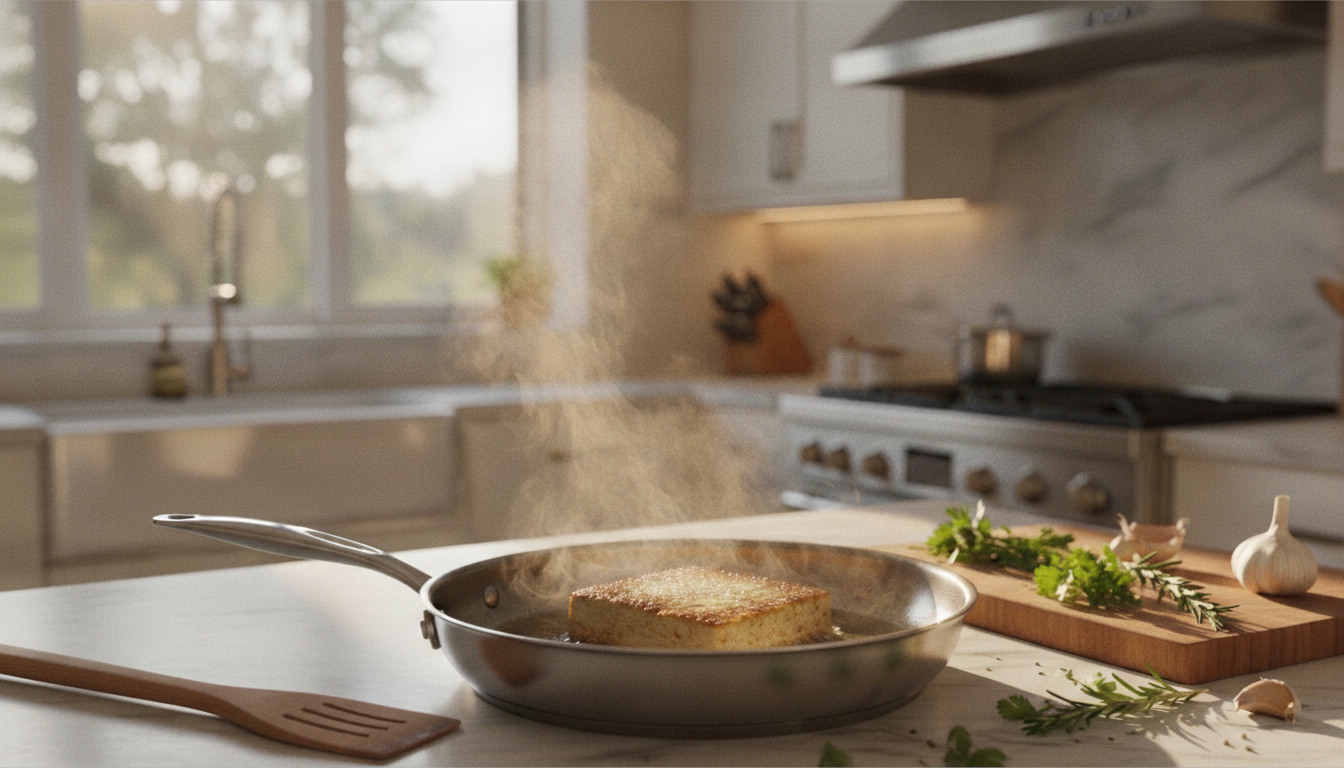
Learn which oils handle high-heat searing for vegan proteins without smoking, and why algae oil's 535 degreesF smoke point outperforms extra virgin olive oil for this task. Matching your oil's heat tolerance to your cookware and cooking time prevents burning while building better seasoning and pan longevity.
Choosing the Right Oil for Your Cookware: Smoke Point Matching Guide
Match your oil's smoke point to your pan type--carbon steel needs high polyunsaturated fat for seasoning, while stainless steel prioritizes heat resistance and neutral flavor.
Stainless steel pans and carbon steel pans: which oils work best
Carbon steel and stainless steel reward different oil strategies, since one depends on building a seasoning layer and the other depends on a slick film reformed with every meal. Carbon steel seasoning works best with oils that combine a high smoke point with a high share of polyunsaturated fat, since heat and oxygen link those fat molecules into a hard, plastic-like coating fused to the metal; grapeseed oil and canola oil both deliver that combination, build smooth layers, and leave no flavor behind [4]. Avocado oil carries one of the highest smoke points among common cooking oils and seasons carbon steel well, though it costs more than grapeseed or canola [6].
Algae oil's rating near 535 degreesF and neutral taste put it in the same high-heat category as these picks, giving it room to build seasoning without scorching, though it performs more like avocado oil here, better suited to everyday cooking in the pan than to laying down the initial seasoning layer. On a pre-seasoned carbon steel pan, that makes it a dependable pick for day-to-day searing once the base seasoning is set. A stainless steel pan doesn't build seasoning the same way, so the priority shifts to an oil that resists smoking at the steady high heat a sear needs while staying neutral enough not to compete with other flavors, a role avocado oil fills reliably by preventing burning while keeping its mild taste out of the way [5].
For searing vegan proteins in a hot stainless pan, algae oil's headroom works the same way it does in carbon steel: it holds steady heat through the minutes needed to form a crust instead of smoking partway through.
Nonstick pan care: why lower-smoke oils protect your coating
Nonstick coatings have their own heat ceiling, and it matters more than any oil's smoke point rating. Most nonstick surfaces begin to deteriorate above 400 degreesF, a threshold algae oil's 535 degreesF rating or avocado oil's high smoke point clears easily, meaning the pan's coating becomes the limiting factor long before the oil does [8]. Because of that, nonstick cookware is built for low to medium heat, so even high-smoke-point oils rarely need their full range in this type of pan [8].
Manufacturer guidance recommends oils like peanut oil, coconut oil, avocado oil, or butter for nonstick cooking, while warning against low-smoke-point oils and aerosol sprays, which burn at lower temperatures and leave a residue that builds up and dulls the coating [8]. Rice bran, sunflower, soybean, and corn oil, each with smoke points in the 445-460 degreesF range, offer similar protection without pushing the pan past its comfort zone [7]. Pair oil choice with a few habits that extend coating life: preheat with a touch of oil instead of heating an empty pan, use wooden or silicone utensils instead of metal, and handwash with a soft sponge rather than relying on a dishwasher's hot water and harsh detergent [7][8].
None of these steps depend on buying a specific oil, but together they keep a nonstick coating slick for years instead of months.

Smoke Point Comparison Table: Algae, Olive, Avocado, and Coconut Oils
Algae oil's 535-degree smoke point outperforms extra virgin olive oil by over 100 degrees, making it the better choice for high-heat cooking.
Chart showing heat ratings, flavor profiles, and best uses
A side-by-side comparison makes the differences in algae cooking oil smoke point versus other common oils easier to apply at the stove. Each entry below lists the smoke point, flavor profile, and best use so you can match the oil to the dish instead of guessing.| Oil | Smoke point | Flavor | Best use |
|---|---|---|---|
| Algae oil | ~535 degreesF | Neutral, barely detectable | Searing tofu/tempeh, stir-frying, high-heat roasting [9][10] |
| Avocado oil (refined) | 480-520 degreesF | Mild, slightly buttery | Pan-searing, grilling, deep frying [9][10] |
| Olive oil (refined/light) | 390-468 degreesF | Neutral to mild | Pan frying, oven roasting [9] |
| Extra virgin olive oil | 325-410 degreesF | Robust, peppery, fruity | Low-to-medium sauteing, dressings, finishing [9][11] |
| Coconut oil (refined) | 400-450 degreesF | Neutral, little coconut taste | Stir-frying, higher-heat sauteing [9][10] |
| Coconut oil (unrefined) | ~350 degreesF | Strong coconut aroma | Baking, curries, low-heat dishes [9][10] |
How to read smoke point data and avoid common misconceptions
Smoke point numbers invite a simple but incomplete takeaway: higher always means better. That overlooks oxidation, a separate process triggered by oxygen, light, heat, and even metal cookware acting as a catalyst, one that can start well before an oil visibly smokes [13]. An oil sitting safely under its smoke point threshold can still be oxidizing with every minute it spends in a hot pan, which is why repeated reheating or leaving oil in a hot skillet longer than needed carries risk even if the smoke point itself never gets touched [13].
Smoke point also doesn't predict how long a bottle lasts in the pantry: oils high in saturated fat hold up for 12 to 24 months, monounsaturated oils for 6 to 12 months, and polyunsaturated oils for as little as 2 to 6 months before turning rancid, regardless of how high their smoke point rating reads [13]. That distinction matters when comparing algae oil and olive oil, since a smoke point rating describes behavior at the stove, not shelf life in the cabinet. A related misconception specific to olive oil: cloudiness or sediment in an unfiltered bottle isn't a flaw signaling spoilage, it's a marker of higher polyphenol content paired with a shorter window to use the oil before quality fades [12].
Reading a smoke point figure in isolation, without accounting for oxidation triggers, fat type, and bottle age, gives an incomplete picture of how an oil actually performs during a vegan sear.


Searing Vegan Proteins Without Smoke: Technique Tips and Pan Selection
Press tofu dry and use high-heat oil in a hot pan to build a golden crust without deep frying.
Temperature control and oil selection for tofu, tempeh, and plant-based meat
Getting a crisp exterior on tofu or tempeh depends as much on prep as on the oil in the pan. Thinner, smaller cuts of tempeh crisp more reliably and absorb marinade faster than thick slabs, which tend to stay bitter and crumbly instead of browning evenly [14]. Tofu needs the opposite prep: pressing out surface water before it hits the pan, since Maillard browning only kicks in above 140 degreesC and residual moisture keeps the surface stuck near 100 degreesC instead of crisping [15].
For both proteins, a hot pan and a neutral, high-heat oil matter more than the brand of skillet; a properly preheated stainless steel or cast iron pan works nearly as well as nonstick for searing tempeh without sticking [14]. Cornstarch-dusted extra-firm tofu fried in a hot pan with neutral oil builds a crust without deep frying, giving a payoff similar to tempeh's golden sear [15]. Tempeh also tolerates a basic olive oil sear with just salt and pepper, but it needs steady watching since it burns faster than tofu once the pan runs hot [16].
Whichever protein is in the pan, the same rule applies: match the oil's heat tolerance to how long the sear needs to run, since a longer crisp-up window calls for an oil that won't start smoking halfway through [14][15].
Maintaining your cookware when cooking with high-smoke-point oils
High-smoke-point oils like algae oil do more than survive a hot sear, they also help maintain the pan itself, since residue only builds up when oil burns past its threshold and turns sticky [17]. A light coat before each use prevents sticking and promotes even browning, and this habit applies across griddle types, whether the surface is cast iron, carbon steel, or stainless [17]. For cast iron and carbon steel specifically, re-seasoning occasionally keeps the surface protective, and oils with high unsaturation levels polymerize more effectively when heated, forming a coating that holds up to repeated use [17][18].
That bonding process rewards consistency over single heavy applications, since multiple heating and cooling cycles build stronger protection on a pan's surface than one thick coat [18]. A few habits keep cookware in shape alongside oil choice: wipe down surfaces while still warm rather than letting burnt residue harden, re-oil lightly after each deep clean, and avoid flooding the pan with oil since a thin layer seasons more evenly than a heavy pour [17][18]. None of this requires specialty products, just matching the oil's heat tolerance to the cookware and staying consistent with light, regular maintenance instead of occasional deep fixes.
Whether you're searing tofu in a stainless skillet or roasting plant-based cutlets in a roasting pan, a neutral high-heat oil like algae oil gives you the headroom to cook hot without burning, while the pan does the rest. For more care & maintenance tips on keeping your cookware in top shape, contact us anytime.
Frequently Asked Questions
-
Is algae oil better than olive oil for searing vegan proteins at high heat?
For high-heat searing, yes - algae oil's ~535°F smoke point and neutral taste give it more headroom than refined olive oil (390-468°F) or extra virgin olive oil (325-410°F), so it holds steady through a longer sear without smoking. The article notes extra virgin olive oil is better saved for low-to-medium sauteing or finishing rather than a long, hot sear.
-
What oil should I use to season a carbon steel pan versus cook in a stainless steel pan?
For building the initial seasoning layer on carbon steel, the article points to grapeseed or canola oil, since their high smoke point and polyunsaturated fat content polymerize into a smooth coating; avocado oil also seasons carbon steel well but costs more. Algae oil is described as better suited to everyday searing once that base seasoning is already set, and in a stainless pan it's framed as a reliable choice for holding heat through a sear without smoking.
-
Can I use regular olive oil in a nonstick pan?
The article doesn't single out olive oil for nonstick use - it cites manufacturer guidance recommending peanut oil, coconut oil, avocado oil, or butter, and warns against low-smoke-point oils and aerosol sprays that leave residue. Since nonstick coatings start deteriorating above 400°F, the coating itself is the limiting factor regardless of an oil's smoke point.
-
Does cloudy or sediment-filled olive oil mean it has gone bad?
No - according to the article, cloudiness or sediment in an unfiltered olive oil bottle signals higher polyphenol content, not spoilage, though it does come with a shorter window to use the oil before quality fades. This is separate from smoke point, which describes stovetop behavior, not shelf life.
-
How do I keep tofu or tempeh from sticking or burning while searing?
Press tofu first to remove surface water, since residual moisture keeps it stuck near 100°C instead of reaching the 140°C needed for browning; tempeh crisps more reliably when cut thinner rather than left in thick slabs. Use a hot, properly preheated pan (stainless, cast iron, or nonstick all work) with a neutral, high-heat oil, and watch tempeh closely since it burns faster than tofu once the pan is hot.
- Algae oil's 535 degreesF smoke point makes it suitable for searing vegan proteins in stainless steel or pre-seasoned carbon steel pans.
- Smoke point alone doesn't determine oil performance; oxidation can occur below the smoke point threshold during extended heating.
- Pressing tofu and cutting tempeh thin improves browning and texture more than oil choice alone.
- High-smoke-point oils prevent residue buildup that dulls nonstick coatings, but the pan's heat ceiling matters more than the oil's rating.
- Polyunsaturated oils build seasoning on carbon steel better than algae oil, which performs better for daily cooking once seasoning is established.
- Consistent light oiling after each use strengthens pan protection more effectively than occasional heavy applications.
- https://zestfulkitchen.com/cooking-oil-smoke-points/
- https://thespoon.tech/algae-cooking-club-debuts-high-cooking-point-cooking-oil-made-from-fermented-microalgae/
- https://www.amazon.es/-/en/Algae-Cooking-Club-Grade-Neutral/dp/B0D5JYKKCQ
- https://www.juliencookware.com/blogs/journal/the-best-oils-for-carbon-steel-cooking-and-seasoning
- https://cafebavaria.com/best-oil-for-stainless-steel-cooking/
- https://chopchopusa.com/blogs/news/best-oil-for-seasoning-a-carbon-steel
- https://www.saffola.in/blogs/cooking-oils-and-non-stick-cookware
- https://circulon.com/blogs/blog/how-to-clean-nonstick-cookware
- https://vomfassusa.com/blogs/gourmet-foods/smoke-point-of-oils
- https://algaecookingclub.com/zine/types-of-cooking-oils
- https://www.webstaurantstore.com/article/800/cooking-oil-smoke-points.html
- https://vomfassusa.com/a/faq
- https://ketodietapp.com/Blog/lchf/Complete-Guide-to-Fats-Oils-on-Low-Carb-Ketogenic-Diet
- https://www.google.com/goto?url=CAESaAHrOzAVtP7_CQ5o3xEP3dQVuzuoQysjK_Md1sSzoq_PWriD2oLK68zHjXfILqIyshHpa1kzQx18AHIx1Pt8gJdhn93WPaLHu5jGhOtXljclMeh_M3agd9JJawHRk-e1jnRKy8jnF4uy
- https://www.google.com/goto?url=CAESfgHrOzAVg8kX-imt-p6jM41C6pQXiTVz_d9SR5o-d5_ppFt7xLv2xx_3-pU7NR6OfFvhvy4JthPRK_bCROLhYIoIjVedYHl8zYQ-DmmD0N3SsMhBkCwvpn0B-gbMKICFthThBmQpSuW4gYEXGFNH1AJiJ6RjNsGuXAxMWZ-2xw
- https://www.google.com/goto?url=CAESbgHrOzAVSpdyZ0ausURSeTfH6CdQo9oOsq5oR5r17qs_jJPKrXj_mIQMRNf-jTgVCJj_Uywoh9v7O3GXekBCYT4w7H377FB_HOx6V8O5uaFQtoCDOSahF-LfZj0QccT1Slqdluknjsdvz7Pb4_QF
- https://algaecookingclub.com/zine/best-oil-for-griddle-cooking
- https://bbqscope.com/best-high-heat-cooking-oil-for-seasoning-grill/