

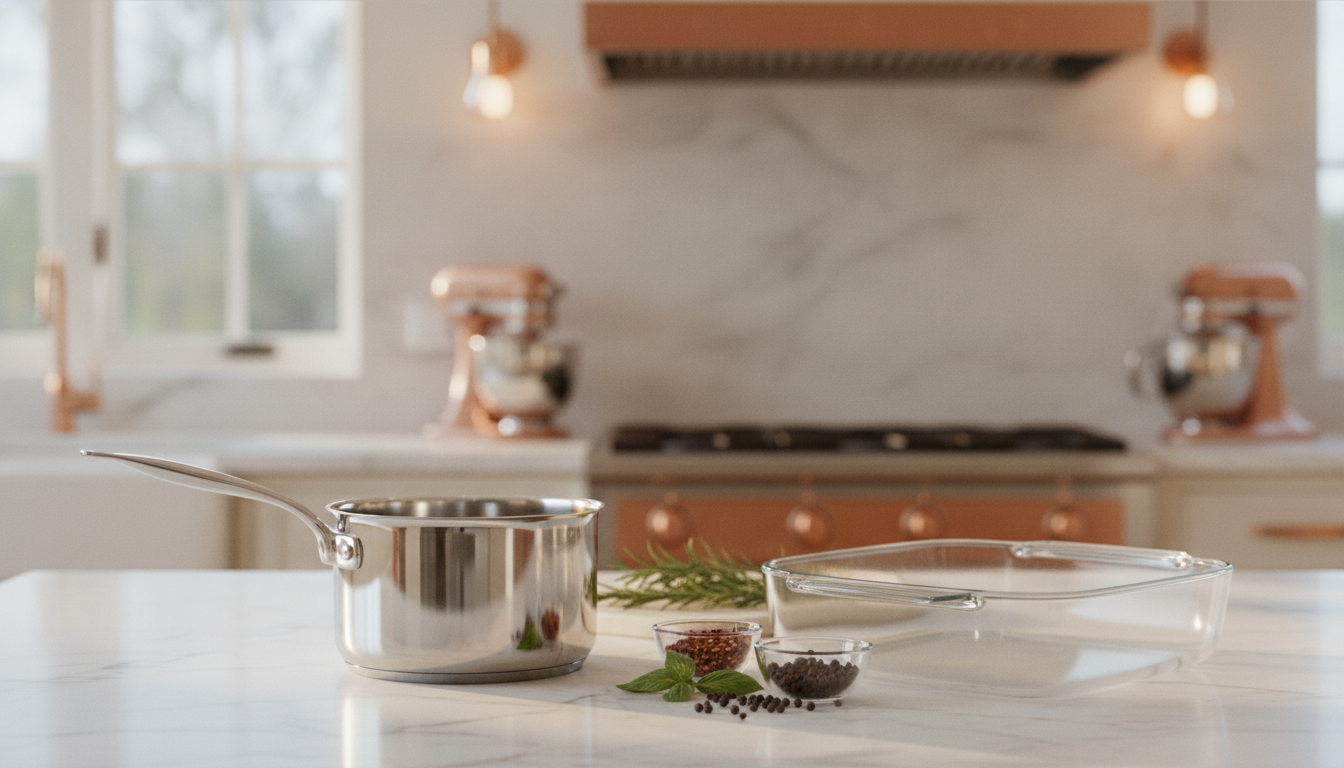
Borosilicate glass excels at handling temperature swings without cracking, while stainless steel resists impact and daily wear better. Your best choice depends on whether your kitchen habits favor careful handling with heat tolerance or frequent drops and dishwasher cycles.
Why Borosilicate and Stainless Steel Dominate Modern Kitchens
Borosilicate glass resists cracking through thermal shock because its low expansion rate lets it survive rapid temperature swings from oven to counter.
The Case for Borosilicate: Heat Resistance and Thermal Shock Protection
Borosilicate glass earns its reputation for heat resistance from a low coefficient of thermal expansion, roughly 30-55x10⁻⁷/ degreesC between 20-300 degreesC, far lower than standard soda-lime glass at 90x10⁻⁷/ degreesC [1]. That lower expansion rate means the glass expands and contracts less when temperatures shift quickly, which is the core reason it resists cracking during thermal shock [1]. Thermal shock resistance is measured using a formula combining tensile strength, elasticity, and expansion rate, and borosilicate scores three to five times higher on this scale than ordinary glass, letting it survive a direct move from a 200 degreesC environment into ice water without fracturing [1].
In practical kitchen terms, that translates to pulling a dish from the oven and setting it on a cool counter, or adding cold liquid to a hot pan, without the crack risk you'd get with regular glass [2]. This same low thermal expansion is why borosilicate shows up so often in bakeware, teapots, drinkware, and food storage containers, since it holds up across the wide temperature swings that everyday cooking demands [2]. The resistance isn't unlimited, though.
At extremes well beyond normal kitchen use, the glass's structural integrity still depends on staying within its rated range, so the real-world benefit for home cooks is reliable performance through oven-to-counter and hot-to-cold swings rather than resistance to industrial-level heat [1].
The Case for Stainless Steel: Durability, Versatility, and Nickel-Free Options
Stainless steel earns its spot in kitchens through corrosion resistance, durability, and the sheer range of cookware it can take, from stockpots to sauciers [5]. The material is graded by its chromium and nickel percentages, and chromium is the non-negotiable piece: a minimum of 10.5% forms the protective oxide layer that prevents rust, regardless of how much nickel is present [5]. Nickel adds shine and pushes corrosion resistance further, which is why 18/10 stainless steel shows up in premium cookware and flatware, but it isn't required for a pan to hold up to daily use [5][4].
For cooks who want to avoid nickel, whether for allergy reasons or simple preference, nickel-free stainless steel in the 18/0 grade still delivers a magnetic, chromium-based alloy with adequate corrosion resistance for everyday cooking, at a lower price point than nickel-bearing grades [5]. The trade-off is that 18/0 stainless runs more brittle and slightly less resistant to prolonged exposure to acidic foods or salt, so it rewards drying and basic care more than its nickel-containing counterpart [5]. Clad construction, where stainless steel sandwiches an aluminum or copper core, is what actually drives heat performance in cookware, independent of the chromium-nickel ratio, so nickel-free pieces built with a conductive core can still heat evenly through searing, sautéing, and simmering [5].
That combination of baseline rust resistance, dishwasher-friendly cleanup, and nickel-free options for sensitive cooks is why stainless steel remains the more versatile pick for a kitchen that needs one material to cover many jobs [4][5]. That versatility extends to cooktop type as well: magnetic stainless steel works on induction, gas, and electric ranges, while borosilicate glass cookware isn't compatible with induction cooktops, since induction heating requires a magnetic cooking surface.
Weight Comparison: How Material Density Affects Daily Cooking
Heavier clad pans with aluminum cores distribute heat evenly across the cooking surface, while lighter glass structures make consistent browning harder to achieve.
Borosilicate Weight: Why Lighter Isn't Always Better for Heat Distribution
Borosilicate glass weighs less than comparable stainless steel cookware, a result of its base chemistry: a silica network modified with boron oxide, which lowers melting point and reduces thermal expansion compared to standard soda-lime glass [6]. Boron also plays a structural role within that glass network, a property researchers have studied directly for how it shapes strength and expansion behavior [7]. That lighter structure is an advantage for carrying a hot dish from oven to table, but it doesn't translate into better heat distribution on the stovetop.
Glass moves heat through its molecular network rather than through the free-moving electrons that let metal spread heat laterally, so a thin-walled piece of borosilicate can develop uneven heat directly above a flame while a thicker, denser piece behaves more predictably [6]. Most borosilicate kitchenware is rated for oven and microwave use rather than direct stovetop flame, so check manufacturer labeling before placing a glass piece on a burner. For oven baking, where heat wraps around the dish from all sides, this distinction rarely matters, but it's the main reason cooks reach for metal pans when a recipe depends on even browning across the bottom surface, something a lighter glass structure makes harder to guarantee [6].
For roasting and browning, a metal roasting pan can give more consistent results across the whole cooking surface.
Stainless Steel Weight: Thickness, Construction, and Cooking Performance Trade-offs
Stainless steel's weight comes down to construction, not just the metal itself. Single-layer stainless steel is lighter but develops hot spots that can burn food, while 3-ply or 5-ply construction sandwiches an aluminum or copper core between steel layers to spread heat evenly, adding noticeable heft to the pan [8]. That aluminum core, with thermal conductivity far higher than steel alone, lets a heavier clad pan heat a cooking surface instantly and evenly, compared to a lighter single-ply piece prone to warping and uneven searing [9].
Thicker gauge steel resists warping and holds its shape over years of use, which is why gauge matters as much as ply count when judging a pan's long-term performance [8]. The trade-off is that nickel-free 18/0 stainless runs slightly lighter than 18/10, but weight savings don't translate into better heat performance on their own, since conductivity depends on the core material sandwiched inside rather than the chromium-nickel ratio of the outer layers [10]. For cooks, a heavier pan with a thick aluminum core typically outperforms a lighter, thinner one for searing and browning, even though it's less convenient to lift and clean [9].
That's the logic behind a 5-ply stainless steel pan, which layers an aluminum core between steel to help distribute heat more evenly and reduce the hot spots common with a thin single-ply piece.
Durability Breakdown: Real-World Lifespan and Maintenance Costs
Borosilicate excels at oven-to-table temperature swings but shatters easily on impact, so careful handling matters even as it tolerates heat ordinary glass cannot.
Borosilicate Durability: Thermal Shock Resistance vs. Impact VulnerabilityBorosilicate's strength against heat doesn't carry over to impact. True borosilicate 3.3 glass, with a coefficient of thermal expansion near 3.3x10⁻⁶/K, can handle temperature swings of up to 150 degreesC without cracking, and tempered versions push that tolerance past 220 degreesC [11]. That same composition gives the glass a melting point around 820 degreesC and thermal shock resistance exceeding 270 degreesC in controlled lab testing, numbers that explain why borosilicate dominates bakeware and lab glassware [13].
But thermal shock resistance and impact resistance are separate properties. Drop a borosilicate dish on a tile floor and it shatters just as readily as ordinary glass, since the low-expansion chemistry that stops cracking under heat does nothing to absorb a sudden mechanical blow [13]. Surface scratches compound the risk: once a scratch forms, it becomes a stress concentrator where a crack can start, even without any temperature change involved [12].
Manufacturing quality matters here too. Testing across multiple factories has found that a meaningful share of glass labeled "borosilicate" actually contains lower silica and higher sodium oxide than the ISO 3585 standard requires, which raises the real-world CTE and narrows the gap between thermal performance and fragility under impact [11]. For a kitchen, this means borosilicate rewards careful handling on counters and in sinks even as it tolerates oven-to-table temperature jumps that would crack ordinary glass or that cooks might otherwise reach for stainless steel to avoid.
Stainless Steel Durability: Why Nickel-Free 18/0 Grade Lasts Through Years of Daily Use
Nickel-free 18/0 stainless steel holds up through years of daily use when a few failure points are kept in check, and pitting, warping, and handle integrity matter more than whether nickel sits in the alloy. Scratches and pits on the cooking surface create spots where bacteria can collect and heat stops distributing evenly, while a warped base leads to burned or undercooked spots during cooking, both signals that call for replacement rather than continued use [14].
Loose or broken handles raise a safety concern when moving hot cookware and count as their own retirement signal, independent of the base metal's nickel content [14]. For 18/0 pans specifically, salt pitting from damaged or corroded surfaces is the main threat worth watching, since nickel's contribution to corrosion resistance is modest enough that nickel-free stainless steel is often marketed as suitable even for cooks managing metal sensitivities [15].
Some makers build their non-nickel stainless steel lines specifically with heavy metal sensitivities in mind, backing the alloy with long warranties that reflect confidence in its long-term performance [15]. That combination, chromium-driven corrosion resistance plus attentive care around salt exposure and drying, is what lets nickel-free stainless steel keep performing without rusting for years, as long as cooks address pitting, warping, or loose handles before those issues compound [14].
Cost Per Year: True Investment Value and Long-Term Savings Estimates
True cost per year depends more on replacement frequency and handling habits than sticker price, so match the material to how you actually cook.
Breaking Down Initial Cost, Replacement Frequency, and Maintenance Expenses
Initial cost comparisons between borosilicate and stainless steel cookware matter less than how long each piece actually stays in rotation, since replacement frequency drives the real cost per year more than the sticker price alone. For stainless steel, replacement tends to track specific failure points: scratches or pits that trap bacteria and disrupt heat, warped bases that cause burned or undercooked spots, and loose or broken handles that create safety risks when moving hot cookware [14].
None of these failure points depend on nickel content, so nickel-free stainless steel pans wear out, or keep performing, on roughly the same schedule as nickel-bearing grades, meaning any price gap at purchase doesn't automatically translate into a shorter lifespan [14]. Borosilicate's maintenance math looks different because its main threat isn't gradual wear but a single impact or thermal event.
Even glass rated for wide temperature swings can develop a hairline fracture from something as ordinary as a splash of room-temperature water hitting a hot surface near the base, a failure with no maintenance fix once it happens [16]. That split means borosilicate's cost per year hinges largely on handling habits and breakage risk, while stainless steel's hinges on catching pitting, warping, or handle wear early, before those issues force a full replacement [14].
Which Material Wins the Cost-Per-Year Test: Decision Framework with Real Scenarios
Matching the material to real kitchen habits is the clearest way to settle the cost-per-year question, since both materials can last for years when their specific weak points are managed [17]. For a cook who drops cookware occasionally, runs a dishwasher daily, and cooks acidic sauces often, stainless steel's resistance to impact outweighs borosilicate's thermal shock advantage, because break resistance "clearly outshines" glass once an impact actually happens [17]. For a cook who values seeing food as it cooks, avoiding any metallic taste, and keeping serving pieces light for oven-to-table moves, borosilicate's chemical inertness and transparency deliver value even though it carries more breakage risk [17][18]. Three scenarios clarify which material wins on a yearly basis:
- Frequent drops or hard-surface kitchens: stainless steel's break resistance lowers replacement frequency [17].
- Oven-to-table serving with careful handling: borosilicate's inert, non-reactive surface adds value without extra wear [18].
- Heavy acidic-food cooking or daily dishwasher use: stainless steel's non-porous surface resists odor and stain buildup [18].
Since neither material's sticker price predicts its actual lifespan, the real driver of cost per year is whether a kitchen's daily habits line up with glass's vulnerability to impact or steel's vulnerability to pitting and wear [17][18]. If your routine involves frequent handling, acidic sauces, or a daily dishwasher cycle, a durable stainless steel pan is the lower-maintenance bet for the long haul. Either way, a few good care and maintenance habits go a long way toward stretching cost per year, and if you're still weighing which piece fits your kitchen, contact us and we'll help you sort it out.
Frequently Asked Questions
-
How much temperature swing can borosilicate glass actually handle before it cracks?
True borosilicate 3.3 glass can handle swings up to about 150°C without cracking, with tempered versions pushing past 220°C, and thermal shock resistance exceeding 270°C in lab testing. That resistance is specific to heat, though - a drop or a scratch-triggered crack is a separate risk the article notes glass doesn't resist the same way.
-
Does nickel-free (18/0) stainless steel last as long as 18/10, and when should I replace a pan?
The article says durability failure points - pitting, warped bases, and loose or broken handles - don't depend on nickel content, so 18/0 and 18/10 wear out on roughly the same schedule. Replace a pan when you see surface pitting or warping that affects heat, or when a handle is loose or broken, since that's flagged as a safety risk when moving hot cookware.
-
Which costs less per year, borosilicate or stainless steel?
The article doesn't give fixed prices for either material; it frames cost-per-year as depending on replacement frequency rather than sticker price. Borosilicate's cost risk comes mainly from a single breakage event, while stainless steel's comes from catching pitting, warping, or handle wear early - so compare how each material fits your actual kitchen habits, and check the linked product pages for current pricing before deciding.
-
Can I use borosilicate glass cookware on an induction cooktop?
No - the article states borosilicate glass cookware isn't compatible with induction cooktops because induction heating requires a magnetic surface. Stainless steel, by contrast, is magnetic and works across induction, gas, and electric ranges.
-
Should I pick a heavier 5-ply stainless pan or a lighter single-ply one?
For searing and browning, the article points to a heavier pan with a thick aluminum core (like 3-ply or 5-ply construction) as the better design choice, since that core spreads heat evenly and resists the hot spots single-ply pans develop. If lifting and cleaning ease matters more than even browning, a lighter single-ply piece is the trade-off to weigh, with warping as the risk to watch for over time.
- Borosilicate glass resists thermal shock three to five times better than standard glass, surviving quick temperature swings without cracking.
- Stainless steel requires minimum 10.5% chromium for rust protection, while nickel adds shine but isn't required for daily cooking.
- Borosilicate shatters easily on impact despite heat resistance, while stainless steel withstands drops and hard-surface kitchens.
- Heavier stainless steel with aluminum or copper cores distributes heat evenly, outperforming lighter single-ply pans for searing and browning.
- Borosilicate's cost per year depends on handling habits and breakage risk, while stainless steel's depends on catching pitting and wear early.
- Nickel-free 18/0 stainless steel performs reliably for years with proper care, rewarding drying and attention to salt exposure.
- https://eureka.patsnap.com/materials/borosilicate-glass-analysis
- https://www.stpgoods.com/home-goods/borosilicate-glass
- https://rapidprecise.com/which-is-better-18-0-or-18-10-stainless-steel/
- https://skcookware.com/blogs/informational/stainless-steel-cutlery-grades-explained-a-guide-to-choosing-the-best
- https://www.zhenneng.com/a-news-essential-factors-when-purchasing-stainless-steel-cookware-a-buyer-s-guide.html
- https://www.sciencedirect.com/topics/engineering/commercial-glass
- https://www.ingentaconnect.com/content/sgt/ejgst/2014/00000055/00000003/art00003?crawler=true
- https://www.baccarat.com.au/blog/best-stainless-steel-cookware-australia-the-complete-buyers-guide-for-2026
- https://world.taobao.com/lang/en-us/shopping-guide/2019080977162174464.htm
- https://world.taobao.com/lang/en-us/shopping-guide/2035582558447599616.htm
- https://www.hemeraglass.com/newsinfo-why-does-your-glass-kitchen-jar-fail-at-150c.html
- https://www.ikoo-glass.com/top-blog/premium-glass-food-storage-containers-microwave-safe-for-kitchens.html
- https://www.chilinglass.com/knowledge/borosilicate-glass-vs-regular-glass-storage-jars-which-is-better
- https://www.zhenneng.com/a-news-retirement-signals-for-stainless-steel-pans-when-to-replace-and-upgrade.html
- https://toxicfreechoice.com/non-toxic-cookware/
- https://world.taobao.com/lang/en-us/shopping-guide/2024438453382414336.htm
- https://www.topglassdesign.com/blog/borosilicate-glass-vs-stainless-steel-which-reusable-bottle-is-best-for-you.html
- https://www.vinodsteel.com/blogs/blog/the-ultimate-guide-to-stainless-steel-vs-glass-storage-containers-which-is-right-for-you