

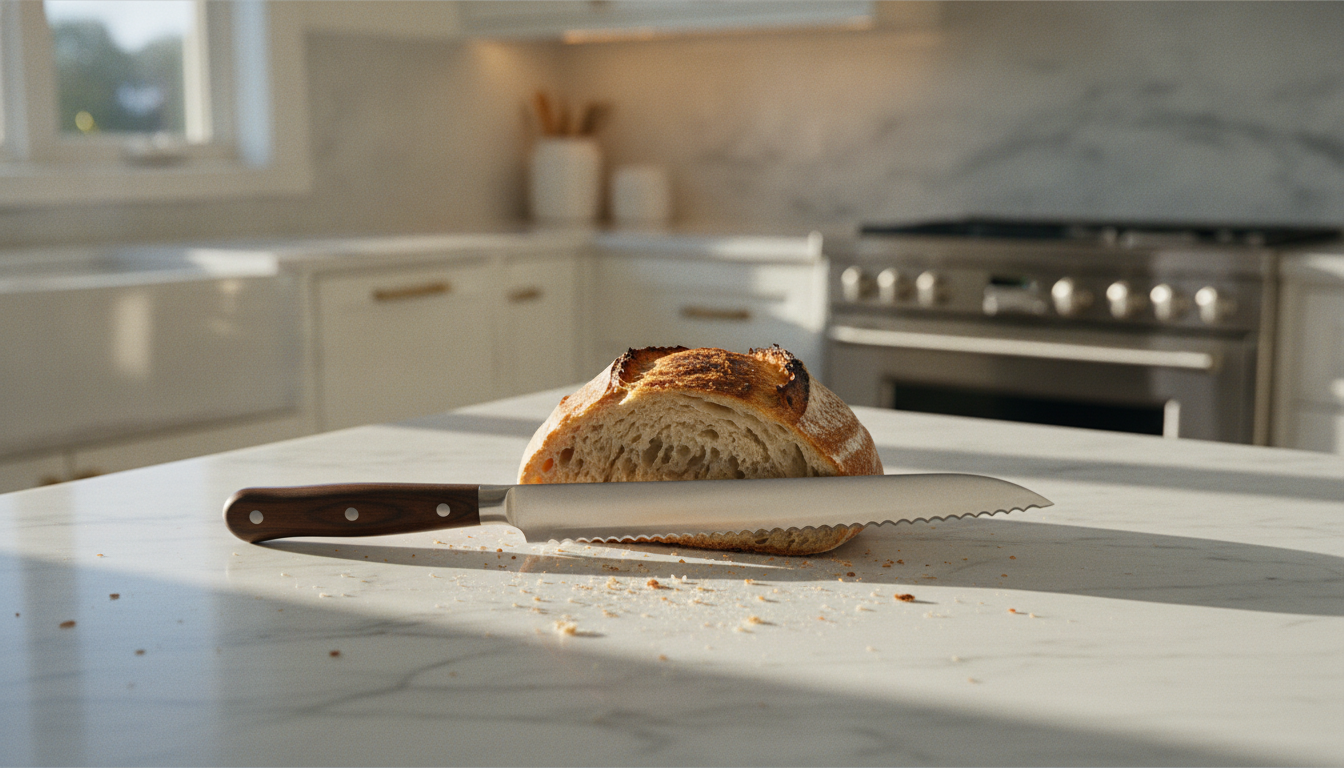
Pointed serration excels at biting through thick, blistered sourdough crusts on the first pass, while wavy serration glides gently through soft breads and delicate foods. Match your knife's tooth pattern to the bread you bake most, then store and maintain it properly to keep it sharp for years.
Understanding Serration Patterns: Wavy vs Pointed Teeth
Wavy serration spreads cutting force across multiple contact points to slice soft breads cleanly without crushing the crumb, while pointed teeth excel at piercing thick, blistered crusts.
How Wavy Serration Works on Tough Crusts
Wavy serration--sometimes called scalloped serration--uses rounded, wave-like curves spaced further apart along the blade rather than sharp, pointed teeth. This design spreads cutting force across multiple contact points instead of concentrating it at a few tips, which reduces the tearing and compression that dense sourdough crust and airy crumb are prone to under aggressive teeth [1].
A wavy edge helps a blade run smoothly through soft breads and thinner, more pliable crusts without squashing a warm loaf, and a well-built blade holds that edge through repeated slicing. On those thinner crusts, that wider spacing can let the blade glide rather than saw-and-tear, which translates to fewer stray crumbs on the board and a crumb structure that stays intact underneath the slice [1].
That's a meaningful difference on softer loaves where the interior stays delicate--though as later testing in this article shows, a thick, blistered sourdough crust tends to favor pointed serration instead, since pointed teeth generally handle that first bite more readily.
Why Pointed Serration Excels at Precision Cuts
Pointed serration uses closely spaced, sharp teeth that concentrate pressure at each tip rather than spreading it across a wide curve, letting the blade "bite" into a surface with minimal downward force [3]. That concentrated contact makes pointed teeth well suited to precision tasks--starting a clean cut through a tomato's skin, sectioning citrus, or slicing cured meats--where you need the blade to grab instantly instead of skating across a slick surface [3].
The tighter tooth spacing also means fewer serrations touch the cutting board during a single stroke, which the source material notes helps the edge stay sharp longer than a straight blade under the same use [4]. On foods with a firm but thin exterior and a tender interior, pointed serration lets you control exactly where the cut starts, which matters more for sandwich rolls, cured meats, and citrus than it does for a thick, blistered sourdough crust [3][4].
Because the teeth are finer and closer together, the resulting cut edge tends to look tighter and less scalloped than what wavy serration produces, giving a cleaner line on foods where presentation matters [3]. That precision comes with a tradeoff: the same closely spaced points that grab a tomato skin so effectively can compress or tear softer, more delicate crumb--like cake or sandwich bread--where a gentler wavy edge tends to glide instead [4].
The Sourdough Crust Challenge: Which Serration Pattern Wins
Pointed serration cuts through thick sourdough crusts cleanly on the first bite, while wavy edges handle delicate foods with minimal tearing once engaged.
Real-World Test Results: Crumb Integrity and Clean Separation
Independent knife testing backs up the tradeoff between these two serration styles on real sourdough loaves. Wirecutter's side-by-side found that its pointed-tooth pick "bites firmly into bread crust and slices with little effort," cutting dozens of thin, even slices "with only a moderate amount of crumbs and without mangling the soft interior" [6].
Its scalloped-edge upgrade pick told a different story on the same test loaves: testers needed "a couple of sawing motions to bite into a bread crust," and the blade could "skitter across the loaf" during those first cuts before settling into a clean pass [6]. Food & Wine's testing panel reached a similar conclusion, noting that pointed teeth "help break through the hard surface and maintain a hold on the crust without slipping," while rounded teeth "slide around on the crust's surface before they bite in".
Bon Appétit's testers reported the reverse benefit once wavy blades did engage: the scalloped pick handled tomato skin and cake with minimal tearing, gliding rather than sawing through delicate structure [5]. Across all three tests, the pattern holds -- pointed serration wins on initial bite and crumb cleanliness for thick, blistered crusts, while wavy serration produces a gentler, less-torn cut once it's through, making crust thickness the real deciding factor rather than either design being universally better [5][6][7].
Why Crust Thickness Matters More Than Blade Length
Blade length gets more attention than it deserves; a longer blade helps you clear a wide boule in fewer strokes, but it does nothing to solve the actual problem of a thick, blistered crust resisting the first bite [8]. Bon Appétit's testing panel found that knives with the same general length performed very differently depending on tooth shape once they hit a dense sourdough crust--the pointed-tooth knife bit in with little effort, while the longer, scalloped one needed extra sawing motions just to break the surface [9].
That gap shows crust thickness, not inches of blade, is what decides whether a knife glides or skitters on the first cut. Buying guides that focus on blade length, height, and flexibility as the main performance levers miss this distinction, since a knife can be long and rigid and still struggle if its serration pattern isn't matched to how thick the crust actually is [10].
For a home baker choosing between two serrated knives of similar length, the practical question is whether the loaf's crust is thin and pliable or thick and blistered--not whether the blade measures nine inches or ten.
Serrated Knife Maintenance: Keeping Your Edge Sharp Between Cuts
Serrated knives need tapered rods and protective storage to stay sharp, since flat whetstones and standard sharpeners can't reach the valleys where cutting happens.
Why Serrated Knives Need Different Care Than Straight Blades
A straight blade meets a whetstone at one continuous angle, but a serrated edge is built from dozens of individual points and valleys, so care has to match that geometry. Serrated bread knives use an asymmetrical grind--one side carries visible angled bevels behind each tooth, while the opposite side stays nearly flat--and flattening or aggressively grinding that flat side erases the serrations entirely [11].
The recessed scallops are also what keep a serrated edge sharp longer than a straight one in daily use, since only the tooth tips touch the cutting board while the deeper curves stay protected from wear [12]. That same protection disappears the moment you run the blade through a flat whetstone or a standard pull-through sharpener built for straight edges, since neither tool can reach into the gullets where the actual cutting happens [11].
A dishwasher creates a different risk: knocking against other utensils and racks can bend or dull individual teeth in ways a straight blade edge doesn't experience [13]. Because sharpening requires reaching each valley rather than sliding along one continuous edge, serrated knives call for tapered rods sized to the serration, not the flat stones, pull-through sharpeners, or honing steels that work fine on a chef's knife [11][12].
Storage and Handling Tips to Prevent Serration Damage
Serrated blades need storage that keeps the toothed edge from touching anything harder than the food it slices--including other utensils sharing the same drawer. Rest a bread knife on its spine whenever possible, and keep enough space between knives so the teeth never bump metal or each other, since that contact is what rolls or chips individual points over time [14]. A knife block or a coated magnetic strip works well because it holds the spine against the surface rather than letting the serration hang exposed [14]. A snug blade guard offers the same protection for a knife stored loose in a drawer or packed for travel, and a padded knife roll or bag adds a layer of cushioning during transport [15]. Loose drawer storage remains the most common daily risk: unprotected teeth knocking against silverware or other blades dulls the edge faster than a knife kept in a slot, block, or guard [14].
Quick habits that protect the serration:
- Store spine-down in a block or drawer insert [14]
- Choose a coated magnetic strip over exposed rails [14]
- Slip on a snug blade guard for drawer or travel storage [15]
- Pack in a padded knife roll for transport [15]
Choosing the Right Serrated Knife for Your Sourdough Routine
Pointed serration bites through thick sourdough crust on the first stroke, while wavy serration glides better through delicate breads and tomatoes.
Serration Pattern Comparison Table: Performance Across Bread Types
The pattern across independent tests holds steady enough to summarize by bread type, which helps match a knife to the loaves you bake most.
| Bread type | Pointed serration | Wavy serration |
|---|---|---|
| Thick, blistered sourdough crust | Bites in on the first stroke, moderate crumbs [6] | Needs a few sawing motions before it catches [6] |
| Baguette (thin crust) | Cuts cleanly with little resistance [16] | Glides through with minimal effort [16] |
| Soft sandwich bread | Can compress crumb if teeth are deep [17] | Smooth, low-crumb slices [17] |
| Tomato skin | Grabs instantly, less slipping [6] | Slides before biting, then cuts clean [6] |
| Cake or delicate crumb | Can tear soft layers [16] | Glides without shredding [16] |
The split shows up clearest on the rustic loaf: Wirecutter's pointed-tooth pick 'bites firmly into bread crust and slices with little effort,' while its scalloped upgrade pick needed 'a couple of sawing motions to bite into a bread crust' before settling in [6]. Bon Appétit's panel found the same divide, noting rounded teeth 'slide around on the crust's surface before they bite in,' while pointed teeth 'help break through the hard surface and maintain a hold on the crust without slipping' [16]. For sandwich loaves, cake, and tomatoes, though, testers repeatedly favored the gentler glide of wavy serration over the more aggressive bite of pointed teeth [16][17]. That reversal is why a single 'best' serration pattern doesn't exist independent of what's under the blade.
When to Replace vs Sharpen Your Serrated Blade
Replace a serrated blade when the teeth show heavy chipping, missing points, or rust pitting near the cutting edge, since that kind of damage goes beyond what a tapered rod can restore [18]. A blade that has already been worn down to the same angle as the spine has lost its serration profile for good, and no amount of honing brings that geometry back [18]. Short of that, sharpening is the better call: most serrated knives, including older and inexpensive ones, return to full cutting life after one proper pass with a rod, and replacement only makes sense once a blade is cracked or badly chipped [19]. For a bread knife in regular use, a useful life of roughly five to ten years is typical before performance decline becomes permanent rather than something a rod can fix [18]. If the tooth-by-tooth process isn't appealing, professional serrated sharpening runs about $20 to $50 per knife plus shipping, a reasonable option for a blade worth keeping [18]. Misen's mail-in knife sharpening service handles that tooth-by-tooth work for you if you'd rather leave it to a pro.
Signs it's time to replace rather than sharpen:
- Missing teeth or heavy chipping along the edge [18]
- Visible rust pitting near the serrations [18]
- Teeth worn flat to the blade's spine angle [18]
- Performance loss even after a proper sharpening attempt [19]
Wavy or pointed, the right serration comes down to the loaves you bake most. Pointed teeth bite through thick, blistered sourdough crust on the first pass, while wavy edges glide gently through soft breads, cake, and tomatoes. Match the pattern to your bread, store the blade so its teeth stay protected, and keep it sharp with the right care & maintenance tips--that's what keeps a bread knife earning its spot in your kitchen for years. Questions about picking or caring for a knife? Contact us anytime.
- Pointed serration bites through thick, blistered sourdough crusts on the first stroke with minimal effort.
- Wavy serration glides through soft breads, cakes, and delicate crumbs without tearing or compression.
- Crust thickness--not blade length--determines whether a knife glides or skitters on initial contact.
- Serrated edges require tapered rods for sharpening; standard whetstones and pull-through sharpeners damage the serration.
- Store serrated knives spine-down in a block or on a magnetic strip to protect teeth from dulling.
- Most serrated knives return to full performance after professional sharpening; replacement is only needed for cracked, badly chipped, or heavily rusted blades.
- https://blog.knife-depot.com/page/5/
- https://shun.kaiusa.com/shun-cutlery-blog-cutting-edge-of-serration?srsltid=AfmBOopyEqxKMC-zxLBG4Qy7kfz_bS2NUWF9iUcfucGPpMtro6OI9UpZ
- https://www.opinel-usa.com/blogs/news/serrated-vs-straight-edge-knives-when-each-wins
- https://www.bonappetit.com/story/best-bread-knives?srsltid=AfmBOooh56jhShxI_5s4vKIkZV0LXaUQXOymAydHnA2VpIFi65-pStpU
- https://www.nytimes.com/wirecutter/reviews/best-serrated-knife/
- https://www.foodandwine.com/lifestyle/kitchen/best-bread-knife
- https://truesourdough.com/choosing-a-knife-for-sourdough-bread-full-guide/
- https://www.bonappetit.com/story/best-bread-knives?srsltid=AfmBOoo6LL_Tbt0v1-Dj1nTyGX7L6fP-q_9WV8nHvNmEkN2DuTm_kghF
- https://skwarehome.com/blogs/knife-education/what-is-the-best-bread-knife-the-buyer-s-guide
- https://seriouslyfastsharpening.com/can-you-sharpen-serrated-knives
- https://www.americastestkitchen.com/articles/3321-the-best-way-to-sharpen-a-serrated-knife
- https://seidoknives.com/blogs/news/how-to-sharpen-serrated-bread-knives?srsltid=AfmBOoq6KrI8Q5emmVmXG02QEC5s0HYREGpUPQCAajLIXLB3oDpMerC3
- https://robinaknifesharpening.com/ultimate-guide-to-storing-knives-for-blade-protection
- https://www.seriouseats.com/how-to-store-knives
- https://www.bonappetit.com/story/best-bread-knives?srsltid=AfmBOoo9HPUp6yRlt5u9_cz2aG_sIld5Pv0YlXDW1Y5hPXuLwOwewYml
- https://www.seriouseats.com/best-bread-serrated-knives-equipment-review
- https://www.knifesharpening.sg/blog/when-should-you-replace-your-knives
- https://vivront.com/blogs/news/how-to-sharpen-a-serrated-knife-at-home?srsltid=AfmBOopB_bIG54ebAVN1NP8NfMhbmt9hSkPaKYZTtQFyoU1kH3e1vyzY