

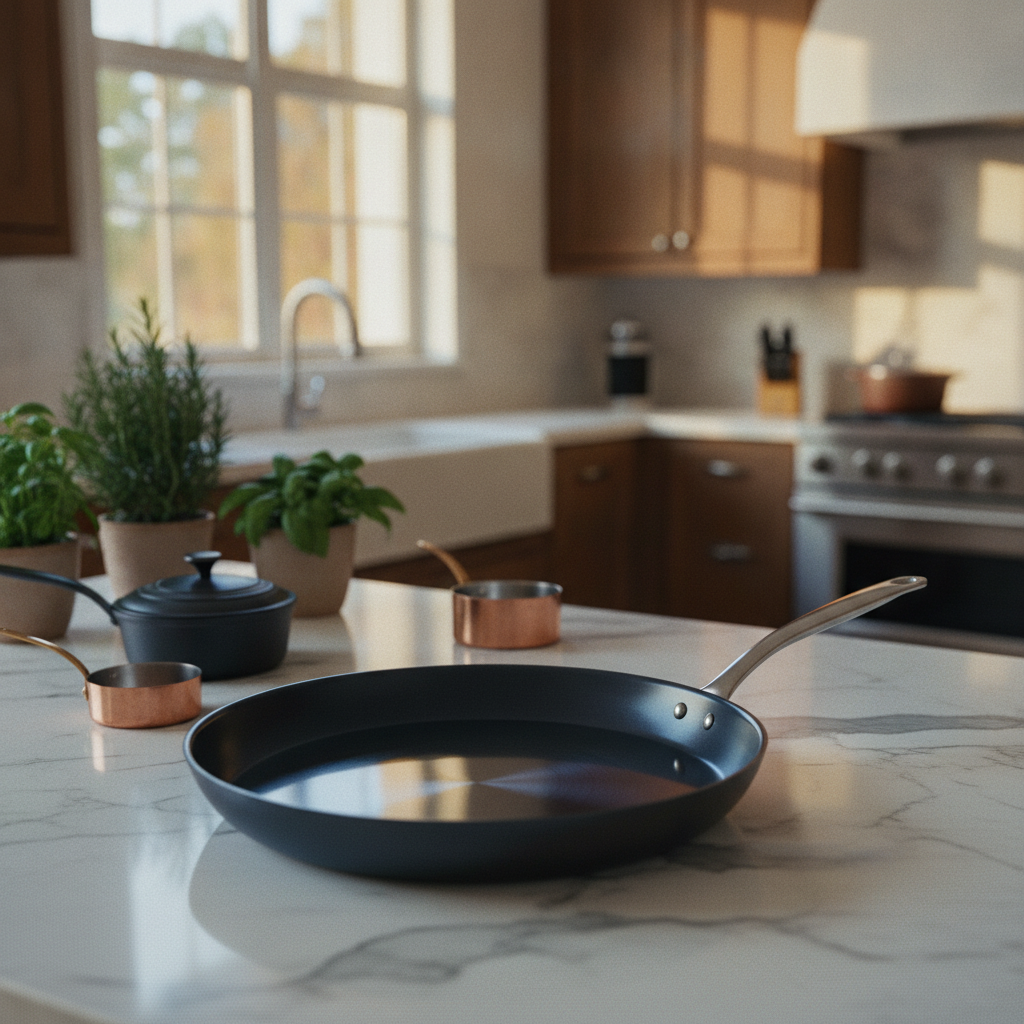
Nitrided carbon steel pans cost more because the steel undergoes an industrial heating process that creates a harder, rust-resistant surface compared to traditional seasoning. Prices range from $109 for 8-inch pans to higher tiers for larger sizes, with the 10-inch model offering the best balance of cooking capacity and manageable weight for most home kitchens.
What Nitrided Carbon Steel Actually Costs: Breaking Down the Price Reality
The nitriding process--heating steel in nitrogen and carbon gases for hours--adds significant manufacturing cost that reflects in the pan's price.
Why nitrided pans cost more than traditional carbon steel: Understanding the manufacturing difference
A nitrided carbon steel pan costs more upfront because the steel goes through an extra industrial step that a plain carbon steel pan skips. Ferritic nitrocarburization diffuses nitrogen and carbon into the surface of the steel by heating it in an atmosphere of ammonia, nitrogen, and a carbon-containing gas to a nitriding temperature between roughly 800 degreesF and 1,300 degreesF for 0.5 to 10 hours [1]. Producing that atmosphere and holding tight temperature uniformity across a furnace load requires equipment built specifically for the job, along with batch processing and careful process validation that a basic seasoning line doesn't need [2].
A traditional carbon steel pan, by comparison, only needs a light coat of oil baked onto the surface at a lower temperature for well under an hour to build its seasoned layer [1]. That difference in processing shows up in hardness: one manufacturer's testing found a conventionally seasoned ferrous surface measured around 120 Vickers hardness, while the same surface after nitrocarburization measured about 350 Vickers [1]. The nitrided layer also resists corrosion far better, since it forms a compound zone that acts as a physical barrier rather than depending on a thin oil film that has to be reapplied [2][3].
Every one of those steps, furnace time, gas atmosphere, temperature control, and quality checks, adds cost that ends up in the price of the finished pan.
Price range by size: 8-inch, 10-inch, 12-inch, and 14-inch nitrided pans compared
Nitrided carbon steel pan prices climb with cooking surface diameter, since a larger pan needs more nitrided steel and more furnace capacity per batch. At 8 inches, nitrided carbon steel pans generally start around $109 to $150 depending on brand and construction, with a typical weight near 3 pounds [4]. Misen's nitrided Carbon Nonstick(TM) Frying Pan comes in 8-, 10-, and 12-inch versions, with the 10-inch model weighing 2.5 pounds and priced around $119 to $129 depending on retailer [5][4]. Because these pans pair an aluminum core with the nitrided steel surface instead of relying on thick steel alone, weight increases only modestly as size goes up, so a 12-inch pan doesn't become dramatically harder to lift than an 8-inch one [5].
By size, current market pricing generally breaks down like this:
- 8-inch nitrided pans: roughly $109-$150 [4]
- 10-inch nitrided pans: roughly $119-$129 [5]
- 12-inch nitrided pans: priced above the 10-inch tier, though exact figures vary by retailer [4]
A 14-inch nitrided pan isn't a common configuration among tested models right now, so shoppers hunting for that size will find fewer options. Worth confirming before buying at any size: cooking surface diameter can run an inch or more smaller than the pan's stated size, which affects how much food actually fits [4].

Size-by-Size Pricing Guide: Which Pan Fits Your Budget and Kitchen
An 8-inch pan is the most affordable entry point to nitrided carbon steel, while 10- and 12-inch sizes handle the widest range of everyday cooking tasks.
8-inch nitrided pans: Best entry price point for home cooks and couples
An 8-inch nitrided carbon steel pan sits at the lowest price tier in the lineup, and that makes it a practical starting point for anyone who hasn't cooked with carbon steel before. Misen's 8" Carbon Nonstick(TM) Frying Pan uses the same nitrided surface and aluminum core as the larger sizes, just scaled down, so buyers get the rust resistance and quick heat response without paying for surface area they don't need [6].
This size suits one or two servings at a time, whether that's a couple of fried eggs, a single chicken breast, or a small batch of sautéed vegetables. Couples and solo cooks who mostly prepare individual portions or side dishes tend to reach for this size more often than a 12-inch pan, since it heats faster and takes up less stovetop and storage space.
It's also a lower-commitment way to try nitrided carbon steel before deciding whether to add a larger pan later. For anyone still comparing sizes beyond entry price, weighing how 8-inch, 10-inch, and 12-inch nitrided pans differ in cooking surface and use case can help narrow the decision before checkout.
10-inch and 12-inch nitrided pans: The sweet spot for most households and professional kitchens
A 10-inch or 12-inch nitrided carbon steel pan covers the widest range of everyday cooking tasks, from searing a single chicken breast to sautéing a full batch of broccoli for three or four people [4]. Misen's nitrided 10-inch Carbon Nonstick(TM) Frying Pan weighs 2.5 pounds with a 9-inch cooking surface, so the nominal size runs a bit smaller than the diameter suggests once you measure the actual floor of the pan [4].
That weight matters more than it seems: testers found pans under roughly three and a half pounds easiest to lift and maneuver even fully loaded, and both the 10-inch and 12-inch nitrided sizes stay well under that threshold thanks to their aluminum cores [4]. That combination of manageable weight and generous surface area is why this size range shows up as often in restaurant lines as it does in home kitchens, since commercial cooks need a pan that can sear, sauté, and shallow-fry in quick succession without switching tools [8].
For a household of two to four eating regular home-cooked meals, a 10-inch or 12-inch nitrided pan offers enough room for a full protein and a side vegetable in a single pass, without the reduced one-handed control that comes with sizing up further. Anyone splitting the difference between an 8-inch pan's speed and a 12-inch pan's capacity will find the 10-inch size lands closest to what most of the tested nitrided models actually deliver.
How Nitriding Affects Price: The Technology Premium Explained
Nitriding builds rust resistance into the steel itself, so your pan stays protected even with less frequent seasoning and maintenance.
Nitrogen diffusion process: What makes nitrided pans more expensive to manufacture
Gas nitriding diffuses nitrogen atoms into the steel surface by heating the metal in an ammonia-rich atmosphere, where the ammonia decomposes into nitrogen and hydrogen and the nitrogen migrates into the iron lattice [10]. This process typically runs between roughly 930 degreesF and 1,150 degreesF and can take anywhere from 4 to 100 hours depending on the case depth needed, since layer growth slows dramatically past that point, making longer runs uneconomical [10].
That diffusion builds a hard compound layer on top with a diffusion zone underneath, and the resulting surface hardness can reach up to 76 HRC, or as high as 1,200 Vickers in some tested steels, far beyond an untreated or lightly seasoned surface [10][3]. Producing that layer at manufacturing scale means running a furnace loaded with a controlled nitrogen-and-ammonia atmosphere for hours at a stretch, holding temperature uniform across every pan in the batch, and confirming the compound layer forms correctly before the pan ships [9][10].
Each of those steps requires specialized furnace equipment and process control that a simple seasoning bake doesn't need, which is the core reason nitrided cookware costs more to produce than pans finished with a basic oil-baked seasoning layer.
Rust resistance and longevity: Why the upfront cost saves money over time
Rust is the main threat to any carbon steel pan, since exposed steel corrodes quickly once its protective layer wears through and moisture reaches bare metal. Nitriding builds that resistance into the metal itself instead of relying on a surface coating, which is why one tester found she could soak a nitrided pan overnight without worrying about rust forming or needing to re-season it right away [11]. A traditional, un-nitrided carbon steel pan--like a classic pre-seasoned carbon steel pan--demands more constant upkeep: dry it immediately after washing, reapply a thin coat of oil, and reheat until that oil sets, since rust appears surprisingly fast once the seasoning layer is compromised [4].
Our carbon care & maintenance tips walk through each of those steps. That maintenance gap compounds over years of regular cooking. A missed drying step on a traditional pan can strip a section back to bare metal and force a full re-seasoning, while the nitrided compound layer keeps protecting the surface even after a wash that isn't followed by an immediate oil wipe [11][4].
Paying more upfront for that built-in corrosion resistance means fewer ruined pans from a forgotten drying step and less time spent rebuilding seasoning from scratch, which is where the higher sticker price starts to pay for itself the longer a pan stays in daily rotation.


Comparing Nitrided Pan Prices Across Brands and Finding Your Best Value
Warranty length, seasoning quality, and handle design matter far more to long-term value than price alone when choosing a nitrided pan.
Price comparison framework: What to look for beyond the sticker price (warranty, seasoning quality, handle design)
Sticker price only tells part of the story with a nitrided carbon steel pan, since two models at the same price point can differ sharply in warranty coverage, out-of-box seasoning, and handle comfort. Warranty length varies more than shoppers expect: most tested pans carry a lifetime warranty, while one nitrided model offers five years instead, and at least one traditional pan's warranty excludes commercial foodservice use entirely [4]. Seasoning quality out of the box matters just as much, since pre-seasoned pans should release eggs and crepes without sticking on the first use, while a pan with splotchy or chipped factory seasoning signals more work ahead before it performs consistently [4][12]. Handle design affects daily usability more than most buyers anticipate before they own the pan: rounded edges beat sharp right angles for comfort, a length between seven and nine inches keeps hands clear of the flame without becoming unwieldy, and a removable silicone sleeve adds grip and heat protection but usually caps out around 350 degreesF before it needs to come off for the oven [4]. A few other details worth checking before buying:
- Whether the handle is welded (no loose rivets) or riveted [12][13]
- Cooking surface diameter versus the pan's stated size [4]
- Max oven-safe temperature for both pan and handle [4]
Weighing these details against price gives a clearer read on long-term value than the sticker alone.
Investment Essentials: Evaluating whether a nitrided pan fits your cooking needs and budget
A nitrided carbon steel pan earns its place in a kitchen by filling a specific gap rather than replacing everything already in the cabinet. One longtime cast iron cook found that after switching to a ceramic cooktop, carbon steel became the daily driver for fish, chicken, and pork chops, while stainless steel still handled acidic sauces and non-stick still handled eggs [14]. That kind of division of labor is worth mapping out before buying: if the stovetop is glass or ceramic, the lighter weight and smoother base of a nitrided pan reduce the risk of cracking that comes with heavier cast iron [14]. Budget matters too. Comparable seasoned carbon steel skillets in the 10- to 12-inch range have sold in the $80 to $130 range, a useful benchmark for judging whether a nitrided pan's price reflects its added durability or just its branding [14].
Before buying, weigh these factors:
- Which cooktop type: glass, ceramic, gas, or induction [14]
- How often proteins versus acidic dishes get cooked [14]
- Whether an existing stainless or non-stick pan already covers overlapping tasks [14]
- Comfort with a seasoning routine that improves gradually over months [15]
A nitrided pan makes sense as an investment when it replaces a gap in the rotation, not when it duplicates a pan already earning its shelf space. Once one lands in your kitchen, a little routine care keeps it cooking for years--and if a question comes up about seasoning, cleanup, or sizing, contact us and we're glad to help.


What Nitrided Carbon Steel Pans Actually Cost, Size by Size
One 8-inch pan, one 10-inch pan, or the full 8+10+12-inch set -- with and without a glass lid
Prices checked August 11, 2026; tax, shipping, and promotions are not included, and prices and availability can change. Misen's nitrided line is sold as "Carbon Nonstick" pans -- carbon steel that goes through the same industrial hardening process described in the post, rather than the brand's traditional pre-seasoned carbon steel line. The tables below assume one 8-inch pan for a starter purchase, one 10-inch pan for the size most buyers settle on, and the 8+10+12-inch three-pan bundle for a full size run-through. A second table repeats the same three tiers in the glass-lid versions of the same pans.
Without glass lid
| Tier | Product | Item # | Qty | Price | Subtotal |
|---|---|---|---|---|---|
| Starter (8" only) | 8" Carbon Nonstick(TM) Frying Pan | MK-2230 | 1 | $109 | $109 |
| Total | $109 | ||||
| Standard (10" only) | 10" Carbon Nonstick(TM) Frying Pan | MK-2231 | 1 | $129 | $129 |
| Total | $129 | ||||
| Expanded (8"+10"+12" bundle) | 8" + 10" + 12" Carbon Nonstick(TM) Frying Pan | MK-2234-V-1 | 1 | $374 | $374 |
| Total | $374 |
With glass lid
| Tier | Product | Item # | Qty | Price | Subtotal |
|---|---|---|---|---|---|
| Starter (8" + lid) | 8" Carbon Nonstick(TM) Frying Pan + Glass Lid | MK-2237-V-1 | 1 | $134 | $134 |
| Total | $134 | ||||
| Standard (10" + lid) | 10" Carbon Nonstick(TM) Frying Pan + Glass Lid | MK-2238-V-1 | 1 | $159 | $159 |
| Total | $159 | ||||
| Expanded (8"+10"+12" bundle + lids) | 8" + 10" + 12" Carbon Nonstick(TM) Frying Pan + Glass Lids | MK-2243-V-1 | 1 | $479 | $479 |
| Total | $479 |
Frequently Asked Questions
-
How much does a nitrided carbon steel pan cost by size?
Based on current market pricing in the article, 8-inch nitrided pans generally run $109-$150, and 10-inch models (like Misen's) run about $119-$129. 12-inch pans are priced above the 10-inch tier but exact figures vary by retailer, and a 14-inch size isn't a common configuration right now, so check the linked product pages for current totals.
-
Is a nitrided carbon steel pan worth paying more for than a traditional seasoned carbon steel pan?
The article notes nitriding builds corrosion resistance into the steel itself (one tester soaked a nitrided pan overnight without rust forming), while traditional carbon steel needs immediate drying and re-oiling to avoid rust. As a benchmark, comparable seasoned carbon steel skillets in the 10-12 inch range have sold for $80-$130, which the article suggests using to judge whether a nitrided pan's price reflects added durability or mostly branding.
-
What size nitrided pan should I get for a household of 2-4 people versus cooking solo?
For one or two servings — like a couple of eggs or a single chicken breast — the article points to the 8-inch size as a lower-commitment starting point that heats faster and takes less storage space. For a household of two to four eating regular meals, the article recommends the 10-inch or 12-inch range, since it fits a full protein and a side vegetable in one pass while both stay well under the 3.5-pound weight threshold testers found easiest to maneuver.
-
Does the stated size of a nitrided pan match the actual cooking surface?
Not exactly — the article specifically flags this as worth confirming before buying, since cooking surface diameter can run an inch or more smaller than the pan's stated size. For example, Misen's 10-inch model has a 9-inch actual cooking surface, which affects how much food fits.
-
Is buying a nitrided pan cheaper than buying comparable cookware pieces separately?
The article doesn't compare a bundled kit to individual pieces — it only gives per-size price ranges (8-inch: $109-$150; 10-inch: $119-$129) and a $80-$130 benchmark for comparable seasoned carbon steel skillets. If you're weighing a set against buying pans individually, compare the actual contents and current price of each against these ranges rather than assuming either is automatically cheaper.
- Nitrided carbon steel costs more due to specialized furnace processing that creates a hard, corrosion-resistant compound layer on the steel surface.
- An 8-inch nitrided pan costs $109-$150, a 10-inch runs $119-$129, and 12-inch models price higher--all lighter than traditional carbon steel thanks to aluminum cores.
- Nitrided pans resist rust without constant re-seasoning because the hardened surface acts as a physical barrier instead of relying on a thin oil film.
- A 10-inch or 12-inch pan handles most everyday cooking tasks and stays under 3.5 pounds, making it the most practical size for home cooks.
- Warranty length, out-of-box seasoning quality, and handle design matter as much as sticker price when comparing nitrided pans across brands.
- Nitrided pans work best on glass or ceramic cooktops and fill a specific gap--they shouldn't replace existing stainless or non-stick pans already in rotation.
- https://patents.google.com/patent/CA2611288C/en
- https://www.heattreattoday.com/category/nitrocarburizing-technical-content/
- https://thermalprocessing.com/the-influence-of-induction-hardening-nitriding-and-boronizing-on-certain-steels/
- https://www.seriouseats.com/best-carbon-steel-pans-7093873
- https://www.bonappetit.com/story/best-carbon-steel-pans
- https://www.ebay.com/shop/nitride-carbon-steel-pan?_nkw=nitride+carbon+steel+pan
- https://www.vietworldkitchen.com/blog/2025/12/nitrided-carbon-steel-nonstick-pans-review.html
- https://www.bonappetit.com/story/how-much-should-you-spend-on-a-good-pan
- https://www.sciencedirect.com/science/article/pii/S2589004226004232
- https://fractory.com/nitriding-explained/
- https://www.thekitchn.com/best-carbon-steel-pan-23788414
- https://www.bonappetit.com/story/best-carbon-steel-pans
- https://www.epicurious.com/shopping/best-carbon-steel-skillets-article-article
- https://www.mantripping.com/stuff/carbon-steel-pans-may-be-the-goldilocks-solution-for-ceramic-cooktop-chefs.html
- https://www.vietworldkitchen.com/blog/2026/06/best-pre-seasoned-carbon-steel-woks-3-popular-models-tested-and-reviewed.html
- Summary
- What Nitrided Carbon Steel Actually Costs: Breaking Down the Price Reality
- Size-by-Size Pricing Guide: Which Pan Fits Your Budget and Kitchen
- How Nitriding Affects Price: The Technology Premium Explained
- Comparing Nitrided Pan Prices Across Brands and Finding Your Best Value
- What Nitrided Carbon Steel Pans Actually Cost, Size by Size
- Key Takeaways
- References