

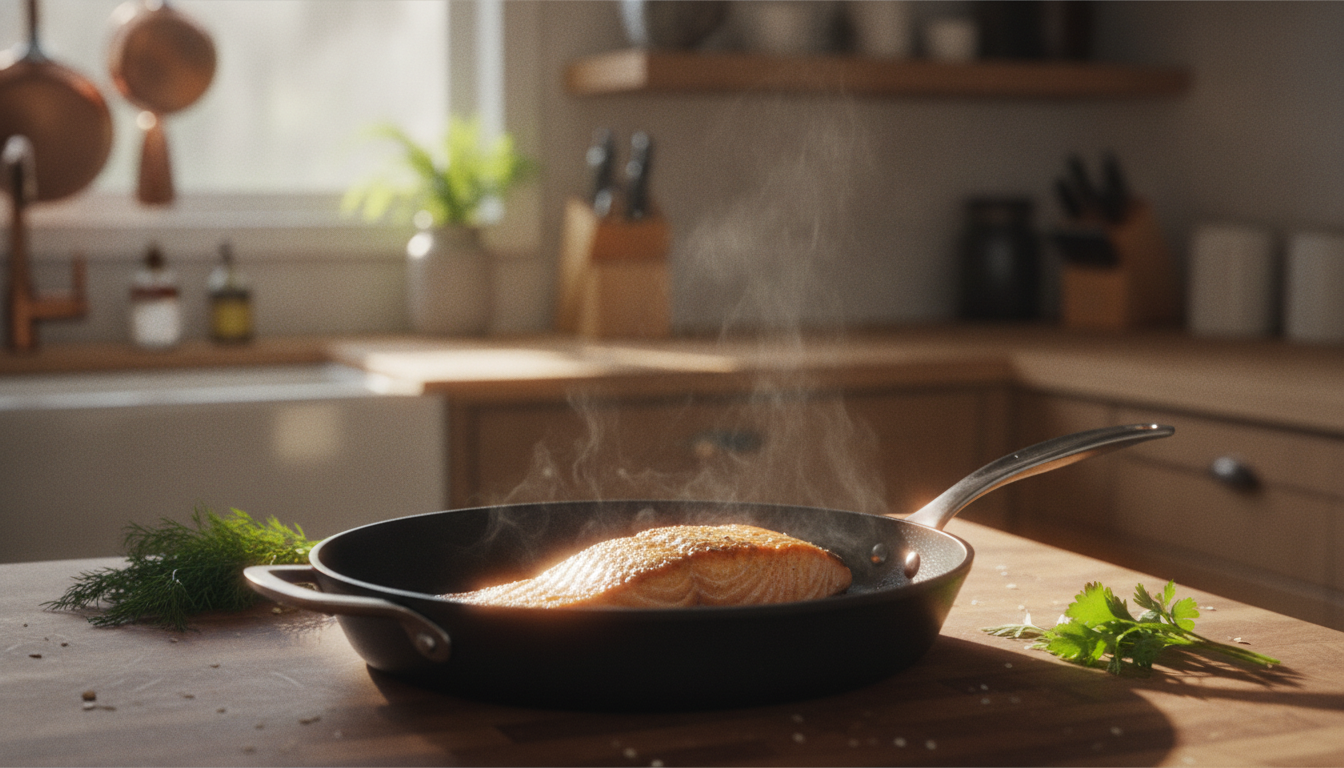
Delicate foods like eggs and fish stick to pans when surface moisture prevents the steam layer that lifts food away from metal, a problem nitrided carbon steel solves better than ceramic coatings. Nitrided carbon steel builds a harder, more durable surface with each use, while ceramic nonstick loses its slip within weeks, making it the smarter choice for regular cooking of protein-rich dishes.
Why Delicate Foods Demand the Right Nonstick Pan
Nitrided carbon steel preheats quickly and hardens the surface to resist sticking, making it ideal for delicate proteins like eggs and fish.
What makes delicate foods stick: egg proteins, fish skin, and thin crepes
Egg proteins, fish skin, and thin crepe batter share one trait: high moisture and protein content that bond directly to a pan's metal surface. Sticking happens because chemical bonds, ranging from weak van der Waals forces to stronger covalent bonds, form between food and metal, and protein-rich foods are especially prone to this because proteins can form complexes with metal atoms like iron [2].
Cold food straight from the fridge makes the problem worse: it lowers the oil's temperature on contact, and any surface moisture drops the pan below the point where a protective steam layer can form [2]. That vapor barrier matters because hot oil causes moisture released from the food to create a cushion of steam that lifts the food off the surface and keeps it from fusing to the pan [2].
Without enough heat, delicate proteins like egg whites or fish skin bond directly to bare metal before that cushion develops, since getting the surface dry and hot enough without overcooking the flesh underneath is the core challenge with any protein food [1]. This is why blotting fish skin dry or letting eggs sit at room temperature before cooking reduces sticking: excess surface water lowers pan temperature and interferes with the vapor layer that keeps delicate proteins from touching hot metal directly [2].
How nitrided carbon steel and ceramic nonstick handle heat differently
Nitrided carbon steel and ceramic nonstick manage heat in different ways, and that difference shows up fast once a pan hits the burner. Nitriding infuses standard carbon steel with nitrogen, making the metal roughly 22% harder and rated for use up to 750 degreesF, while also sealing the surface against water penetration [4]. That density lets nitrided pans preheat quickly, though testing on a nitrided model found the center of the cooking surface ran noticeably hotter than the edges, producing uneven browning on chicken skin until the pan was rotated during cooking [4].
Thicker carbon steel in general disperses heat more evenly than thin, single-layer versions, which tend to scorch food before it has a chance to develop color [4]. Ceramic nonstick pans work on a different principle entirely: their slip comes from a non-wetting silica surface rather than heat-driven bonding, and that surface property starts degrading from the first time the pan is heated [3]. Because ceramic's nonstick performance depends on a coating that wears down with repeated heat cycles, cooks tend to notice a drop-off in release quality within weeks or months of regular use, even when heat is applied evenly [3].
Nitrided carbon steel, by contrast, tends to build a more durable working surface the more it's used, since the hardened metal itself is doing the work rather than a coating layered on top of it [4].
Nitrided Carbon Steel: The Natural Nonstick Breakthrough for Delicate Cooking
Nitrided carbon steel builds a hardened metal surface that won't peel or chip, and actually improves with cooking rather than degrading over time.
What is nitrided carbon steel and how does the coating work
Nitriding is a heat treatment that diffuses nitrogen into carbon steel's surface at high temperature, forming a dense, hardened layer rather than a sprayed-on coating [5]. This process increases surface hardness and builds resistance to rust and corrosion, addressing the main weakness of standard carbon steel, which stays vulnerable to rust wherever its oil-based seasoning is thin or uneven [5].
Because the hardened layer forms through chemical infiltration into the metal itself rather than paint or a PTFE spray, it can't peel, chip, or flake the way enamel or traditional nonstick coatings eventually do [5]. Some nitrided pans, including Misen's Carbon Nonstick(TM) pan, pair this treatment with an aluminum core, which helps the pan heat faster and repel oil to a greater degree right out of the box than other nitrided carbon steel pans on the market [6].
That oil-repelling surface means a nitrided pan needs less oil to reach a functionally nonstick state than a traditional carbon steel pan, even though the surface isn't truly oleophobic and continues building seasoning with cooking fat over time [6]. Unlike Teflon or ceramic coatings that start degrading from the first use, this hardened metal surface is designed to hold up well against metal utensils and abrasive scrubbing, unlike a sprayed-on coating [6].
Real-world delicate food performance: eggs, fish fillets, and pancakes tested
Independent testing backs up the eggs-fish-pancakes case for nitrided carbon steel. Serious Eats' carbon steel pan tests included Misen's Carbon Nonstick(TM) as one of only a handful of pre-seasoned models that produced perfect over-easy eggs and thin, evenly cooked crepes right out of the box, without the sticking issues that plagued most unseasoned pans in the same lineup [7]. A separate Kitchn review put the pan through a skin-on salmon test, and the quick-heating surface crisped the fillet's skin while the flesh cooked through, with the fish releasing cleanly on the first flip [8].
The same reviewer fried an egg with no oil at all to stress-test the surface, and it slid out so cleanly the pan looked unused, a result she called more impressive than her go-to coated nonstick skillets [8]. Savory pancakes on medium-low bubbled gently and flipped without tearing or splattering, even with minimal oil in the pan [8]. Serious Eats separately clocked the pan as the lightest of its carbon steel winners at 2.5 pounds and the most heat-tolerant at up to 1,100 degreesF, two factors that make it easier to swirl batter thin and hold consistent heat under delicate proteins [7].
Across both outlets, the pattern holds: eggs, fish, and pancakes all released with minimal fat, and performance didn't depend on a coating that degrades with use [7][8].
Ceramic Nonstick Pans: Strengths and Critical Limitations for Delicate Foods
Ceramic nonstick coatings degrade rapidly with delicate foods like eggs and fish, often failing within months despite premium pricing and health-focused marketing.
Why ceramic coating appeals to health-conscious cooks and its actual durability
Ceramic nonstick coatings appeal to health-conscious cooks because they're marketed as a "clean," nontoxic alternative to PFAS-based nonstick, using a sol-gel coating made from silicon- and titanium-based nanoparticles sprayed onto a metal core rather than the fluorine-carbon chemistry found in Teflon [9]. Many ceramic cookware brands lean heavily on that promise, using phrases like "toxin-free" and "worry free" in their marketing, even though "nontoxic" has no regulated definition, no certification body, and no required testing protocol in cookware.
That marketing gap matters because the actual durability doesn't match the health pitch: ceramic's nonstick performance comes from a non-wetting surface that starts degrading the moment the pan is heated, and testing found some ceramic pans losing their slick release after roughly a dozen uses in the worst cases and within a handful of months in the best [10]. Ceramic is also more brittle than PTFE, making it prone to chipping in addition to scratching, and separate lifespan estimates put ceramic nonstick coatings at three years or less, sometimes markedly shorter [9][10].
For cooks drawn to the "clean" label, that combination means paying a premium for cookware that may need replacing well before a nitrided or seasoned carbon steel surface would show comparable wear.
Where ceramic fails with delicate proteins and how heat management differs
Ceramic's failure with delicate proteins shows up fastest with eggs, the food most nonstick pans are judged on. Wirecutter's tester fried eggs in ten ceramic pans and found that release held up for the first couple of rounds, then eggs stopped sliding cleanly by the third round of frying, well before any visible coating damage appeared [12]. Fish fared worse: flipping fillets in several ceramic pans left a thin sheet of cooked flesh behind, forcing the cook to coax it up with a spatula, a problem the PFAS-coated control pan never showed [12].
Independent lab testing backs this up. CHOICE's home economist found that most ceramic frypans needed oil or butter rubbed into the surface before eggs would release at all, unlike other nonstick types that need little to none [12]. Heat management compounds the issue: ceramic's non-wetting surface depends on staying at low to medium heat, since higher temperatures accelerate the coating's breakdown and make browning uneven [11].
Because ceramic lacks the fluorine-carbon chemistry that gives PFAS its slip, its performance with high-moisture, protein-rich foods depends entirely on a surface treatment that degrades from the first heating cycle, not on a heat-driven bond that improves with use [12].


Nitrided vs Ceramic: Head-to-Head Comparison Table and Care Requirements
Nitrided carbon steel builds nonstick grip with every use, while ceramic coatings fade within weeks, making durability and maintenance the deciding factors.
Feature-by-feature breakdown: release, heat capacity, longevity, and maintenance demands
Lined up side by side, the two materials diverge on every metric that matters for delicate cooking.
- Release: nitrided carbon steel ships pre-seasoned and near-nonstick out of the box, then keeps improving with use, while ceramic starts slick and loses grip within a handful of frying sessions [7].
- Heat capacity: Misen's nitrided pan is rated to 1100 degreesF and stays the most heat-tolerant option tested, while ceramic coatings are meant to stay in a lower, narrower band since high heat speeds up their breakdown [7].
- Longevity: carbon steel's patina thickens with every cooking session, but ceramic-coated surfaces diminish over time, especially with frequent high heat or dishwasher use [14].
- Maintenance: both need hand-washing, but nitrided pans occasionally want a light reseasoning to keep their edge, while ceramic pans need no reseasoning at all, just gentler heat and utensil habits to slow the coating's decline [14].
The maintenance gap explains the longevity gap. Nitriding hardens the metal itself, so upkeep is a five-minute wipe-and-heat routine that reinforces a surface built to last, similar to how a pre-seasoned carbon steel pan holds up with normal care [13]. Ceramic's slip depends on a coating layered onto a metal core, and no amount of gentle handling stops that layer from thinning once heat cycling begins [14]. For cooks weighing daily eggs or fish against occasional light sautéing, that difference in what maintenance can actually accomplish tends to decide which pan earns a permanent spot on the stove.
Which pan wins for your cooking style and how to maintain peak performance
For cooks who fry eggs, sear fish, or make crepes on a near-daily basis, nitrided carbon steel fits the routine better than ceramic, since its surface builds grip with use instead of losing it, though buyers should expect a short break-in period where food sticks more than expected for the first two to three weeks [15]. Cooks who sauté only occasionally and want zero seasoning upkeep might still lean ceramic, accepting that release quality drops off within a handful of frying sessions and that replacement is likely within a year or two of regular use [7].
Maintaining either pan for peak performance comes down to a few habits: hand-wash and dry both immediately rather than running them through a dishwasher [7]; wipe carbon steel with a thin layer of oil after cleaning to reinforce the surface [7]; avoid simmering acidic, long-cooked sauces in carbon steel, which can strip seasoning [7]; reseason a nitrided pan if sticking returns as its factory coating wears down [7]; and keep ceramic pans on low-to-medium heat, since higher temperatures speed up coating breakdown [7]. Cost factors into the decision too.
Nitrided pans in this price range may outlast several rounds of ceramic replacements, while ceramic buyers often pay a premium for cookware with a shorter working life before it needs replacing [15][7]. Whichever surface fits your cooking, a little consistent upkeep goes a long way toward keeping either pan performing well.
Frequently Asked Questions
-
How many uses does ceramic nonstick coating last before it stops releasing food cleanly?
The article cites testing showing some ceramic pans lost their slick release after roughly a dozen uses in the worst cases, and within a handful of months in the best cases. Wirecutter's tester specifically found eggs stopped sliding cleanly by the third round of frying, well before any visible coating damage appeared. Fish fillets fared worse, often leaving cooked flesh stuck to the pan during flipping.
-
Does a nitrided carbon steel pan need reseasoning, or is it truly low-maintenance like ceramic claims to be?
Nitrided carbon steel occasionally needs a light reseasoning to keep its edge, plus a thin wipe of oil after cleaning to reinforce the surface. The article notes the hardened metal layer can't peel, chip, or flake like a sprayed-on coating, and it tends to build a more durable working surface the more it's used. Ceramic, by contrast, needs no reseasoning but instead requires gentler heat and utensil habits to slow its coating's decline.
-
Which pan is better if I cook eggs or fish almost every day versus just occasionally?
For near-daily cooking of eggs, fish, or crepes, the article recommends nitrided carbon steel since its surface builds grip with use rather than losing it, though it flags a short break-in period of two to three weeks where food may stick more than expected. For occasional sautéing with zero seasoning upkeep, ceramic is presented as a workable option, with the caveat that release quality drops off within a handful of frying sessions and replacement is likely within a year or two.
-
Is nitrided carbon steel more expensive than ceramic in the long run?
The article doesn't give fixed prices for either material, but it notes nitrided pans in this price range may outlast several rounds of ceramic replacements, while ceramic buyers often pay a premium for cookware with a shorter working life (three years or less, per cited estimates) before it needs replacing. Compare the actual purchase price of a specific nitrided pan against how many ceramic replacements you'd likely buy over the same span.
- Delicate proteins stick to metal when surface moisture prevents the steam layer that lifts food off the pan.
- Nitrided carbon steel hardens the metal itself through nitrogen infusion, so the nonstick surface improves with every use.
- Ceramic coatings degrade from the first heating cycle and lose release quality within weeks or months of regular cooking.
- Nitrided pans handle temperatures up to 1,100 degreesF and release eggs, fish, and crepes cleanly with minimal oil.
- Ceramic pans need replacement within 1-3 years, while nitrided surfaces build durability and last through consistent care.
- Maintenance differs fundamentally: nitrided pans need occasional light reseasoning to strengthen their surface; ceramic cannot be restored once coating wears.
- https://modernistcuisine.com/mc/the-maillard-reaction/
- https://www.scienceofcooking.com/why_food_sticks.htm
- https://www.nytimes.com/wirecutter/reviews/give-up-on-ceramic-nonstick-pans/
- https://www.epicurious.com/shopping/best-carbon-steel-skillets-article-article
- https://www.sarchicookware.com/news/is-nitriding-cookware-safe-to-use.html
- https://www.bonappetit.com/story/misen-carbon-nonstick-pan-review
- https://www.seriouseats.com/best-carbon-steel-pans-7093873
- https://shopping.yahoo.com/home-garden/kitchen/articles/carbon-nonstick-pan-rave-reviews-230000753.html
- https://www.seriouseats.com/nonstick-vs-ceramic-skillets-7110252
- https://foodprint.org/blog/what-to-know-about-nonstick-cookware/
- https://modernsurvivalblog.com/survival-kitchen/healthy-ceramic-nonstick-pans-what-actually-makes-one-safer/
- https://www.choice.com.au/home-and-living/kitchen/cookware/buying-guides/ceramic-cookware
- https://www.bonappetit.com/story/best-carbon-steel-pans
- https://www.debuyer-usa.com/blogs/guides/carbon-steel-vs-ceramic-pans-which-is-right-for-your-kitchen
- https://www.vietworldkitchen.com/blog/2025/12/nitrided-carbon-steel-nonstick-pans-review.html
- Summary
- Why Delicate Foods Demand the Right Nonstick Pan
- Nitrided Carbon Steel: The Natural Nonstick Breakthrough for Delicate Cooking
- Ceramic Nonstick Pans: Strengths and Critical Limitations for Delicate Foods
- Nitrided vs Ceramic: Head-to-Head Comparison Table and Care Requirements
- Key Takeaways
- References