

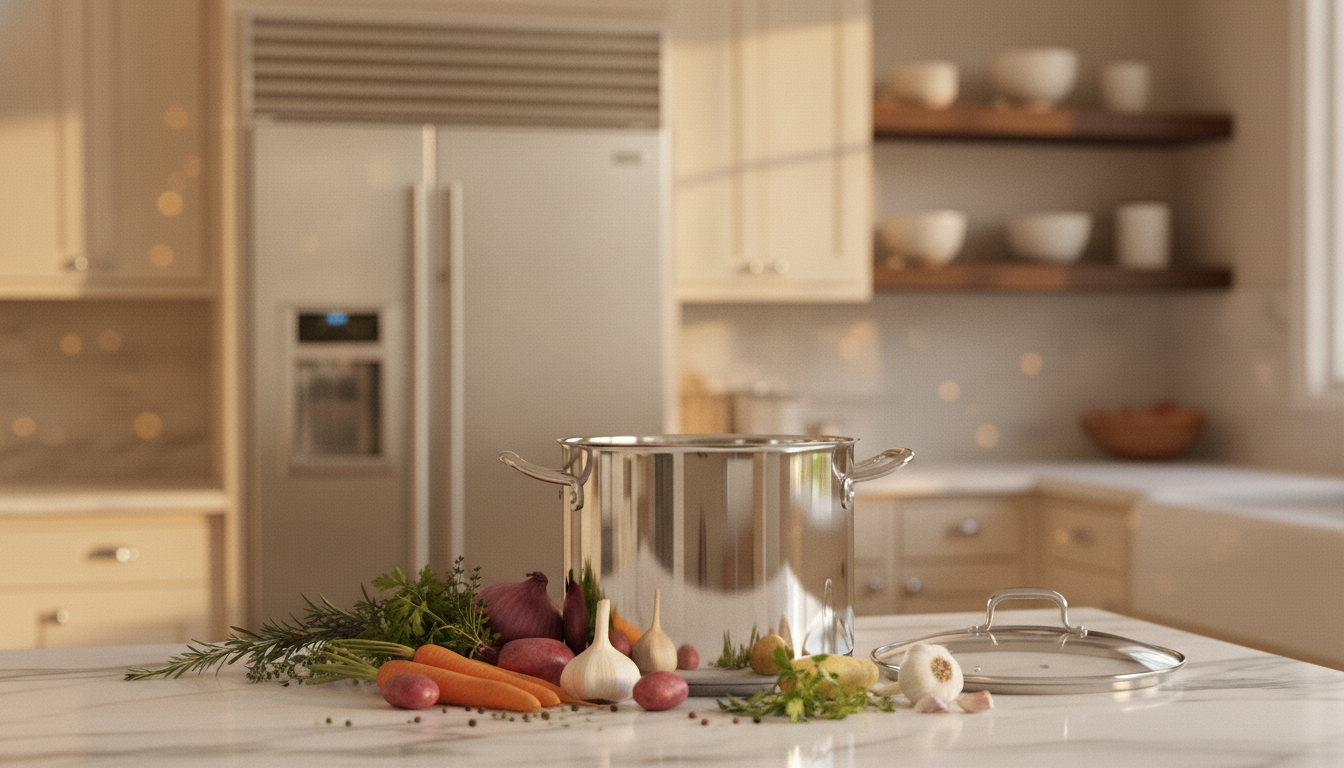
Learn how to choose the right stockpot size for batch cooking vegetarian soups and stews by matching capacity to your weekly cooking habits. Stainless steel construction with proper maintenance ensures even heat distribution and durability through hundreds of batches.
Why Stockpot Size Matters for Batch Cooking Vegetarian Soups and Stews
How pot volume affects cooking time, flavor development, and ingredient distribution
Pot size determines how much room ingredients have to move during cooking, and that space directly shapes texture and flavor. When vegetables are cut into uniform pieces and given enough room in the pot, they cook at the same rate, which prevents some pieces from turning mushy while others stay undercooked [1]. A pot that's too small forces overcrowding, so vegetables steam against each other instead of simmering freely in liquid, which slows even heat transfer and leads to patchy doneness.
Liquid volume matters just as much as vegetable volume: broth should be added gradually, covering the vegetables by about an inch, since this controls thickness and keeps the simmer gentle enough to meld flavors without scorching the bottom layer [1]. Material also plays into this equation. Stainless steel is non-reactive and heats evenly, which matters more as batch size grows, because a larger volume of vegetables and broth needs a pot that distributes heat consistently from edge to center rather than concentrating it in one spot [2].
Larger batches also mean longer simmer times are needed for flavors to fully meld, since the broth has to permeate a greater volume of vegetables before it takes on their color and character [1]. Undersized pots compound all of these issues at once: crowded vegetables, uneven heat, and liquid that can't circulate properly, which is why matching pot volume to batch size is as much about flavor development as it is about convenience.
Common sizing mistakes home cooks make when scaling recipes
Scaling a soup or stew recipe up for batch cooking trips up even experienced cooks, and the mistakes tend to repeat themselves. Buying too large is one of the most common: a 24-quart pot sounds capable, but it takes far longer to bring water to a simmer for a weeknight batch than an appropriately sized pot would, wasting both time and energy [4]. Going too small causes the opposite problem, forcing boilover, crowded vegetables, and multiple batches when one pot run would have worked [3]. Cooks also tend to fill a pot to its stated capacity instead of leaving room for expansion and safe handling, which raises the risk of spills once broth and vegetables are both added [4]. A few patterns show up again and again when scaling:
- Sizing the pot to the most ambitious recipe instead of weekly habits [4]
- Filling to the rim instead of leaving headspace for simmering liquid [4]
- Ignoring burner size, which causes uneven heating on an oversized pot [3]
- Assuming more vegetables always need proportionally more liquid [3]
The fix is matching pot size to what gets cooked most often, not to the rare big batch, since an oversized pot used occasionally still costs time and energy every single time it's used [4].

The Batch Cooking Math: Calculating the Right Stockpot Size for Your Needs
Sizing Estimates: servings, storage containers, and cooking frequency
Matching stockpot size to actual need starts with servings per batch, not recipe size. A six-quart pot yields about twelve cup-and-a-half servings, enough for twelve lunches when the soup is frozen flat in quart bags [5]. That math scales directly, so planning around a weekly cadence, like five lunches every two weeks, keeps pot size tied to actual eating habits rather than the biggest recipe on file [5].
Storage containers matter as much as pot size. Quart freezer bags filled two-thirds full and frozen flat on a sheet tray use shelf space efficiently and thaw in about an hour in cool water, while a bag filled too full risks splitting at the seam as the soup expands [5]. Rigid airtight containers work too, but leftovers need to go into them within two hours of cooking to stay food-safe, and any container should leave roughly an inch of headspace for liquid expansion [6].
Serving calculators also factor in soup style: clear broths need less solid volume per serving than chunky stews, which pack more vegetables into the same cup measurement [6]. For a cook making lunches once a week, a six-quart pot paired with quart bags covers the math without wasted broth or crowded freezer shelves. For a household feeding four people plus leftovers, moving up a size accounts for the larger per-serving volume without requiring two separate cooking sessions in one week [6].
Standard stockpot sizes explained (6-quart, 8-quart, 12-quart) and which suits vegetarian cooking best
Standard stockpot sizing follows a tiered scale, and the three most common capacities (6-quart, 8-quart, and 12-quart) each suit a different volume of vegetarian soup or stew. A 6-quart pot, often sold with a lid as an induction-compatible option, works for single-recipe batches of soup for one or two people with enough headroom to add vegetables and broth without boiling over [8]. Moving up to 8-quart capacity suits a household making weekly lunches or doubling a stew recipe, since the larger diameter and depth give vegetables more room to simmer evenly, which matters most in vegetable-heavy dishes that lean on even heat for consistent texture across the batch [8]. A 12-quart pot, available with a glass lid or in tri-ply clad construction for induction cooktops, is sized for canning-style batches, large gatherings, or freezer-stocking sessions where several servings of stew or stock need to come out of one simmer [8].
Note that safely canning low-acid foods like vegetable soups and stews for shelf storage requires a pressure canner, not just a large stockpot. Keep in mind that capacity figures are measured to the rim, so the actual working volume runs lower than the stated size. A pot really handles noticeably less than its full quart rating once you factor in headspace for boiling and stirring, and this two-thirds rule is a useful guideline across most sizes [7]. Stockpots in general are built deep and tall specifically for large-batch soups, stews, stocks, and broths, which is why their proportions favor volume over the wide, shallow surface area a Dutch oven offers for browning [9].
For most vegetarian batch cooking, the 8-quart size balances enough capacity for a week of lunches against a pot that still heats evenly on a standard burner. If you want a pot built for exactly this kind of cooking, Misen's 8-quart stockpot is sized and built to deliver even heat across that working volume.
Choosing the Best Cooking Set for Vegetarian Soup and Stew Preparation
Stainless steel resists corrosion from acidic ingredients like tomatoes and vinegar, keeping your broth clean and your pot durable through repeated batches.
What to look for in a stockpot: material, heat distribution, and lid quality
Material is the first thing to check, since it determines both cooking quality and how long the pot lasts under weekly batch cooking [10]. Fully clad construction, where layers run up the sidewalls instead of just the base, heats more evenly throughout the vessel, which matters for dishes that simmer against the pot's walls [10]. Disc-bottom construction works well for stockpots specifically, since a tall, narrow vessel built mainly for volume relies less on sidewall heating, and this style tends to cost less [10].
A multi-layer or encapsulated base distributes heat more evenly across the bottom, which matters for dishes that simmer slowly without scorching [11]. Thickness plays a role too: a pot that's too thin heats fast but unevenly, while an overly heavy pot feels stable but tiring to lift once full of soup [10]. Lid quality deserves equal attention.
A glass lid lets you monitor a simmer without releasing heat, while a stainless lid is more traditional and durable [10][11]. If you cook on induction, confirm the base carries a magnetic stainless exterior, since not every stainless pot works on induction despite the name, and the induction symbol alone doesn't guarantee strong contact with the burner [10][12]. Handles matter as well, needing heat-resistant material and a secure, balanced grip for carrying a full pot safely from stove to counter [12].
Why stainless steel outperforms other materials for long-simmering vegetable-based dishes
Long-simmering vegetable soups and stews often include acidic ingredients like tomatoes, wine, or vinegar, and stainless steel's non-reactive surface means those ingredients won't pick up a metallic taste or cause the pot to corrode over repeated batches [13]. This is a big reason Misen builds its stainless steel cookware for exactly these kinds of dishes. That same chemistry also protects the broth itself: unlike ceramic coatings that break down under sustained heat, or non-stick surfaces that can degrade and release compounds when overheated, stainless steel holds up through hours at a simmer without warping or leaching anything into the food [13].
Durability compounds this advantage over time. Stainless steel resists rust, corrosion, and pitting even after years of exposure to moisture and acidity, which matters for a pot that's doing double duty as both a cooking vessel and a long-term kitchen investment [15]. Most stainless stockpots also build in an aluminum or copper core, since steel alone doesn't conduct heat especially well, and that layered base is what lets a tall, narrow pot distribute heat evenly from the burner up through gallons of broth and vegetables rather than scorching the bottom [14][15].
Cleanup reinforces the case: stainless steel is dishwasher-safe, and any stuck-on bits from a long simmer can be loosened by boiling water in the pot for fifteen to twenty minutes before a final scrub [13]. Added up, a well-maintained stainless stockpot can last for decades, which keeps its cost-per-batch far lower than materials that need replacing every few years [13].
Maintenance Tips to Keep Your Stockpot Performing Through Hundreds of Batches
Proper cleaning and storage techniques for stainless steel stockpots
Handwashing extends a stockpot's service life, but stainless steel is one of the few cookware materials that tolerates a dishwasher cycle if you're pressed for time [17]. Treat any scorched broth or stuck-on vegetables right away: soap, water, and the scrubbing side of a sponge should be the first move, since letting stains sit makes them harder to remove later [17]. If that doesn't clear things up, fill the pot with a solution of one part vinegar to three parts water and bring it to a boil, then let it cool and wash with soap and water as usual [17].
Still seeing dark spots after that? Pull the pot off the heat, stir in a tablespoon or two of baking soda, pour out the solution, and wash as normal [17]. For scorch marks or stubborn residue that vinegar can't touch, a non-bleach cleanser like Bar Keepers Friend works well: make a paste with a little water and the powder, then scrub vigorously until the stains lift [16].
Once the pot is clean, dry it completely before stacking or hanging it, since trapped moisture undermines any cookware's finish over time [17]. When storage space is tight and the stockpot shares a shelf with other pots, layer cloth or paper towel between pieces to prevent scratching and reduce the clatter of pots shifting against each other [17].
When to upgrade or replace your stockpot based on wear patterns and cooking frequency
How often you batch-cook soup speeds up wear, so cooking frequency is as much a signal for replacement as any visible damage [18]. A stockpot that no longer sits flat on the burner has started warping, which keeps heat from spreading evenly and makes the pot less stable once it's full of broth [18]. Loose handles are another red flag, since a handle that won't tighten back up with a screwdriver has moved past repair and becomes a hazard when you're lifting a pot full of soup [18]. Scratches and pitting deep enough to expose the layer beneath the cooking surface matter too, since that breakdown can let metal leach into acidic broths [18]. Light discoloration alone isn't a reason to retire a pot, but rust is, since rust getting into food can cause health issues [18]. Layers separating at the rim is the clearest sign to stop using a stockpot altogether, since the exposed edge can be sharp and becomes more prone to further rusting [18]. A pot in weekly batch-cooking rotation will show these signs faster than one used only occasionally, so it's worth a quick check every so often rather than waiting for an obvious failure to force the decision.
Matching stockpot size to how you actually cook is the whole game: pick the capacity that fits your weekly habits, lean on stainless steel for long, acidic simmers, and follow a few simple care & maintenance tips so the pot lasts for years. For most vegetarian batch cooking, Misen's 8-quart stockpot covers the math without the wasted space or energy of an oversized pot. Still not sure which size fits your kitchen? Contact us -- we're happy to help you find the right fit.
Frequently Asked Questions
-
What size stockpot do I actually need for weekly vegetarian soup batches - 6, 8, or 12 quart?
For design purposes, a 6-quart pot suits single-recipe batches for one or two people, an 8-quart pot suits a household making weekly lunches or doubling a stew recipe, and a 12-quart pot is sized for canning-style batches, large gatherings, or freezer-stocking sessions. The article notes the 8-quart size balances a week of lunches against even heating on a standard burner for most vegetarian batch cooking.
-
How many servings will a 6-quart pot of soup actually give me, and how should I store them?
A 6-quart pot yields about twelve cup-and-a-half servings, enough for twelve lunches when frozen flat in quart freezer bags filled two-thirds full. Rigid airtight containers work too, but leftovers need to go into them within two hours of cooking and should leave about an inch of headspace for liquid expansion.
-
Can I use a 12-quart stockpot to can vegetable soup for shelf storage?
A 12-quart stockpot is sized for canning-style batches, large gatherings, or freezer-stocking sessions, but the article specifically notes that safely canning low-acid foods like vegetable soups and stews for shelf storage requires a pressure canner, not just a large stockpot.
-
Is a stainless steel stockpot worth the cost compared to other materials for long-simmered dishes?
The article doesn't give fixed prices, so compare the actual price and construction of any specific pot you're considering. It does note that stainless steel resists rust, corrosion, and pitting even after years of acidic, moist use, and that a well-maintained stainless stockpot can last for decades, which keeps its cost-per-batch lower than materials that need replacing every few years.
-
How do I clean a stockpot with burnt-on broth or scorch marks without damaging it?
Start with soap, water, and the scrubbing side of a sponge right after cooking, since letting stains sit makes them harder to remove. If that doesn't work, boil a solution of one part vinegar to three parts water, or for dark spots, stir baking soda into the hot pot before washing as usual; stubborn scorch marks can be treated with a paste of water and a non-bleach cleanser like Bar Keepers Friend.
- Pot size controls vegetable texture and heat distribution, preventing mushy or undercooked pieces in the same batch.
- A 6-quart pot yields about twelve 1.5-cup servings, while an 8-quart suits weekly batch cooking for most households.
- Stainless steel resists rust and corrosion from acidic ingredients like tomatoes and vinegar without leaching metal into broth.
- Size pots to weekly cooking habits, not rare large batches, since oversized pots waste time and energy on every use.
- Fully clad or multi-layer bases distribute heat evenly across tall stockpots, preventing scorching during long simmers.
- Check for warping, loose handles, deep pitting, or rust as signs a stockpot needs replacement from regular batch cooking.
- https://www.kotichefhub.com/recipes/vegetable-preparations/pureesoup
- https://www.fareastcookware.com/blog/can-i-use-a-double-layer-steam-pot-to-make-soup-129965.html
- https://www.cookwarecw.com/what-is-a-stock-pot-difference-with-soup-pot/
- https://www.cwchangwen.com/stock-pot-sizes-for-restaurants/
- https://www.google.com/goto?url=CAESZgHrOzAVQodTm_BMcdDyq83tbO4xrT-QSxcuavQVbq-VNgzHpVSAz7hiMPJtMfHgnWNhi4eal3WGk884saz8bYzzZs1-t77a6tSG8--LFFFRJtMUEdHKYxe7vVixEr7ursXMR1epdw
- https://www.google.com/goto?url=CAEScgHrOzAV6nI-NVfZv2IqgO01vwDEnzcATLKr3Ek2igrkrYG4YiBrPYdswBoYt1R_Q1Je5rWwRkse4UMowv3s29m18ZabEMXQOwuVK_9kG7vcwOvL13Y0E5Ay9M-dX0WnUZ54R2XHrh2OfO5sKHQFEFUGlA
- https://www.ciwete.com/blogs/ai/cookware-size-conversion-chart-cm-inches-quarts-and-litres-explained
- https://www.lowes.com/ple/stainless-steel-stockpot
- https://kitchpulse.com/cookware-dutch-oven-vs-stock-pot/
- https://chantal.com/blogs/recipes/stainless-steel-cookware-buying-guide
- https://www.joybuy.de/blog/cookingpotbuyingguide/HtAJDoQc
- https://www.joybuy.fr/blog/stock-pot-dutch-oven-buying-guide/KusuxWQi
- https://saladmaster.com/en-ph/cook-more/saladmaster-blog/ceramic-vs-stainless-steel-cookware-which-is-best-for-your-kitchen
- https://www.jessicagavin.com/types-of-cookware-materials/
- https://www.zhenneng.com/a-news-what-makes-stainless-steel-frying-pans-a-good-choice-for-cooking-vegetables.html
- https://barkeepersfriend.com/blogs/bar-keepers-blog/how-to-clean-a-scorched-pan
- https://www.reviewed.com/cooking/features/how-to-care-for-your-cookware-stainless-steel-cast-iron-nonstick-and-more
- https://www.google.com/goto?url=CAES0AEB6zswFckfkYAg_EXqFWhPuS_DeuKDba1jCdIicN8Nchce7Phwr-4LRaETMoVKKL2TeoSGTLNPUfHUsRzG3L81gMhXC03P7sxqjrq21RJtwWQ1fzXBkIh8hH9miwVXsV6h0v7yBobkTE3wsiE2LJ5V-k-t2oM0R8nUSdmbefO42KjO4S4et3VrV6sziJbQUHnHCaofC66ciGUyeXmoZwaQWN-dl5e0jYNBoErJ3ZRdFgsM8W3UoNZDNpIdYafIRyJgjVkyz3ute_RbotdAPSXs
- Summary
- Why Stockpot Size Matters for Batch Cooking Vegetarian Soups and Stews
- The Batch Cooking Math: Calculating the Right Stockpot Size for Your Needs
- Choosing the Best Cooking Set for Vegetarian Soup and Stew Preparation
- Maintenance Tips to Keep Your Stockpot Performing Through Hundreds of Batches
- Key Takeaways
- References