

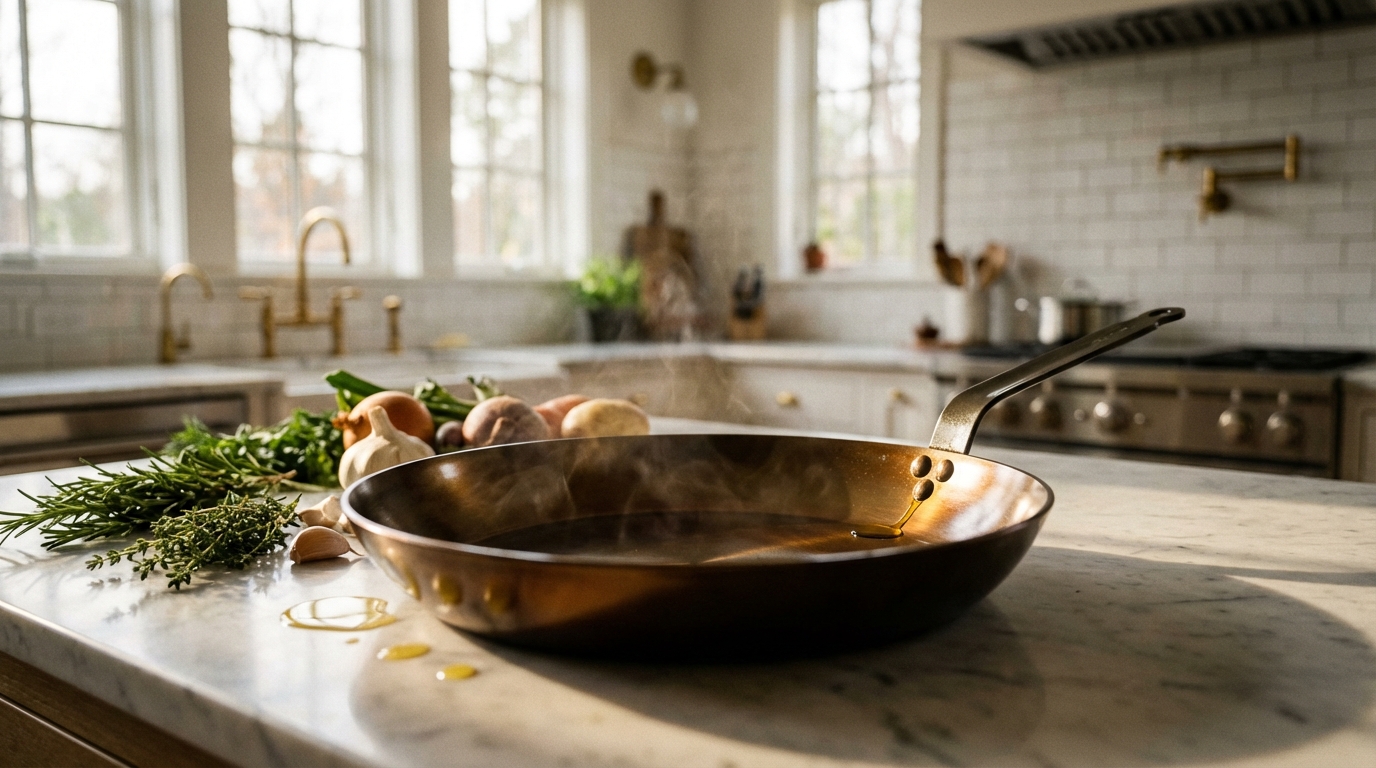
By trading PFAS-laden synthetic non-stick for a hand-seasoned carbon steel pan, you get a forever-surface that improves every time you cook: the article demystifies how a whisper-thin film of high-smoke-point oil, heated until it polymerizes, bonds to bare metal and builds a silky, jet-black patina that releases food like Teflon yet lasts for generations. Readers learn the critical prep steps--stripping factory coating, drying the pan on a burner within minutes to stop flash rust, and choosing avocado or peanut oil--then master the counter-intuitive "wipe it almost dry" technique that prevents sticky spots while multiple 10-minute stovetop rounds create a durable, PFAS-free non-stick layer. Daily care is equally simple: a quick wash with modern dish soap, thorough towel-and-stove drying, and a micro swipe of oil keep the seasoning intact; if food starts grabbing or rust blooms, spot-re-season rather than tossing the pan. Along the way the piece unpacks the health and environmental hazards of "forever chemicals," shows how each fatty meal reinforces the coating, and reassures beginners that blotchy early layers soon even out into a lustrous, low-maintenance surface--delivering safe, professional-level searing and effortless cleanup without a single toxic molecule.
Key Points
Ditch the PFAS-laced nonstick pan: season a carbon-steel skillet by polymerizing thin layers of high-smoke-point oil until it's naturally slick, then simply wash, dry, and wipe with a trace of oil after each use to keep it rust-free and re-season only when food starts to stick.
- PFAS in nonstick pans persist in body/environment and are linked to cancer, liver damage, and immune harm. - Carbon steel becomes nonstick by heating high-smoke-point oil until it polymerizes into a durable, plastic-like layer. - Wash, dry on stove, wipe on micro-thin oil, heat until smoke appears; repeat 3-5 times for solid seasoning. - Daily: wash with soap, towel-dry, heat to evaporate moisture, then wipe on a trace of oil to prevent rust. - Re-season when food sticks or rust appears; scour, dry, and apply fresh ultra-thin oil layers to restore surface.

Understanding PFAS-Free Seasoning Chemistry
Ditch the PFAS-laden pans and season a carbon steel skillet with oil and heat to create a forever-chemical-free, ever-improving non-stick surface that keeps toxins out of your food, fumes out of your kitchen, and pollutants out of the planet.
> By choosing a carbon steel pan that seasons naturally with heat and oil, you get a non-stick surface that improves with every use--no forever chemicals, no toxic fumes, and no environmental guilt.
Why PFAS-Free Matters for Your Health
You've probably heard about "forever chemicals" in nonstick cookware--and there's good reason for concern. PFAS (per- and polyfluoroalkyl substances) earned their nickname because they stick around in your body and environment for years [1]. These synthetic compounds have been linked to serious health issues including liver damage, weakened immunity in children, cancer, reproductive problems, and hormone disruption [1][2]. Here's what's troubling: even pans labeled "PFOA-free" often still contain PFAS, according to Consumer Reports testing [1].
When traditional nonstick pans overheat, they release fumes toxic enough to kill birds and potentially harm you too [1]. Plus, these chemicals contaminate our water supply--nearly half of Americans have detectable PFAS in their tap water [2]. That's where carbon steel comes in. Instead of relying on synthetic chemicals, carbon steel pans develop their non-stick properties naturally through seasoning.
This process transforms regular cooking oil into a slick, durable coating that gets better with use--no toxic chemicals required [3]. Quality pre-seasoned carbon steel pans give you that naturally non-stick surface from day one.
How Oil Polymerizes to Create a Natural Non-Stick Layer
So how does oil turn into a non-stick coating? It's actually pretty fascinating. When you heat oil past its smoke point on your carbon steel pan, you trigger polymerization--essentially, the oil molecules link together to form a hard, protective layer that bonds directly to the metal [4][5]. Here's what happens: the heat breaks down the oil into components.
The glycerol burns off (creating that seasoning smoke), while the fatty acids transform into a tough, plastic-like coating [5]. This natural coating repels water while attracting oils--that's why properly seasoned carbon steel releases food so easily [5]. Unlike synthetic non-stick coatings that wear out over time, this polymerized layer actually gets stronger with use. Every time you cook with fats or oils, you're reinforcing that protective barrier [6].
No PFAS, no mysterious chemicals--just oil transformed by heat into a naturally slick surface that improves with every meal you make. We'll show you exactly how to create this coating in the seasoning steps that follow.
Preparing Your Carbon Steel Pan for Seasoning
Strip every trace of factory coating and moisture from your carbon steel pan, heat it dry, then rub on a thin film of high-smoke-point oil--because only a bone-clean, bone-dry surface lets seasoning bond to the metal and builds the slick, rust-proof surface you'll cook on for decades.
> Strip every trace of factory coating and moisture from your carbon steel pan, then heat it dry before rubbing on a thin film of high-smoke-point oil like avocado or peanut--this is the non-negotiable prep that lets seasoning bond to bare metal and builds the slick, rust-proof surface you'll cook on for decades.
Cleaning and Drying: The Essential First Steps
Your first step is removing the protective coating that prevents rust during shipping. Check your pan's instructions for the best removal method, then give it a thorough wash [7]. Here's the crucial part: dry your pan immediately and completely. Bare carbon steel starts rusting surprisingly fast--within minutes of water exposure. Towel-dry first, then pop the pan on a burner to evaporate every last drop [7].
This isn't just about preventing rust--any moisture left behind will block the oil from bonding properly during seasoning [8]. The good news? That heating step flows right into your seasoning process [7]. Got stubborn factory residue? A gentle salt scrub works wonders [9].
Some pans, like Misen's pre-seasoned carbon steel pan, arrive ready to cook with just a quick rinse [8]. Whatever pan you're working with, you want that surface completely clean and bone-dry. That's what lets the seasoning oil create a molecular bond with the metal--your foundation for natural non-stick cooking [8].
Choosing the Right High-Smoke-Point Oil
Your oil choice makes or breaks good seasoning. You need something with a high smoke point--that's the temperature where oil starts burning and creating off-flavors (plus potentially harmful compounds) [10]. Your best bets? Avocado oil leads the pack at 519 degreesF, followed by soybean (453 degreesF), peanut (449 degreesF), and grapeseed oil (420 degreesF) [10].
Regular vegetable and canola oils work fine too, with smoke points around 399 degreesF. If you're into traditional Chinese cooking, pork lard (374 degreesF) brings authentic flavor [10]. Here's where it gets tricky: flaxseed oil. Some swear by its drying properties for seasoning, but quality varies wildly--smoke points range from 224 degreesF to 449 degreesF depending on purity [10].
Skip extra virgin olive oil completely. Its low smoke point (228-323 degreesF) can't handle seasoning temperatures [10]. Coconut oil might seem tempting at 449 degreesF, but its strong taste and solid texture at room temperature make it more trouble than it's worth [10]. Stick with neutral oils unless you want that specific flavor in everything you cook.


Step-by-Step Seasoning Process
Wipe on an almost-invisible film of oil, heat until it smokes, cool, and repeat three to five times to forge a slick, black non-stick surface that won't fail you.
> Wipe on the thinnest possible film of oil, heat until it just smokes, cool, and repeat three to five times to transform your pan into a slick, blackened workhorse that will never stick again.
Heating the Pan and Applying Thin Oil Layers
Getting the heat and oil application just right is key to building that perfect seasoning. Start by warming your clean, dry pan on low heat, then apply a tiny amount of your chosen high-smoke-point oil [11][12]. Here's the trick: don't pour oil directly into the pan. Instead, fold a paper towel, barely dampen it with oil, and wipe it across the entire cooking surface [12].
Now comes the part that feels wrong but works perfectly--grab a fresh paper towel and wipe off almost all that oil until your pan looks matte, not shiny [13]. This "barely there" layer is exactly what you need for proper seasoning [13]. Crank the heat to medium-high and wait for the magic to happen. Within about 10 minutes, you'll see wisps of smoke and notice the surface turning a lovely brownish color [11].
That smoke tells you the oil is transforming into your future non-stick surface [11]. Let it smoke briefly, then remove from heat and let the pan cool completely before round two [11]. Too much oil leaves you with sticky spots that refuse to harden, while too little heat means the oil won't properly bond to the steel [13]. Quick tip: open those windows--proper seasoning creates smoke, and that's actually a good sign [12].
Repeating the Cycle for a Durable Black Patina
Building that beautiful black patina takes patience and a few rounds of seasoning. After your first layer, you'll notice the pan has turned a light brown--that's your starting point [14]. Each new layer gradually darkens the surface and makes it more nonstick [15]. We recommend applying at least 3-5 layers for a solid foundation [13].
Between rounds, let the pan cool down to just warm--about 30-45 minutes does the trick [14]. Take a moment to check for any uneven spots or thin areas that need extra attention [14]. Stick with the same technique for each layer: that super-thin oil application followed by wiping until the pan looks almost dry [13]. If you're using the oven for subsequent layers, try dropping the temperature to around 425 degreesF (220 degreesC) to prevent burning while still getting good results [14].
You'll know you're on track when the surface develops a consistent dark brown to black color [14]. Don't worry if early layers look blotchy or streaky--that's totally normal and will even out with use [15]. As you cook with your

Maintaining and Re-Seasoning Your Pan
Keep your carbon-steel pan forever non-stick by washing, drying, and oiling it after every single use, and spot-season the moment food sticks or rust blooms.
> Wash, dry, and oil your carbon steel pan after every use--never soaking or dishwashing--and spot-season whenever food starts sticking or rust appears to keep the surface forever restorable.
Everyday Care: Cleaning, Drying, and Light Oiling
Daily maintenance of your carbon steel pan follows a simple three-step routine: wash, dry, oil [16][17]. After cooking, let the pan cool, then clean it with warm, soapy water and a scrub brush [17]. Unlike the misconception that soap damages seasoning, modern dish soap works fine for carbon steel [17].
For stuck food, use a pan scraper or simmer water in the pan for 3-5 minutes while scraping with a spatula [17]. Never soak the pan or use a dishwasher, as both will strip seasoning and cause rust [17]. After washing, dry the pan immediately and thoroughly--first with a towel, then by heating it briefly on the stove to evaporate any remaining moisture [16].
Once dry, apply a very thin layer of oil with a paper towel to prevent rust until next use [17]. This protective oil layer also contributes to seasoning development over time [17]. Early in your pan's life, you might notice the patina developing unevenly--this is normal, and the surface improves with consistent use and care [16].
When to Re-Season: Signs and Simple Refresh Techniques
Your carbon steel pan will signal when it needs re-seasoning. Watch for food suddenly sticking to previously non-stick surfaces, flaking seasoning (more common on carbon steel than cast iron), tacky/sticky spots that never properly hardened, or rust appearing on the surface [7][18]. For minor issues like small flaking areas, you don't need to strip the entire pan--simply season over the problem spots to patch them up [7].
When dealing with sticky residue (usually from applying too much oil during previous seasoning), scour only the affected areas with salt or mild abrasive, wash with soap and water, then re-season those spots [18]. For rust or extensive seasoning damage, use the full re-seasoning process: scour the pan to remove all compromised areas, wash thoroughly, dry completely on the stovetop, and apply fresh seasoning layers [18]. The beauty of carbon steel is its resilience--even a pan with damaged seasoning can be completely restored with proper technique [7].
Regular cooking with fatty foods naturally maintains and enhances seasoning over time, requiring less dedicated re-seasoning [7].
- PFAS in nonstick pans persist in body/environment and are linked to cancer, liver damage, and immune harm.
- Carbon steel becomes nonstick by heating high-smoke-point oil until it polymerizes into a durable, plastic-like layer.
- Wash, dry on stove, wipe on micro-thin oil, heat until smoke appears; repeat 3-5 times for solid seasoning.
- Daily: wash with soap, towel-dry, heat to evaporate moisture, then wipe on a trace of oil to prevent rust.
- Re-season when food sticks or rust appears; scour, dry, and apply fresh ultra-thin oil layers to restore surface.