

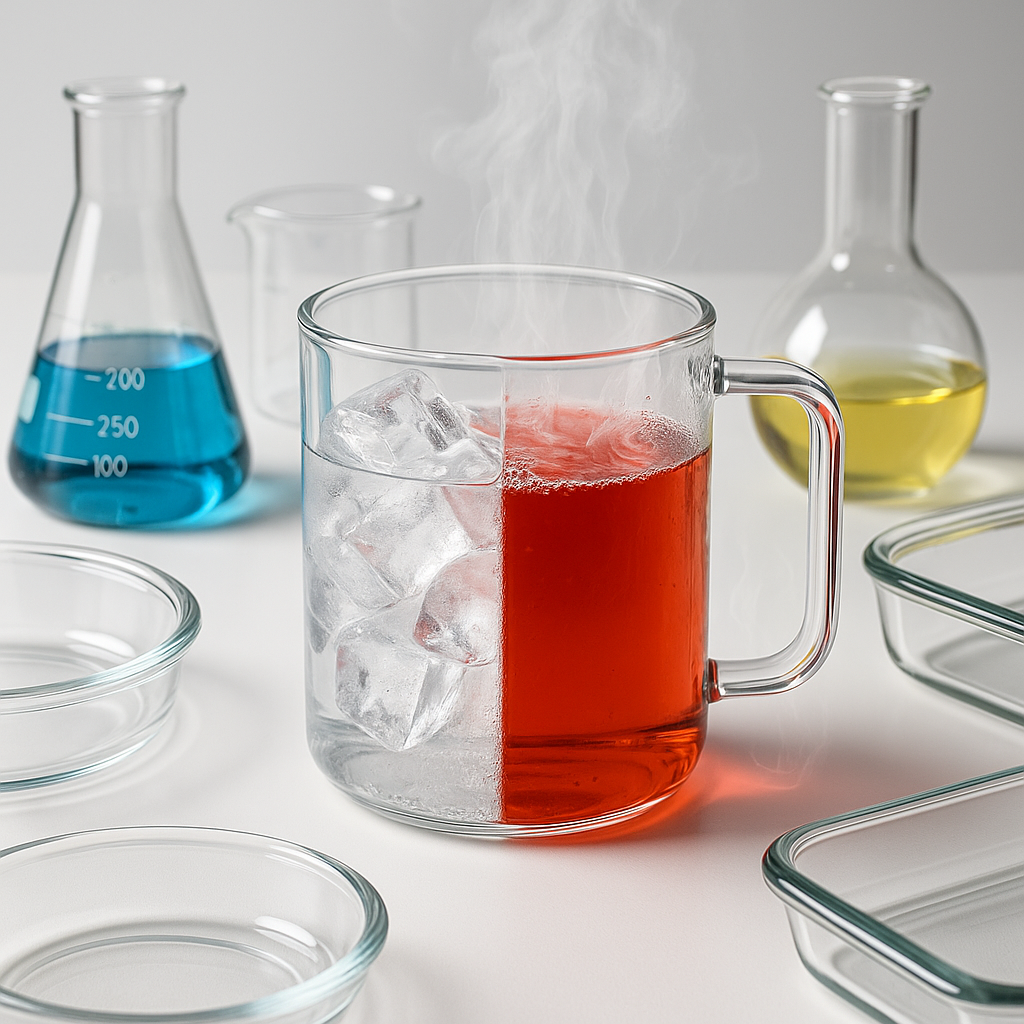
Borosilicate glass combines boron oxide with silica to create a material with exceptional thermal stability, chemical resistance, and durability that outperforms standard glass and plastic in kitchen use. Its low thermal expansion coefficient allows freezer-to-oven transitions without cracking, while its non-porous surface resists staining and won't leach chemicals into food.
Introduction
Boron oxide is the structural difference that makes borosilicate glass three times more heat-resistant than standard soda-lime glass.
The Growing Popularity of Borosilicate Glass Products
Borosilicate glass has moved well beyond the laboratory -- it's now one of the fastest-growing material categories in consumer kitchenware.
The global borosilicate glass market was valued at approximately $2.35 billion in 2025 and is projected to reach $4.7 billion by 2035, growing at a 6.8% CAGR. [2] Much of that growth is driven by home cooks who want non-toxic, heat-resistant alternatives to plastic storage and conventional glass bakeware -- and borosilicate glass pans are increasingly at the center of that conversation. [1] The culinary segment's rise connects to a broader preference for materials that don't react with food, hold up to temperature swings, and last far longer than cheaper alternatives. [3]
Brief Overview of What Makes Borosilicate Glass Special
What sets borosilicate glass apart from standard soda-lime glass comes down to one structural addition: boron oxide.
Adding B₂O₃ to silica lowers the thermal expansion coefficient, increases thermal shock resistance, improves chemical durability, and enhances mechanical strength -- all in a single composition change. [4] Its thermal expansion coefficient sits around 5 x 10⁻⁶/ degreesC, roughly one-third that of soda-lime glass, which is why it handles thermal shock far better than conventional glass. [4] That combination of heat resistance, chemical inertness, and optical clarity explains why the same material shows up in laboratory beakers, pharmaceutical vials, LCD displays, and kitchen bakeware. [4]
Why Understanding Borosilicate Glass Matters for Consumers and Industries
Knowing what borosilicate glass actually is -- and how it differs from cheaper alternatives -- directly shapes the purchasing decisions you make in the kitchen.
Not all glass products marketed as heat-resistant are true borosilicate: some brands, including certain Pyrex lines sold today, use tempered soda-lime glass instead, likely for cost reasons. [4] Across industries, the material's chemical inertness, thermal stability, and mechanical strength make it the standard for pharmaceutical vials, laboratory beakers, LCD display substrates, and consumer bakeware. [4] Understanding the health and safety implications of your cookware material helps you assess whether a product will actually hold up to temperature swings, acidic foods, and daily use.
The Science Behind Borosilicate Glass: Composition and Structure
Borosilicate glass's boron oxide content and tight molecular network make it chemically inert and thermally stable across kitchen, lab, and pharmaceutical uses.
What Is Borosilicate Glass?
Core Definition and ClassificationBorosilicate glass is formally classified as USP and ASTM Type I glass, which designates it as the least reactive glass available for containers, pharmaceutical packaging, and laboratory apparatus. [7] German glassmaker Otto Schott developed the material in the late 19th century, combining silica, boron oxide, sodium, and aluminum into a formulation that behaves fundamentally differently from standard soda-lime glass at the compositional level. [5] In laboratory and industrial contexts, the most widely used variant is 3.3 expansion borosilicate glass, which meets ISO 3585 and DIN 12217 international standards. [6] That formal classification matters when evaluating cookware -- products labeled 'heat-resistant glass' don't automatically meet Type I specifications. [7]
Chemical Composition Breakdown: Silica, Boron Oxide, and Other Elements
Borosilicate glass contains roughly 80-81% silica (SiO₂), 12-13% boron trioxide (B₂O₃), 4% sodium and potassium oxides, and 2% aluminum oxide (Al₂O₃) by weight. [10] The boron oxide component is what structurally separates it from soda-lime glass -- it replaces the soda and lime, and the glass must include at least 5% boron oxide to meet the classification. [9] Aluminum oxide reinforces the structural network, while sodium and potassium oxides bring the melting point down enough to make manufacturing practical. [8] Together, those four components produce the thermal stability, chemical inertness, and durability that make borosilicate useful across kitchens, laboratories, and pharmaceutical packaging alike. [10]
Molecular Structure: How Boron Changes Glass Properties
Boron switches between two coordination states inside glass -- three-coordinated [BO₃] triangular units and four-coordinated [BO₄] tetrahedral units -- and that ratio determines much of what the glass can do. [11] The BO₄ groups bond directly into the silicon-oxygen network, increasing connectivity and reducing non-bridging oxygen atoms to less than 1-2% of the total structure, which tightens the network and raises both chemical resistance and hardness. [11] BO₃ units, by contrast, connect through weaker van der Waals forces, so a higher BO₃ ratio raises thermal expansion and lowers structural integrity. [12] This composition-dependent shift in boron coordination -- called the boron anomaly -- explains why seemingly small formulation differences produce measurable changes in thermal, mechanical, and chemical performance. [12]
Comparing Borosilicate to Soda-Lime and Other Common Glass Types
Soda-lime glass accounts for roughly 90% of manufactured glass -- windows, bottles, food jars -- but its higher coefficient of thermal expansion makes it poorly suited for direct heat exposure. [14] Borosilicate scores 7.5 on the Mohs hardness scale compared to soda-lime's 6, is less dense at approximately 2.23 g/cm³, and contains a significantly higher silica proportion (80.6% versus 69%). [14] Chemical durability also differs sharply: in both acidic and alkaline conditions, soda-lime glass degrades at ten times the rate of borosilicate. [13] That performance gap is why borosilicate is the standard material for lab equipment, pharmaceutical containers, and food-safe bakeware, while soda-lime remains the right fit for architectural glazing and packaging where thermal and chemical demands stay low. [13]
Distinctive Properties That Define Borosilicate Glass
Borosilicate glass handles extreme temperature swings from freezer to oven without cracking, and its non-porous surface won't alter food flavor or leach compounds.
Superior Thermal Resistance and Low Coefficient of Expansion
The practical temperature range of borosilicate is what separates it from standard glass in daily use.
It handles working temperatures up to 500 degreesC and performs reliably down to -192 degreesC -- a range that covers everything from freezer storage to oven baking in the same vessel. [6] That range is possible because its low coefficient of thermal expansion means the material expands and contracts minimally as temperatures shift, so transferring a dish directly from the freezer to a hot oven doesn't generate the internal stress that would crack ordinary glass. [14] For home cooks, this means no pre-warming steps, no thermal cracking risk between a cold start and a hot finish, and a vessel that holds up through the full temperature arc of everyday cooking. [6]
Exceptional Chemical Durability and Inertness
Borosilicate glass has a non-porous surface that doesn't absorb residues or leach compounds into food or liquids, which is why it earns the designation "neutral glass" in pharmaceutical classification. [4] It resists corrosion from deionized water, saline solutions, most acids, halogens like chlorine and bromine, and organic substances without measurable surface degradation. [15] The exceptions are specific: hydrofluoric acid attacks the surface even in trace amounts, and concentrated phosphoric acid or caustic solutions above 30% concentration can cause etching when heated -- though at ambient temperatures, caustic solutions up to 30% pose no problem. [15] For kitchen applications -- acidic tomato sauces, citrus marinades, vinegar-based preparations -- none of those edge cases apply, so you get a vessel that won't alter the flavor, color, or chemistry of what you're cooking. [16]
Mechanical Strength and Impact Resistance Characteristics
Adding boron oxide to a silicate glass network increases mechanical strength and hardness -- properties that translate directly to durability in daily kitchen use. [4] Boron concentrations around 3% enhance the elastic modulus and surface hardness of the glass, making it more resistant to minor abrasion and physical stress than standard soda-lime alternatives. [17] Borosilicate glass isn't unbreakable, though -- it holds up better against impact than conventional glass, but a sharp drop on a hard surface can still cause fracture. [18] For practical care, avoid hard impacts and extreme temperature swings outside the material's rated range, and it will perform reliably through years of regular use.
Optical Properties: Clarity, Transparency, and Light Transmission
Borosilicate glass transmits light across a wide spectrum -- from visible wavelengths through infrared -- with minimal distortion or signal loss, which is why it's the standard material in optical fiber, laboratory lenses, and precision windows. [19] BK7, the most widely used optical-grade borosilicate glass, is colorless and highly transparent across the visible range, with reliable transmission down to approximately 350 nm before UV performance starts to drop. [21] Its refractive index -- typically between 1.51 and 1.52 -- gives optical engineers precise control over how light bends without requiring thick glass. [20] For home cooks, that same optical clarity provides unobstructed visibility into the vessel during cooking, making it easy to monitor browning, liquid levels, or layering without disturbing what's inside. [19]
Manufacturing Process and Historical Development
Borosilicate glass manufacturing uses precise forming methods--microfloat, down-draw, and tube-drawing--that set final dimensions during production rather than after, preserving surface quality and strength.
The Birth of Borosilicate Glass: Historical Context and Invention
Borosilicate glass was invented in 1881 by German chemist Otto Schott, who found that adding boric acid to a silica melt eliminated the bubbles, streaks, and optical defects that plagued laboratory glassware. [22] His work with physicist Ernst Abbe -- who had called for better scientific glass in an 1876 report -- led to the 1884 founding of the Schott & Associates Glass Technology Laboratory, which published a catalog of 44 glass types by 1886 and made Germany the dominant supplier of optical and scientific glass. [23] Corning Glass Works later adapted the formula -- first for railroad signal lenses, then for kitchen use -- launching Pyrex bakeware in 1915 after J.
T.
Littleton's wife Bessie showed that a borosilicate pan could bake a cake more evenly than metal. [22]
Modern Manufacturing Techniques and Production Methods
Borosilicate glass production starts with tank melting, where raw materials pass through four sequential phases: batch melting, refining to eliminate gas bubbles, homogenization, and conditioning. [24] The molten glass is then shaped using one of several methods depending on the end product: the microfloat process floats glass over a molten tin bath to produce flat, optically homogenous sheets; the down-draw process pulls glass through a nozzle and rollers to create ultra-thin sheets as fine as 30 μm; and the Danner tube-drawing process wraps molten borosilicate around a mandrel with blown air to form precision tubing for pharmaceutical and laboratory use. [24] In each method, final dimensions are set by draw speed and tooling geometry during forming rather than post-production cutting -- which keeps surface quality high and eliminates the grinding steps that introduce stress into conventional glass. [24]
Quality Control Standards in Borosilicate Glass Production
Quality control for borosilicate glass is verified through a layered set of international standards, not just composition claims.
ISO 3585 defines the material requirements for borosilicate 3.3, while ASTM E438-92 Type I, Class A sets specifications for laboratory apparatus -- both benchmarks manufacturers reference to confirm a glass meets minimum composition and performance requirements. [25] Hydrolytic resistance, the core measure of how much alkali a glass releases into water, is tested under ISO 719 at 98 degreesC and the more stringent ISO 720 at 121 degreesC, with surface-specific testing handled by ISO 4802 for pharmaceutical containers. [26] For cookware buyers, a product verified against USP <660> or Ph.
Eur. 3.2.1 Type I specifications has passed documented chemical inertness tests -- not just a label. [25]
Evolution from Laboratory Innovation to Widespread Commercial Use
After Schott's formula was adapted for industrial production, borosilicate glass expanded from scientific apparatus into pharmaceutical packaging, consumer cookware, and electronics throughout the 20th century. [23] Its thermal shock resistance and chemical inertness established it as the reference material for Type I pharmaceutical containers--vials, ampoules, and prefillable syringes--where sterilization integrity and minimal ion release are required. [27] Those same properties proved equally practical in home kitchens, where a baking dish needs to move from freezer to oven without cracking. [28] Today, borosilicate's controlled thermal expansion, optical clarity, and low dielectric loss support applications spanning consumer bakeware, LCD substrates, and hermetic electronics packaging--a commercial reach well beyond its original laboratory context. [27]
Diverse Applications Across Multiple Industries
Borosilicate glass serves labs, kitchens, and lighting applications because it withstands extreme temperatures and resists chemical damage without degrading.
Laboratory and Scientific Applications: Why Researchers Depend on Borosilicate
Research labs standardize on borosilicate glass for beakers, boiling flasks, test tubes, condensers, and ground-joint assemblies because the material handles nearly all temperatures encountered in lab processes without cracking or contaminating samples. [29] Borosilicate centrifuge tubes withstand relative centrifugal force exceeding 10,000 xg -- more than three times what ordinary glass tubes can tolerate -- making them the default choice for high-speed separation work. [29] Pyrex and Duran, both high-silica borosilicate formulations with over 80% SiO₂, are the benchmark lab glassware brands because they deliver the combination of transparency, high melting point, and resistance to water, acids, and caustic solutions that scientific apparatus requires. [4] That material consistency is what lets researchers move the same vessel from a burner to a storage rack without introducing variables into their results. [4]
Kitchen and Culinary Uses: From Bakeware to Storage Containers
Borosilicate glass handles the full range of everyday kitchen tasks -- bakeware for casseroles, food storage containers for leftovers, and serving dishes -- without needing separate material types for each function.
Strong-flavored ingredients like tomatoes, vinegar, or spiced foods won't stain or leave odors in the glass, so the same container works across different foods without carrying flavor between uses. [30] Moving a dish from freezer to preheated oven without cracking -- or from oven directly to the table -- is a workflow benefit that plastic and standard glass containers can't reliably deliver. [30] For cooks who meal prep, bake, and store in the same containers, that versatility makes borosilicate a durable, cost-effective long-term choice over materials that degrade under repeated heat cycles. [31]
Industrial Applications: Lighting, Electronics, and Specialized Equipment
In lighting, borosilicate tube assemblies enclose LED elements in long-life devices because the glass maintains structural integrity at sustained operating temperatures that would cause standard glass to fail. [32] Electronics manufacturing depends on non-alkali borosilicate for LCD substrates and semiconductor processing -- alkali elements like sodium raise ionic conductivity, which creates leakage currents and signal interference, so their removal is a formulation specification in those applications, not an optional refinement. [33] Boron-containing dielectric glass variants reduce signal loss in circuit boards and fiber-optic networks, making the material standard wherever high-frequency data transmission requires consistent electrical performance. [33] Industrial piping systems rely on borosilicate for corrosive chemical waste handling, and solar-grade borosilicate sheets are used in both UV-C sterilization devices and solar thermal collectors. [32][2]
Artistic and Decorative Uses in Contemporary Design
Borosilicate glass's thermal stability makes it the preferred medium for lampworking -- a technique where artists heat pre-made glass tubes and rods with a bench torch to sculpt beads, ornaments, jewelry, and figurines without the glass cracking under rapid temperature changes. [35] Contemporary artists fuse stringer (colored glass rods) into hot glass during shaping to produce intricate color patterns in finished decorative objects. [34] In the 1990s, those flameworking techniques extended into functional art -- pipes and sculptural rigs -- now recognized as a distinct segment of American studio glass. [36] The material's tolerance for repeated torch cycles, the same property that qualifies it for lab use, is what established it as the standard medium for this work. [34]
Health, Safety, and Practical Considerations
Borosilicate glass won't leach chemicals into your food and resists thermal shock, letting you skip the pre-warming steps that standard glass requires.
Health Benefits: Non-Toxic Nature and BPA-Free Properties
Plastic containers, particularly older ones, may contain BPA or phthalates that seep into food during heating -- chemicals linked to hormone disruption, per the NIH. [37] Borosilicate glass contains none of those additives by composition, making it a chemically inert food-contact material that doesn't transfer compounds into what you cook or store. [37] A practical nuance: some glass containers receive BPA-containing resin coatings during manufacturing to improve durability, so checking for an explicit "BPA-free" label confirms the glass itself is uncoated. [38] For cooks working with acidic marinades, reheated leftovers, or long-term food storage, that chemical neutrality is a concrete, measurable health advantage over plastic alternatives. [37]
Safety Features: Thermal Shock Resistance in Real-World Scenarios
Thermal shock resistance translates directly into how you can use borosilicate in a working kitchen without adding extra steps to your workflow.
The low coefficient of thermal expansion -- roughly one-third that of standard soda-lime glass -- means different parts of the vessel expand at nearly the same rate during temperature changes, so the internal stress that shatters ordinary glass doesn't build up. [39] A borosilicate dish moves from freezer to preheated oven, or from a hot oven directly to a cool countertop, without cracking -- workflows that would fracture soda-lime glass. [9] That reliability removes the pre-warming and gradual temperature-adjustment steps that standard glass bakeware requires, making it a practical advantage every time you cook. [40]
Environmental Impact and Sustainability Aspects
Borosilicate glass is recyclable, but it must be processed separately from soda-lime glass because the two materials have different melting points -- combining them in standard recycling streams degrades the output material. [42] Unlike plastic, glass doesn't shed microplastics during use or end-of-life breakdown, removing a contamination pathway that applies to every food-contact plastic container. [41] The environmental case for borosilicate strengthens through longevity: a single baking dish used for years spreads its manufacturing energy cost across hundreds of uses, while cheaper alternatives that chip, stain, or crack under repeated heat cycles require more frequent replacement and generate proportionally more waste. [41] For cooks prioritizing both kitchen performance and lower long-term material waste, borosilicate's durability is the environmental argument -- fewer replacements, not just recyclability. [42]
Proper Care, Maintenance, and Usage Guidelines
Hand washing with warm water and mild soap is the recommended cleaning method -- it removes residue without exposing the surface to the concentrated detergents in dishwasher cycles. [44] Grip pieces by the base rather than the rim, use dry hands to reduce slip risk, and store individual pieces with soft padding between them to prevent chips from contact with other cookware. [44] Before each use, inspect the rim and base for hairline cracks; a vessel with visible damage can fail under heat even if the flaw looks minor. [43] For stubborn stains, soak in a mild cleaning solution first, then scrub with a soft sponge -- abrasive pads scratch the surface and introduce stress points that raise fracture risk over time. [44]
Conclusion
Summarizing What Makes Borosilicate Glass a Superior Material
The combination of thermal resilience, chemical inertness, and mechanical durability that qualifies borosilicate glass for pharmaceutical and research settings translates directly into practical kitchen advantages. [4] A single vessel that handles freezer-to-oven transitions, resists staining from acidic foods, and holds up through repeated heat cycles removes the need for separate container types across different cooking tasks. [18] That performance range separates it from soda-lime alternatives and plastic containers, both of which degrade under conditions borosilicate handles without issue. [45] For cooks who value materials that last years rather than requiring frequent replacement, the same chemistry behind medical-grade containers applies equally to reliable, durable cookware. [4]
Future Innovations and Emerging Applications
The next phase of borosilicate development centers on two areas: lower-emission manufacturing and precision joining for high-tech devices.
Anhydrous borates -- such as boric oxide -- require less energy to melt than hydrated counterparts, reducing CO2 output during glass production. [33] Specialized dielectric glass formulations using boron reduce signal loss in circuit boards and fiber-optic networks, making borosilicate central to high-frequency data transmission. [33] Femtosecond laser welding -- which uses ultrashort pulses to bond glass at the focal point without broad thermal damage -- is enabling hermetic seals in MEMS packaging and aerospace components, with tested joint strengths exceeding twice the strength required for standard components. [46] The medical segment is projected to reach $2.2 billion by 2035, driven by pharmaceutical packaging innovation and expanding device applications. [1]
Making Informed Decisions When Choosing Glass Products
Three criteria cut through most of the confusion when buying glass cookware: confirm the product is certified borosilicate rather than tempered soda-lime, check for documented compliance with food-contact standards like FDA or LFGB, and verify a BPA-free label if the container has any applied coating. [48] Soda-lime glass can be processed to look similar to borosilicate, but it degrades faster under repeated heat cycles and acidic exposure -- the performance gap widens the more you cook. [47] For any combination of heating, direct food contact, and regular use, borosilicate's higher upfront cost distributes across years of reliable performance, making it the more dependable long-term investment once you understand the material differences. [48]
- Borosilicate glass has a thermal expansion coefficient one-third that of standard glass, enabling freezer-to-oven transfers without cracking.
- The material is chemically inert and contains no BPA or phthalates, making it safer than plastic for food storage and cooking.
- Borosilicate glass resists staining and flavor absorption from acidic foods like tomatoes and vinegar, unlike plastic containers.
- The global borosilicate market is projected to reach $4.7 billion by 2035, driven by demand for non-toxic, durable cookware.
- Verify products are certified borosilicate (not tempered soda-lime) and meet FDA or LFGB food-contact standards before purchasing.
- A single borosilicate dish spreads manufacturing costs across years of use, making it more economical than frequently replaced alternatives.
- https://www.marketresearchfuture.com/reports/borosilicate-glas-market-24943
- https://www.futuremarketinsights.com/reports/borosilicate-glass-market
- https://www.oganalysis.com/industry-reports/borosilicate-glass-market
- https://www.sciencedirect.com/topics/materials-science/borosilicate-glass
- https://www.borosilscientific.com/a-comprehensive-guide-to-borosilicate-glass-understanding-types-composition-and-properties/
- https://www.dwk.com/na/technical/glass-types-properties
- https://www.coleparmer.com/tech-article/physical-properties-of-glass
- https://kjhil.com/borosilicate-glass-types-composition-properties/
- https://advancedtechnicalprod.com/is-borosilicate-glass-safe/
- https://www.dwk.com/na/resource/whitepapers/borosilicate-glass-in-lab-applications
- http://www.glassonweb.com/article/structure-property-correlations-borosilicate-comparison-soda-lime-glass
- https://pmc.ncbi.nlm.nih.gov/articles/PMC9267155/
- https://www.ljstar.com/resources/glass-comparison/?srsltid=AfmBOop4I-Jg6t-j8rH45rvpDIPGpccyegJleWlqs00wOpwz2XlJQXLS
- https://www.westlab.com/blog/what-is-the-difference-between-soda-lime-glass-and-borosilicate-glass
- https://www.dedietrich.com/en/borosilicate-glass
- https://www.labdepotinc.com/articles/what-is-borosilicate-glass-properties-benefits-and-best-practices-in-the-lab.html?srsltid=AfmBOoouhuWpwkUfC57dF8ln9Ls3Ntw8IS0xP7M8TO8Ig6-BZZllcQWF
- https://pmc.ncbi.nlm.nih.gov/articles/PMC11376643/
- https://lightinginglass.com/understanding-borosilicate-glass-properties-benefits-and-applications/
- https://www.fiberopticsystems.com/borosilicate-glass-powering-fiber-optic-technology
- https://www.samaterials.com/blog/refractive-index-basics-and-examples.html
- https://customoptics.net/bk7-vs-fused-silica-how-to-choose-the-right-optical-glass/
- https://www.americanscientist.org/article/the-chemical-history-of-superior-glass
- https://grokipedia.com/page/Otto_Schott
- https://www.schott.com/en-us/expertise/glass-melting-and-hot-forming
- https://www.fishersci.be/be/en/lab-reporter/2023/monthly-editorial/november/borosilicate-glass-a-trusted-and-safe-choice-for-in-process-pharmaceutical-manufacturers.html
- https://www.octrd.com/blogs/knowledge/pharmaceutical-glass-testing-standards?srsltid=AfmBOoruMEs935ffj_2il7LBWrbdsl5hfWuv6pel-XpE8QZlPWnatfgH
- https://pmc.ncbi.nlm.nih.gov/articles/PMC12897758/
- https://www.britannica.com/technology/glass
- https://www.labdepotinc.com/articles/what-is-borosilicate-glass-properties-benefits-and-best-practices-in-the-lab.html?srsltid=AfmBOoqema5MfUA7gmmSGAUYjUkrYk8BQk11INoK8j3xSQQpFYXL3v48
- https://www.leheglass.com/info/the-benefits-of-high-borosilicate-glass-with-f-91521739.html
- https://myborosil.com/blogs/tips-tricks/10-surprising-benefits-of-using-borosil-cookware?srsltid=AfmBOoquMWbaaKnhNb0XzCPLLJQlyRY1Yt6J417ut-aZ_7Ben6yxR-5X
- https://www.schott.com/en-gb/expertise/materials/borosilicate-glass
- https://www.borax.com/news-events/august-2025/what-is-borosilicate-glass
- https://mjarsenal.com/blogs/dab-rigs/borosilicate-glass?srsltid=AfmBOorqzQ0bEaghnwJrnjkf0JNbBpiJMLDRKXMZ8AEV-FCWQJb-5Wti
- https://bernardkatz.com/types-of-glass-art/
- https://www.shannieartandglass.com/blog/softvsboro
- https://seedandsprout.com/blogs/news/glass-vs-plastic-the-ultimate-guide-to-food-storage
- https://www.ruanliving.com/blog/best-nontoxic-food-and-beverage-glass-storage-containers
- https://www.johnmorrisgroup.com/blog/what-is-borosilicate-glass-properties-types-lab-uses?srsltid=AfmBOorVflwqmY0JCRvhTL6QR_OXNnrCMS8C2FkqRsfjijWmK-Fi_tD0
- https://pobel.com/en/blog/guides/borosilicate-glass-what-it-is-characteristics-types-and-uses
- https://myequa.com/blogs/news/why-use-glass-bottles-benefits?srsltid=AfmBOooqoHv1kzUC8n8ltklshB0f5bRfu9girmmMLnWP0TYokRY3aDXn
- https://opticalglass.net/borosilicate-glass-vs-glass-whats-the-real-difference/
- https://www.ultident.com/blog/post/how-to-maintain-your-borosilicate-laboratory-equipment-for-longevity
- https://www.glasafe.com/blogs/glasafe-blogs/caring-of-glassware-clean-maintain-store-borosilicate-glass?srsltid=AfmBOoqOBI4oquHKIEaG5kqimvCaG79ZP-aX-nlMbzCHt4Z1cKP5grCa
- https://pegglass.com/borosilicate-glass/
- https://pmc.ncbi.nlm.nih.gov/articles/PMC12430699/
- https://www.dwk.com/na/knowledge-hub/blogs/soda-lime-vs-borosilicate-glass-in-the-laboratory
- https://slyprc.com/soda-lime-vs-borosilicate-glass-guide/
- Summary
- Introduction
- The Science Behind Borosilicate Glass: Composition and Structure
- Distinctive Properties That Define Borosilicate Glass
- Manufacturing Process and Historical Development
- Diverse Applications Across Multiple Industries
- Health, Safety, and Practical Considerations
- Conclusion
- Key Takeaways
- References