

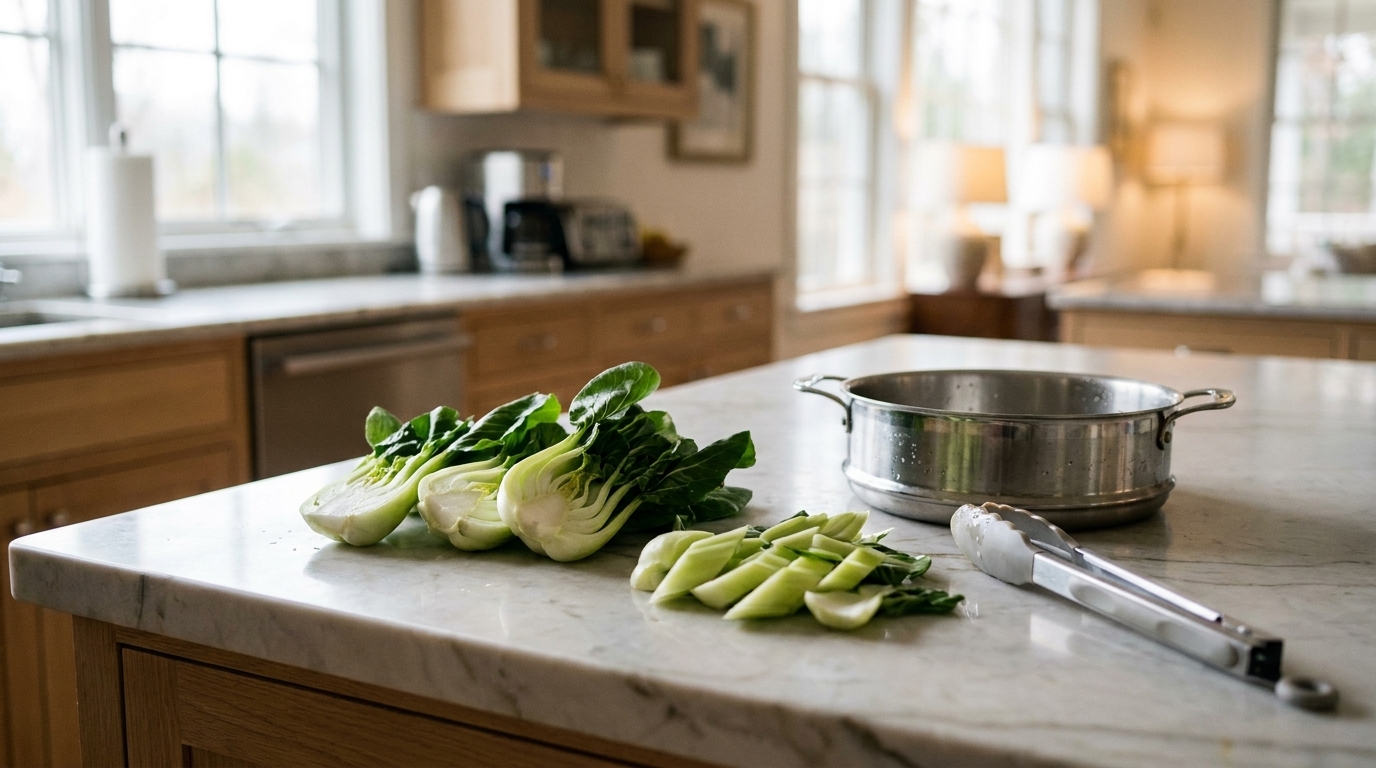
Master the cutting and steaming techniques that keep bok choy crisp instead of mushy, from halving and bias cuts to precise timing and equipment setup. Uniform piece size and proper steam temperature give you a predictable cooking window where texture stays firm and tender.
Why Cutting Technique Matters: The Science Behind Wilting
Uniform piece size gives you one timing target instead of several, keeping bok choy crisp-tender instead of mushy or underdone.
How surface area affects cooking speed and texture retention
When you cut bok choy, the exposed surface area you create determines how fast heat reaches each piece.
More surface area means faster moisture loss and quicker cell membrane breakdown -- the primary reason finely chopped bok choy turns watery and limp within a minute.[2] Plant cell texture depends on turgor pressure, the hydrostatic pressure inside each cell that keeps leaves firm and stems crisp; once heat disrupts the cell membrane, that pressure drops and the tissue softens irreversibly.[1] Cutting into larger, uniform pieces slows this process and gives you a wider window to pull the bok choy before texture degrades -- the same principle that applies when you master consistent cuts with leafy greens.[2]
Why uniform cuts prevent uneven steaming and mushiness
Mixed-size pieces in one basket create two problems at once: the smaller cuts turn mushy while larger pieces stay underdone.
Research on cut vegetables confirms that smaller pieces have roughly twice the surface-to-volume ratio of larger ones, which accelerates moisture loss and heat penetration -- so size inconsistency directly produces texture inconsistency.[3] Steaming operates within a window where the gap between crisp-tender and soft can be as little as 60 seconds, making non-uniform cuts nearly impossible to time correctly.[4] Keeping all pieces the same size gives you one timing target instead of several.
The 4 Essential Bok Choy Cuts and When to Use Each One
Halving baby bok choy lengthwise creates a flat surface that browns in 1 to 2 minutes per side, while bias cuts maximize contact for quick stir-frying.
Halved lengthwise: Best for baby bok choy and pan-searing
Halving baby bok choy lengthwise -- cutting straight through the root end so both halves stay intact -- creates a flat surface that makes direct contact with a hot pan.
That contact drives browning: the exposed core and inner leaves caramelize in about 1 to 2 minutes per side without the whole head going soft.[6] Whole baby bok choy or halves take roughly 5 to 7 minutes total over high heat, giving the stems time to soften while outer leaves keep some structure.[6] A wide nonstick frying pan gives the cut sides enough flat surface contact to sear properly -- and keeping the root intact when cutting holds each half together so the layers don't separate in the pan.[5]
Diagonal bias cuts: The stir-fry standard that cooks evenly in 2-3 minutes
A diagonal bias cut holds the knife at roughly a 45-degree angle to the stem, creating a wider oval cross-section that increases the surface contact between each piece and the hot pan or wok.
For stir-fry, cut both stems and leaves into 1-inch (2.5-cm) pieces at this angle, keeping sizes consistent so everything finishes in the same window.[7] Add the stems to the pan first and cook for 1 to 2 minutes until they begin to turn translucent, then add the bias-cut leaves and toss in the oil for about 15 seconds before covering with a small pour of broth for one final minute.[7] The best oils for this method are peanut, vegetable, or canola -- all with smoke points high enough to handle the medium-high heat stir-fry requires without burning before the bok choy is done.[7]
Prepping and Washing Bok Choy: What Parts to Keep and What to Trim
Treat stems, leaves, and core as separate components to nail both your prep sequence and cooking timing for perfectly cooked bok choy.
Which parts are edible: White stems, leafy greens, and the tender core
Bok choy is entirely edible except for the tough root end at the base, which you trim off and discard or save for stock.[8] The white stalks are firm and crisp with a mild flavor -- pale green in baby bok choy -- while the dark, crinkly leaves are softer and cook down faster.[9] The tender core sits at the center where all the leaf layers meet; halved, it creates the flat contact surface that browns in a hot pan.[10] Treating stems, leaves, and core as three distinct components gives you both a prep sequence and a timing guide for any cooking method.[8]
The 60-second washing method that removes grit without bruising delicate leaves
The method works in about 60 seconds: cut baby bok choy in half lengthwise to expose interior surfaces where grit hides, then submerge in a bowl of cold water and swish gently to loosen debris.[12] Cold water is key -- it prevents the wilting that warm water triggers by starting premature cell breakdown.[11] Change the water two to three times until it runs clear, then lift the pieces out rather than pouring them into a strainer, which would reintroduce the settled sediment.[12] Pat dry with paper towels or a salad spinner before cooking -- surface moisture flashes to steam on contact with a hot pan and softens leaves before you intend it to.[11]
Steaming Bok Choy Without the Wilt: Temperature, Timing, and Tool Selection
Steaming bok choy perfectly depends on cut size and a tight-fitting lid--get both right and you'll achieve crisp-tender results every time.
Ideal steaming temperatures and 3-5 minute timing windows by cut size
Steaming time for bok choy scales directly with cut size, and getting it right means the difference between crisp-tender and mushy.
Halved baby bok choy needs about 5 minutes of steam, medium heads quartered take 5 to 6 minutes, and large bok choy requires a staggered approach: 3 minutes for the diced stems first, then 2 more minutes after adding the leaf pieces.[14] Arrange everything stems-down and leaves-up in the basket so the denser parts are closest to the steam source while the leaves cook more gently from above.[14] Baby bok choy steamed for just 3 to 4 minutes will stay noticeably crunchier -- the right call for dishes where texture matters more than full tenderness.[13]
Choosing the right cookware and utensils to prevent overcooking and maintain texture
The most important factor in steaming bok choy without overcooking is a pot with a tight-fitting lid -- loose lids bleed steam and extend cooking time unpredictably.
A standard steamer basket inside a lidded pot works well, but three golf ball-sized aluminum foil balls on the pot bottom with a heat-proof plate resting on top creates the same effect without any specialized equipment. [15] Fine-mesh sieves don't work as a substitute because they sit too low in most pots for a tight cover, so steam escapes and bok choy overcooks past crisp-tender before you catch it. [15] For removal, silicone-tipped tongs give you a firm grip on wet bok choy halves without tearing the leaves -- particularly useful when lifting pieces from a confined steamer plate.
- Cut bok choy into uniform sizes to control cooking time and prevent mushy texture.
- Smaller pieces have twice the surface-to-volume ratio, causing faster moisture loss and overcooking.
- Halve baby bok choy lengthwise to create flat surfaces that brown and caramelize properly.
- Steam halved baby bok choy for 5 minutes with stems down and leaves up for even cooking.
- Wash bok choy in cold water to prevent premature wilting from heat-triggered cell breakdown.
- Use a tight-fitting lid when steaming--loose lids extend cooking time unpredictably past crisp-tender.
- Add stems to the pan first, then bias-cut leaves for stir-fry to match cooking windows.
- https://pmc.ncbi.nlm.nih.gov/articles/PMC2995313/
- https://pmc.ncbi.nlm.nih.gov/articles/PMC12469137/
- https://lifetips.alibaba.com/kitchen-hacks/how-to-steam-vegetables
- https://www.healthyseasonalrecipes.com/how-to-cut-bok-choy/
- https://www.jessicagavin.com/how-to-cook-bok-choy/
- https://www.wikihow.life/Cook-Bok-Choy
- https://naturalkitchenschool.com/how-to-cut-bok-choy/
- https://iheartumami.com/how-to-cut-bok-choy/
- https://www.tasteofhome.com/article/how-to-cook-bok-choy-3-ways/
- https://www.wikihow.com/Clean-Bok-Choy
- https://www.thedailymeal.com/1441303/best-method-cleaning-bok-choy/
- https://www.infinebalance.com/baby-bok-choy/
- https://iheartumami.com/steamed-bok-choy-garlic-oyster-sauce/
- https://www.epicurious.com/expert-advice/how-to-steam-without-a-steaming-basket-article