

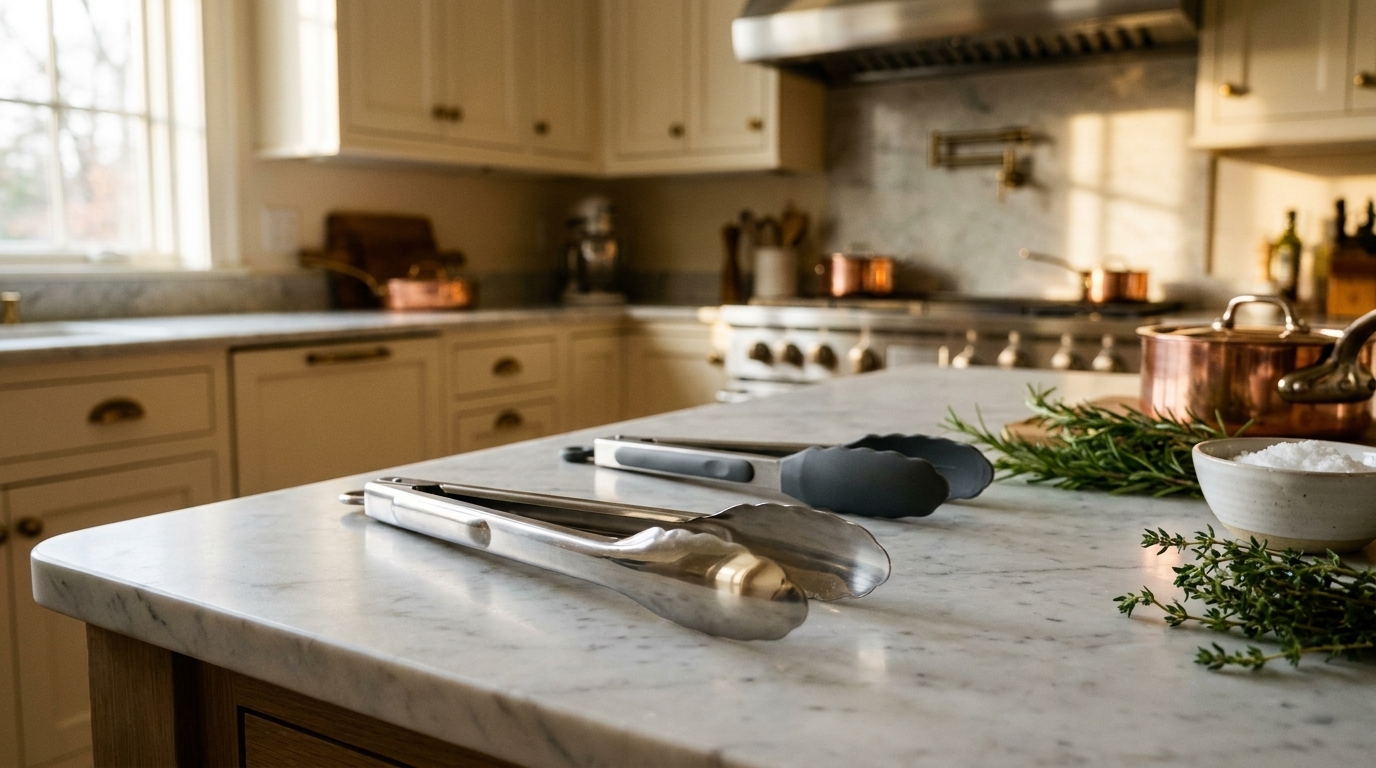
Stainless steel and silicone-tipped tongs each excel in different cooking situations based on your cookware and heat source. Match stainless steel to cast iron and high-heat tasks, silicone to nonstick pans, or keep both for complete kitchen versatility.
Stainless Steel Tongs: Durability, Heat Tolerance, and Professional Performance
All-metal stainless steel tongs withstand unlimited heat without degradation, making them ideal for searing, grilling, and broiler work where coated alternatives fail.
Why Professional Chefs Prefer Stainless Steel Construction
Professional kitchens favor stainless steel tongs primarily because of precision and hygiene -- all-metal, one-piece construction eliminates joints where bacteria can accumulate, making them faster to sanitize between tasks.[5] Stainless steel also doesn't absorb odors or flavors, which matters when you're moving between proteins and aromatics without stopping to swap tools.[5] The thinner, more precise tips give cooks better control over smaller items like shrimp tails or individual pasta strands -- tasks where bulkier silicone heads become a liability. [6] For high-heat work like searing in a stainless steel skillet or grilling over open flame, all-metal tongs hold up without any risk of tip degradation over time. [6]
Temperature Limits and When Stainless Steel Outperforms Other Materials
Stainless steel tongs have no practical upper heat ceiling the way coated alternatives do -- nylon tips typically max out around 400-450 degreesF, and quality silicone is rated to 600 degreesF, while all-metal tongs handle temperatures beyond that without degrading. [7] That makes them the right call for cast iron cooking, open-flame grilling, and broiler work where sustained high heat is unavoidable. [7] One practical note: stainless conducts heat efficiently, so tongs left resting on a hot pan edge will become hot to the touch -- always rest them off the heat source between uses. [7] For high-heat tasks like searing steak in cast iron, all-metal construction holds up without any risk of tip degradation over time. [7] Comparison Table: Silicone vs. Stainless Steel Tongs for Every Cooking Scenario
Interactive Tongs Selection Checklist: Find Your Ideal Match
Three questions help you decide: what cookware do you use most, what's your primary heat source, and how precise does the work need to be?
If your answers are nonstick or ceramic pans, stovetop or oven heat, and larger foods like chicken pieces or whole vegetables, silicone-tipped tongs are the right call. [8] If you primarily cook in cast iron or stainless steel, work over open flame or a grill, and handle small or precise items, all-metal tongs hold up without any degradation risk. [9] Households doing both -- weeknight stovetop on coated pans and weekend grilling -- often find a 12-inch pair of each covers everything without compromise. [10]
How to Match Tongs Material to Your Cookware and Cooking Style
Matching tongs to cookware comes down to surface type first, then task.
Silicone-tipped tongs belong alongside any coated surface -- nonstick, ceramic, or enameled -- where even incidental contact from metal tips can accelerate surface wear over time. [3] All-metal tongs pair naturally with uncoated cookware like cast iron or carbon steel, where their thinner, lighter tips improve precision during searing and high-heat transfers without any compatibility concern. [3] If your kitchen includes both coated and uncoated cookware -- which describes most home setups -- keeping one pair of each eliminates guesswork at the stove. [3]


Maintenance and Care: Extend the Life of Your Cooking Tongs
Prompt washing, thorough drying, and proper storage protect both silicone and stainless steel tongs from degradation and extend their kitchen lifespan.
Cleaning and Storage Tips for Silicone-Tipped Tongs
Silicone tips require soft sponges rather than abrasive pads -- steel wool scratches the surface at a microscopic level, creating grooves where food residue and odors accumulate. [12] If soapy or oily smells develop, soak the tips in a 1:1 white vinegar and water solution for four hours, or bake clean tongs at 250 degreesF for 20-30 minutes to release trapped oils. [11] Air-dry completely before storing -- moisture trapped in silicone creates conditions for mold -- and keep them in a cool, dry spot away from direct sunlight, which weakens the material's tensile strength over time. [12]
How to Maintain Stainless Steel Tongs for Years of Use
Stainless steel tongs need less upkeep than silicone, but a few habits separate tongs that last a decade from ones that pit or corrode early.
Wash them promptly after each use -- food residue left to harden is harder to remove and can degrade the metal's protective chromium oxide layer. [14] Avoid steel wool, wire brushes, and chloride-based cleaners, which scratch the surface or cause pitting that undermines corrosion resistance -- the same principles that apply to cleaning stainless steel pans. [14] Dry thoroughly before storing, since hard water deposits left on the surface break down the protective layer over time, and apply a small amount of food-safe oil to the locking mechanism periodically to keep it operating smoothly. [13]


- Stainless steel tongs handle unlimited heat for searing, grilling, and broiler work without tip degradation.
- Silicone-tipped tongs protect nonstick and ceramic cookware from metal scratches that accelerate surface wear.
- All-metal construction eliminates bacteria-trapping joints, making stainless tongs faster to sanitize between tasks.
- Thinner stainless steel tips give precise control over small items like shrimp or individual pasta strands.
- Most home kitchens benefit from owning both types: silicone for coated pans, stainless for cast iron and high heat.
- Silicone tips require soft sponges and vinegar soaks to prevent odor absorption; stainless needs prompt washing to prevent pitting.
- Match tongs to cookware first: silicone pairs with coated surfaces, all-metal pairs with uncoated cast iron or carbon steel.
- https://www.lotechsales.com/what-materials-are-the-best-for-custom-tongs-and-how-do-they-affect-durability-heat-resistance-and-usability/?srsltid=AfmBOoqUfnjJ-af01c3Xok_bmJAgC0-Il3Tip6rKe_5hqdADSVt7Csge
- https://www.thinkitchen.in/blogs/latest/types-of-tong-materials?srsltid=AfmBOoraWxxVqgOhC1kqVo4uVOx_FZiUerRKg0Tiunp_hZ8XnQ5b9Yk1
- https://www.seriouseats.com/the-best-kitchen-tongs-equipment-review
- https://www.dioro.com/blogs/news/silicone-tipped-vs-metal-kitchen-tongs?srsltid=AfmBOoqU7gw2pta4jG8-IDp4R6zM5OM465JIA3yAUP0dhZd-mHaoREeI
- https://www.dioro.com/blogs/news/stainless-steel-tongs?srsltid=AfmBOoqm69JxSYxxrwcXcHQsNTp3m15J4nLXTj72OV24NhMZQpdU2LAa
- https://www.foodandwine.com/lifestyle/kitchen/best-kitchen-tongs
- https://www.dioro.com/blogs/news/versatile-kitchen-tongs-for-cooking?srsltid=AfmBOoqyudJ9c6X9KmK0Cb3m3dItraux6PPfMUZ8PfO_Av6lrb0L-ca3
- https://www.seriouseats.com/basic-starter-kitchen-equipment
- https://www.nytimes.com/wirecutter/blog/6-alternatives-to-pro-kitchen-tools/
- https://www.dioro.com/blogs/news/stainless-steel-utensil?srsltid=AfmBOooTl41lkCVaKhdWcdOGd19EptHDDoN1nO3emHJAPrkWF-FTf4YG
- https://www.consumerreports.org/home-garden/cleaning/how-to-clean-silicone-kitchen-utensils-and-more-a6730152629/
- https://www.tastingtable.com/1992349/rules-follow-using-silicone-kitchenware/
- https://www.dioro.com/blogs/news/stainless-steel-tongs?srsltid=AfmBOorhFdXZrYt4o2x1YaaHf0JWMU0MlQ3_QyzK5G1uQeePwKDcdYyG
- https://www.webstaurantstore.com/guide/542/how-to-clean-stainless-steel.html?srsltid=AfmBOorW7GwbovVz-lYQr2hN-Dh3G0mboYYKURC6TBaoezGKgsP1GpZr