

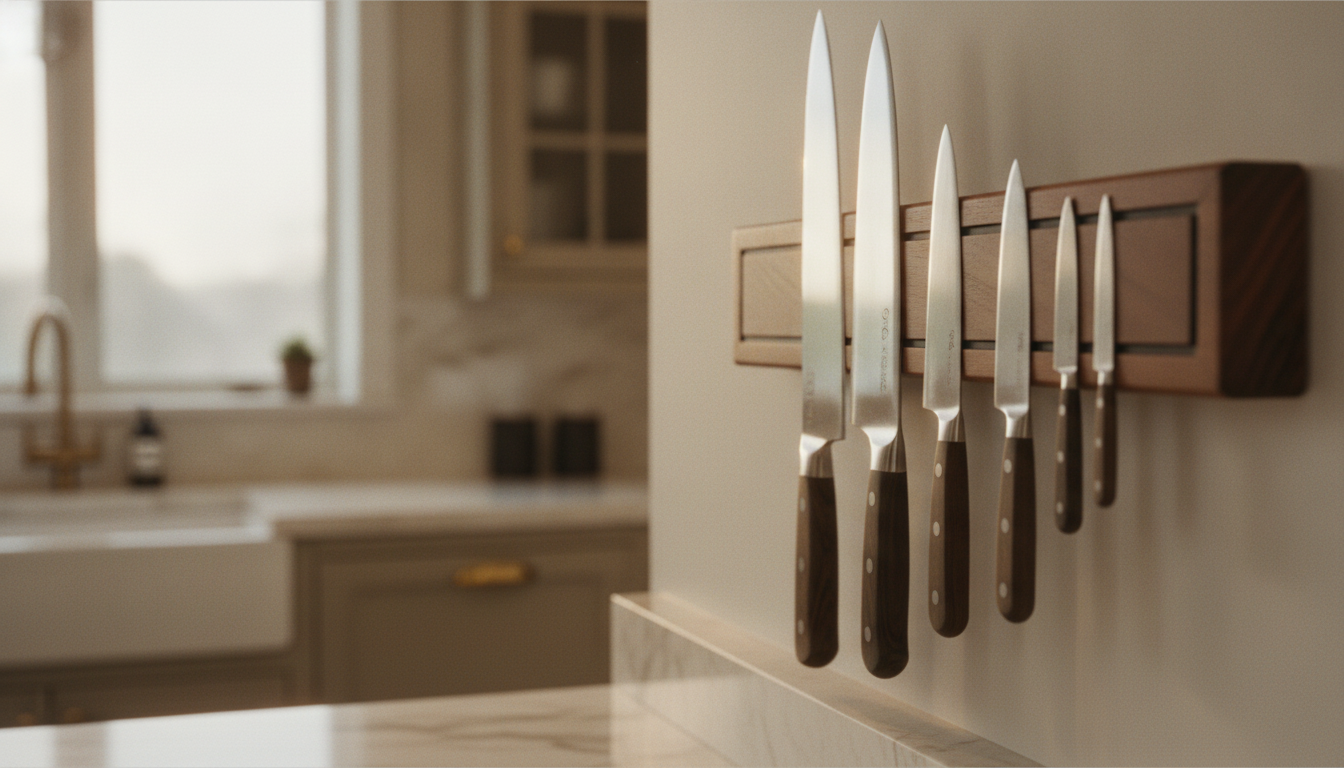
Knife edges dull through repeated contact with hard surfaces during storage, not from a single impact, so choosing the right storage method keeps your blades sharp longer. Magnetic strips, quality wooden blocks, and blade guards each protect edges differently--pick one that fits your space and keeps blades separated from contact.
Why Proper Knife Storage Protects Your Edge: The Science Behind Blade Dulling
Blade edges dull from repeated contact during storage, not just from dramatic impacts, so choosing the right storage method protects your knife's sharpness.
How blade contact and friction wear down steel over time
A knife edge is essentially two polished planes meeting at a microscopic apex, and that apex only stays sharp as long as it stays intact [2]. During normal cutting, contact with food and cutting boards abrades the steel, rounding off the apex, while pressure against the board causes it to roll or fold to one side [1].
Storage works the same way: sliding a blade against another knife, a drawer's metal edge, or a wooden block's interior repeats that same abrasive contact, just without any food in between. Even soft materials can dull an edge through repeated friction, since wear accumulates with every pass regardless of what the blade is touching [1].
This is why loose drawer storage causes gradual dulling over weeks, not from one dramatic impact, but from constant low-grade contact wearing the apex down bit by bit [1] [2].
The difference between dulling and chipping: why storage method matters
Dulling and chipping are different types of damage, and storage method determines which one your knife suffers. Dulling happens gradually: the edge rolls or wears down from repeated contact with a hard surface, the same abrasive process that flattens an apex during normal cutting [4].
Chipping is sudden instead of gradual, occurring when the edge strikes something harder than the steel itself, like another blade, a ceramic dish, or the metal wall of a drawer [4]. Thin, hard blades are especially vulnerable to this kind of impact damage, since the same properties that let them hold a fine edge also make them prone to fracture under lateral stress [4].
Loose drawer storage puts a knife at risk for both problems at once: constant sliding wears the apex down while sharp impacts against metal or ceramic can chip it outright [4]. Choosing a storage method that keeps blades separated and free of contact addresses both failure modes, rather than trading one kind of damage for another.

Five Storage Methods Ranked by Edge Protection: Which One Stops Dulling Best
Magnetic strips preserve blade sharpness best by keeping the cutting edge completely untouched during storage, with no slot wear or edge pressure over time.
Magnetic knife strips: blade suspension without contact
A magnetic knife strip is a bar with strong magnets mounted on a wall, holding blades by their flat side rather than sliding them into a slot [6]. Since the cutting edge never touches a surface, the apex stays untouched during storage, which preserves sharpness better than designs that force the blade against interior walls [7]. Magnet quality matters here: weak or standard magnets lose holding strength quickly, letting knives slide or drop, so look for strips with hidden, strong neodymium magnets [5].
Our magnetic knife strip is built this way, holding blades securely by their flat side with no slot to wear the edge. A wood or leather-covered strip is worth choosing over bare metal, since it protects the blade from chipping or scratching if it ever brushes the surface [5]. Strips also dry faster than enclosed slots, since air circulates freely around the blade and leaves no trapped moisture for bacteria to grow [7].
The tradeoff is tang stress: magnetic holders put pressure on the tang when a knife is lifted off, which can affect knives that aren't full-tang over time [5].
Knife blocks: the traditional choice with material considerations
Wooden knife blocks remain the standard choice, prized for stability and their ability to absorb residual moisture off blades after washing [8]. The material matters more than most buyers realize: quality blocks use horizontal slots, since vertical storage forces the edge to press downward under its own weight, gradually rolling the apex over time [8]. If a block only offers vertical slots, store blades upside down with the edge facing up to keep gravity from working against the steel [5].
Bamboo blocks look similar to hardwood but bamboo is technically a grass with a harder, more abrasive surface, meaning it wears an edge down faster than actual wood [8]. Plastic flex-rod blocks solve the fit problem by accepting any blade shape, but the rods get nicked with repeated use and eventually crack, and unlike wood they don't wick away moisture [8]. If you want a hardwood option that seats blades without grinding the edge into the material, our knife storage block holds a full set while absorbing residual moisture after washing.
Whatever the material, a slotted design that doesn't match your knife set's actual dimensions creates a bigger problem: knives forced into ill-fitting slots angle against wood or plastic walls, and tight-fitting slots also trap food debris where bacteria can grow [5].
In-drawer organizers with blade guards: safety meets accessibility
In-drawer organizers solve a real problem: even a full magnetic strip or block runs out of room, and loose blades rattling in a drawer accelerate both dulling and chipping [9]. A cork-lined or foam-slotted tray keeps each knife in its own channel so edges never touch metal, wood, or each other, and the dividers flex to fit odd-sized blades that don't match a block's fixed slots [9].
For knives stored bare in a drawer, individual edge guards close the gap: hard plastic sleeves lined with felt or foam wrap the blade so it can't bang the drawer walls or slide against other tools every time the drawer opens [10]. Guards also matter for safety, since anyone reaching into a drawer full of loose blades risks a cut, while a sheathed edge lets you grab a knife without checking its orientation first [10].
Fit is the detail people skip: a guard needs to hold the blade snugly, so measuring length and width before buying prevents knives from sliding out or shifting inside the sleeve [10].
Knife sheaths and blade protectors: portable edge defense
Blade guards are rigid or semi-rigid sheaths that slide over a knife's edge, and they solve a problem magnetic strips and blocks can't: portability [11]. A guard should match the blade's length almost exactly, since a too-short guard leaves edge exposed to chips and scratches, while a loose fit lets the blade wobble and dull against the guard's interior [11].
PVC and hard-plastic guards are the most common choice, offering a dishwasher-safe, universal-fit option that works for everyday chef's knives, paring knives, and serrated blades [11]. For Japanese-style knives like a gyuto or santoku, a wood saya offers a custom, snug fit that protects the edge without abrasion while absorbing minor moisture [11] [12].
Leather sheaths, often paired with European forged blades, mold to the blade's shape over time and typically close with a snap or belt loop [11]. Whatever the material, a guard that fits snugly prevents the blade from shifting inside during transport, which is the main cause of dulling in portable storage [11].
Knife rolls: storage for chefs on the move
A knife roll is a fabric or leather wrap with individual pockets for each blade, built to protect edges and travel wherever the cook goes, unlike a wall-mounted strip or a counter-bound block [14]. Each knife slides in handle-first with the tip pointed toward the tie strings, so a shifting blade never points back at your hands when the roll opens [13].
Waxed canvas and full-grain leather outperform thin nylon, since flimsy interior fabric can fray or get sliced by an unguarded edge, a failure mode testers flagged directly [14]. Individual blade guards inside each pocket add a second layer of protection beyond the roll itself, keeping edges from contacting the fabric or each other during transport [15].
Most working chefs pack 4-6 knives rather than a full block's worth, which keeps the roll manageable and each blade properly seated [14]. For flights, rolls go in checked luggage only, never carry-on, with the roll wrapped and cushioned inside the suitcase [13] [14].
The Safest Way to Store Knives in Your Kitchen: Practical Setup for Families and Small Spaces
Magnetic modular storage scales with your knife collection and keeps blades safely out of reach on walls or compact stands, protecting both edges and curious hands.
Knife storage without a block: alternatives for minimal countertop space
Minimal countertop space rules out bulky blocks, but knife storage without a block still protects the edge if you pick the right gear. Magnetic strips mount to a wall and take up zero counter or drawer space, which makes them the top pick for a kitchen where every inch of surface matters [16].
Narrow freestanding magnetic stands work as a compact alternative for renters or anyone without wall space to spare, holding blades against an exterior magnetic core instead of inside fixed slots [16]. A modular magnetic knife storage set solves the sizing problem that traps most small-kitchen buyers, since pieces click together and expand only as your collection grows, rather than locking you into a fixed number of slots [16].
For truly tight setups, cup hooks installed under a cabinet keep sheathed or guarded blades within reach without using any counter or drawer space at all [17]. Whatever combination you choose, gear that scales to your available space protects the edge better than a full-size block that either wastes room or runs out of room for your knives.
Storing knives safely with children at home: height, visibility, and accessibility rules
Kids treat kitchens as a magnet for exploration, so knife placement needs to account for both height and sight lines, not just a locked door [18]. Wall-mounted magnetic strips work well for this: mount the strip above counter height and out of a child's reach, since the blades stay visible to adults but too high for small hands to grab [19].
Countertop blocks need the same rule -- keep them pushed toward the back of the counter or on a shelf children can't climb to, since the block's presence alone doesn't stop a curious kid from pulling at handles [19]. Drawer storage requires an added layer: a child safety latch that isn't easily worked open, since a loose drawer full of blades is one of the more accessible hazards in a kitchen with kids around [18].
Whatever method you choose, teach kids early that knife storage isn't a toy or shelf display, since awareness paired with physical barriers cuts risk more than either one alone [19].


Long-Term and Travel Knife Storage: Preventing Rust, Corrosion, and Blade Damage
Moisture is the biggest threat to stored knives, so keep blades in a dry space with silica gel and apply a thin coat of mineral oil or wax before long periods away.
How to store knives long-term: humidity control and protective coatings
Long-term storage means limiting how long a blade sits between uses, and moisture is the biggest threat during that stretch, especially for carbon steel, which reacts to air and water far more readily than stainless [22]. Store knives in a dry, climate-controlled space away from damp basements, humid pantries, or hot garages, and drop a few silica gel packets into the case or drawer to absorb ambient moisture [20] [21].
Before storing, clean and dry the blade fully, then apply a thin coat of food-grade mineral oil or a beeswax-based wax, since even a small residue of water left on steel can develop rust spots [20] [22]. Protective coatings like Parkerizing or a ceramic finish add a layer of defense, but any coating can scratch with normal handling, exposing bare steel underneath, so waxing a coated blade is still worth doing [20].
Airtight containers or vacuum-sealed bags work well for knives that won't be touched for months, since sealed storage keeps humidity from creeping in over time [21]. Pull knives out periodically to inspect for early rust spots, which wipe away easily if caught before they pit the steel [20] [22].
How chefs store knives when traveling or moving: portable solutions that preserve edges
The knife roll covered earlier is the standard for transport, and the same rules apply on the road: keep each blade separated and guarded so nothing shifts in transit [24]. For air travel, knives go in checked luggage only, sheathed or wrapped, since carry-on rules ban them regardless of size or blade type [23] [24]. In a car, store the roll in the trunk or a locked compartment rather than the passenger seat, since state and local laws still apply even without federal restrictions [24]. When moving house, wrap each blade individually in packing paper, tape it securely, and label the box "sharp" rather than relying on loose padding [24]. Whether you pack four knives or six, cinch the roll tight enough that nothing knocks against the case walls [25].
No matter what your kitchen looks like, the goal stays the same: keep the edge off hard surfaces and keep moisture away from the steel. Pick storage that fits your space and your set, guard the blades that travel, and dry every knife before it goes away. For more care & maintenance tips, or help choosing the right setup for your knives, contact us -- and when a well-used blade finally needs a tune-up, our knife sharpening service can bring the edge back.
- Knife edges dull from repeated contact with hard surfaces, not just dramatic impact--even soft materials cause wear over time.
- Magnetic strips preserve sharpness best by keeping blades suspended away from surfaces, avoiding both dulling and chipping.
- Wooden blocks with horizontal slots protect edges better than vertical designs, which force blades downward under their own weight.
- Cork-lined drawer organizers and edge guards prevent dulling by keeping blades separated and protected during storage.
- Carbon steel requires moisture protection during long-term storage--apply mineral oil or beeswax coating before putting knives away.
- For small kitchens, modular magnetic storage scales with your collection instead of locking you into fixed slot counts.
- Knife rolls with individual guards are the only storage method that protects edges during transport and travel.
- https://www.knifeopedia.com/properties
- https://sharppebble.com/blogs/blogs/the-science-behind-knife-sharpening-how-abrasion-works?srsltid=AfmBOorm5CZdlK6j4Yrc5p3ZC3nBOW6K3vWn5F3mthMqkgvbaa-8HOsG
- https://oishya.com/journal/kitchen-knives-101-buying-storage-cutting-techniques-and-more/
- https://seidoknives.com/blogs/news/how-do-you-maintain-an-aus-10-knife?srsltid=AfmBOoqK1cuRvlFGWggwCqtDjfpbsOjj3R90ADPd_8KHn1TGWqyx6dW8
- https://oishya.com/journal/knife-drawer-knife-stand-or-magnetic-rack-what-is-better/
- https://blog.magnetsusa.com/blog/wood-magnetic-knife-blocks
- https://www.honeyhone.com/blogs/news/magnetic-knife-strip-vs-wooden-block-which-storage-solution-is-best?srsltid=AfmBOoow39ys6ayL8j3GKuJqInzrnfWfwyFqyJd1jSIvEu2CbDNeTzdX
- https://www.centurylife.org/how-to-choose-a-knife-in-depth-product-reviews-kitchen-knives-sharpeners-knife-blocks-and-other-knife-storage/
- https://www.cuisineathome.com/review/knife-holder
- https://www.epicurious.com/expert-advice/this-knife-protector-changed-my-knife-storage-game-for-the-better-article
- https://www.americastestkitchen.com/articles/3271-how-to-choose-a-guard-for-your-knife
- https://www.knivesandtools.com/en/ct/knife-protectors.htm
- https://seidoknives.com/blogs/news/how-to-pack-a-knife-roll?srsltid=AfmBOorpG1EauTbIZwhANd64D0xD0nm0De6Xt3VQYICxvCsU3ZWfovk-
- https://www.fliproducts.com/blogs/blade-guard/what-is-a-chefs-knife-roll?srsltid=AfmBOoqROIcAsYuLszOU_ilzTZ8yyxOpBBzmk5hX52sX3Tk7m0xyKgc2
- https://ontheroadeats.com/best-knife-rolls/
- https://www.bonappetit.com/story/best-knife-storage?srsltid=AfmBOoqWI9adUuywSYrRGrOZEKsVZsGE0vFFlCFfTjozBh9_PMnmyp-Y
- https://www.nytimes.com/wirecutter/reviews/small-kitchen-ideas/
- https://www.akti.org/news/kids-knives-in-the-kitchen/
- https://oishya.com/journal/best-way-to-store-kitchen-knives-around-children/
- https://www.montanaknifecompany.com/blogs/news/how-to-keep-knives-from-rusting?srsltid=ARcRdnqIX3RuII7kvrl1Cfp4kiM4_aeIf7BA-cmx-mZWui-LdaLiQeiP
- https://blog.knife-depot.com/how-to-store-knives-the-right-way/
- https://perkinknives.com/blogs/knives/how-to-store-carbon-steel-knives-properly-to-extend-blade-life
- https://www.boldric.com/blogs/news/travelling-with-knives-how-to-pack-your-knife-bag-safely-and-legally?srsltid=AfmBOoqAUyW8PNutKB5VMOvWtdYgTFlEfnHF4UKU3716qsfzpcXttw_M
- https://www.fliproducts.com/blogs/blade-guard/how-to-safely-transport-kitchen-knives?srsltid=AfmBOoqF5gWvaKe-ENHS2w9uDQsoKa5a_gNvf19_ke7jj9eFFP7QeHsi
- https://frontierleatherco.com/leather-knife-roll-vs-hard-knife-case/?srsltid=AfmBOooNqQEwyIyV-oj-M3r8hV9REfq-1fazgODhjyCFBW-GqOi8GqjI
- Summary
- Why Proper Knife Storage Protects Your Edge: The Science Behind Blade Dulling
- Five Storage Methods Ranked by Edge Protection: Which One Stops Dulling Best
- The Safest Way to Store Knives in Your Kitchen: Practical Setup for Families and Small Spaces
- Long-Term and Travel Knife Storage: Preventing Rust, Corrosion, and Blade Damage
- Key Takeaways
- References