

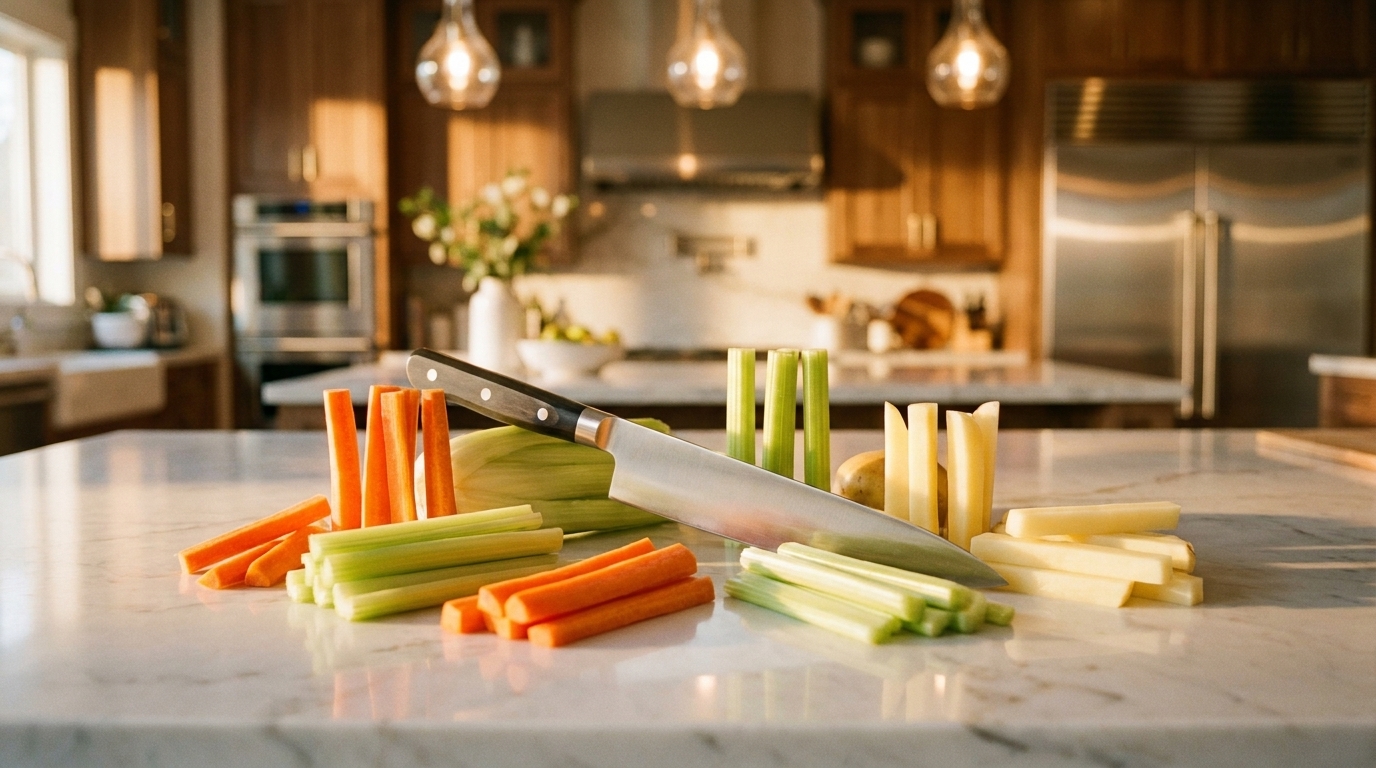
Learn the batonnet cut technique to create uniform vegetable sticks that cook evenly and consistently across dishes like stir-fries, roasted vegetables, and crudités. Mastering this foundational knife skill ensures every piece reaches the target temperature simultaneously, eliminating overcooked edges and undercooked centers.
What Is a Batonnet Cut and Why It Matters in Your Kitchen
Uniform batonnet cuts ensure every piece cooks at the same rate, eliminating overcooked edges and mushy or firm texture variations.
The exact dimensions and definition of batonnet cuts
The batonnet cut (pronounced bah-tow-NAY) is a French knife cut that produces rectangular vegetable sticks measuring ½ inch x ½ inch x 2½ to 3 inches [1]. The name translates directly to "baton" or "stick" in French, which describes the shape precisely [2].
Beyond its use as a standalone cut, the batonnet also serves as the starting point for medium dice -- cross-cut those sticks into ½-inch sections and you get uniform cubes ready for soups, stews, or sautés [1]. That dual function makes it one of the more practical foundation cuts you can build on, and a core part of mastering knife cuts at any skill level.
How batonnet cuts improve cooking speed and consistency
Uniform knife cuts do more than look clean -- they directly control how evenly your food cooks. [3] When every piece shares the same dimensions, they reach the target temperature at the same time, which eliminates overcooked edges or underdone centers in dishes like stir-fries, roasted vegetables, or soups. [4] Consistent sizing also affects texture: a mix of thick and thin pieces yields both mushy and firm bites from the same pan, while matched batonnet cuts produce uniform results throughout. [4] That reliability also speeds up prep -- once the technique becomes habit, you stop compensating for irregular pieces mid-cook and start trusting your mise en place. [3]
Batonnet vs Julienne and Other Common Knife Cuts
Batonnet, julienne, and allumette differ only in thickness--adjust your starting dimensions to produce any cut and control how quickly vegetables cook.
Side-by-side comparison: batonnet, julienne, and dice cuts with visual reference guide
Three cuts that share a similar stick shape differ significantly in cross-section size: batonnet measures ½ x ½ x 2½-3 inches, julienne runs ⅛ x ⅛ x 2½ inches, and the allumette sits between them at ¼ x ¼ x 2½-3 inches [1]. Julienne is produced by slicing a batonnet lengthwise into four equal sticks -- that direct relationship means you can produce any of the three cuts simply by adjusting your starting dimensions [5].
Dice cuts follow the same hierarchy: cross-cutting batonnet sticks yields medium dice (½-inch cubes), while cross-cutting allumette sticks yields small dice (¼-inch cubes) [1]. Brunoise, the smallest dice cut at ⅛ x ⅛ x ⅛ inches, comes from cross-cutting julienne and is typically reserved for garnishes [1].
When to use batonnet instead of other cutting techniques
The choice between batonnet and other cuts depends on how fast you need the vegetable to cook and how much texture you want in the finished dish. Julienne suits recipes where ingredients need to cook quickly or soften into the background -- thin stir-fry strips, slow-cooked braises, or salad garnishes where delicacy matters [6].
Batonnet is the better call when the vegetable should hold its shape and stay prominent, and it's the foundation for batonnet cut recipes built around crudité platters, roasted sides, and chunky soups [7]. It's also the right starting cut when medium dice is the goal, since cross-cutting uniform sticks is faster and more consistent than cubing irregular pieces [7].
Step-by-Step Guide to Mastering the Batonnet Cut
Squaring off your vegetable and mastering the pinch grip and claw hold ensures consistent ½-inch sticks that cook evenly every time.
Preparing your vegetables and selecting the right knife for precision
Before any cutting starts, square off the vegetable on all four sides to remove rounded edges -- flat surfaces keep the ingredient stable and make each slice consistent. [8] A sharp chef's knife with a long, balanced blade is the standard choice for batonnet work because it handles straight, full-length strokes cleanly through firm vegetables like carrots, zucchini, and potatoes. [9] Hold the knife with a pinch grip -- thumb and index finger on either side of the blade base -- and curl the fingers of your guiding hand into a claw so your knuckles guide the blade while your fingertips stay protected. [9]
The six-step batonnet cutting process from start to finish
With your vegetable squared and your grip set, move through the remaining steps in order: wash and peel the vegetable first -- a vegetable peeler handles firm roots like carrots and parsnips quickly -- then slice off both ends to create flat, stable cutting surfaces. [10] Cut the prepared vegetable crosswise into 2½-to-3-inch sections to establish the length of your sticks. [10] Stand each section upright on its flat end, slice lengthwise into ½-inch planks, stack those planks together, and cut straight down through them at ½-inch intervals to produce the finished strips. [10] Every stick should come out at ½ x ½ x 2½ to 3 inches -- consistent enough that all pieces reach the right temperature at the same time. [10]
Best Vegetables and Real-World Uses for Batonnet Cuts
Carrots, celery, potatoes, and sweet potatoes hold their shape best under the batonnet cut, making them ideal for French fries, stir-fries, and crudité platters.
Which vegetables work best for batonnet cuts and why
Carrots, celery, potatoes, and sweet potatoes are the most reliable choices for the batonnet cut -- all firm enough to square off cleanly and hold their shape without compressing under the knife.[11] Celery and carrots are the standard for crudité platters, while potatoes and sweet potatoes produce the clean, straight-sided sticks that French fries depend on for even cooking.[12] Zucchini works well when it's firm and fresh, but softens at the cut edges during stir-frying or roasting if it's overripe.[11] Leafy or tender produce can't hold the ½-inch rectangular form this cut requires -- for those ingredients, the chiffonade technique produces more consistent results.[11]
Practical recipes and cooking applications where batonnet shines
The batonnet cut delivers best in three practical applications: French fries, stir-fries, and crudité platters. [7] For fries, the ½-inch cross-section holds structure in hot oil long enough for the center to finish before the outside overcooks. [7] In stir-fries, uniform batonnet sticks -- carrots, zucchini, celery -- all reach doneness together in a nonstick pan, which eliminates the mix of soft and undercooked pieces that inconsistent cuts produce. [7] On a crudité platter, the extra thickness keeps sticks intact at room temperature and sturdy enough to scoop through dense dips without snapping -- a durability advantage the thinner julienne cut doesn't offer. [7]
- Batonnet cuts measure ½ x ½ x 2½-3 inches and serve as the foundation for medium dice.
- Uniform piece size ensures vegetables cook evenly and reach target temperature simultaneously.
- Square off vegetables on all four sides before cutting to maintain stability and consistency.
- Carrots, celery, potatoes, and sweet potatoes hold their shape best for batonnet cuts.
- Batonnet works best for French fries, stir-fries, and crudité platters where structure matters.
- A sharp chef's knife with a pinch grip and claw hand position prevents slips and injuries.
- https://www.thespruceeats.com/culinary-arts-knife-cuts-photo-gallery-4121795
- https://www.webstaurantstore.com/article/796/types-of-knife-cuts.html?srsltid=AfmBOopQqDF9EpD_h2Xfcmyhjym-NAodB0ZxXQQXSgsdgxb3CGyKRlY4
- https://reluctantgourmet.com/knife-cuts/
- https://www.escoffier.edu/blog/recipes/knife-cutting-techniques-for-professional-chefs/
- https://www.wekivaculinary.org/basic-culinary-knife-cuts-and-how-to-make-them/
- https://www.chowhound.com/1687876/julienne-vs-batons-knife-cuts-difference/
- https://www.escoffier.edu/blog/culinary-arts/8-knife-cuts-every-professional-cook-should-know/
- https://dalstrong.ca/blogs/news/types-of-knife-cuts-and-dalstrong-tools-you-will-need?srsltid=AfmBOooG8aZR_nJemANbR26Hy4syFLBEZI_s3LT6j3KuP-vCUfko2pmA
- https://kotaikitchen.com/blogs/beginners-guide/how-to-cut-food-like-a-chef?srsltid=AfmBOoqDNxs74__mEk7XAgmbS-f_eDwLn7v26pqNunUXf3qVQQ7pfcCp
- https://hexclad.ca/blogs/posts/batonnet-cut?srsltid=AfmBOoqID-8u1mXpb9S0vog4W2952pO95ky_qdgvOZAahkMrXJ7Wb9Us
- https://hexclad.ca/blogs/posts/batonnet-cut?srsltid=AfmBOorIzjGnRbjA_W8pQ1vjwlmbeB_sS27pP6tI7nT6xfDCB_k26EYi
- https://www.foodandwine.com/knife-cuts-7099945