

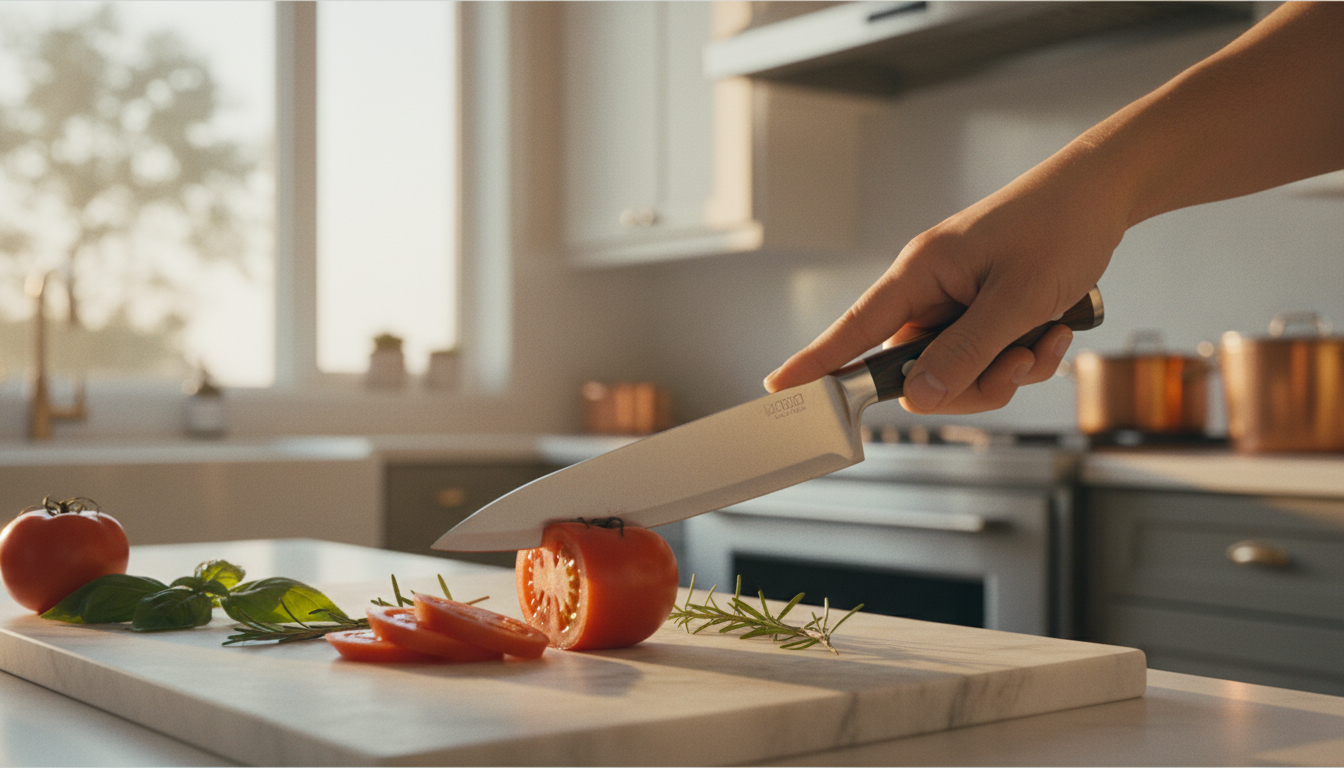
Understanding how a knife feels in your hand--its balance, weight, and grip--predicts whether it'll become your go-to tool or collect dust in a drawer. Misen knives are engineered so the blade and handle work as one system, letting the knife do the work instead of your wrist fighting it with every cut.
Why the First Cut Tells You Everything About a Knife
Your hand reads balance, weight, and grip the moment you pick up a knife, and that first impression predicts how it will perform through an entire prep session.
The moment you grip a Misen knife: what separates quality from the rest
Pick up a knife and your hand reads three things almost instantly: balance, weight, and how the handle sits against your palm [1]. Hold it once, and that first grip already tells you whether the knife will earn a permanent spot in rotation or end up back in the drawer, which is the difference this entire guide is built around. That first-touch impression is not just a feeling, it predicts how the knife will perform once prep gets repetitive, since poor balance forces the wrist and forearm to compensate for every cut [1]. With Misen knives, the blade and handle are designed to meet at a point that aims to keep the edge from pulling forward or lagging behind, helping the knife settle into a pinch grip rather than fighting it [1].
Handle material shapes that first grip too. Synthetic handles resist moisture, hold their shape through repeated washing, and keep a secure hold whether hands are wet or dry, which is part of why professional kitchens lean on them over untreated wood [2]. Fit matters as much as material: a handle sized to your hand and matched to your dominant grip, whether that's a tight pinch near the bolster or a fuller wrap around the handle, cuts down the strain that builds over a long prep session [3]. None of this shows up on a spec sheet.
It shows up the moment you cut your first onion and notice the blade is doing the work instead of your wrist, which is the real test of whether a knife is built for how people actually cook. Hold it once, and the difference is immediate: either the knife disappears into the task, or it keeps reminding you, cut after cut, that something about the balance, grip, or weight is working against you.
Balance, weight distribution, and edge geometry--the three factors that matter on day one
Resting a knife across one finger to find where it stops tipping is the classic balance test, but that static spot only tells part of the story. On most Western-style blades, the balance point sits near the bolster, where blade weight and handle weight roughly offset each other, and a knife counts as blade-heavy or handle-heavy depending on which side carries more mass [4]. Weight distribution matters more than total weight, since a heavier knife with the right balance for your grip can feel lighter in hand than a lighter knife that fights you, because fatigue comes from constantly correcting a blade pulling in the wrong direction, not from lifting mass [4].
Edge geometry adds another layer: a blade with a longer belly and forward curve naturally carries more weight toward the tip, which favors rocking chop motions, while a flatter profile with less curve keeps weight closer to the handle for controlled push cuts [6]. None of this holds up under a static test alone. Once a knife moves through food in a proper pinch grip, the effective fulcrum shifts forward, and a blade that felt handle-heavy sitting still can feel completely different once you're actually cutting, which is why balance in motion matters more than where a knife rests on a fingertip [5].
Misen knives are designed with that moving test in mind, aiming for the blade, handle, and edge geometry to work as one system that tracks evenly through a cut rather than needing frequent correction.

Is Misen a Good Brand of Knives? What the Data Shows
Misen balances hardness, edge retention, and durability so your knife stays sharp through regular use without demanding special care.
Hardness, edge retention, and steel composition: how Misen stainless steel performs against expectations
Hardness alone doesn't predict how well a blade performs, but it sets the ceiling for everything else. The Rockwell C scale measures how much a blade resists denting under load, and kitchen knives generally land in the 58-62 HRC range, which balances edge retention against the toughness needed to avoid chipping during daily prep [8].
Chromium content is what makes a steel stainless, but corrosion resistance and wear resistance pull in different directions: steel needs enough chromium in solution to resist rust, and separately enough hard carbide formers like vanadium or chromium carbide to resist abrasive dulling, so a well-balanced stainless recipe has to manage both without over-committing to either [7]. That trade-off explains why two steels at the same HRC number can behave very differently in a kitchen: carbide type and volume, not hardness alone, drive how long an edge survives slicing through fibrous or acidic foods [7][8].
A softer steel in the 54-58 range sharpens faster but dulls sooner, while anything pushed past 62-63 HRC gains edge life at the cost of flex, raising the odds of a chipped tip on a cutting board edge or a frozen item [8]. Misen knives use stainless steel chosen to aim for that balanced middle ground, with the goal of a blade that holds a working edge through regular use without demanding specialty sharpening equipment or extra-careful handling around hard contact.
Real user feedback: why home cooks and professionals choose Misen knives
Home cooks and professionals who stick with a knife long-term tend to describe the same pattern: confidence from the first cut, with no adjustment period needed before they trust the blade [10]. That immediate sense of control, secure grip, and stable tracking through a cut is what separates a knife someone reaches for daily from one that ends up back in the drawer [10].
Looking across kitchen knife brands broadly, the traits that earn repeat use and loyalty come down to consistent sharpness, sturdy construction, and balance that holds up over years, not just a favorable first impression at the store [9]. Reviewers who track knife brands over time note that durability and the ability to hold an edge without constant resharpening are what actually keep a knife in daily rotation [9].
Those markers, a grip that doesn't require retraining your hand, a blade that cuts predictably, and steel that holds its edge through repeated sessions, line up with what users report when a knife becomes the one they default to without thinking twice [10]. That pattern of feedback across both professional reviews and everyday use points to the same conclusion: trust in a knife builds fast when balance, grip, and edge retention work together instead of fighting the cook [9][10].
Where Misen Knives Are Made and Why Manufacturing Matters
Forging, heat treatment, and tight tolerances work together to create a blade that holds its edge through years of daily kitchen use.
The sourcing and production story behind precision blade manufacturing
Blade manufacturing starts long before a knife reaches a kitchen, and the process a blade goes through shapes everything about how it performs later. Forging, the traditional method of heating a steel billet and shaping it under pressure, aligns the steel's internal grain structure, which produces a blade that resists chipping and holds an edge longer than one simply stamped from a flat sheet [11]. After forging, blades go through heat treatment to set hardness before grinding and polishing bring the edge and profile to spec, a sequence that determines whether a knife ends up brittle, soft, or balanced in between [11].
Precision heat treatment is where that balance gets locked in: hardening and grinding set the blade's final Rockwell hardness, typically in the 58-62 HRC range for stainless kitchen blades, giving the steel enough resilience to shear through repeated use without chipping or dulling prematurely [12]. Tolerances matter just as much as the steel itself. Manufacturing to tight, consistent tolerances keeps edge geometry uniform from the first knife off the line to the last, which is what lets a brand promise the same feel across every unit rather than treating each blade as a one-off [12].
That combination, aligned grain structure from forging, controlled hardness from heat treatment, and tight tolerances through grinding, is what separates a blade designed for daily kitchen use from one that was never built to survive repeated sharpening and contact with a cutting board [11][12].
Quality control checkpoints that ensure every knife feels the same in your hand
Quality control on a production knife line checks the same things your hand checks instinctively: does the handle meet the tang without gaps, does the blade sit true, and does the grip hold steady under real conditions [14]. Final assembly inspection confirms that handle and blade fit together without play, since any looseness at that junction throws off the balance a cook feels the moment they pick up the knife [14]. Beyond fit, checkpoints test the knife the way a hand actually uses it rather than how it looks sitting still, which is why a simple hold test, gripping the knife for an extended stretch without needing to readjust, catches ergonomic problems a visual inspection misses [13]. Weight distribution and secure grip in moist conditions get evaluated specifically because wrist fatigue and slipping are the failures that show up only after repeated use, not on day one [15]. A production run that skips these checks might still ship knives with correct dimensions on paper while feeling inconsistent from unit to unit once a cook actually grips them.
Typical checkpoints before a knife ships include:
- Handle-to-tang fit, checked for gaps or play [14]
- Grip stability test under sustained, extended hold [13]
- Weight distribution check for wrist fatigue risk [15]
- Secure grip verification under moist or wet conditions [15]
These same hand-feel standards are what separates a knife that passes a spec sheet from one that passes the test of actually staying sharp through daily use, since a blade that slips in a sweaty grip or wobbles at the handle won't hold a controlled edge for long regardless of its steel.


Choosing Your First Misen Knife: The Right Blade for Your Kitchen
Start with a chef's knife for everyday chopping, add a paring knife for detail work, then bring in a serrated blade for tomatoes and bread.
Chef's knife vs. paring vs. serrated: matching blade type to your cooking styleA Misen chef's knife handles the bulk of daily prep, since its longer blade and curved belly are built for rock-chopping vegetables and breaking down proteins, while a paring knife's 3 to 4 inch blade takes over wherever precision matters more than reach, including peeling, deveining, or trimming seeds [17]. Serrated edges solve a different problem: the teeth saw through tough, slippery, or crusty surfaces, like tomato skin or citrus rind, without the squishing a straight edge causes once it's not freshly sharpened [18]. That's why a small serrated paring knife earns a permanent spot near the cutting board for anyone who slices citrus, tomatoes, or chilled cookie dough regularly, a task a dull chef's knife handles poorly by comparison [16]. Matching blade type to what you actually cook, more produce versus more bread and citrus, decides which knife gets used daily and which one sits in the drawer. Building a knife skills foundation around these three blade types covers most kitchen tasks before you need anything more specialized.
Matching blade to task:
- Chef's knife: chopping, dicing, rock-cut vegetables and proteins [17]
- Paring knife: peeling, deveining, decorative cuts [17]
- Serrated knife: citrus, tomatoes, bread, chilled dough [16][18]
- Straight edge overall: herbs and produce without bruising [18]
Building your knife collection without overbuying: a practical progression guide
Most home cooks never need a full block set on day one, since a handful of blades covers nearly every task you'll face in a typical week. Start with a chef's knife for the bulk of chopping and dicing, add a paring knife for peeling and detail work, then bring in a serrated bread knife once you're slicing crusty loaves or ripe tomatoes regularly [19]. A beginner knife set built around these three, sometimes with a utility knife for mid-size jobs, gives you enough range to learn proper technique before spending on anything specialized [20]. Resist the pull toward boning knives, cleavers, or fillet blades until a specific recipe or ingredient actually demands one, since those tools sit unused in most home kitchens and add cost without adding daily value [21]. A practical progression looks like this:
- Chef's knife first: handles most chopping, dicing, mincing [19][20]
- Paring knife second: peeling, trimming, small detail cuts [20][21]
- Serrated knife third: bread, tomatoes, citrus [19]
- Utility knife optional: fills the gap between chef's and paring [20]
Buy each blade only once the one before it earns daily use, and let your actual cooking habits, not a set's piece count, decide what comes next.
A knife earns its place by how it feels in your hand and how well it holds up over years of prep, not by the spec sheet alone. That's the whole point of picking one up before you buy: hold it once, and the difference between a knife built for daily use and one that just looks the part becomes obvious immediately, cut after cut. Start with the blades you'll actually reach for, keep them sharp, and let the rest follow as your cooking grows. When your edges need refreshing, our mail-in knife sharpening service brings them back to a working edge, and you can always explore our knife collection to find the blade that fits how you cook. Questions about care or fit? Contact us--we're glad to help.
Frequently Asked Questions
-
How many knives do I actually need to start a Misen collection?
The article recommends a simple progression rather than a full block set: start with a chef's knife for everyday chopping and dicing, add a paring knife for peeling and detail work, then bring in a serrated bread knife once you're regularly slicing crusty loaves or ripe tomatoes. A utility knife can be added later for mid-size jobs if needed.
-
What's the difference between a chef's knife, paring knife, and serrated knife, and which should I buy first?
Per the article, the chef's knife's longer, curved blade handles the bulk of daily prep like rock-chopping vegetables and proteins, the paring knife's 3-4 inch blade takes over for precision tasks like peeling and deveining, and a serrated edge is built for sawing through tough or slippery surfaces like tomato skin, citrus rind, or crusty bread. Which one to buy first depends on what you cook most: more produce points to the chef's knife, while frequent citrus or bread slicing points to adding serrated sooner.
-
How durable are Misen knives, and will the edge hold up without constant resharpening?
The article states Misen stainless steel targets the 58-62 HRC range typical of kitchen knives, which balances edge retention against toughness so the blade resists chipping while still holding a working edge through regular use. It also notes the blades are forged and heat-treated, a process that aligns the steel's grain structure and locks in hardness, rather than simply stamped from a flat sheet.
-
Is a Misen knife set a better value than buying each knife separately?
The article doesn't provide fixed prices for the knife set versus individual knives, so it can't confirm which is cheaper. It does note that a beginner knife set built around a chef's knife, paring knife, and serrated bread knife (sometimes with a utility knife) covers most tasks without overbuying - compare what's actually included in the linked knife set to the cost of buying those same pieces individually before deciding.
- Balance and weight distribution matter more than total weight, since fatigue comes from correcting a blade pulling in the wrong direction, not from lifting mass.
- Stainless steel in the 58-62 HRC hardness range balances edge retention against toughness, avoiding both premature dulling and chipping during daily prep.
- A chef's knife handles most chopping and dicing, a paring knife covers peeling and detail work, and a serrated knife tackles citrus, tomatoes, and bread.
- Forged blades with aligned grain structure, controlled heat treatment, and tight manufacturing tolerances hold an edge longer than stamped blades.
- Quality control checks grip stability under extended hold and moist conditions, catching ergonomic problems that visual inspection misses.
- Start with one knife that earns daily use before adding another, letting your actual cooking habits decide what comes next, not a set's piece count.
- The first grip tells you whether a knife will stay in rotation, since balance in motion during cutting matters more than static balance on a fingertip.
- https://www.chuboknives.com/blogs/news/knife-balance-weight-ergonomics
- https://3claveles.com/en/blog/knives/what-is-the-best-handle-for-your-kitchen-knife
- https://nuluknives.com/blogs/news/what-makes-an-ergonomic-knife-a-biomechanical-breakdown
- https://www.mattiaborrani.com/blogs/news/chef-knife-balance-weight-explained
- https://elementknife.com/blogs/pro-tips-knife-buying/knife-balance-explained-what-really-makes-a-kitchen-knife-feel-right
- https://thecookingguild.com/blogs/news/what-makes-a-great-chef-knife-steel-balance-and-geometry-explained
- https://knifesteelnerds.com/2021/10/19/knife-steels-rated-by-a-metallurgist-toughness-edge-retention-and-corrosion-resistance/
- https://blog.knife-depot.com/knife-steel-hardness-rockwell-scale-explained-simply/
- https://www.bostonbrandmedia.com/news/the-definitive-guide-to-the-best-kitchen-knife-brands
- https://theavidoutdoorsman.com/knives-that-become-favorites-the-moment-you-use-them/
- https://www.gdyjjinhui.com/top-10-forged-knife-manufacturer-in-usa.html
- https://jstmt.com/industrial-knives-and-blades-manufacturers/
- https://eknives.com/blog/how-to-spot-quality-knives-in-a-trendobsessed-market/
- https://eknives.com/blog/breaking-down-process-elaborating-blades/
- https://www.klausmeyerknife.com/blogs/all-posts/what-quality-standards-actually-tell-you-as-a-buyer
- https://www.epicurious.com/expert-advice/why-i-love-my-serrated-paring-knife-article
- https://seidoknives.com/blogs/news/utility-knife-vs-paring-knife
- https://www.opinel-usa.com/blogs/news/serrated-vs-straight-edge-knives-when-each-wins
- https://knifesets.com/best-knife-sets-top-chef-choices/
- https://kyokuknives.com/blogs/kyoku-chef-blog/how-to-buy-your-first-beginner-chef-s-knife-complete-guide
- https://www.insight-kitchenknife.com/how-to-select-the-ideal-kitchen-knife-set.html