

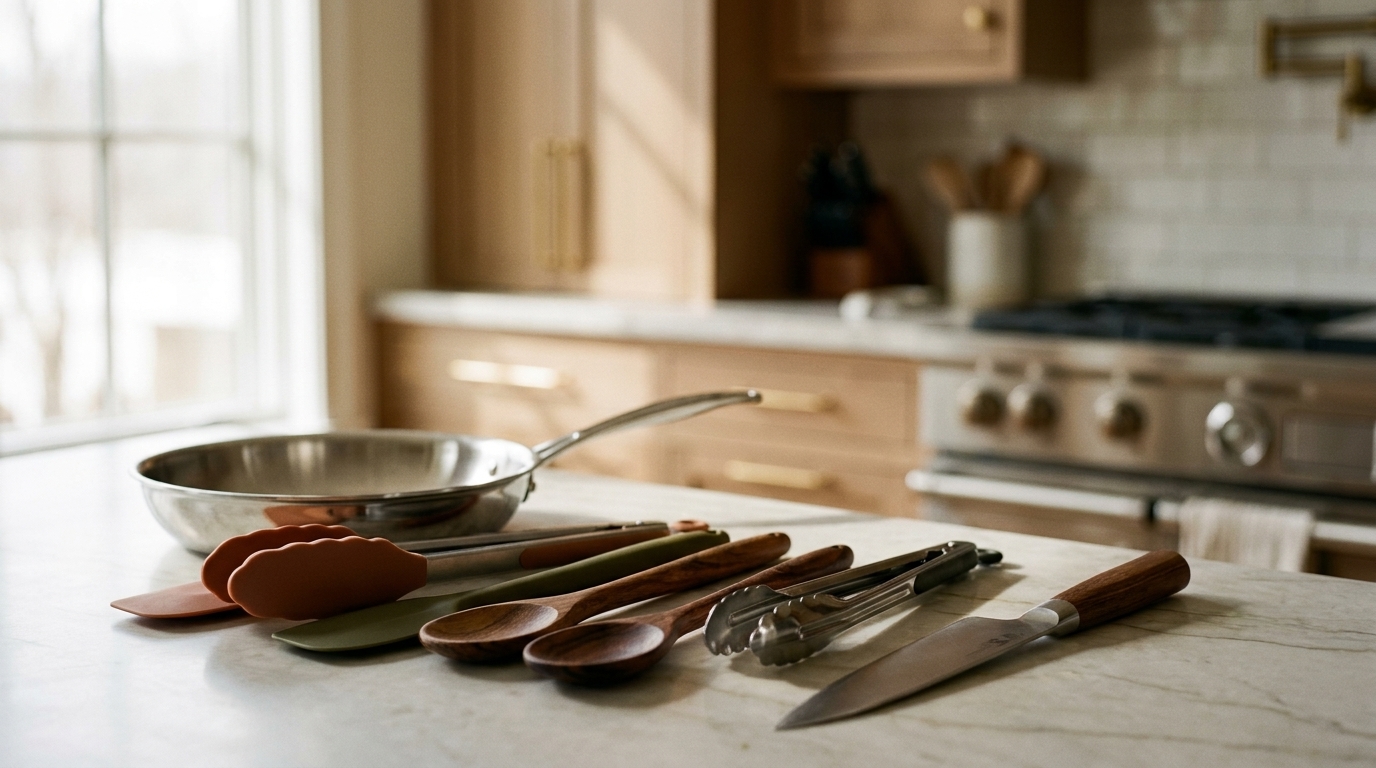
Choose the right utensil materials--silicone, wood, or stainless steel--to protect your cookware and avoid health risks from melting plastic. Starting with a quality skillet, pot, and chef's knife gives you a functional first kitchen for under $200.
The 5 Core Cooking Utensils Every First Apartment Kitchen Needs
Silicone spatulas and wooden spoons handle high heat without melting or leaching chemicals, making them the practical foundation for apartment cooking.
Spatulas and turners: Why silicone and wood outperform plastic for nonstick cookware
Plastic spatulas often blend cheap polymers that soften or leach chemicals once they sit against a hot nonstick pan, which is exactly the scenario apartment cooks hit most often--eggs, pancakes, quick sautés [1]. Silicone solves that problem directly: food-grade versions tolerate roughly 450 degrees-600 degreesF depending on the brand, so they won't melt against a hot skillet or release compounds into your food [1]. Silicone is also nonreactive, meaning it won't interact with acidic sauces the way some metals do, and it's fully dishwasher-safe and nonporous, so it resists bacteria buildup better than a scored plastic edge [1]. Nylon, a common budget alternative to plastic, tops out around 400 degreesF before it starts to soften or warp, and pushing past that limit risks releasing chemicals into whatever you're cooking [2]. Wood offers a different advantage: it's gentle on cookware, doesn't conduct heat into the handle, and has a tactile quality silicone can't match, though it needs hand-washing and occasional oiling to avoid cracking [1][3]. For a first apartment kitchen built around nonstick or enameled pans, the practical takeaway is straightforward:
- Silicone resists heat up to 600 degreesF without melting [1]
- Nylon softens near 400 degreesF, limiting high-heat use [2]
- Wood protects pans but needs more upkeep [3]
- Plastic is the least heat-stable, most scratch-prone option [1]
Either silicone or wood beats plastic for everyday cooking on nonstick surfaces, and keeping one of each covers nearly every stovetop task.
Tongs, spoons, and ladles: The three-piece foundation for everyday cooking
Tongs, a slotted spoon, and a ladle round out the utensils apartment cooks reach for most, and each one solves a problem a spatula can't. Tongs give one-handed control for flipping, plating, and tossing, and the sweet spot for an all-purpose pair sits around 11 to 12 inches, long enough to keep hands clear of heat but short enough for precise plating work [5]. Silicone-tipped tongs with a stainless steel core hold up to roughly 600 degreesF without melting, and the silicone tips protect nonstick surfaces that plain metal tongs will scratch [5]. A locking mechanism keeps tongs compact in a drawer and lets you grab them one-handed mid-cook, which matters more in a small apartment kitchen where drawer space is tight [5]. A slotted spoon does what tongs can't: it lifts food from a pan or pot while draining liquid or fat behind it, and a silicone-coated version won't scratch nonstick cookware the way a metal one can [4]. A ladle covers the third gap, serving soups, stews, and sauces from a deep pot, and stainless steel construction paired with a silicone-wrapped handle resists heat well enough to rest against the pot without melting [4]. Together, these three tools cover nearly every liquid- or heat-heavy task a spatula and turner set leaves uncovered:
- Tongs: flipping, tossing, and plating with heat-safe control [5]
- Slotted spoon: lifting food while draining liquid or fat [4]
- Ladle: serving soups, stews, and sauces from deep pots [4]

10 Kitchen Utensils That Transform Apartment Cooking From Basic to Confident
Three sharp knives and proper hand technique--the chef's grip and claw guard--prevent slips and build confidence in a small kitchen.
Cutting boards, knives, and prep tools: Building your knife skills in a compact kitchen
Three knives cover nearly every task in a small kitchen: a chef's knife for chopping and dicing, a utility knife for small or soft ingredients, and a serrated knife for bread and firm-skinned produce like squash or citrus [6]. An 8-inch chef's knife with a plastic handle is a practical starting size, and you can work up to a 10-inch blade as your skills grow [6]. Utility knives run 3 to 4 inches, making them easier to control for shallots, mushrooms, or peaches, and since they're hard to sharpen at home, replacing a cheap one when it dulls is normal [6]. For cutting boards, wood is gentlest on blade edges, thick plastic is the next best option, and glass should be avoided since it dulls knives fast [6]. A kitchen towel underneath the board keeps it from sliding on the counter, which matters on tighter apartment counters [6].
Good technique matters as much as good tools. The chef's grip chokes up on the handle with thumb and index finger pinching the blade, giving more control than wrapping the whole hand around it [6]. The other hand should curl into a "claw," knuckles down and fingertips tucked under, to guide food while keeping fingers clear of the blade [6][7]. This pairing, a sharp blade plus a stable guiding hand, is what actually prevents slips and cuts, not just careful movement alone [6]. For storage, a block, magnetic strip, or a drawer with blades kept separated protects the edge from nicks that dull it faster [6].
Measuring cups, mixing bowls, and prep containers: Organization tools that save space and time
Measuring cups and mixing bowls take up more drawer and cabinet space than almost any other prep tool, which makes their footprint worth planning around before buying. Collapsible measuring cups and spoons fold nearly flat when not in use and still measure accurately, freeing up a fraction of the drawer space rigid sets require [8]. For mixing bowls, a nesting set in the 1.5-to-5-quart range covers most everyday tasks, and shallower bowls with thin, flared rims pour more cleanly and stack more compactly than deep, straight-walled designs [9]. Stainless steel nesting sets are lighter and easier to store than glass or ceramic, though glass and ceramic versions can go in the microwave, a tradeoff worth weighing against available shelf space [9]. Measuring cups and spoons also nest directly inside mixing bowls, turning two separate categories of tools into a single storage unit [10]. A few habits keep this system from sprawling back out:
- Choose nesting sets over standalone pieces when possible [9]
- Buy only the bowl capacity you'll use weekly [10]
- Store lids separately if they don't stack cleanly [9]
Keeping these categories consolidated, rather than scattered across multiple drawers, is one of the simplest ways to reclaim counter and cabinet space in a small kitchen [10].
Materials Matter: Choosing Between Silicone, Stainless Steel, and Wood Utensils
Silicone won't scratch nonstick coatings, handles multiple tasks, and works for both stovetop and oven cooking without needing separate tools.
Silicone utensils for nonstick cookware: Heat tolerance, safety, and why they're ideal for first apartments
Silicone earns its place in a first apartment kitchen because it holds up to sustained stovetop heat without warping, a trait tied directly to its use for stirring sauces, folding batter, and scraping nonstick bowls without scratching the coating [12]. That stability matters because nonstick cookware itself can release irritating or poisonous fumes if overheated, so pairing it with a utensil that won't break down under the same conditions keeps cooking safer [11]. Silicone is a synthetic rubber built from bonded silicon, an element drawn from sand and rock, plus oxygen, which is part of why food-grade versions are rated for both bakeware and stovetop use rather than one or the other [11]. For someone furnishing a first kitchen on a budget, that dual rating means a single material covers most daily tasks instead of requiring separate tools for oven and stove work [12].
- Won't scratch or wear down nonstick coatings over time [12]
- Handles stirring, folding, and scraping in one tool [12]
- Rated for both bakeware and stovetop use [11]
- Made from bonded silicon and oxygen, not petroleum plastic [11]
Stainless steel and wood: Durability comparison and which works best with different cookware types
Stainless steel utensils resist bending, warping, and corrosion even under heavy daily use, and they go straight into the dishwasher without losing their finish [15]. That toughness makes them the right pick for uncoated cookware like a stainless steel skillet, cast iron, and bare aluminum, where a metal spoon or spatula can handle heavy stirring or lifting thick cuts of meat without wearing out [15]. The tradeoff shows up on coated surfaces: steel utensils scratch nonstick and enameled finishes, and they can cut through the seasoned patina on a well-used carbon steel pan or cast iron pan if used aggressively [14]. Wood avoids that problem entirely. It won't mark stainless steel cookware, holds up to real heat, and weighs little enough to feel comfortable during long stretches of cooking [14]. Its porous surface, though, absorbs acidic sauces and stains over time, so it needs hand washing and periodic oiling rather than a trip through the dishwasher [13][14]. In practical terms:
- Stainless steel: best for uncoated pans, heavy lifting, dishwasher-safe [15]
- Wood: best for nonstick, carbon steel, and cast iron with patina [14]
- Wood needs oiling and hand washing; steel doesn't [13][14]
Matching the utensil to the cookware, rather than picking one material for everything, protects both the pan's surface and the tool's lifespan.


Building Your First Apartment Kitchen: Utensil Essentials and Budget Guide
Reinforced silicone utensils rated to 550 degreesF outperform cheaper alternatives, scraping bowls clean and resisting warping through repeated use.
Priority-ranked Essentials: What to buy first, second, and third on a limited budget
Prioritizing purchases by what you'll use daily, rather than buying everything at once, keeps costs manageable in a first apartment kitchen. A skillet, a pot, and a sheet pan handle most cooking tasks, and paired with a chef's knife and paring knife, these five items cover the bulk of what you'll cook, typically running $100-150 for cookware and $55-90 for knives [16]. Buying individual utensils rather than a mismatched drawer set also tends to result in pieces that better fit how you actually cook [17]. Next, round out a seven-piece utensil set, spatula, tongs, slotted spoon, ladle, wooden spoon, whisk, and can opener, usually $40-60 total, since these handle nearly every stovetop task without resorting to single-use gadgets [16]. Third on the list: measuring cups and spoons ($30-50) and prep and storage pieces like nesting mixing bowls ($50-80), which matter most once you're baking regularly or meal-prepping ahead [16].
- First: skillet, pot, sheet pan, chef's knife, paring knife [16]
- Second: spatula, tongs, slotted spoon, ladle, wooden spoon, whisk [16]
- Third: measuring cups/spoons, nesting mixing bowls, storage containers [16]
Following this order keeps a functional kitchen under roughly $400 while skipping tools most people rarely touch [16].
Where quality matters most: Investing in utensils that work with quality cookware like Misen
Pairing new cookware with worn-out or bargain-bin utensils undercuts the investment before the pan even heats up. Testing across multiple nonstick turners found that reinforced silicone construction, with a head tapered to a thin edge, held up to repeated flips of eggs and burgers without warping, while thinner or all-nylon models frayed at the edges or pushed food around the pan instead of sliding under it [18]. The same pattern showed up in full utensil sets: pharmaceutical-grade silicone rated heat-proof to 550 degreesF scraped bowls clean and survived a flipper test without breakage, while sets built with nylon pieces "didn't seem as durable" after repeated use [20]. Since sharp or rigid edges scratch nonstick coatings permanently, sticking to nonstick-safe materials, silicone, wood, or well-made nylon, protects a new pan's surface from the first use [19]. For an apartment kitchen built around a quality nonstick pan like Misen's, that means:
- Choose reinforced silicone with a sturdy core, not thin single-layer pieces [18]
- Skip low-grade nylon that frays and softens near 400 degreesF [18][19]
- Look for dishwasher-safe construction that survives repeated washes [20]
Buying fewer, better-made tools upfront costs more at checkout but avoids replacing frayed or warped pieces every season, which keeps both the utensils and the cookware they touch in working shape longer [18][20].
Start with the essentials, match your tools to your pans, and add pieces as your cooking grows. A well-chosen set of utensils paired with durable cookware is what turns a bare apartment kitchen into one you actually want to cook in. For more care & maintenance tips on keeping your tools and pans in working shape, explore our collection at Misen, and contact us anytime with questions.
Frequently Asked Questions
-
What's the best utensil material to use with nonstick cookware?
Silicone and wood are the better choices for nonstick pans. Food-grade silicone tolerates roughly 450–600°F without melting and won't scratch nonstick coatings, while wood is gentle on pans but needs hand-washing and occasional oiling. Plastic is the least heat-stable and most scratch-prone option, and nylon starts softening near 400°F.
-
How much should I expect to spend outfitting a first apartment kitchen with utensils?
The article breaks costs into priority tiers: a skillet, pot, sheet pan, chef's knife, and paring knife run about $100-150 for cookware and $55-90 for knives. A seven-piece utensil set (spatula, tongs, slotted spoon, ladle, wooden spoon, whisk, can opener) typically runs $40-60, and measuring cups/spoons plus nesting mixing bowls add $30-50 and $50-80. Following this order keeps a functional kitchen under roughly $400 — check the actual prices on the specific products you're buying, since totals vary by brand.
-
How many utensils do I actually need to start cooking in a new apartment?
The article recommends buying in three stages rather than all at once. First: a skillet, pot, sheet pan, chef's knife, and paring knife (5 items). Second: a seven-piece utensil set covering spatula, tongs, slotted spoon, ladle, wooden spoon, whisk, and can opener. Third: measuring cups/spoons and nesting mixing bowls, once you're baking or meal-prepping regularly.
-
Are silicone cooking utensils dishwasher-safe and durable enough to reuse long-term?
Yes — the article notes silicone is nonporous and fully dishwasher-safe, which also helps it resist bacteria buildup better than scored plastic. In testing, pharmaceutical-grade silicone rated heat-proof to 550°F scraped bowls clean and survived a flipper test without breakage, while nylon pieces in the same sets held up less well over repeated use.
-
Is it safe to use silicone or wood utensils with nonstick pans, and does that affect food safety?
The article ties utensil material directly to nonstick safety: nonstick cookware can release irritating or poisonous fumes if overheated, so pairing it with a utensil that also won't break down under heat matters. Silicone is nonreactive and rated for both bakeware and stovetop use up to roughly 600°F, while wood won't scratch the coating but needs hand-washing and periodic oiling rather than dishwasher use.
- Food-grade silicone withstands 400-600 degreesF without leaching chemicals or melting into food.
- Wooden spoons stay cool during cooking and won't scratch or react with acidic sauces.
- A sharp chef's knife handles roughly 90% of cutting tasks in any kitchen.
- Start with one skillet, a pot with lid, and a chef's knife for a functional $200 kitchen.
- Utensil material directly protects cookware--silicone or wood pairs with quality nonstick pans.
- Stainless steel utensils scratch nonstick coatings; avoid them on coated surfaces entirely.
- Quality tools bought once cost less long-term than cheap equipment replaced every six months.
- https://www.bonappetit.com/story/best-non-toxic-utensils
- https://thedoublewave.com/blogs/blog-articles/nylon-vs-silicone-cooking-utensils
- https://www.anzhucraft.com/wood-vs-silicone-utensils/
- https://www.mealime.com/kitchen-essentials-list
- https://www.dioro.com/blogs/news/versatile-kitchen-tongs-for-cooking
- https://cooking.nytimes.com/article/basic-knife-skills
- https://www.knorr.com/uk/tips-and-tricks/knife-skills.html
- https://www.foodandwine.com/small-apartment-mini-collapsible-kitchen-tools-11997432
- https://www.seriouseats.com/equipment-the-best-mixing-bowls-how-to-buy
- https://www.nytimes.com/wirecutter/reviews/small-kitchen-ideas/
- https://www.canada.ca/en/health-canada/services/household-products/safe-use-cookware.html
- https://www.bcknife.com/blogs/news/heat-resistant-kitchen-tools-what-temperature-rati/
- https://americankitchen.com/blogs/table-talk/utensils-and-stainless-steel-guide-to-selecting-the-best-cooking-utensils-for-stainless-steel-pots-and-pans
- https://www.debuyer-usa.com/blogs/guides/craft-culinary-excellence-the-best-utensils-for-stainless-steel
- https://www.lotechsales.com/silicone-vs-stainless-steel-which-cooking-utensils-are-best-for-your-kitchen/
- https://smallaptkitchen.com/first-apartment-kitchen-checklist/
- https://nymag.com/strategist/article/how-to-build-a-starter-kitchen.html
- https://www.seriouseats.com/best-nonstick-silicone-spatulas-turners-flippers
- https://americankitchen.com/blogs/table-talk/which-utensils-should-you-use-with-nonstick-cookware
- https://www.foodnetwork.com/how-to/packages/shopping/product-reviews/best-kitchen-utensil-sets
- Summary
- The 5 Core Cooking Utensils Every First Apartment Kitchen Needs
- 10 Kitchen Utensils That Transform Apartment Cooking From Basic to Confident
- Materials Matter: Choosing Between Silicone, Stainless Steel, and Wood Utensils
- Building Your First Apartment Kitchen: Utensil Essentials and Budget Guide
- Key Takeaways
- References