

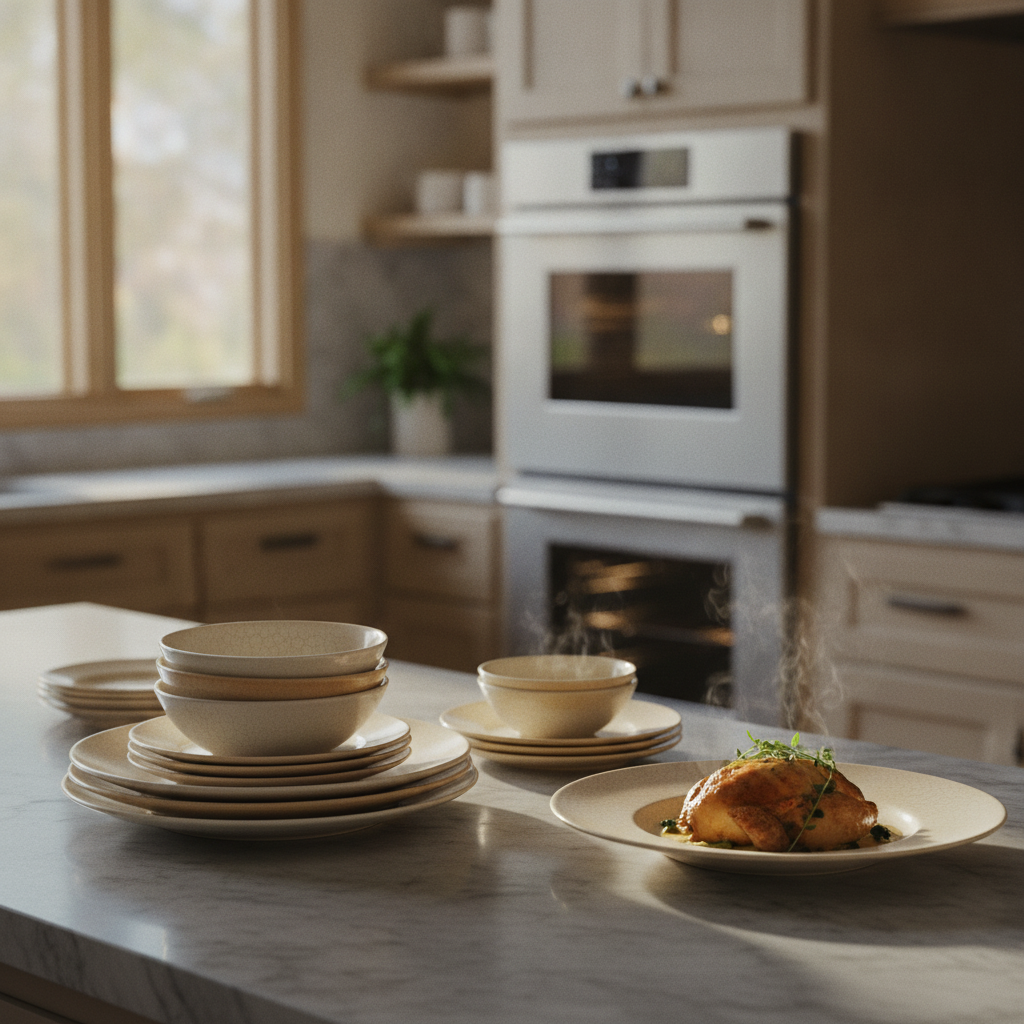
Learn how to identify oven-safe dinnerware by understanding temperature ratings and reading manufacturer labels so you can confidently cook from stovetop to table. Knowing the right heat limits and care habits for ceramic, stoneware, and porcelain protects both your dishes and your food.
What Makes Dinnerware Oven-Safe: Materials and Temperature Ratings
Most consumer dinnerware maxes out at 450-500 degreesF, so always check the manufacturer's label before using dishes for high-heat cooking or broiling.
How to identify oven-safe dinnerware by material type (ceramic, stoneware, porcelain, and bone china)
Understanding temperature ratings: Why 350 degreesF, 500 degreesF, and 600 degreesF matter for your table-to-oven workflow Temperature ratings matter because they define the ceiling for safe use, not a guideline you can push past for a few extra minutes of browning. Standard oven-safe dinnerware is typically rated for prolonged exposure between 350 degreesF and 500 degreesF, and manufacturers generally will not certify a piece beyond that range without specific testing [4]. Porcelain sits toward the higher end of that consumer range, with quality porcelain commonly withstanding 500 to 572 degreesF, compared to tempered glass, which tops out around 470 degreesF [5].
Commercial-grade vitrified ceramic, fired above 2,300 degreesF during manufacturing, is a different category altogether. Some vitrified pieces carry a 500 degreesF oven rating and salamander broiler safety for direct high-heat exposure in professional kitchens, but that broiler-safe designation is specific to that product line and firing process, not a general property of ceramic dinnerware [6]. This matters for a table-to-oven workflow because broiler and high-heat searing temperatures, often in the 550 to 600 degreesF range, exceed what most consumer stoneware, porcelain, or bone china pieces are rated to handle unless the label explicitly says broiler-safe [4] [6].
Treat 350 degreesF as the safe baseline for reheating and light baking, 450 to 500 degreesF as the working range for most oven-safe stoneware and porcelain, and anything approaching 600 degreesF as reserved for cookware and dinnerware explicitly marked for direct flame or broiler use. Checking the manufacturer's stated maximum before every high-heat use protects both the dish and the food inside it.

How to Know If Your Plates Are Oven-Safe: Reading Labels and Manufacturer Guidelines
When labels wear off or are missing, use the tap and water tests to safely check if a plate can handle the oven before use.
Decoding oven-safe symbols and markings on the bottom of dinnerware
What to do when manufacturer information is missing or unclear: Safe testing methods and Misen's customer support resources When a piece has no stamped rating or the markings have worn off, skip the guesswork and rely on two low-risk checks before committing a piece to the oven. The tap test gauges density: a clear, high-pitched ring suggests a dense, vitrified body that handles heat more evenly, while a dull thud points to a more porous, chip-prone piece better suited to cold storage than baking [11]. The water test helps flag microwave and heat concerns on unlabeled pieces, since a dish that heats up faster than the water inside it likely absorbs more moisture and holds heat unevenly, a trait that also raises oven-safety questions [11].
Even after testing, skip the oven entirely for thin glass mixing bowls, decorative ceramics never built for baking, and anything showing crazing, those fine surface cracks in the glaze that signal the glaze and clay body are expanding at different rates and heading toward failure [10] [11]. Gradual cooling matters just as much as the initial test, since moving a hot dish straight onto a cold counter or into cold water can cause thermal shock even in oven-rated pieces [11]. If the origin or safety markings on a plate are genuinely unclear, contact Misen's customer support team directly.
Manufacturers remain the most reliable source for confirming a specific item's rated temperature range and intended use, and that one extra step protects both the dish and whatever you're cooking in it.
Best Oven-Safe Dinnerware Sets for Cooking-to-Table Entertaining
Stoneware retains heat longest after leaving the oven, while porcelain tolerates the widest temperature range among the three materials.
| Material | Typical max oven temp | Durability notes | Maintenance |
|---|---|---|---|
| Ceramic (general) | Up to 500 degreesF [15] | Even heat distribution but moderate chip risk; can craze if quality is inconsistent [16] | Hand wash with a soft sponge; avoid moving cold pieces into a hot oven [16] |
| Stoneware | 450 degreesF, with some high-fire lines rated to 500 or 575 degreesF [15] [16] | Dense body resists chipping and cracking better than standard ceramic [15] | Dishwasher-safe on most pieces; occasional hand washing preserves glaze longer [16] |
| Porcelain | 500 degreesF to 572 degreesF [15] | Non-porous and lightweight, with strong chip resistance when properly fired [15] | Dishwasher and microwave safe on plain pieces; skip the microwave if there's metallic trim [15] |


Pairing Oven-Safe Dinnerware with Misen Cookware for Seamless Meal Prep
Match your dinnerware's heat rating to your finishing step, not your pan's rating, to safely sear and finish dishes in the oven.
Finishing dishes in the oven: Why oven-safe dinnerware works with Misen's stainless steel and nonstick cookware
Cooking-to-table meals follow the same stove-to-oven logic already built into cookware guidelines, and that logic carries straight over to your dinnerware. Professional-grade clad stainless steel cookware, like Misen's stainless steel pan, can be rated oven-safe up to 800 degreesF, giving you a wide margin for searing on the stovetop before finishing a dish in the oven [17].
Nonstick pans need more caution, since coatings degrade past their rated ceiling, typically 350 degreesF to 500 degreesF depending on whether the coating is ceramic or Teflon-style, and ceramic nonstick generally tolerates oven heat better than Teflon [17] [18]. That gap between pan and coating limits is the same gap to check when plating a seared protein onto oven-safe dinnerware to finish browning or melt cheese under the broiler: the dish's rated maximum, not the pan's, sets the ceiling for that final step [17].
Quick pairing notes for a stove-to-oven workflow:
- Stainless steel pans: often rated oven-safe well above 500 degreesF [17]
- Nonstick pans: generally capped at 350 degreesF to 500 degreesF, never broiler [17] [18]
- Ceramic nonstick coatings hold up to oven heat better than Teflon [18]
- Always match the plate's own rated max to the finishing step, not the pan's
Care and maintenance tips to keep your oven-safe dinnerware performing for years
Long-term durability comes down to a few consistent habits rather than special treatment for oven-safe dinnerware. Starting a piece in a cold oven and letting it warm up along with the appliance, rather than placing it into a fully preheated oven, protects against the stress that leads to cracking over repeated use [19]. Letting a hot dish cool gradually before washing, and avoiding contact with wet or cold surfaces right after baking, prevents the rapid swings that cause thermal shock damage over time [20]. Stains from tea, coffee, or pigmented sauces usually lift with a baking soda paste and a soft sponge instead of abrasive scrubbing that dulls the glaze [21]. Dishwashers clean stoneware and porcelain effectively, but repeated exposure to high heat, water pressure, and harsh detergent can gradually dull glaze or cause chips, so occasional hand washing with a gentler cleaner extends the finish's life [21].
Quick habits that add years to a piece:
- Start cold, heat gradually with the oven [19]
- Let dishes cool before washing or stacking [20]
- Use baking soda paste on stubborn stains [21]
- Hand wash occasionally to protect glaze [21]
- Slip a soft liner between stacked plates [21]
- Skip the oven for pieces with metallic rims [20]
Oven-safe dinnerware works best when it's paired with cookware built for the same stove-to-oven workflow, so matching your plates to a durable pan lineup keeps every step of a cooking-to-table meal steady. Explore Misen's carbon steel pan for high-heat searing and the roasting pan for larger oven-to-table dishes to round out your setup. And if you're ever unsure about a piece's oven rating or the right care & maintenance for it, contact us and we'll help you sort it out.
Frequently Asked Questions
-
How can I tell if my plates are oven-safe if there's no stamped label?
Try the tap test: a clear, high-pitched ring suggests a dense body suited to baking, while a dull thud points to a more porous piece better kept for cold storage. The water test can also flag heat-retention issues, and any crazing (fine surface cracks in the glaze) means the piece should stay out of the oven regardless of test results. If markings are unclear, the article recommends contacting Misen's customer support for confirmation.
-
What's the maximum oven temperature for stoneware, porcelain, and general ceramic dinnerware?
Per the article's comparison table, general ceramic tops out around 500°F, standard stoneware is rated to about 450°F (with some high-fire lines reaching 500–575°F), and porcelain ranges from 500°F to 572°F. Treat 350°F as a safe baseline for reheating, and always check the manufacturer's stated maximum before higher-heat use.
-
Can I put oven-safe dinnerware under the broiler to melt cheese or brown a dish?
Not unless the piece is explicitly labeled broiler-safe. The article notes that broiler and searing temperatures often reach 550–600°F, which exceeds what most consumer stoneware, porcelain, or ceramic is rated for - broiler safety depends on the specific product's firing process, not the material category in general.
-
Is oven-safe dinnerware dishwasher-safe, and how do I keep it lasting?
According to the article's table, stoneware and porcelain are generally dishwasher-safe, though occasional hand washing helps preserve the glaze longer. Other care habits mentioned include starting pieces in a cold oven rather than a preheated one, letting dishes cool gradually before washing, using a baking soda paste on stains instead of abrasive scrubbing, and slipping a soft liner between stacked plates.
-
How do oven-safe dinnerware temperature limits compare to Misen cookware like the stainless steel pan?
Misen's stainless steel pan can be oven-safe up to 800°F, well above what most dinnerware can handle, so the article stresses matching the plate's own rated maximum - not the pan's - when finishing a dish in the oven. Nonstick pans are capped lower, typically 350°F to 500°F, and should never go under the broiler.
- Standard oven-safe dinnerware is rated between 350 degreesF and 500 degreesF, with porcelain reaching up to 572 degreesF depending on firing quality.
- Temperature ratings are ceilings, not guidelines. Broiler use at 550-600 degreesF requires explicit broiler-safe labeling on the piece.
- Use the tap test and water test on unlabeled pieces, but skip the oven for thin glass, decorative ceramics, or dishes showing crazing.
- Stoneware retains heat better after baking due to its dense clay body, while porcelain tolerates a wider heat range than general ceramic.
- Start dishes in a cold oven and let them cool gradually after baking to prevent thermal shock and cracking over repeated use.
- Match your dinnerware's rated maximum to the finishing step, not your cookware's rating, since the plate sets the actual ceiling.
- Hand washing occasionally and using baking soda paste for stains protects the glaze longer than repeated dishwasher cycles.
- https://malacasa.com/blogs/journal/ceramic-tableware-temperature-stability-11
- https://www.lomatohouseware.com/news/comprehensive-guide-ceramic-tableware-materials
- https://www.kedali.com/common-types-of-ceramic-tableware-explained/
- https://www.vancassotableware.com/blogs/care-use-safety/oven-safe-dinnerware-safety-guide
- https://malacasa.com/blogs/buying-guides/how-to-safely-use-and-cook-with-porcelain-plates
- https://hfcoors.com/pages/commercial-hub
- https://www.vancassotableware.com/blogs/news/how-to-select-high-quality-dinnerware
- https://m.joybuy.co.uk/blog/ceramic-kitchenware-uk-guide/Y55YXCxD
- https://malacasa.com/blogs/buying-guides/choose-best-porcelain-dinnerware-buying-guide
- https://www.yahoo.com/lifestyle/articles/stop-putting-6-kitchen-items-163000970.html
- https://world.taobao.com/lang/en-us/shopping-guide/2041142028825264128.htm
- https://www.joybuy.de/blog/dinnerware-set-buying-guide/oCRQERUL
- https://www.joybuy.de/blog/dinnerware-set-buying-guide/3U0WGt5V
- https://www.happylifetableware.com/Comparing-Ceramic-Bowls-Pricing-Specifications-And-Best-Uses-id08187145.html
- https://giraffyco.com/blogs/news/selecting-oven-safe-serving-platters-for-seamless-kitchen-to-table-meals
- https://mykitchenhints.com/best-ceramic-baking-dishes-for-casseroles/
- https://circulon.com/blogs/blog/how-to-know-if-pan-is-oven-safe
- https://www.foodnetwork.com/how-to/packages/help-around-the-kitchen/can-you-put-nonstick-pans-in-the-oven
- https://www.google.com/goto?url=CAES2gEB6zswFUjlUD4aKh5Yw0NY-xab9SZVww7tl7GFVkeMr7L4_BBd7tpsfXxUQRM67GWGwkGRcDT0sOIywRriYIU_CNxuPIt7HeEwqCWYBu9wtFV74YVnYV1XI8QBpWbdgqQafrGf0lcXwgId-sB_49efSxyXHXFbRndwipXvwTJ_2mDVoJzZviCky0XvANO9u5PJ6gpbbvFg4fRjgIITkhQQbLD6W_QY-Xtebo4RWIiJWmYmle7CZeIxmy9u55wskngEvqMwtEMx6u7ZFxc5banspRAcd_Qe6AC73g
- https://www.google.com/goto?url=CAES1gEB6zswFSYxTdKy_nnm5pbLUXNkrbrO1Q6ttQpvAuXBMF3DZ76fpJPC7HuL2e_a2htFhyPQgX3qjMNfbZ-Hhneq5kw70UlTI8BHeyd4zkltgjheOBKgKOLJONRQpkr_6XJoIgRgThEZb-kXWLAUhcyRwUZYyDOuaRSbDYcb6J3W4MqQs5oZL9wDvQgllVrzipM_Xc_fEhQPJ14YNezOLsQOKLLU1PvCYptZf5Rft-gv5-uoiPyjuw3lzNdDgw1ieN3hikEnKtZyjCU_2NFjEofWX_HaRat7
- https://www.google.com/goto?url=CAESpQEB6zswFUJ3WWRTcgazyjooEEbTNzhfmUKKAhUAU2yalCoBBqwiUpScdp7bNF6kAm7EBCgCaPUT8Zcu9GOYugADr4Xm5dYtJfggt6G1IK5DNVcFSVFgc8HyTPx0gAx9yINnuYngdgUH6QcJOTqLAXJLdkIzWBtSUcZJJ_5hhQgBJhTeBgvRsJIsMtmkQ7WPEGoVDCNv6EFyLMj9eaRxSzZxqTHbbNs
- Summary
- What Makes Dinnerware Oven-Safe: Materials and Temperature Ratings
- How to Know If Your Plates Are Oven-Safe: Reading Labels and Manufacturer Guidelines
- Best Oven-Safe Dinnerware Sets for Cooking-to-Table Entertaining
- Pairing Oven-Safe Dinnerware with Misen Cookware for Seamless Meal Prep
- Key Takeaways
- References