

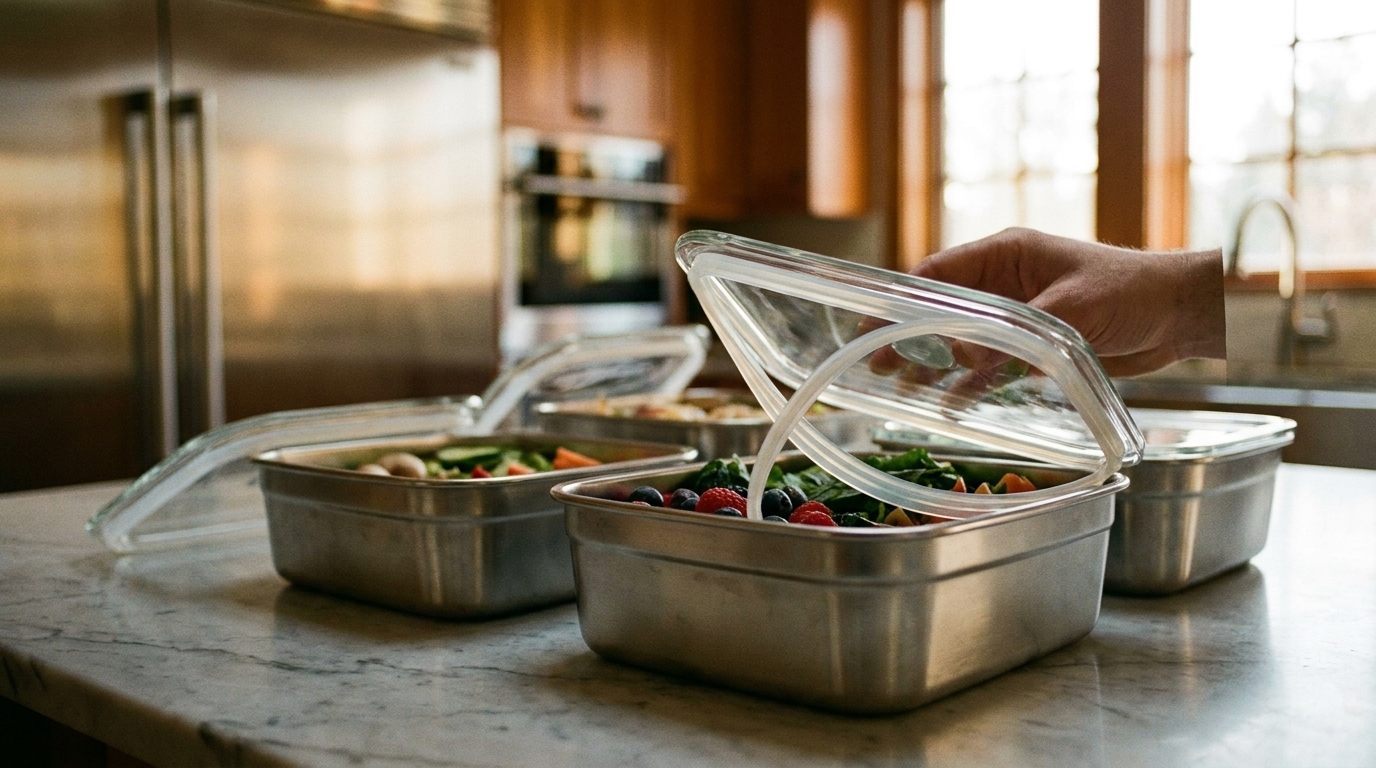
Learn how gasket material, thickness, and design determine whether your stainless steel container lid actually seals or just sits in place. Food-grade silicone gaskets last 10-20 years and handle extreme temperatures, but proper maintenance and monthly inspection checks keep them working reliably.
Why Gaskets and Seals Matter: The Science Behind an Airtight Seal
Food-grade silicone gaskets handle extreme temperature swings and resist degradation far better than rubber, so your seal stays airtight for years.
How gaskets create an airtight seal on stainless steel container lids
A gasket is the silicone or rubber ring seated inside a lid that creates an airtight seal on stainless steel container lids when it's compressed against the container's rim.
Closing and locking the lid forces the gasket to fill every micro-gap between the two surfaces -- a hermetic seal that blocks gas and moisture from passing through. [1] The gasket material has to be soft enough to conform to minor surface irregularities while firm enough to hold its position under pressure. [2] Without a locking mechanism maintaining that compression, the gasket sits loose and the seal never fully activates -- a lid resting in place without engaging a lock is a cover, not a seal. [3]
Common gasket materials and why silicone outperforms rubber for food storage
Gaskets in stainless steel food storage containers with lids are typically made from natural rubber, EPDM (ethylene propylene diene monomer), nitrile rubber (NBR), or food-grade silicone -- and silicone leads for food storage applications.
It handles temperatures from -60 degreesC to 200 degreesC (-76 degreesF to 392 degreesF), well beyond NBR's -30 degreesC to 120 degreesC ceiling and EPDM's -40 degreesC to 130 degreesC range, which matters when containers move between the freezer and a hot oven. [4] Silicone is also FDA-compliant, non-toxic, and odorless, so it won't leach chemicals or transfer flavors into stored food -- a real concern with rubber compounds that can release contaminants when exposed to heat. [4] Its resistance to UV, ozone, and aging means silicone gaskets hold their flexibility and dimensional stability far longer than rubber alternatives, cutting down how often you need a stainless steel container lids airtight gasket replacement. [5]

Gasket Types and Specifications: What to Look For When Choosing Lids
Silicone gaskets last 10-20 years and handle temperature swings better than rubber, so choose the right material for your lid's demands.
Silicone vs. rubber gaskets: durability, temperature range, and replacement frequencySilicone gaskets in food storage applications typically last 10-20 years when kept away from petroleum-based fluids and heavy abrasion -- far longer than natural rubber or EPDM, which begin to crack and lose flexibility well before that under similar cycling conditions. [7] For stainless steel containers moving daily between the freezer and stovetop, plan to inspect gaskets every 6-12 months and replace them every 2-3 years regardless of visible wear, since thermal cycling accelerates compression set even when no cracking is obvious. [7] Rubber seals do offer strong mechanical durability in high-wear environments, but their shorter service life and faster thermal degradation make them a poor fit for food containers that regularly hit temperature extremes. [6]
| Property | Food-Grade Silicone | EPDM Rubber | Nitrile (NBR) |
|---|---|---|---|
| Temperature range | -55 degreesC to +200 degreesC | -40 degreesC to +130 degreesC | -30 degreesC to +120 degreesC |
| Expected lifespan | 10-20+ years | 3-5 years | 2-4 years |
| Dishwasher safe | Yes | Limited | No |
| Food-grade certified | Yes (FDA-compliant) | Varies | Specialized grades only |
| Thermal cycling resistance | Excellent | Moderate | Poor |
| Replacement frequency (daily use) | Every 2-3 years | Every 1-2 years | Every 1-2 years |
Gasket thickness, density, and edge design: how specs affect seal performance
Gasket thickness determines how much surface variation the seal can bridge -- thicker gaskets accommodate more rim irregularities but need consistent clamping pressure to activate fully. [8] Density controls how readily the material flows into micro-gaps under compression: softer, lower-density compounds conform more completely to uneven surfaces, while higher-density gaskets hold their shape better under repeated compression cycling. [8] Edge design is equally critical -- a beveled edge guides the gasket into the lid groove and prevents rolling or displacement during closure, whereas a flat-edged gasket depends entirely on tight groove tolerances to stay seated. [9] A displaced gasket breaks the contact plane entirely, regardless of material quality, which is why a stainless steel lid with a rolled edge won't seal reliably against a flat silicone gasket groove designed for a different profile. [10]
Extending Gasket Life: Maintenance Tips That Keep Seals Working
Monthly gasket inspections catch wear before it compromises your seal, using five simple tests you can do at home.
Daily cleaning and drying practices that prevent gasket degradation
Daily gasket care comes down to one habit most people skip: removing the gasket from the lid groove before every wash. Pull it out, rinse under warm water, scrub the groove with a small brush, and let both parts air dry fully before reassembling -- reassembling while still damp traps moisture that accelerates odor buildup and gasket degradation. [11] Avoid bleach and abrasive scrubbers; bleach degrades silicone over time, and micro-tears from abrasion create surfaces where contaminants accumulate. [11] Swab tests on 320 "clean" containers found bacteria in 68% of gasket grooves -- almost always the result of skipping gasket removal during washing. [12]
Monthly Gasket Inspection Checklist
Run these checks once a month to catch wear before it breaks your seal:
- Visual crack check: Hold the gasket up to light and flex it gently. Visible cracks or splits mean replace immediately.
- Flexibility test: Stretch the gasket between your fingers. A healthy silicone gasket snaps back to shape. Stiff or permanently deformed gaskets have lost compression strength.
- Odor test: Smell the gasket after washing. Persistent odor that doesn't clear after a 30-minute white vinegar soak signals that silicone has absorbed compounds -- replace the gasket. [11]
- Groove fit check: Reseat the gasket in the lid groove. It should sit flush with no lifting or gapping along any edge.
- Seal test: Fill the container with water, close the lid, and invert it over a sink for 10 seconds. Any dripping indicates a failed or misaligned gasket. [12]
- Surface inspection: Run a fingertip around the gasket surface. Tackiness, rough patches, or a chemical smell point to degradation from cleaning products.
Storage, temperature exposure, and when to replace your gasket
Store stainless steel containers with lids in a cool, dry spot away from direct light -- UV exposure accelerates silicone degradation even from indoor light near windows, and sustained heat or cold between uses shortens gasket life before any washing-related wear sets in. [13] Thermal cycling is the other primary wear factor: repeated trips between the freezer and room temperature create cumulative compressive stress that causes permanent deformation in the gasket over time, even when no cracking is visible. [5] Replace gaskets on a schedule rather than waiting for visible failure -- every 18-24 months for daily-use containers, every 2-3 years for moderate use -- since a degraded seal allows vapor exchange and odor absorption well before it visibly leaks. [14] If you notice surface tackiness, loss of snap-back elasticity, visible cracking, or persistent odor after washing, that gasket needs replacing now, not at the next scheduled interval. [14]
Matching Lids to Containers: Gasket Compatibility and Sizing Guide
Measure your lid's gasket groove diameter and depth with calipers to ensure your replacement gasket seats with proper compression and creates a reliable seal.
How to measure gasket diameter and rim width to ensure a proper fit
Getting the right replacement gasket starts with two measurements: the inner diameter of the lid's gasket groove and the groove depth.
Use digital calipers and measure the groove's inner diameter at several points around the rim -- thermal cycling and repeated use can cause minor deformation that only shows up as inconsistencies across multiple readings. [16] For groove depth, measure from the bottom edge of the groove to where the gasket should rest; this confirms that your replacement gasket's cross-sectional thickness matches the available space before you order. [15] Silicone gaskets stretch slightly during installation, so a replacement dimensioned just under the measured groove diameter will seat with better compression than one that matches the groove dimension exactly. [15]
Troubleshooting loose seals and finding replacement gaskets that work
A loose seal on a stainless steel container lid most often comes down to gasket misalignment, shrinkage, or minor rim deformation -- in that order of likelihood.
Check alignment before ordering a stainless steel container lids airtight gasket replacement: remove the gasket and press it back into the lid groove around the full perimeter until it sits completely flush with no lifted edge. [17] A small visible gap between the container body and the closed lid is normal; it allows the gasket to compress against the sealing rib on closure rather than signaling seal failure. [17] If realignment doesn't resolve the problem, contact us or the container's manufacturer for brand-matched replacement gaskets -- generic options rarely match the original groove tolerances closely enough to restore a reliable seal. [17]
- Food-grade silicone gaskets last 10-20+ years, far outlasting rubber or EPDM alternatives that degrade in 2-5 years.
- Remove gaskets before washing and inspect monthly--bacteria found in 68% of grooves skipped during cleaning.
- Thermal cycling between freezer and stovetop accelerates wear; replace gaskets every 18-24 months regardless of visible damage.
- Gasket thickness and edge design determine seal reliability; beveled edges prevent rolling while flat edges depend on tight tolerances.
- Measure groove inner diameter and depth with calipers at multiple points; replacements slightly undersized seat with better compression.
- Persistent odor, stiffness, visible cracks, or tackiness signal gasket failure and require immediate replacement.
- https://giraffyco.com/blogs/news/why-some-storage-containers-fail-even-when-they-look-airtight
- https://reliancepak.com/blog/what-is-an-airtight-container-materials-applications/
- https://whitefeathersupplies.com/blogs/kitchen-tips/your-baking-container-lid-is-the-difference-between-fresh-and-stale-here-is-what-to-look-for?srsltid=AfmBOopGe4dUEY2MVnnUfcqh5bx6es52sefWIEdoTmeW5cYgFGm97SG2
- https://www.dxtseals.com/articles/features-of-foodgrade-silicone-seals-and-their-advantages-over-other-rubber-materials
- https://detroitsealing.com/feeds/blog/silicone-vs-epdm
- https://www.sspseals.com/blog/comparing-rubber-vs-silicone-seals-which-is-best-for-your-project
- https://rubberandseal.com/what-is-the-life-of-silicone-gaskets/
- https://www.iqsdirectory.com/articles/gasket/rubber-gaskets.html
- https://www.tricorbraun.com/packaging-definitions
- https://lifetips.alibaba.com/kitchen-hacks/how-to-organize-pot-lids
- https://razab.com/blogs/kitchen-tips/how-to-deep-clean-glass-food-containers-and-get-rid-of-smells-stains-and-haze?srsltid=AfmBOooK8upjiLSkDIwnm8P65sCblNXTm8WYo0LzXWVgGUwAuQgSOZr6
- https://lifetips.alibaba.com/kitchen-hacks/best-dry-food-storage-containers
- https://www.medicalsiliconetube.com/blog-how-long-does-food-grade-silicone-last.html
- https://ecodataaudit.com/glass-tupperware-with-bamboo-lids-silicone-seal-degradation/
- https://blog.esslinger.com/how-to-replace-an-rubber-o-ring-watch-back-gasket/
- https://decentmachinery.com/how-to-measure-a-seal-group-before-replacement/
- https://www.omielife.com/pages/faq-2?srsltid=AfmBOoofVcIG1OY_YHEOb7_w8Iiw4UM3ZTdHCB2j4xhNBBGBNafnWR70